







Comparative Analysis of Dielectric Withstand and Insulation Resistance Testing Methodologies
Electrical safety testing constitutes a fundamental pillar in the design, manufacturing, and maintenance of electrical and electronic equipment. Two principal methodologies dominate this domain: Dielectric Withstand Testing, commonly referred to as Hipot testing, and Insulation Resistance (IR) testing, often conducted with a Megger instrument. While both are indispensable for verifying the integrity of electrical insulation, their underlying principles, applications, and diagnostic outcomes are fundamentally distinct. A comprehensive understanding of these differences is critical for engineers, quality assurance professionals, and safety inspectors across diverse industries, from medical devices to aerospace components. This analysis delineates the technical nuances between Hipot and Megger testing, elucidating their respective roles within a robust safety compliance framework.
Fundamental Principles: Stress Application versus Resistance Measurement
The core distinction lies in the physical parameter being evaluated and the method of excitation. A Hipot tester, or dielectric withstand tester, operates on the principle of applying a significantly high voltage—substantially above the normal operating voltage—across the insulation barrier between live parts and accessible conductive parts. The objective is not to measure a quantitative value but to subject the insulation to an extreme stress condition. The apparatus monitors the resultant leakage current flowing through or across the insulation. A pass condition is confirmed if the leakage current remains below a predetermined threshold throughout the test duration, typically several seconds, indicating the insulation can withstand transient overvoltages or fault conditions without breakdown.
Conversely, an Insulation Resistance tester, such as a Megger (a trademarked name that has become generic for IR testers), applies a lower, steady-state DC voltage, commonly 250V, 500V, or 1000V. Its function is to measure the quantitative ohmic resistance of the insulation material itself. This is achieved by sourcing a known DC voltage and precisely measuring the minute current that flows through the insulation’s bulk. The instrument then calculates and displays the resistance in megohms (MΩ) or gigohms (GΩ). This measurement provides a snapshot of the insulation’s quality, cleanliness, and dryness, reflecting its ability to impede conductive leakage under normal operating conditions.
Diagnostic Objectives: Withstand Capability versus Material Degradation
The differing principles lead to divergent diagnostic goals. Hipot testing is a go/no-go safety test. It is primarily a design verification and production-line test intended to uncover gross defects: insufficient creepage and clearance distances, pinched or compromised insulation, solder splashes, or contaminants that create a direct breakdown path. It simulates severe but plausible electrical stress, such as lightning surges or switching transients. A failure manifests as a flashover, arc, or excessive leakage current, indicating an immediate safety hazard.
Insulation Resistance measurement is a quantitative diagnostic and predictive maintenance tool. It assesses the gradual deterioration of insulation materials over time. Factors such as thermal aging, moisture ingress, chemical contamination, and physical cracking cause a progressive decrease in IR values. By trending these measurements, maintenance personnel can predict impending insulation failure before it reaches a critical state. For instance, in industrial control systems or cable and wiring systems, a steadily declining IR trend is a clear indicator for preventative intervention. It is less about detecting a catastrophic fault and more about evaluating material condition and system health.
Industry Applications and Regulatory Standards Context
The application of each test is often dictated by international safety standards, which prescribe specific test voltages, durations, and leakage current limits.
Hipot Testing Applications:
- Household Appliances & Consumer Electronics: Final production testing to ensure user safety from electric shock, as per IEC 60335. Tests are performed between the power cord’s live/neutral and the appliance’s accessible metal chassis.
- Medical Devices (IEC 60601): Critical for patient-protected equipment, with stringent leakage current limits. Testing ensures no hazardous voltage can reach the patient connection points.
- Automotive Electronics (ISO 26262, LV214): For high-voltage components in electric vehicles, such as battery packs and inverters, Hipot testing validates isolation integrity at voltages often exceeding 2000V DC.
- Lighting Fixtures (IEC 60598): Verifies insulation between the lamp holder’s live parts and the fixture’s external metal body.
- Aerospace and Aviation Components (DO-160, AS4373): Ensures components can withstand altitude-induced pressure changes and associated dielectric stresses.
Insulation Resistance Testing Applications:
- Cable and Wiring Systems: Routine maintenance of installed power and control cables to identify moisture damage or insulation aging.
- Electrical Components: Quality inspection of switches, sockets, transformers, and motors to verify the integrity of internal insulation before assembly.
- Industrial Control Systems: Periodic verification of motor windings, busbars, and control panel wiring to prevent ground faults.
- Telecommunications Equipment: Testing of backbone and distribution cables for insulation integrity.
- Office Equipment: Pre-compliance checks on power supplies and internal wiring.
The LISUN WB2671A: Integrating Precision in Dielectric Withstand Verification
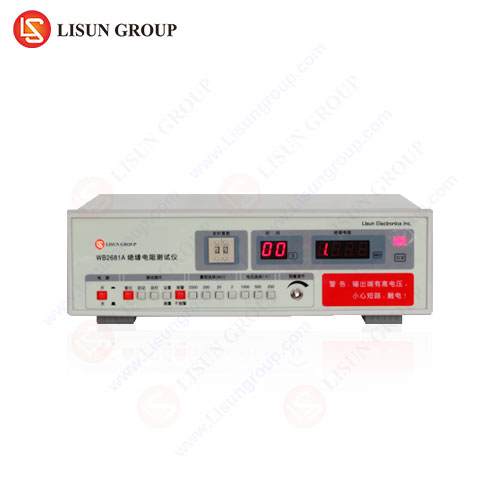
For rigorous and reliable Hipot testing in manufacturing and laboratory environments, the LISUN WB2671A Withstand Voltage Test represents a sophisticated implementation of the dielectric withstand principle. This instrument is engineered to deliver precise, compliant, and safe high-voltage testing for a broad spectrum of electrical and electronic products.
Testing Principles and Specifications:
The WB2671A generates a user-defined high AC or DC output voltage, with a typical maximum of 5kV AC/6kV DC, though higher-range models exist. It applies this voltage across the Device Under Test (DUT) with a controlled ramp-up rate to avoid transient inrush currents that could cause false failures. During the dwell time (1-99 seconds programmable), it continuously monitors the real leakage current with high accuracy. A key feature is its programmable dual-limit judgment: it can set separate thresholds for alarm current and trip current, allowing for nuanced failure analysis. Its measurement accuracy for leakage current is typically within ±(2%+3 digits), ensuring reliable pass/fail judgments. The instrument incorporates multiple safety interlocks, including zero-start protection (output voltage must begin at 0V) and over-current protection, which are critical for operator safety and DUT protection.
Industry Use Cases:
The WB2671A’s programmability and accuracy make it suitable for automated production lines and quality control labs. In automotive electronics manufacturing, it can sequentially test the isolation of a DC-DC converter by applying a 3000V DC test for 60 seconds. For a medical device like a patient monitor, it would perform an AC Hipot test at 1500V for 3 seconds between the mains input and all patient-connected leads, with a leakage current limit set below 100µA as per IEC 60601. A lighting fixture manufacturer would use it to test between the LED driver’s output and the metal heat sink, ensuring safety even if the thermal paste degrades.
Competitive Advantages:
The WB2671A distinguishes itself through several technical merits. Its high stability and low ripple high-voltage output ensure the stress applied is consistent and pure, preventing false failures due to voltage spikes. The true RMS measurement of AC leakage current is essential for accurately assessing leakage in switch-mode power supplies common in consumer electronics and office equipment, where waveform distortion can lead to measurement errors in average-responding meters. Furthermore, its programmable ramp, dwell, and ramp-down sequences allow for testing sensitive components like aerospace and aviation semiconductors or telecommunications equipment capacitors without causing damage from sudden voltage application or discharge. The inclusion of ARC detection circuitry can identify intermittent breakdowns that might be missed by a simple current limit, providing a deeper diagnostic layer for electrical components like relays and connectors.
Synthesizing a Comprehensive Safety Testing Regimen
In practice, Hipot and Megger tests are not mutually exclusive but are complementary stages in a product’s lifecycle. A typical regimen might involve:
- Design & Qualification: Initial IR testing on prototypes to benchmark insulation quality, followed by rigorous Hipot testing to validate design safety margins.
- Production Line: 100% Hipot testing on every finished product as a final safety gate to catch manufacturing defects.
- Field Maintenance & Repair: Periodic IR testing on installed systems (e.g., industrial control panels, cable runs) to monitor aging. After any repair, a Hipot test may be performed to verify the integrity of the intervention before re-energization.
The choice of test voltage, whether AC or DC Hipot, and the appropriate IR test voltage (250V vs. 1000V) are determined by the operational voltage of the equipment and the relevant standard (e.g., IEC 61010, UL 60950-1).
Conclusion
Dielectric Withstand (Hipot) and Insulation Resistance (Megger) testing serve orthogonal yet equally vital functions in the ecosystem of electrical safety. The Hipot test is the definitive stress test for immediate safety, a non-negotiable verification of insulation strength against catastrophic failure. The IR test is the diagnostic probe, quantifying insulation health and forecasting long-term reliability. Instruments like the LISUN WB2671A Withstand Voltage Test embody the precision required for the former, providing controlled, repeatable, and standards-compliant high-voltage stress testing. A mature electrical safety program strategically employs both methodologies, leveraging the go/no-go assurance of Hipot and the predictive intelligence of IR measurement to ensure comprehensive protection across the entire product lifecycle, from inception to decommissioning.
FAQ: Dielectric Withstand Voltage Testing
Q1: Why would I choose an AC output versus a DC output on a Hipot tester like the WB2671A?
AC testing stresses the insulation in a manner similar to the operational voltage waveform and tests the total insulation system equally, including capacitive coupling. It is often specified for line-voltage equipment. DC testing applies a continuous polarizing stress, draws only real leakage current (simplifying measurement), and is safer for capacitive loads. It is preferred for high-capacitance DUTs like long cables, switch-mode power supplies, and semiconductor components, as it avoids damaging capacitive charging currents.
Q2: What is the significance of the “ramp” function in advanced Hipot testers?
A controlled voltage ramp (e.g., 500 V/s) is critical for two reasons. First, it prevents inrush currents into capacitive loads from being misinterpreted as a breakdown, eliminating false failures. Second, it allows for the observation of a “soft breakdown” or corona inception, where leakage current increases non-linearly before a hard breakdown, providing valuable diagnostic information about impending insulation weakness in components like transformers or motors.
Q3: How do I determine the appropriate test voltage and duration for my product?
The test parameters are strictly defined by the applicable safety standard for the product category (e.g., IEC 62368-1 for IT/AV equipment). The standard dictates the test voltage (often a function of the working voltage, insulation type, and pollution degree), waveform (AC or DC), and duration (typically 60 seconds for type tests, 1-3 seconds for production line tests). The WB2671A allows precise programming of these standard-mandated values.
Q4: Can a product pass a Hipot test but fail an Insulation Resistance test, or vice versa?
Yes, this is common and highlights their complementary nature. A product may pass Hipot (no catastrophic breakdown) but show a low IR value due to surface moisture or contamination, indicating a future reliability issue. Conversely, a product with a small, localized defect like a pinhole may show a good overall IR reading (as the bulk insulation is healthy) but fail Hipot instantly as the high voltage arcs through the pinhole.
Q5: What safety features are essential in a production-line Hipot tester?
Beyond basic electrical safety compliance, key features include: Zero-Start Protection (ensures output is 0V before test initiation), Hardware Over-Current Protection (independent circuit to cut voltage if current exceeds a hardware limit), Front-Panel Safety Interlock (requires a key or code to access high-voltage settings), and a Grounding Verification Circuit. The WB2671A incorporates these to protect both the operator and the device under test.
