







Advanced Grounding Resistance Measurement: Principles, Applications, and the Role of High-Current Testing
Ensuring the integrity of grounding systems is a non-negotiable prerequisite for safety, operational continuity, and electromagnetic compatibility across the modern technological landscape. A low-impedance path to earth is fundamental for dissipating fault currents, mitigating step and touch potentials, protecting sensitive equipment from transient surges, and providing a stable reference potential. While traditional grounding resistance testers utilizing simplified methods like the fall-of-potential technique suffice for basic applications, the evaluation of grounding systems in high-stakes or complex environments demands more rigorous methodologies. This article examines the critical importance of high-current, low-frequency grounding resistance testing, with a specific focus on the application of a 10-ampere test current, as exemplified by instruments like the LISUN WB2678A Grounding Resistance Tester. We will explore the underlying electrical principles, relevant international standards, and the multifaceted industrial applications where such precise measurement is indispensable.
The Electrical Imperative of Low-Impedance Earth Connections
The primary function of a grounding electrode system is to provide a path of least resistance for electrical current to flow safely into the earth. The effectiveness of this system is quantified by its ground resistance, measured in ohms (Ω). This resistance is not a simple property of a single rod but a complex function of the soil’s resistivity, the geometry and material of the electrode, the depth of installation, and the interconnection of multiple electrodes. High ground resistance can lead to catastrophic consequences: during a line-to-ground fault, inadequate dissipation can cause hazardous voltage gradients on the ground surface and elevate the voltage of equipment enclosures, posing severe shock risks. Furthermore, in industries reliant on precise signal reference, such as telecommunications or medical imaging, a poor ground can introduce noise, degrade signal integrity, and cause operational malfunctions.
The relationship between fault current and ground resistance is defined by Ohm’s Law (V=IR). A lower ground resistance ensures that during a fault, the voltage rise on grounded equipment remains within safe limits, facilitating the rapid operation of overcurrent protection devices. Consequently, regulatory bodies and standards organizations worldwide, including the IEC (International Electrotechnical Commission), IEEE (Institute of Electrical and Electronics Engineers), and NFPA (National Fire Protection Association), stipulate maximum permissible ground resistance values for various applications, often requiring verification through standardized testing procedures.
Limitations of Conventional Testing and the 10A Solution
Common grounding testers often employ a test current of a few milliamperes at a frequency distinct from the power line frequency (e.g., 128 Hz or 111 Hz) to avoid interference. While suitable for simple rod or grid testing in benign environments, these low-current methods possess inherent limitations. They can be susceptible to stray earth currents, galvanic noise, and high soil contact resistance, leading to unstable or inaccurate readings. More critically, they may not adequately stress the grounding system to reveal nonlinear behaviors, such as ionization or breakdown in the surrounding soil, which only manifest under high-current conditions similar to an actual fault.
The use of a 10-ampere test current, as implemented in advanced testers like the LISUN WB2678A, addresses these shortcomings. By injecting a substantially higher current, the tester effectively “stresses” the ground electrode system, providing a measurement that more closely simulates its performance under real fault conditions. This high-current, low-frequency approach minimizes the influence of stray voltages and contact resistance, yielding a more stable, accurate, and representative value of the ground resistance. The test frequency, typically between 94 Hz and 128 Hz, is chosen to be immune to standard power line harmonics while maintaining measurement precision.
Operational Principles of a 10A Grounding Resistance Tester
Instruments like the LISUN WB2678A Grounding Resistance Tester operate on a refined version of the fall-of-potential principle but are engineered for high-current output. The internal circuitry generates a constant alternating current (I), typically at 105 Hz or 111 Hz, which is injected into the ground electrode under test (E) and a remote current probe (C). A separate potential probe (P) is placed at a specific interval between E and C. The tester then measures the voltage drop (V) between E and P. The ground resistance (R) is calculated using Ohm’s Law: R = V / I. The sophistication lies in the instrument’s ability to maintain a precise, sinusoidal 10A output, accurately measure the resulting microvolt-level potential differences, and digitally process the signal to reject noise.
Key specifications of a robust 10A tester include:
- Test Current: 10A AC (constant current output).
- Measurement Range: Typically from 0.00 Ω to 30.00 Ω with high resolution (0.001 Ω) for low values, extending to higher ranges for soil resistivity testing.
- Accuracy: High accuracy, often ±(1% of reading + 3 digits) or better within the primary range.
- Open Circuit Voltage: A high compliance voltage (e.g., 50V AC) to overcome circuit impedance.
- Noise Rejection: Advanced filtering and digital signal processing to achieve high common-mode and series-mode noise rejection, often exceeding 80 dB.
Table 1: Representative Specifications of a High-Current Grounding Tester (e.g., LISUN WB2678A)
| Parameter | Specification | Relevance |
| :— | :— | :— |
| Test Current | 10.0 A AC, 105 Hz/111 Hz | Simulates fault conditions; overcomes contact resistance. |
| Ground Resistance Range | 0.00 Ω – 30.00 Ω (10A) | Covers critical low-resistance requirements for industrial sites. |
| Resolution | 0.001 Ω | Essential for verifying ultra-low resistance in data centers or medical facilities. |
| Basic Accuracy | ±(1% rdg + 3 digits) | Ensures reliable, standards-compliant verification. |
| Open Circuit Voltage | 50 V AC | Ensures current can be driven through high-impedance test loops. |
| Noise Rejection | 80 dB (at 50 Hz/60 Hz ± 1 Hz) | Enables accurate measurement in electrically noisy environments. |
Industry-Specific Applications and Compliance Drivers
The requirement for high-current grounding verification permeates numerous sectors where safety, reliability, and data integrity are paramount.
Electrical and Electronic Equipment & Industrial Control Systems: Manufacturing facilities for semiconductors, printed circuit boards (PCBs), and industrial robotics require “clean” grounds to prevent electrostatic discharge (ESD) damage and control system errors. The 10A test validates that equipment grounding conductors and signal reference grids (SRGs) provide a near-zero impedance path, as per IEC 60364 and IEEE 1100 recommendations.
Telecommunications Equipment and Data Centers: Telecommunication exchanges and data halls utilize extensive bonding and grounding networks (e.g., based on ANSI/TIA-942 and IEC 60364-4-44) to protect sensitive servers and switches from lightning-induced surges and to ensure signal integrity. High-current testing verifies the effectiveness of main grounding busbars and the interconnection resistance between grounding points.
Medical Devices and Healthcare Facilities: In hospitals, specialized rooms for imaging (MRI, CT), surgery, and intensive care require isolated power systems and stringent grounding per IEC 60601-1. A 10A test ensures that the protective earth connection for life-support equipment has exceptionally low resistance, safeguarding patients from leakage currents and ensuring device functionality.
Aerospace and Aviation Components: Ground support equipment (GSE), aircraft hangars, and communication towers must have grounding systems capable of handling lightning strikes and static dissipation. Standards like FAA AC 150/5340-26 and MIL-STD-188-124 mandate rigorous testing, often with high current, to validate the grounding infrastructure’s surge impedance.
Automotive Electronics and EV Charging Stations: The proliferation of high-voltage systems in electric vehicles (EVs) and their charging infrastructure (per IEC 61851) necessitates robust grounding for operator safety. Testing charging station earth electrodes with a 10A current confirms their ability to safely handle potential fault currents from the DC fast-charging system.
Lighting Fixtures, Cable Systems, and Electrical Components: Large outdoor lighting installations (streetlights, stadium lights) and the grounding continuity of cable sheaths/metal conduits are verified to protect against insulation faults. Testing sockets, switches, and distribution boards ensures the integrity of the fixed wiring’s protective earth, a fundamental requirement in IEC 61010 and national electrical codes.
Technical Advantages of the LISUN WB2678A Methodology
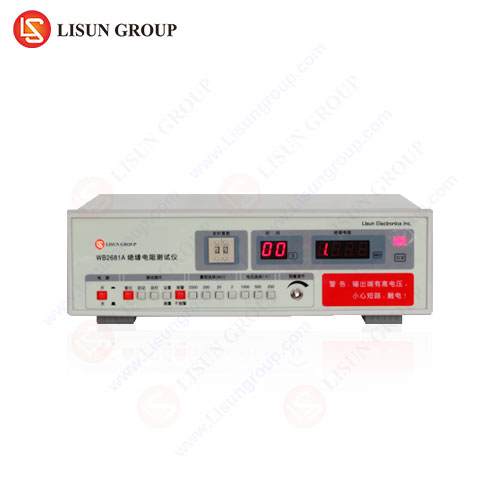
The LISUN WB2678A Grounding Resistance Tester embodies the technical approach discussed. Its design prioritizes accuracy and robustness in field conditions. The 10A constant current output provides the necessary stress for a true performance assessment. Its high noise rejection capability allows for reliable operation in active substations or industrial plants teeming with electromagnetic interference. The instrument often integrates additional functionalities, such as soil resistivity measurement (using the Wenner or Schlumberger four-pin method), which is crucial for designing new grounding systems. The ability to measure ground voltage prior to testing is a critical safety feature, preventing test initiation in the presence of dangerous potentials on the ground system. By consolidating high-current testing, soil resistivity analysis, and auxiliary measurements into a single, ruggedized unit, it streamlines the compliance process for engineers across the industries outlined.
Interpretation of Results and Standards Alignment
A measurement result is only as valuable as its correct interpretation. A 10A test yielding a resistance of 0.5 Ω for a hospital’s main grounding busbar would indicate excellent compliance, whereas the same value for a single residential rod might be suboptimal. Interpretation is always contextual and referenced against project specifications and applicable standards, such as:
- IEC 60364-6: Low-voltage electrical installations – Verification.
- IEEE Std 81: Guide for Measuring Earth Resistivity, Ground Impedance, and Earth Surface Potentials.
- NFPA 70 (NEC) Article 250: Grounding and Bonding.
- ITU-T K.27: Bonding configurations and earthing inside a telecommunications building.
Trend analysis is equally important. A gradual increase in resistance over successive annual tests for a telecommunications tower may indicate corrosion of the electrode or changes in soil moisture, signaling the need for preventative maintenance before performance degrades to a non-compliant level.
Conclusion
The verification of grounding system integrity through high-current testing represents a critical engineering practice for ensuring safety and operational reliability. Moving beyond basic milliampere-level checks to a 10-ampere test methodology, as enabled by instruments like the LISUN WB2678A, provides a far more authoritative assessment of a ground electrode’s performance under realistic fault conditions. This approach is mandated or strongly implied by a multitude of international standards governing sectors from medical care to aerospace. As electrical systems grow more complex and power densities increase, the role of precise, high-current grounding resistance measurement will only become more central to the design, installation, and lifelong maintenance of safe and effective electrical infrastructure.
FAQ Section
Q1: When is a 10A grounding resistance test necessary versus a standard lower-current test?
A 10A test is essential when verifying grounding systems in high-stakes environments (data centers, hospitals, industrial plants), for large or interconnected ground grids, when soil conditions suggest potential nonlinear behavior, or when specifications or standards explicitly require a high-current test method. It provides superior accuracy and noise immunity. A standard test may suffice for simple, single-electrode residential installations.
Q2: How does the LISUN WB2678A ensure operator safety during a 10A test?
The instrument incorporates multiple safety features. It includes a ground voltage detection circuit that warns the operator or inhibits testing if a hazardous voltage is present on the electrode. The output is current-limited and uses an isolated, low-frequency AC signal to minimize risk. Proper use of personal protective equipment (PPE) and adherence to safe testing procedures, as outlined in the product manual, are always required.
Q3: Can this tester be used to measure the grounding of energized equipment or systems?
No. Grounding resistance testing must only be performed on de-energized, isolated systems. The test involves connecting probes directly to the grounding conductor and earth. Attempting to test an energized system is extremely hazardous and can damage the tester. The voltage detection function is for checking for stray or induced voltages on a supposedly isolated ground conductor before connecting the tester.
Q4: What is the significance of the test frequency (e.g., 105 Hz/111 Hz)?
This frequency is chosen to be distinct from the power line fundamental (50/60 Hz) and its dominant harmonics. This allows the tester’s filtering circuits to easily reject interference from ubiquitous AC power sources, resulting in a stable and accurate measurement even in electrically noisy environments.
Q5: Beyond resistance, why does the WB2678A include soil resistivity measurement capability?
Soil resistivity (measured in Ω·m) is the key parameter for designing a new grounding system. By measuring resistivity at different probe spacings (depths), an engineer can determine the optimal type, number, and depth of grounding electrodes needed to achieve a target resistance before installation begins. This integrates the design and verification workflows into a single instrument.
