








A Comprehensive Framework for Accelerated Weathering Test Standards in Durable Goods Manufacturing
Introduction to Environmental Simulation and Material Degradation
The long-term reliability and aesthetic integrity of materials and components across a vast spectrum of industries are fundamentally governed by their resistance to environmental stressors. Solar radiation, temperature fluctuations, moisture, and atmospheric pollutants act in concert to induce photochemical and thermal-oxidative degradation, leading to color fading, chalking, loss of gloss, surface cracking, embrittlement, and ultimately, functional failure. For manufacturers of Electrical and Electronic Equipment, Automotive Electronics, Aerospace components, and Consumer Electronics, predicting and mitigating this degradation is not merely a quality concern but a critical imperative for safety, brand reputation, and regulatory compliance. Accelerated weathering testing serves as the primary scientific methodology to simulate years of environmental exposure within a controlled laboratory timeframe, enabling comparative material analysis, formulation improvement, and service life prediction.
The efficacy and reproducibility of these tests are wholly dependent on the adherence to rigorous, consensus-based standards and the precision of the instrumentation employed. This document delineates the core principles of established weathering test standards, examines their application across key industrial sectors, and elucidates the technological specifications required in modern test equipment to ensure valid, correlative data. A detailed analysis of the LISUN XD-150LS Xenon Lamp Test Chamber is provided as a paradigm of an instrument engineered to meet these exacting requirements.
Fundamental Principles of Xenon Arc Exposure Simulation
Xenon arc lamp technology is universally recognized as the benchmark for full-spectrum solar simulation due to its spectral power distribution (SPD), which most closely approximates terrestrial sunlight across the ultraviolet, visible, and infrared regions. The underlying principle involves subjecting test specimens to controlled cycles of light irradiation, temperature, and relative humidity, often interspersed with dark phases and water spray cycles to simulate rain or dew. The photochemical damage is primarily driven by UV radiation (295-400 nm), while IR radiation contributes to thermal loading, and visible light can influence certain photodegradation pathways in dyes and polymers.
The fidelity of the simulation is contingent upon several critical instrument parameters: spectral match to a defined standard (e.g., CIE No. 85, Table 4; ASTM G177), irradiance control and uniformity across the test plane, black panel or black standard temperature accuracy, and chamber humidity control. Filters are employed to modify the xenon lamp’s output, allowing simulation of different conditions such as direct sunlight (Daylight Filters), sunlight through window glass (Window Glass Filters), or extended UV conditions. The calibration and monitoring of these parameters are non-negotiable prerequisites for test validity.
Deconstructing Prevalent International Weathering Test Standards
A multitude of international standards organizations, including ISO, ASTM, IEC, and SAE, have developed specific protocols tailored to material types and end-use environments. These standards prescribe precise test parameters, which instrumentation must be capable of replicating.
- ISO 4892-2: Plastics — Methods of exposure to laboratory light sources — Part 2: Xenon-arc lamps. This is a foundational standard for plastic materials, detailing multiple exposure cycles (e.g., continuous light, light/dark with spray) with strict tolerances for irradiance (commonly 0.51 W/m² @ 340 nm or 1.1 W/m² @ 420 nm), chamber temperature, and black standard temperature.
- ASTM G155: Standard Practice for Operating Xenon Arc Light Apparatus for Exposure of Non-Metallic Materials. This comprehensive practice provides general guidelines and multiple cycle options for paints, plastics, textiles, and roofing materials. It emphasizes the importance of regular calibration of irradiance, temperature, and humidity sensors.
- IEC 60068-2-5: Environmental testing — Part 2-5: Tests — Test Sa: Simulated solar radiation at ground level and guidance for solar radiation testing. Critical for electrical and electronic components, this standard addresses solar heating and photochemical effects. It specifies spectral distributions and irradiance levels for testing items like automotive electronics, telecommunications enclosures, and outdoor lighting fixtures.
- AATCC TM16 & TM169: Colorfastness to Light. Textile-specific standards, often referenced for automotive interiors, upholstery, and apparel, which detail exposure conditions and methods for evaluating color change using grayscale or instrumental color measurement.
- SAE J2527 & J2412: Automotive performance standards for exterior materials. SAE J2527 (accelerated exposure) and J2412 (interior trim) are globally accepted benchmarks for evaluating the weatherability of automotive paints, plastics, textiles, and composites.
Industry-Specific Applications and Failure Mode Analysis
The application of weathering standards is highly contextual, dictated by the operational environment and critical failure modes of the product.
- Automotive Electronics & Exterior Components: Control units, sensors, and wiring harnesses must withstand under-hood temperatures exceeding 125°C and UV exposure. Testing evaluates insulation cracking, connector deformation, and PCB delamination. Exterior plastics and coatings are assessed for gloss retention (>50% after specified exposure), color shift (ΔE < 2.0), and crack formation.
- Aerospace and Aviation Components: Materials face extreme UV intensity at high altitudes and wide thermal cycles. Testing for composites, cockpit displays, and exterior seals focuses on maintaining mechanical strength and preventing outgassing or fogging.
- Electrical Components & Cable Systems: Switches, sockets, and cable jackets for outdoor use are tested for UV-induced embrittlement, which can lead to crack propagation and insulation failure, posing electrical safety hazards. Tracking resistance after weathering is a key metric.
- Lighting Fixtures & Consumer Electronics: Outdoor LED luminaires and consumer device casings are evaluated for yellowing of polycarbonate lenses, degradation of optical diffusers, and integrity of weather seals. Color stability and luminous flux maintenance are critical performance indicators.
- Medical Devices & Telecommunications Equipment: Devices used outdoors or in sun-exposed clinical settings require validation that housing materials do not degrade, leach plasticizers, or become brittle, ensuring sterility and operational reliability.
Instrumentation Imperatives: The LISUN XD-150LS Xenon Lamp Test Chamber
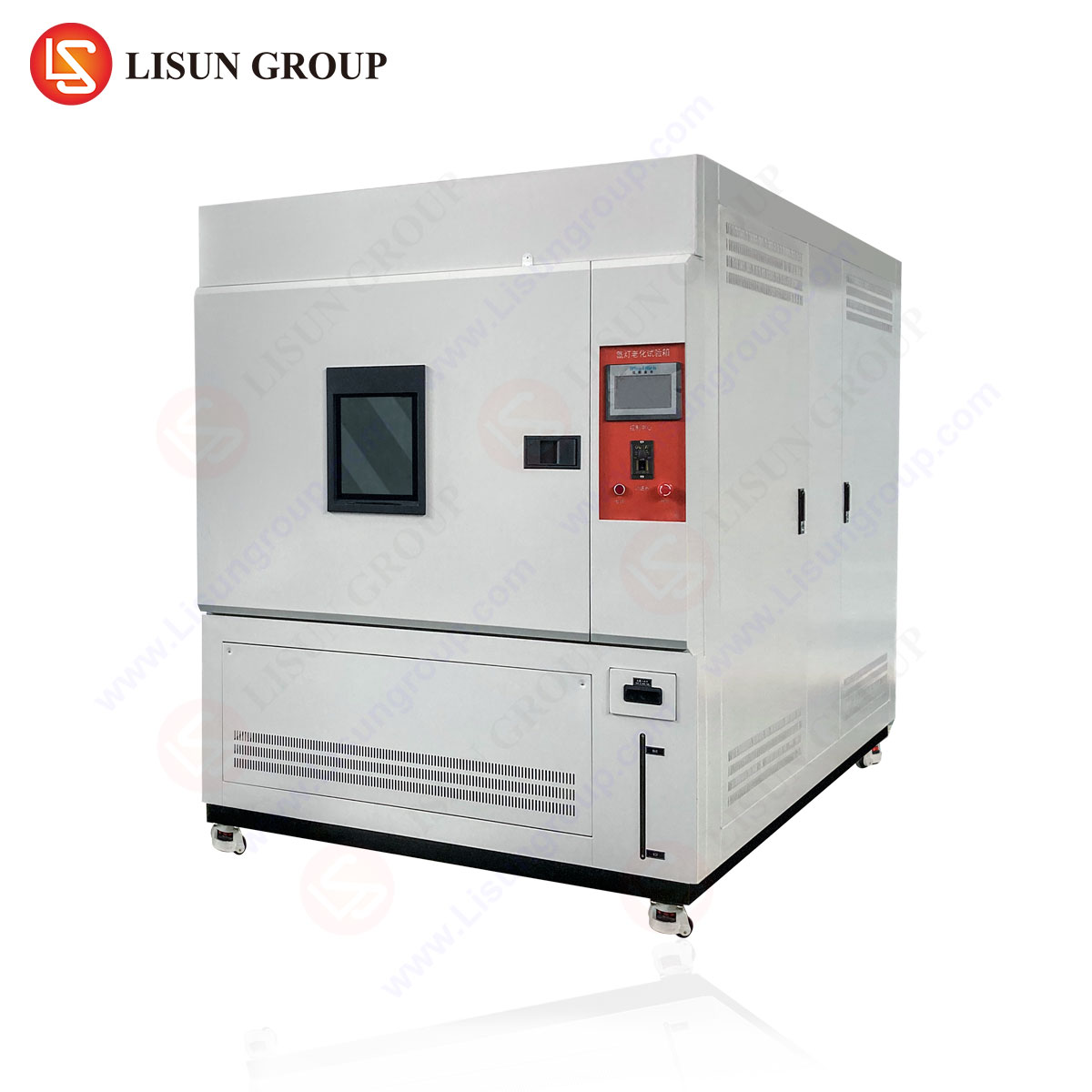
To execute the standards delineated above with precision, test chambers must offer uncompromising control, durability, and measurement accuracy. The LISUN XD-150LS Xenon Lamp Test Chamber is engineered as a solution for rigorous material qualification testing.
Core Specifications and Testing Principles:
The chamber incorporates a 1500W water-cooled xenon arc lamp, a configuration favored for its stable output and efficient heat management. Spectral matching is achieved through a selection of interchangeable optical filters. A closed-loop irradiance control system, typically utilizing a 340nm or 420nm narrowband sensor, automatically adjusts lamp power to maintain user-set irradiance levels, compensating for lamp aging and ensuring consistent dosage. The chamber provides precise control over black panel temperature (range: ambient +10°C to 110°C) and relative humidity (10% to 98% RH), enabling simulation of diverse climates from arid to tropical.
The test principle revolves around programmable cyclic exposure. A user can define complex test profiles, for example: 3.8 hours of light only at 0.55 W/m² @ 340nm and 70°C BPT, followed by 1 hour of light with front spray. This directly replicates cycles specified in standards like SAE J2527. The chamber’s interior is constructed of corrosion-resistant SUS304 stainless steel, and the sample turntable ensures uniform exposure for all specimens.
Industry Use Cases and Competitive Advantages:
In practice, a manufacturer of industrial control systems might use the XD-150LS to subject polyamide enclosures to 2000 hours of testing per IEC 60068-2-5, assessing impact strength retention afterward. An automotive supplier would validate a new interior fabric against SAE J2412, measuring color fade with a spectrophotometer at 400 kJ/m² intervals.
The competitive advantages of such a system lie in its integration and control fidelity:
- Stable Spectral Output: Water-cooling and robust power supply minimize spectral drift, a common source of inter-laboratory test variation.
- Advanced Control System: Digital PID controllers for temperature and humidity, coupled with true irradiance feedback control, provide superior parameter stability versus simpler time-proportional systems.
- Comprehensive Safety Protections: Features including water shortage protection, over-temperature safeguards, and chamber overheat protection ensure operational security during unattended long-duration tests.
- Data Integrity: Continuous logging of all test parameters (irradiance, temperature, humidity, time) supports audit trails and is essential for correlating exposure doses with measured material degradation.
Correlation and Validation of Accelerated Test Data
The ultimate value of accelerated testing is its predictive correlation to real-world performance. Achieving correlation is a non-trivial challenge, as acceleration factors are material-dependent. A well-controlled chamber like the XD-150LS provides the consistent, repeatable stress conditions necessary for developing such correlations. The process involves exposing materials to accelerated testing while deploying identical samples in real-world outdoor exposures (e.g., Florida, Arizona, or temperate climates). By comparing the degradation mechanisms—using techniques like FTIR, SEM, or mechanical testing—and matching the degree of degradation, an acceleration factor (e.g., 1 year outdoors ≈ 1000 hours in the chamber) can be estimated for a specific material and failure mode under defined climatic conditions.
Future Trajectories in Weathering Test Methodology
The evolution of weathering testing is moving towards greater specificity and intelligence. This includes the development of standards for newer materials like carbon-fiber composites and organic photovoltaics, the integration of in-situ monitoring (e.g., real-time gloss measurement), and the use of computational modeling to supplement physical testing. The drive for sustainability is also pushing for tests that more accurately simulate the effects of climate change variables, such as increased UV intensity or novel pollutant combinations. Instrumentation must, therefore, be adaptable, with upgradeable control software and the capability to implement novel, yet-to-be-standardized test cycles.
Conclusion
A robust framework of weathering test standards, executed with high-precision instrumentation, forms the backbone of durability engineering for modern manufactured goods. From the polymer housing of a medical ventilator to the composite winglet of an aircraft, the assurance of performance over intended service life is derived from controlled, accelerated environmental simulation. Adherence to published standards ensures a common language for specification and qualification, while the selection of capable test equipment, as exemplified by the LISUN XD-150LS Xenon Lamp Test Chamber, guarantees that the data generated is both reliable and actionable. As material science advances and product environments become more demanding, the role of precise, standardized weathering testing will only increase in its critical importance to global manufacturing quality and innovation.
FAQ Section
Q1: What is the primary difference between a xenon arc test chamber and a UV condensation test chamber?
A1: Xenon arc chambers simulate the full spectrum of sunlight, including visible and infrared light, and can control temperature, humidity, and light in complex cycles, including water spray. They are used for general weathering and photostability testing. UV condensation chambers use fluorescent UV lamps (typically UVA-340) that emit only ultraviolet light and rely on condensation for moisture. They are often used for faster, more severe UV degradation screening but do not simulate full-spectrum effects.
Q2: Why is irradiance control at a specific wavelength (e.g., 340 nm) so critical?
A2: Ultraviolet radiation, particularly in the 295-365 nm range, is the primary driver of photochemical degradation in most polymers and dyes. Controlling irradiance at a representative wavelength like 340 nm ensures a consistent and quantifiable dosage of this damaging energy is delivered to the specimens. This allows tests to be repeatable across different laboratories and over time, as the total UV dose (irradiance x time) becomes the controlled variable, not simply exposure time.
Q3: How often should the xenon lamp and filters be replaced in a chamber like the XD-150LS?
A3: Replacement intervals are not fixed by time but by usage hours and performance degradation. A typical 1500W water-cooled xenon lamp may have a useful life of 1000-1500 hours before spectral shift or output instability necessitates replacement. Optical filters should be inspected regularly for clouding or deposits and replaced if they show signs of degradation, as they directly affect the spectral output. Most standards recommend regular calibration checks (e.g., every 500 hours of operation) to determine when components are out of tolerance.
Q4: Can the XD-150LS chamber test both automotive exterior paints and interior textiles?
A4: Yes, provided the appropriate test standards and cycles are programmed. For exterior paints, one would select a filter combination to simulate direct sunlight and implement a cycle like SAE J2527, which includes irradiance, temperature, humidity, and spray phases. For interior textiles, a different filter set (often Window Glass) would be used to simulate sunlight filtered through car windows, and a cycle like SAE J2412 would be applied, which typically uses lower irradiance and different temperature/humidity setpoints. The chamber’s programmability allows it to store and run these distinct profiles.
Q5: What sample preparation and evaluation methods are typically used alongside weathering testing?
A5: Samples must be representative of the final product in composition, thickness, and color. They are often mounted on specimen holders with inert backing. Pre-test conditioning to a standard atmosphere (e.g., 23°C/50% RH) is common. Evaluation is both quantitative and qualitative: instrumental color measurement (spectrophotometer), gloss measurement (glossmeter), and mechanical testing (impact, tensile strength) are quantitative. Visual inspection for cracking, chalking, blistering, and mold growth provides qualitative data. FTIR spectroscopy can identify chemical changes like carbonyl group formation, indicating polymer oxidation.
