







The Critical Role of High-Potential Testing in Modern Electrical Safety Assurance
The relentless advancement of electrical and electronic technology, permeating every facet of modern industry and daily life, brings with it an irreducible imperative: operational safety. The integrity of insulation systems forms the foundational barrier between functional circuitry and catastrophic failure modes, including electric shock, fire, and equipment destruction. High-potential (Hipot) testing, or dielectric withstand testing, stands as the paramount non-destructive evaluation method for verifying this integrity. This procedure subjects an insulation barrier to a significantly elevated voltage for a prescribed duration, ensuring it can not only withstand normal operating stresses but also provide a safe margin against transient overvoltages and environmental degradation. The objective application of Hipot testing is therefore not merely a compliance step but a fundamental engineering discipline essential for risk mitigation, quality validation, and the preservation of brand integrity across global supply chains.
Fundamental Principles and Testing Methodologies
At its core, Hipot testing evaluates the efficacy of an electrical insulation system by applying a stress voltage that exceeds its normal operating rating. The test seeks to confirm two primary characteristics: adequate dielectric strength and sufficient clearance/creepage distances. The applied voltage, typically AC or DC, induces a stress across insulating materials. A satisfactory test outcome is defined by the absence of dielectric breakdown, which is characterized by a sudden, uncontrolled flow of current (a “flashover” or “breakdown current”) through or over the surface of the insulation.
Two principal methodologies are employed: AC Hipot and DC Hipot testing. An AC Hipot test applies a sinusoidal voltage, usually at power frequency (50/60 Hz), between live parts and accessible conductive parts. This method most accurately simulates real-world operational and fault conditions, including peak voltage stresses, and is sensitive to both capacitive and resistive leakage paths. It is the predominant test for most finished products, such as household appliances, lighting fixtures, and medical devices, as specified in standards like IEC 60335-1 and IEC 60601-1.
Conversely, DC Hipot testing applies a unidirectional voltage. Its primary advantage lies in its lower intrinsic current demand, allowing the use of smaller, more portable test equipment. It is particularly effective for testing capacitive loads, such as lengthy cables, wiring harnesses, and high-voltage capacitors, where AC testing would result in prohibitively high capacitive leakage currents that could mask fault conditions. DC testing is also employed for field testing of installed equipment, such as industrial control system wiring and aerospace componentry. However, it applies a different stress distribution within heterogeneous insulation materials compared to AC, a factor that must be considered during test specification.
The critical measured parameter is leakage current. Test instruments monitor this current in real-time, comparing it against a user-defined failure threshold. A gradual increase in leakage current may indicate contamination or moisture ingress, while a sudden spike signifies insulation puncture. Modern Hipot testers integrate sophisticated measurement circuits to distinguish between harmless capacitive charging current and hazardous resistive leakage current, ensuring accurate failure detection.
Industry-Specific Applications and Regulatory Imperatives
The universality of electrical safety translates into a broad spectrum of Hipot testing applications, each tailored to the unique risks and standards of its sector.
In Electrical and Electronic Equipment and Consumer Electronics, testing verifies the safety of power supplies, printed circuit board assemblies (PCBAs), and final assemblies. It ensures separation between primary (mains) and secondary (low-voltage) circuits, a critical requirement in switch-mode power supplies for office equipment and telecommunications devices.
Household Appliances, from refrigerators to electric kettles, are subjected to rigorous production-line testing. Standards such as IEC 60335 mandate tests after assembly to verify that insulation has not been compromised during manufacturing, for instance, by a misplaced screw or a pinched wire.
Automotive Electronics presents a unique challenge due to the harsh operating environment. Components like engine control units (ECUs), battery management systems (BMS) for electric vehicles, and sensor arrays must withstand not only standard voltage stresses but also load dump transients. Hipot testing here validates isolation in high-voltage traction systems (e.g., 400V or 800V DC buses) and ensures reliability under vibration and thermal cycling.
Medical Devices (IEC 60601-1) impose the most stringent safety requirements, often incorporating “means of patient protection” (MOPP) criteria. Hipot testing is critical for verifying the insulation between applied parts (which contact the patient) and the mains, with test voltages scaled based on the required level of protection. A failure could directly endanger human life.
For Lighting Fixtures and Electrical Components like switches and sockets, the test confirms isolation between live terminals and the external metallic casing or mounting hardware. In Aerospace and Aviation Components, testing ensures functionality and safety at altitude, where reduced atmospheric pressure can lower the dielectric strength of air, increasing the risk of corona discharge and arcing.
Cable and Wiring Systems undergo routine Hipot testing, both post-manufacture and after installation in buildings or industrial plants. This is a primary method for identifying insulation flaws, crushed sections, or moisture penetration in power and control cables.
Industrial Control Systems and Telecommunications Equipment rely on Hipot testing to guarantee isolation between signal lines, data buses, and power conductors, preventing ground loops, noise injection, and equipment damage from power cross faults.
Across all industries, compliance with international standards (IEC, UL, ISO, MIL-STD) is non-negotiable for market access. Hipot testing is a explicitly mandated verification in nearly every safety standard, serving as a globally recognized benchmark for product safety.
The WB2671A Withstand Voltage Tester: Engineering Precision for Comprehensive Safety Validation
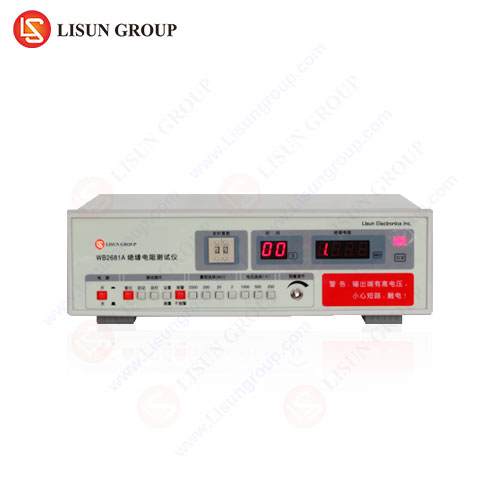
Meeting the diverse and stringent demands of modern Hipot testing requires instrumentation that combines accuracy, reliability, operational safety, and adaptability. The LISUN WB2671A Withstand Voltage Test System is engineered to fulfill this role as a comprehensive solution for design validation, production line testing, and quality assurance auditing.
The WB2671A is a fully programmable, microprocessor-controlled AC/DC dielectric withstand tester. Its core function is to generate a high-precision, stable test voltage from 0 to 5kV AC (50/60Hz) and 0 to 6kV DC, with a voltage accuracy of ±(2% of reading + 0.2% of full scale). This range effectively covers the vast majority of test requirements for the industries previously outlined. The unit features a high-resolution leakage current measurement system with a range of 0.01mA to 20.0mA, configurable with both upper and lower alarm limits. This dual-limit capability is crucial for identifying not only insulation breakdown (upper limit) but also open-circuit conditions or poor connections (lower limit), a common requirement in automotive wiring harness testing.
Its testing principle adheres to the highest standards of accuracy and operator protection. The instrument utilizes a high-quality, low-distortion output transformer for AC and a voltage multiplier circuit for DC, ensuring a clean, stable test waveform. A dedicated ground continuity check circuit verifies proper earth connection of the equipment under test (EUT) prior to applying high voltage, a critical safety interlock. The test sequence is fully configurable: ramp time (0.1~999.9s), dwell time (test duration from 1~999.9s), and decay time (0.1~999.9s) can be programmed to create tailored stress profiles. This is essential for testing components like capacitors or complex medical devices where controlled voltage ramping is necessary to avoid inrush currents that could be misinterpreted as failures.
Industry Use Cases and Competitive Advantages:
In a medical device manufacturing setting, the WB2671A’s programmable sequences allow for automated testing per IEC 60601-1, logging pass/fail data and leakage current values for traceability. Its precise current measurement is vital for verifying subtle insulation degradation.
For automotive component suppliers, testing a 400V DC EV cable assembly requires a DC Hipot test at perhaps 2.5kV DC. The WB2671A’s ability to handle capacitive loads and its robust arc detection circuitry can identify a microscopic insulation weakness that might lead to a future thermal runaway event.
A lighting fixture producer can use the instrument’s AC output to test between the live pin of a plug and the metallic housing at 1.5kV AC for 60 seconds, as per IEC 60598. The clear, bright digital display and audible/visual alarm provide unambiguous feedback for production line operators.
The competitive advantages of the WB2671A are multifaceted. Its integrated design combines the high-voltage generator, measurement unit, and control system into a single benchtop unit, saving space and reducing setup complexity compared to modular systems. Advanced safety features include a zero-start interlock (voltage cannot be output if the instrument starts from a non-zero setting), a hardware-based over-current protection relay, and a shielded test chamber interlock terminal. Operational efficiency is enhanced through programmable memory slots for storing up to 100 different test routines, allowing rapid changeover between product lines. Finally, its communication interfaces (RS232, USB, optional LAN/GPIB) enable seamless integration into factory data acquisition systems and automated test stations, supporting Industry 4.0 quality management protocols.
Interpreting Test Results and Mitigating Common Failure Modes
A “pass” result from a Hipot test provides strong statistical evidence of adequate insulation integrity at the time of testing. However, correct interpretation of results, especially failures or marginal data, is essential for effective corrective action.
A sudden, catastrophic failure (flashover) is typically unambiguous, indicating a direct bridge across insulation, such as a solder splash, a conductive contaminant, or a compromised creepage distance. More nuanced is the analysis of elevated but stable leakage current. A current reading that is high yet constant may point to surface contamination (dust, flux residue), humidity absorption by hygroscopic materials, or design margins that are too tight. A steadily increasing leakage current during the dwell period is a serious indicator of progressive insulation degradation under stress, often due to partial discharge activity within voids in the insulating material.
Common failure root causes are often traceable to manufacturing processes. In Electrical Components, a molding flaw in a plastic connector body can create a thin section. In PCBAs for Industrial Control Systems, insufficient conformal coating or a hairline crack from thermal stress can provide a path for tracking. For Household Appliances, a misrouted wire chafing against a sharp chassis edge during assembly is a typical fault found by Hipot testing.
Mitigation strategies are equally varied. They include design reviews to increase creepage/clearance distances, process controls to ensure proper cleaning and avoidance of contamination, material selection to specify insulation with higher dielectric strength or better tracking resistance, and 100% production line testing to catch process drift or assembly errors before products leave the factory.
Integrating Hipot Testing into a Holistic Quality Management System
While Hipot testing is indispensable, it represents one node within a broader quality and safety ecosystem. It is most effective when deployed in conjunction with other electrical safety tests. Insulation Resistance (IR) testing, typically performed with a DC megohmmeter, provides a quantitative measure of the insulation’s resistive quality at a lower, non-destructive voltage. It is excellent for detecting moisture and gross contamination. Ground Bond (Earth Continuity) testing verifies the integrity and low resistance of the protective earth path, ensuring fault currents can be safely diverted. A comprehensive test sequence might involve: 1) Visual inspection, 2) Ground bond test, 3) Insulation resistance test, and finally, 4) Dielectric withstand (Hipot) test.
Integrating the WB2671A or similar instruments into automated test equipment (ATE) stations or production lines creates a closed-loop quality system. Test parameters and results for every unit produced can be logged to a database, enabling statistical process control (SPC). Trends in average leakage current, for example, can signal a gradual degradation in a supplied component’s insulation material long before a hard failure occurs, allowing for proactive supply chain intervention.
Furthermore, Hipot test data is a critical component of safety certification dossiers submitted to bodies like UL, TÜV, or Intertek. The ability of an instrument like the WB2671A to generate calibrated, repeatable, and documented test results is therefore not just a production concern but a fundamental requirement for regulatory compliance and global market access.
FAQ Section
Q1: What is the primary difference between AC and DC Hipot testing, and when should I choose one over the other?
AC Hipot testing applies a stress that closely replicates real-world AC mains conditions and is sensitive to a wider range of faults, including those related to capacitive coupling. It is the standard for most finished products. DC Hipot testing applies a steady-state voltage, drawing only microampere-level leakage current, making it ideal for testing highly capacitive objects like long cables, motors, or for field testing where portable equipment is needed. The choice is often dictated by the relevant product safety standard.
Q2: How do I determine the correct test voltage and duration for my product?
Test parameters are almost exclusively defined by the applicable safety standard for your product category (e.g., IEC 61010-1 for lab equipment, IEC 62368-1 for AV/IT equipment). These standards specify test voltages based on the working voltage, insulation type (basic, supplementary, reinforced), and the required “means of protection.” Duration is typically 60 seconds for type tests and 1-3 seconds for routine production tests. Never arbitrarily select a test voltage, as over-stressing can damage good insulation, and under-stressing provides a false sense of security.
Q3: The WB2671A offers both upper and lower leakage current limits. Why would I need a lower limit?
A lower limit alarm is crucial for detecting “open” test conditions. If a test lead becomes disconnected, or if you are testing a multi-branch wiring harness and a specific wire is not properly contacted by the test fixture, the measured leakage current will be near zero. Without a lower limit, this would be recorded as a “pass,” despite a portion of the product not being tested at all. It ensures the completeness of the test.
Q4: Can Hipot testing damage my product?
When performed correctly according to standards, Hipot testing is a non-destructive test. However, applying a voltage significantly higher than the insulation system is designed for, or repeatedly testing the same sample beyond qualification needs, can cause cumulative dielectric aging and eventually lead to breakdown. This is why production test voltages are sometimes derated (e.g., 80% of the type test voltage) to preserve product life while still providing a meaningful safety check.
Q5: Is remote control and data logging possible with the WB2671A?
Yes. The WB2671A is equipped with RS232 and USB interfaces as standard, with optional LAN (Ethernet) or GPIB interfaces available. This allows for complete remote control of test parameters, initiation, and termination from a host computer or PLC. All test results (voltage, current, pass/fail status) can be retrieved and logged into a database or manufacturing execution system (MES) for full traceability and quality analysis.
