







Ensuring Electrical Safety: The Importance of Accurate Ground Resistance Measurement with a Ground Rod Tester
Abstract
A robust grounding system is a non-negotiable cornerstone of electrical safety and system integrity across a vast spectrum of industries. Its primary functions—providing a path for fault currents, stabilizing voltage during normal operation, and mitigating the risks of electric shock and equipment damage—are entirely contingent upon achieving and maintaining a low-resistance connection to earth. The accurate quantification of this resistance is therefore a critical diagnostic and verification procedure. This technical article examines the principles of earth electrode testing, the operational methodologies of modern ground rod testers, and the profound implications of measurement accuracy for compliance, safety, and operational continuity. A detailed analysis of the LISUN WB2678A Grounding Resistance Tester is provided to illustrate the application of advanced testing technology in meeting stringent international standards.
The Critical Role of Grounding Systems in Modern Infrastructure
The grounding electrode system, often visualized simply as a ground rod driven into the soil, constitutes a fundamental protective measure. Its efficacy is measured not by its physical presence but by its electrical performance, specifically its resistance to earth. This resistance value determines how effectively fault current, such as that from a line-to-case short circuit, will be diverted safely into the earth, thereby facilitating the rapid operation of overcurrent protection devices. In the absence of a low-resistance path, hazardous voltages can persist on equipment enclosures, creating a severe electrocution risk for personnel. Furthermore, in sensitive applications like telecommunications equipment and medical devices, a stable ground reference is essential for mitigating electromagnetic interference (EMI) and ensuring signal integrity and data accuracy. The consequences of an inadequate grounding system are not limited to safety hazards; they extend to latent equipment degradation, unexplained system resets in industrial control systems, and catastrophic failure of aerospace and aviation components during power transients.
Fundamental Principles of Ground Resistance Measurement
Understanding the methodology for measuring ground resistance is prerequisite to interpreting results accurately. The most prevalent and reliable technique, employed by instruments like the LISUN WB2678A, is the Fall-of-Potential method. This method operates on the principle of injecting a known current into the earth through the electrode under test and measuring the voltage drop across a specific segment of the soil.
The test configuration requires the placement of two auxiliary electrodes: a current probe (C2) placed a significant distance from the ground rod under test, and a voltage probe (P2) placed at strategic intervals between them. The ground rod tester generates an alternating current (AC) signal, which is passed between the electrode under test (E) and the current probe (C2). The voltage probe (P2) measures the potential difference at a point where the electrical fields from the electrode under test and the remote current probe do not significantly interact. By applying Ohm’s Law (R = V/I), the instrument calculates the resistance. A critical aspect of this method is ensuring sufficient separation between the electrodes to avoid overlapping resistance areas, a condition that would lead to erroneous readings. For a single ground rod, the distance to the current probe should typically be at least five times the length of the rod, though soil resistivity profiles may necessitate greater distances.
Advanced Instrumentation: The LISUN WB2678A Grounding Resistance Tester
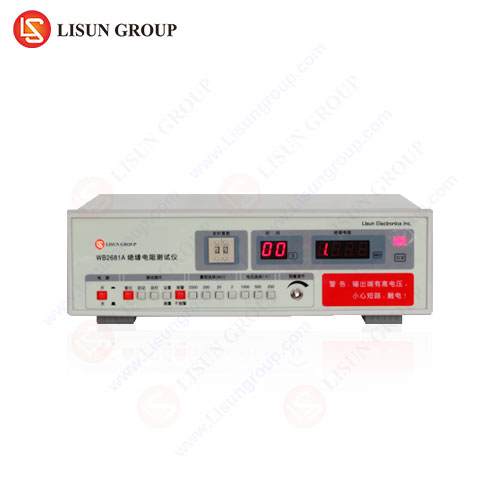
The LISUN WB2678A represents a contemporary implementation of grounding resistance test technology, integrating precision measurement with user-centric features designed for field reliability. Its design adheres to stringent international safety and performance standards, including IEC 61010, making it suitable for use in high-risk electrical environments.
Key Specifications and Testing Principles:
The WB2678A operates on the classic Fall-of-Potential method but enhances it with digital signal processing for improved noise rejection. A significant technical feature is its ability to perform tests with a two-pole method for quick checks on simple electrodes and the more comprehensive three-pole and four-pole methods. The four-pole method is particularly advantageous as it eliminates the influence of test lead resistance, a common source of error when measuring very low resistance values, which is critical in applications like data center grounding or telecommunications base stations.
- Measurement Ranges: The instrument typically offers multiple selectable ranges, for example, from 0.00Ω to 20.00Ω on a low range with high resolution (0.01Ω), up to a high range of 0Ω to 2000Ω. This versatility allows it to assess everything from a single residential ground rod to complex grounding grids at utility substations.
- Test Signal: It utilizes a specific frequency, often around 820 Hz, to avoid interference from power line frequencies (50/60 Hz) and their harmonics, which are pervasive in industrial settings.
- Noise Rejection: Advanced digital filtering algorithms allow the WB2678A to provide stable readings even in electrically noisy environments, such as those found near industrial control systems or variable-frequency drives.
Table 1: Representative Specifications of the LISUN WB2678A Grounding Resistance Tester
| Parameter | Specification | Application Significance |
| :— | :— | :— |
| Ground Resistance Range | 0.00Ω ~ 20.00Ω; 20.0Ω ~ 200.0Ω; 200Ω ~ 2000Ω | Covers everything from low-resistance computer room grids to high-resistance rocky soil installations. |
| Resolution | 0.01Ω / 0.1Ω / 1Ω | High resolution is critical for verifying compliance with standards that may require <1.0Ω. |
| Test Current | >20mA (AC) | A sufficient test current ensures measurement accuracy and overcomes contact resistance at the probes. |
| Open Circuit Voltage | ~50V AC | A safe yet effective voltage for driving current through the soil circuit. |
| Noise Rejection | >30dB at 50/60Hz 10V | Ensures reliable operation in electromagnetically hostile environments like manufacturing plants. |
Industry-Specific Applications and Compliance Imperatives
The requirement for verified grounding resistance permeates virtually every sector that utilizes electrical or electronic systems.
- Household Appliances and Consumer Electronics: Manufacturers must ensure that production-line testing verifies the integrity of the grounding connection in products like washing machines, refrigerators, and power tools. The WB2678A can be integrated into automated test stations to perform a high-speed, pass/fail check, ensuring every unit shipped meets the safety requirements of standards like IEC 60335.
- Automotive Electronics: While vehicles themselves are not grounded to earth, their manufacturing facilities and the test equipment for high-voltage components in electric vehicles (EVs) require impeccable grounding. The charging infrastructure for EVs also demands periodic verification of ground resistance at charging stations to protect users and equipment.
- Lighting Fixtures: Large-scale outdoor lighting systems, such as those for stadiums or public roadways, are susceptible to lightning strikes. A low-resistance grounding system is essential for safely dissipating surge energy. The tester is used during installation and maintenance to confirm the efficacy of the grounding network.
- Medical Devices: In hospitals, patient safety is paramount. Equipment ranging from MRI machines to bedside monitors requires a reference ground that is both stable and low-resistance to prevent leakage currents from reaching the patient. Adherence to IEC 60601-1 necessitates rigorous ground bond testing during production and facility verification.
- Aerospace and Aviation Components: Ground support equipment and the electrical infrastructure of hangars and control towers must have grounding systems that can handle massive fault currents. Accurate measurement ensures these systems will perform as designed during a fault condition, protecting both personnel and multi-million-dollar assets.
- Telecommunications Equipment: Telecom shelters and cell towers are prime targets for lightning. A typical requirement for a tower’s grounding system is a resistance value of 5Ω or less. The WB2678A is used to validate this, often using the more complex 4-pole method to achieve the necessary precision.
Comparative Analysis of Testing Methodologies and Instrument Selection
While the Fall-of-Potential method is the benchmark, alternative techniques exist for specific scenarios. The Selective Method allows for testing without disconnecting the ground electrode from the facility’s neutral, which is crucial for testing live systems. The Stakeless Method (or Clamp-On tester) is used for measuring the resistance of interconnected grounding grids without auxiliary spikes. However, the stakeless method has limitations; it is ineffective on isolated rods and can be influenced by parallel paths.
The competitive advantage of a dedicated ground rod tester like the LISUN WB2678A lies in its directness and traceable accuracy. It provides a primary measurement of the electrode’s performance in isolation from the utility connection. Its multi-mode functionality (2-pole, 3-pole, 4-pole) offers flexibility, while its robust construction and safety certifications make it a reliable tool for engineers and technicians working in diverse field conditions, from a muddy construction site to a climate-controlled server room.
Interpretation of Data and Adherence to International Standards
A measured resistance value is meaningless without a benchmark for comparison. Various standards provide these benchmarks. The National Electrical Code (NFPA 70) in the United States mandates a maximum of 25Ω for a single electrode. However, many specifications for sensitive electronic equipment or lightning protection systems demand a much lower value, frequently 5Ω or even 1Ω.
Accurate measurement with an instrument like the WB2678A provides the empirical data required for compliance. Furthermore, by logging resistance values over time, facility managers can track the degradation of their grounding system due to factors like soil corrosion, seasonal moisture variation, or construction damage, enabling proactive maintenance before a safety-critical threshold is crossed.
Frequently Asked Questions (FAQ)
Q1: Why is it necessary to use an AC test signal from the ground rod tester instead of DC?
Using DC would cause electrolytic polarization at the electrode-soil interface, leading to a rapidly increasing and inaccurate resistance reading. The ionic nature of soil behaves like an electrolyte, and a DC current induces a back-EMF. The AC signal, particularly at a frequency chosen to avoid power-line interference, provides a stable and repeatable measurement by overcoming this polarization effect.
Q2: My measurement readings are unstable and fluctuating. What are the most likely causes?
Fluctuating readings typically indicate one of two issues: excessive electrical noise in the environment or high resistance at the auxiliary probe contact points. First, ensure the WB2678A’s noise rejection is functioning correctly. Second, verify that the voltage and current probes (P2 and C2) are driven into moist, conductive soil. Pouring water around the probes can significantly improve contact and stabilize the reading.
Q3: When should I use the 4-pole method over the standard 3-pole method on the WB2678A?
The 4-pole method is essential when measuring very low resistance values (typically below 0.5Ω) or when the test lead wires are very long. This method uses separate pairs of leads for current injection and voltage sensing, effectively negating the resistance of the test leads themselves from the final calculation, thereby providing a more accurate measurement of the ground electrode resistance alone.
Q4: Can the LISUN WB2678A be used to test the grounding of an entire building’s system, which is connected to the utility neutral?
For a true measurement of the earth electrode’s independent resistance, the electrode should be isolated from the utility neutral connection. The WB2678A, used in the standard 3-pole Fall-of-Potential method, requires this isolation. To test the system while it remains connected to the utility, a different technique, such as the Selective Method (which the WB2678A may support with specific accessories) or a Stakeless Clamp-On tester, must be employed. The choice of method depends on the specific test objective and system configuration.
