







A Framework for Comprehensive Electrical Safety Standards in Appliances
Electrical safety constitutes a non-negotiable pillar in the design, manufacture, and certification of appliances across all consumer and industrial sectors. The proliferation of electrically powered devices, from ubiquitous Household Appliances to mission-critical Aerospace and Aviation Components, necessitates a rigorous, standards-based approach to mitigate risks of electric shock, fire, and electromagnetic interference. This article delineates the core principles of electrical safety standards, explores their application across diverse industries, and examines the critical role of precision measurement in ensuring compliance, with a specific focus on grounding integrity verification.
Fundamental Principles of Insulation and Dielectric Withstanding
The primary barrier against electric shock is effective insulation. Standards such as IEC 60335-1 for household appliances and IEC 60601-1 for Medical Devices mandate rigorous dielectric strength (hipot) testing. This test applies a high voltage—significantly higher than the appliance’s operating voltage—between live parts and accessible conductive surfaces to verify the insulation system’s integrity. The test voltage is determined by the appliance’s working voltage, insulation class (Basic, Supplementary, or Reinforced), and the applicable standard. For instance, a Class I appliance with reinforced insulation operating at 230V AC may require a test potential of 4000V AC for 60 seconds. Failure, indicated by a breakdown current exceeding a specified threshold (typically 5-10 mA), reveals insufficient creepage/clearance distances, contaminations, or material defects. This principle is universally applied, from the internal power supplies of Office Equipment to the motor windings in Industrial Control Systems.
The Critical Role of Protective Earth Continuity in Class I Equipment
For Class I appliances, which rely on a protective earth connection for safety, the integrity of the grounding path is paramount. A high-resistance or open-circuit ground connection renders overcurrent protection devices ineffective, allowing accessible metal parts to become energized in the event of a fault. Standards specify a maximum allowable resistance for the protective earth circuit, typically ranging from 0.1 Ω to 0.5 Ω, depending on the appliance type and cord length. The test involves applying a high current (often 25A or 1.5 times the rated current) from the mains plug’s earth pin to all user-accessible conductive parts. The resulting voltage drop is measured to calculate resistance. This is especially critical for high-power Household Appliances like washing machines, industrial machinery, and Automotive Electronics charging systems, where fault currents can be substantial.
Leakage Current Limitations and Patient Safety Considerations
Even with intact insulation, a small capacitive or resistive current can flow from live parts to earth or accessible parts. This leakage current must be strictly limited. Touch current (formerly “enclosure leakage”) and earth leakage current are measured under normal and single-fault conditions. For general appliances, permissible touch currents are usually below 0.5 mA for AC and 1.5 mA for DC. The constraints are far more stringent for Medical Devices (IEC 60601-1), where patient auxiliary currents are limited to microampere levels (e.g., 10 µA AC for cardiac applications) to prevent micro-shock hazards. Specialized measuring networks simulate the frequency-weighted impedance of the human body. Lighting Fixtures, particularly those with large metal housings or switch-mode drivers, and Consumer Electronics with EMI filtering capacitors must be meticulously evaluated for leakage.
Environmental Stress Testing and Long-Term Reliability
Safety is not merely a function of initial production but must be maintained throughout a product’s operational life. Standards incorporate environmental stress tests to simulate aging and harsh conditions. These include humidity conditioning (damp heat), thermal cycling, vibration, and mechanical impact tests, followed by a re-evaluation of dielectric strength and leakage current. A Telecommunications Equipment cabinet deployed outdoors, for instance, must withstand moisture ingress without degradation of its insulation resistance. Similarly, components within Aerospace and Aviation Components are subjected to extreme temperature and pressure cycles. The insulation resistance test, performed by applying a DC voltage (commonly 500V DC) and measuring the resultant current, is a key post-stress metric, indicating whether the insulation has remained non-conductive (values often required to be >2 MΩ).
Verification of Grounding System Integrity with Precision Instrumentation
The efficacy of the protective earth in Class I equipment hinges on a low-resistance, permanent connection. While simple continuity testers can identify open circuits, they lack the precision to verify that the ground path resistance is sufficiently low to facilitate protective device operation under real fault conditions. A high-current, low-resistance ground bond test is mandatory. Advanced testers perform this by sourcing a calibrated AC or DC current, typically between 5A and 30A, and employing a 4-wire (Kelvin) measurement principle to eliminate the influence of test lead resistance. This method is essential for certifying Electrical Components like industrial sockets, distribution boards, and the Cable and Wiring Systems that interconnect them.
The WB2678A Grounding Resistance Tester: Ensuring Fault Path Integrity
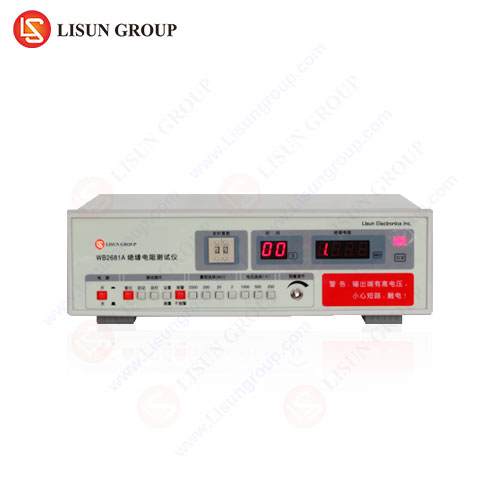
The LISUN WB2678A Grounding Resistance Tester is engineered to meet the exacting requirements of ground bond testing as per IEC 61010, IEC 60335, and other major standards. It provides a definitive validation of the protective earth circuit’s current-carrying capacity and resistance.
Specifications and Testing Principle:
The instrument generates a selectable test current of 5A, 10A, 20A, or 30A AC (RMS), with a open-circuit voltage limit of 12V AC for operator safety. Its core operation is based on a four-terminal measurement. Two force terminals (F+, F-) deliver the high test current through the ground path under evaluation. Two separate sense terminals (S+, S-) measure the precise voltage drop across the exact same path. By using Ohm’s Law (R = V/I), the instrument calculates the resistance with high accuracy, inherently nullifying the resistance of the test leads and contact points. The test duration is programmable from 1 to 999 seconds, allowing for both rapid production-line checks and extended tests that account for thermal effects. An audible and visual alarm triggers if the measured resistance exceeds a user-set limit (0.1 Ω to 1.2 Ω), providing a clear pass/fail result.
Industry Use Cases:
- Electrical and Electronic Equipment Manufacturing: Final production-line verification of appliances, power tools, and industrial control cabinets.
- Automotive Electronics: Testing the grounding of EV charging stations, onboard chargers, and high-voltage component enclosures.
- Medical Device Compliance: Validating the protective earth of Class I medical equipment, such as surgical beds, imaging system cabinets, and dental chairs.
- Aerospace and Aviation Components: Ensuring ground path integrity in in-flight entertainment systems, galley equipment, and ground support apparatus.
- Quality Assurance for Electrical Components: Testing the earth continuity of switches, sockets, connectors, and distribution boards before integration.
Competitive Advantages:
The WB2678A distinguishes itself through its robust safety design, including electronic circuit protection and a failsafe interlock system. Its high measurement accuracy (±(1%+3 digits)) and stable current output ensure repeatable, reliable results critical for audit compliance. The intuitive interface with large LCD display and programmable test sequences enhances efficiency in high-throughput environments. Compared to simpler continuity checkers, its ability to apply a high current simulates a realistic fault condition, proving not just connection existence, but its adequacy.
Standards Harmonization and Global Market Access
Achieving global market access requires navigating a complex landscape of national and international standards. While the IEC (International Electrotechnical Commission) standards form the basis, regional deviations exist (e.g., UL in North America, GB in China, BS in the UK). The most efficient path to compliance involves designing to the highest common denominator of hazard-based safety requirements, then conducting testing through accredited laboratories. Key horizontal standards like IEC 62368-1 for audio/video and Information Technology Equipment are increasingly adopting a hazard-based engineering approach, focusing on energy source classification rather than prescriptive rules. Understanding these nuances is vital for manufacturers of Consumer Electronics and Telecommunications Equipment aiming for worldwide distribution.
Integration of Safety Testing in Automated Production Lines
Modern manufacturing of high-volume appliances necessitates the integration of safety tests into automated production test stations. Sequential testing—earth bond, insulation resistance, dielectric strength, and functional run—is performed in a cycle time of seconds. Equipment like the WB2678A can be controlled via PLC or PC interfaces (e.g., RS232, USB, GPIB) to log every test result, creating a traceable quality record for each serialized unit. This is indispensable in industries such as Lighting Fixtures and Household Appliances, where production volumes are in the millions. Automated handling systems present the product’s earth terminal to the test probes, execute the sequence, and sort units based on pass/fail criteria, ensuring no non-compliant product proceeds to packaging.
Emerging Challenges: High-Frequency Leakage and DC Systems
New technologies introduce novel safety assessment challenges. The widespread use of high-frequency switch-mode power supplies in virtually all electronics increases high-frequency leakage currents, which are not accurately measured by 50/60Hz-weighted networks. Future standards are evolving to address this. Furthermore, the rise of DC distribution systems in renewable energy installations, data centers, and Automotive Electronics (e.g., 48V vehicle systems) requires revised test methodologies for DC dielectric strength and DC leakage current, as the human body’s impedance and physiological effects differ from AC exposure. Safety standards for Electrical Components in these DC ecosystems are still under active development.
Documentation and Technical Construction File Requirements
Compliance is not demonstrated by testing alone. A comprehensive Technical Construction File (TCF) or equivalent documentation dossier is required. This includes circuit diagrams, material specifications (e.g., UL-recognized insulation), clearance and creepage distance calculations, risk assessment reports, descriptions of protective systems, and summarized test reports from all safety evaluations. For a Medical Device, this file is scrutinized by a notified body. For Industrial Control Systems, it provides the evidence of due diligence. Meticulous record-keeping, supported by data from calibrated instruments like grounding resistance testers, forms the legal and technical foundation of product safety certification.
FAQ: Ground Bond Testing and the WB2678A
Q1: Why is a high-current test necessary for ground bond verification when a simple continuity check shows the wire is connected?
A continuity check, often using a low current (e.g., 200 mA), only confirms the physical connection exists. It cannot reliably detect a high-resistance joint, such as a corroded terminal or a loose screw, which would overheat and potentially fail under a real fault current of tens of amperes. The high-current test (e.g., 25A) stresses the connection, revealing these marginal faults by measuring the voltage drop under a simulated fault condition, ensuring the path can safely carry enough current to trip the circuit breaker or fuse.
Q2: What is the significance of the four-wire (Kelvin) measurement method used by the WB2678A?
The four-wire method is critical for accuracy at low resistance values. In a two-wire measurement, the resistance of the test leads themselves (which can be tens of milliohms) is added to the measurement, causing significant error when the specification limit is 0.1 Ω. The four-wire method uses separate pairs for current injection and voltage sensing. The sense wires measure the voltage directly across the device under test, bypassing the lead resistance, resulting in a precise measurement of the ground path resistance alone.
Q3: For how long should the ground bond test be performed?
Standard test durations are typically between 5 and 30 seconds. A shorter test (e.g., 5s) is suitable for fast production-line checks. A longer test (e.g., 30s to 2 minutes) may be specified to ensure the connection remains stable as it heats up due to the test current, simulating a sustained fault. The WB2678A’s programmable timer allows adherence to specific standard requirements or internal quality procedures.
Q4: Can the WB2678A be used to test the earth electrode resistance of an electrical installation?
No. The WB2678A is designed for ground bond or earth continuity testing of appliances and equipment, measuring the low resistance of a manufactured conductive path. Testing the resistance of an earth electrode (ground rod) in soil is a different application requiring an earth ground resistance tester, which uses alternative methods like the fall-of-potential or clamp-on principle to measure the impedance of the earth itself, which is typically higher (e.g., <25 Ω).
Q5: What is the consequence of setting an incorrect resistance limit on the tester?
Setting a limit too high may allow a product with a marginally compliant or unsafe ground connection to pass, creating a potential safety hazard in the field. Setting a limit too low may cause an excessive number of false failures, disrupting production and incurring unnecessary rework costs on products that are actually safe. The limit must be set according to the applicable product safety standard and the specific design criteria of the appliance under test.
