







The Imperative of Dielectric Withstand Testing in Global Product Compliance
Electrical safety compliance testing constitutes a non-negotiable pillar in the design, manufacture, and certification of virtually all electrically powered and electronic products. Its primary objective is to verify that a product’s insulation system provides adequate protection against electric shock under both normal and single-fault conditions. Among the suite of tests mandated by international standards, the Dielectric Withstand Voltage Test, commonly known as the Hipot (High Potential) test, stands as a critical and definitive assessment of a product’s basic insulation integrity. This procedure applies a significantly elevated voltage between live parts and accessible conductive surfaces, simulating stress conditions far beyond typical operational parameters to ensure a safe margin of protection exists.
The consequences of inadequate dielectric strength are severe, ranging from catastrophic failure and fire hazard to direct user electrocution. As global supply chains integrate and regulatory frameworks like the European Union’s Low Voltage Directive (LVD) and various national codes (e.g., UL, CSA, IEC) demand rigorous proof of safety, standardized, reliable, and traceable testing methodologies become paramount. This article delineates the technical principles, standards landscape, and practical implementation of dielectric withstand testing, with a focused examination of advanced instrumentation such as the LISUN WB2671A Withstand Voltage Tester, which exemplifies the technological capabilities required for modern compliance verification.
Fundamental Principles of Dielectric Strength Evaluation
The dielectric withstand test is a pass/fail, type-test evaluation designed to stress a product’s insulation beyond its rated working voltage. The core principle involves applying a high AC or DC voltage—typically 1-3 kV AC for basic insulation in mains-powered equipment, and often significantly higher for specialized applications—between parts that should be electrically isolated. This includes primary circuits and accessible metal parts (e.g., chassis, enclosures), between primary and secondary circuits of power supplies, and across isolation barriers in components.
The test voltage, its waveform (AC or DC), duration (commonly 60 seconds for type tests, 1 second for production-line tests), and pass/fail criteria are strictly defined by the applicable product safety standard. Examples include IEC 62368-1 for audio/video and IT equipment, IEC 60335-1 for household appliances, IEC 60601-1 for medical electrical equipment, and ISO 26262 / LV 214 for automotive components. The primary failure mode sought is dielectric breakdown, indicated by an excessive leakage current flowing through or across the insulation. Test instruments do not merely monitor for a full short-circuit; they are calibrated to trip at a precise current threshold (e.g., 1 mA, 5 mA, 100 mA), which represents the onset of unacceptable insulation degradation. A pass result confirms that no disruptive discharge or excessive leakage occurred, validating the insulation’s ability to withstand transient overvoltages, such as those from switching surges or indirect lightning strikes.
Navigating the Labyrinth of International Testing Standards
Selecting the correct test parameters is impossible without reference to the governing standards. These documents, developed by bodies like the International Electrotechnical Commission (IEC), Underwriters Laboratories (UL), and the International Organization for Standardization (ISO), provide the legal and technical framework for safety. They specify not only the test voltage—often calculated as a multiple of the working voltage plus a fixed offset—but also the environmental preconditions (e.g., humidity conditioning), instrument accuracy requirements, and test setup geometry.
For instance, IEC 62368-1 stipulates different withstand voltages for Basic, Supplementary, and Reinforced insulation. A switch-mode power supply for office equipment may require 3 kV AC applied between its primary lines and grounded secondary for 60 seconds. Conversely, a patient-connected medical sensor per IEC 60601-1 might demand a test of 4 kV AC across its isolation barrier to ensure operator and patient safety. Automotive electronics for 48V systems, governed by LV 214, often undergo DC hipot tests at levels like 500 V DC to check isolation resistance in harsh vehicular environments. The tester must, therefore, be versatile enough to accommodate these disparate yet precise requirements across industries including Telecommunications Equipment, Aerospace and Aviation Components (where DO-160 standards may apply), and Lighting Fixtures (IEC 60598-1).
Instrumentation for Precision: The LISUN WB2671A Withstand Voltage Tester
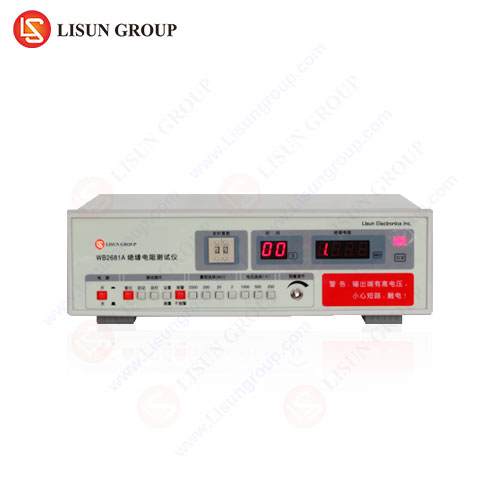
Modern compliance testing necessitates instrumentation that combines high-voltage generation with precise measurement, robust safety features, and data integrity. The LISUN WB2671A exemplifies this class of equipment, engineered to perform AC and DC dielectric withstand tests up to 5 kV AC (10 kV DC optional) with a current measurement range from 0.01 mA to 20 mA. Its design addresses the core needs of both R&D validation and high-throughput production line testing.
Key Specifications and Operational Capabilities:
- Output Voltage: 0–5 kV AC (50/60 Hz), with optional DC extension to 10 kV.
- Voltage Accuracy: Typically ± (2% of reading + 5 V), ensuring adherence to standard-mandated instrument accuracy (often ±3%).
- Leakage Current Measurement: Multiple selectable upper limits (e.g., 0.5/1/2/5/10/20 mA) with high resolution (0.01 mA), allowing alignment with specific standard trip thresholds.
- Timing Function: Programmable test duration from 1–999 seconds, supporting both type-test and production-line durations.
- Arc Detection: Advanced circuitry to detect intermittent breakdowns (arcing) that may not cause a sustained over-current but indicate insulation flaws.
- Output Ramp Control: Programmable voltage rise time (ramp-up) and fall time (ramp-down) to prevent transient surges from damaging sensitive Devices Under Test (DUTs).
The testing principle employed by the WB2671A involves a closed-loop feedback system. The microcontroller sets a target voltage, which the power amplifier and high-voltage transformer generate. A dedicated high-accuracy sampling circuit continuously monitors the actual output voltage and the current flowing through the DUT. This current, the leakage current, is vectorially composed of capacitive charging current (which is normal, especially for large products or long cables), resistive leakage current (indicative of insulation quality), and any sudden inrush from a breakdown. The instrument’s intelligence lies in its ability to differentiate these components and trip only when the resistive component exceeds the pre-set limit, ignoring the harmless capacitive surge at test initiation.
Application Across Diverse Industrial Sectors
The universality of electrical safety is reflected in the WB2671A’s application across a broad industrial spectrum.
- Household Appliances & Consumer Electronics: Testing insulation between live parts (heating elements, motors) and the grounded metal casing of washing machines, refrigerators, and power adapters per IEC 60335-1.
- Automotive Electronics: Verifying the isolation integrity of battery management systems (BMS), onboard chargers for electric vehicles, and control units, ensuring they withstand the electrical noise and transients of the vehicle’s electrical system.
- Medical Devices: Performing critical patient protection tests on the insulation of dialysis machines, MRI components, and surgical tools, where failure could be lethal. The tester’s high accuracy is non-negotiable here.
- Lighting Fixtures & Electrical Components: Checking sockets, switches, and LED driver modules for sufficient clearance and creepage distance by applying high voltage between terminals and mounting surfaces.
- Industrial Control Systems & Telecommunications: Ensuring programmable logic controllers (PLCs), servers, and router power supplies can endure lightning-induced surge voltages on data or power lines.
- Aerospace and Aviation Components: Testing wiring harnesses and avionics boxes for insulation integrity after environmental stress testing, as per DO-160G Section 4.
- Cable and Wiring Systems: Performing routine quality control on batches of insulated wire, applying high voltage between the conductor and a water bath or foil wrap to detect pinhole defects in the insulation.
Mitigating Risk and Enhancing Test Validity
A critical, often overlooked aspect of high-potential testing is the mitigation of risk—both to the operator and the Device Under Test. The LISUN WB2671A incorporates several safeguards. High-voltage output is enabled only when the interlock circuit is closed, typically via a safety fixture that physically encloses the DUT. An immediate, automatic discharge circuit engages upon test termination or abort, draining stored capacitive energy from the DUT to prevent residual shock hazard. Furthermore, the programmable ramp functions prevent the application of a full voltage step, which can generate damaging displacement currents in capacitive loads and lead to false failures. The instrument’s ability to log test results (voltage, current, pass/fail status) provides an auditable trail for quality assurance and regulatory submission, a feature increasingly demanded in medical and automotive industries.
Comparative Advantage in a Competitive Landscape
The competitive landscape for safety testers ranges from basic analog units to fully automated systems. The WB2671A’s position is defined by its balance of performance, reliability, and user-centric design. Its advantages include a high-stability, low-distortion output waveform, which is crucial for accurate leakage current measurement at high frequencies of interference. The intuitive interface, with both manual knob control and digital keypad, reduces setup errors. Perhaps most significantly, its robust construction and protection circuits ensure longevity in demanding production environments where uptime is critical. When compared to lower-cost alternatives, its calibrated accuracy and compliance with international instrument standards (IEC 61010-1) make it a defensible choice for audit-facing compliance labs and high-volume manufacturers.
Integrating Hipot Testing into a Comprehensive Safety Regime
It is vital to contextualize the dielectric withstand test as one element within a holistic safety testing protocol. It is typically preceded by tests like protective earth continuity (for Class I equipment) and insulation resistance (a low-voltage, high-resistance measurement). It may be followed by functional tests to ensure the applied stress did not degrade the DUT’s performance. For example, a medical device would undergo a withstand test, then a thorough functional verification to ensure all diagnostic readings remain accurate. In production, the hipot test is a final gatekeeper, but its parameters are derived from the design validation phase, where type tests are performed under worst-case environmental conditions.
Frequently Asked Questions (FAQ)
Q1: What is the practical difference between AC and DC dielectric withstand testing, and when should each be used?
AC testing (50/60 Hz) stresses insulation in a manner similar to the operating frequency of mains power, making it the preferred and most realistic test for most line-powered equipment. It is more effective at detecting flaws related to material voids or delaminations. DC testing applies a unidirectional stress, resulting in only resistive leakage current (no capacitive component). It is used for testing very capacitive loads (e.g., long cables, large motors) where the AC charging current would be prohibitively high, for testing after humidity conditioning where water leakage paths could cause false AC failures, and for specific standards like those for automotive or telecom DC systems.
Q2: The WB2671A offers adjustable leakage current trip limits. How is the correct limit determined?
The trip limit is not arbitrary; it is specified in the applicable end-product safety standard. For instance, IEC 62368-1 often specifies a trip current of 1 mA for basic insulation tests. IEC 60601-1 may specify 5 mA for equipment with large protective earth conductors. The limit is chosen to be sensitive enough to detect incipient breakdown but high enough to ignore normal, harmless leakage currents (like the capacitive charging current of a large product). The tester’s adjustable limits allow it to be configured for compliance with dozens of different standards.
Q3: Can a product pass a hipot test but still be unsafe in real-world use?
Yes, which is why hipot is part of a test suite. A hipot test is a momentary stress test. It does not assess long-term insulation aging, the effects of thermal cycling, or mechanical wear. A product with marginally sufficient creepage distances might pass a 60-second hipot but fail over years of service due to dust accumulation and humidity. Furthermore, hipot does not test for other hazards like energy, fire, or radiation. Comprehensive safety evaluation requires all tests prescribed by the standard.
Q4: Why is arc detection an important feature in a modern withstand voltage tester?
Insulation failures are not always catastrophic shorts. A carbonized track or a small air gap may break down intermittently, causing a series of micro-arcs. These arcs generate high-frequency noise and heat, degrading insulation over time but may not sustain a leakage current above the standard trip limit long enough for the tester to react. A dedicated arc detection circuit identifies these high-frequency discharge events, flagging a potentially flawed insulation system that a basic current-limit test might erroneously pass. This is critical for high-reliability sectors like aerospace and medical devices.
Q5: How does programmable voltage ramp control benefit the testing process?
A sudden application of full test voltage can cause high inrush currents into the natural capacitance of the DUT, which may exceed the leakage current trip limit and cause a false failure. A controlled ramp (e.g., 500 V/s) allows this capacitive current to stabilize. Similarly, a controlled ramp-down at the end of the test prevents voltage spikes that could damage sensitive semiconductors within the DUT. This feature protects both the test integrity and the equipment being tested, especially valuable for expensive prototypes or finished goods.
