








The Role of AC/DC Hipot Testers in Modern Electrical Safety Compliance
Introduction to Dielectric Withstand Verification
The imperative for electrical safety across manufacturing and quality assurance sectors necessitates rigorous validation of insulation integrity. Dielectric withstand testing, commonly termed hipot testing, serves as a fundamental compliance and safety checkpoint. This non-destructive test applies a high voltage between conductive parts and insulation to verify that the insulation can withstand transient overvoltages and operational stresses without breakdown or excessive leakage current. The AC/DC Hipot Tester represents the core instrument for executing these critical evaluations, blending high-voltage generation, precise measurement, and safety interlocking into a unified system. Its application spans from component-level validation to final product certification, forming an indispensable barrier against potential electric shock hazards, fire risks, and premature field failures.
Fundamental Principles of Hipot Testing: AC versus DC Modalities
The operational principle of a hipot tester is deceptively simple: apply a stress voltage significantly higher than normal operating voltage for a specified duration and monitor for insulation failure. The choice between alternating current (AC) and direct current (DC) testing modalities, however, is governed by distinct physical principles and application-specific requirements.
An AC hipot test applies a sinusoidal high voltage, typically at power frequency (50/60 Hz). This method most closely simulates real-world operational stress and utility-borne transients. The test voltage is usually specified as a root-mean-square (RMS) value. The primary measured parameter is the total leakage current, which comprises a resistive component (in-phase with voltage) and a capacitive charging current (90 degrees out of phase). For large capacitive loads like long cables or power supplies with large Y-capacitors, this capacitive current can be substantial, requiring testers with sufficient output current capacity. The AC test is particularly effective at detecting weaknesses related to spacing (creepage and clearance) and inclusions within insulating materials.
Conversely, a DC hipot test applies a steadily maintained high voltage. The key advantage lies in the nature of the leakage current measured. Once the capacitive charging current subsides (a transient phenomenon during voltage ramp-up), the remaining current is primarily resistive leakage through the insulation. This allows for the detection of very small, steady-state leakage paths that might be masked by large capacitive currents in an AC test. DC testing is also less stressful on capacitive loads, requires lower output current from the tester, and is inherently safer due to the lower stored energy after a breakdown. It is the preferred method for testing components like capacitors, cables, and high-capacitance assemblies. However, it may not adequately stress insulation in the same manner as an AC voltage, potentially missing certain types of flaws.
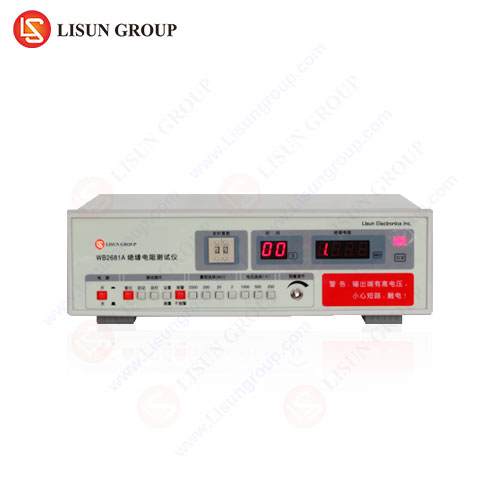
Modern composite testers, such as the LISUN WB2671A Withstand Voltage Tester, integrate both AC and DC testing capabilities, allowing engineers to select the appropriate modality based on the device under test (DUT) and relevant international standards.
Architectural Overview of a Modern Composite Hipot Tester
A contemporary AC/DC hipot tester is a sophisticated electromechanical instrument comprising several key subsystems. The high-voltage generation module is central, utilizing a precision-controlled transformer and voltage regulator for AC output, and a high-voltage DC converter with smoothing and regulation circuits for DC output. Voltage measurement is performed via high-accuracy, high-impedance dividers, ensuring the applied stress is within a tight tolerance of the setpoint.
Current measurement is equally critical. The instrument must accurately distinguish between the inherent capacitive charging current of a healthy DUT and a genuine resistive leakage current indicating insulation degradation. Advanced testers employ true RMS sensing for AC and high-resolution analog-to-digital converters for DC, with programmable trip thresholds. The control system, often microprocessor-based, manages test sequencing, ramp rates, dwell times, and safety interlocks. A robust safety circuit is mandatory, featuring zero-start protection (ensuring output voltage is zero before a test initiates), over-current protection, arc detection, and hardware-based emergency cutoff. The user interface ranges from simple keypad-and-display units to fully graphical touchscreens with data logging and network connectivity for integration into automated production lines.
Introducing the LISUN WB2671A Withstand Voltage Test Instrument
The LISUN WB2671A exemplifies the evolution of the composite hipot tester into a versatile, safety-focused, and standards-compliant instrument. Designed to meet the stringent requirements of global safety standards, it provides a reliable platform for both laboratory development and high-volume production line testing. Its architecture is built around precision, repeatability, and operator safety.
Key Specifications of the WB2671A:
- Test Voltages: AC: 0–5 kV / 0–10 kV / 0–20 kV (RMS); DC: 0–6 kV / 0–12 kV / 0–20 kV.
- Voltage Accuracy: ± (2% of reading + 3% of range).
- Current Measurement Range: AC: 0–2 mA / 0–20 mA; DC: 0–2 mA / 0–10 mA.
- Current Accuracy: ± (2% of reading + 3 digits).
- Output Power: 100 VA (for AC 5kV model); 500 VA (for AC 20kV model).
- Timer Range: 1–999 seconds, programmable.
- Ramp Time: Programmable from 1–999 seconds.
- Compliance Standards: Meets the test methodology requirements of IEC 61010, GB4793, and other derivative standards for safety testing equipment.
The WB2671A operates on the principle of controlled stress application with continuous monitoring. In AC mode, it generates a stable, low-distortion sinusoidal high voltage. It measures the true RMS leakage current, comparing it in real-time against user-defined upper (FAIL) and lower (OPEN) limits. The lower limit is crucial for detecting open test circuits, such as a disconnected probe. In DC mode, the instrument ramps the voltage to the setpoint, allows for capacitive settling, and then monitors the steady-state resistive leakage current. Its arc detection circuitry can identify sudden, brief current surges indicative of partial discharges or surface tracking, even if the overall current does not exceed the fail threshold.
Industry-Specific Application Scenarios and Standards Alignment
The utility of a composite hipot tester is demonstrated through its cross-industry application. Each sector presents unique DUT characteristics and invokes specific international standards.
Electrical and Electronic Equipment & Household Appliances: Testing to IEC 60335-1 involves applying AC hipot voltages (e.g., 1250 V or 3750 V based on class) between live parts and accessible conductive surfaces. The WB2671A’s ability to handle the capacitive load of a motor-driven appliance while accurately measuring leakage is critical. For power supplies within appliances, DC hipot testing of the primary-to-secondary isolation is performed per IEC 61558, often at 3000 VDC or higher.
Automotive Electronics: Components must endure harsh electrical environments. ISO 16750-2 and LV 124 mandate rigorous dielectric testing. A DC hipot test is frequently used for ECUs, sensors, and wiring harnesses to check insulation after exposure to humidity and temperature cycling, with test voltages derived from the operating voltage of the vehicle’s electrical system (e.g., 14V nominal, test at 500 VDC).
Lighting Fixtures and LED Drivers: IEC 60598-1 requires hipot testing of luminaires. LED drivers, as switch-mode power supplies, require both AC input-to-output isolation tests and DC tests for the output circuit. The WB2671A’s dual-mode capability allows for comprehensive testing of the entire fixture assembly.
Medical Devices: The stakes for insulation failure are extreme. IEC 60601-1 mandates stringent dielectric strength tests, often with higher test voltages and lower allowable leakage currents (e.g., patient auxiliary current limits of 100 µA). The high accuracy and resolution of the WB2671A’s current measurement are essential for compliance.
Aerospace and Aviation Components: Standards like DO-160G require dielectric withstand testing with both AC and DC for equipment operating in aircraft electrical systems. Testing must account for altitude derating, where breakdown voltages decrease with reduced air pressure. A programmable tester can automate this derated voltage calculation.
Cable and Wiring Systems: QC/T 29106 for automotive wiring and various IEEE standards for power cables involve DC hipot testing as a routine production test. The tester must source enough current to charge the cable’s capacitance quickly. For fault location, a DC test is preferred as the steady-state current can help pinpoint high-resistance flaws.
Industrial Control, Telecommunications, and Office Equipment: These products, governed by standards like IEC 61010-1, IEC 60950-1 (now superseded by IEC 62368-1), require verification of basic and reinforced insulation. The test often involves applying an AC voltage between primary circuits and grounded or accessible parts.
Competitive Advantages of Integrated AC/DC Testing Platforms
The integration of both AC and DC testing within a single instrument, as seen in the LISUN WB2671A, confers several operational and technical advantages. It reduces capital expenditure and bench space by eliminating the need for two separate dedicated testers. It streamlines the test workflow for products requiring both test types, as parameters and limits can be stored in linked test sequences. From a data integrity perspective, using one calibrated instrument for all dielectric tests minimizes measurement systemic error.
Furthermore, advanced instruments offer features that enhance reliability and safety. Programmable ramp rates (V/s) prevent inrush currents from causing false failures and reduce stress on the DUT. Real-time plotting of voltage and current during the test can provide diagnostic insight into insulation behavior. Secure data logging with time-stamped results is indispensable for audit trails and quality management systems. The WB2671A’s design emphasizes these aspects, providing a robust interface for automation (via RS232, USB, or LAN) and ensuring that safety interlocks are hardware-based for fail-safe operation.
Interpreting Test Results and Failure Analysis
A successful hipot test is one where the insulation withstands the applied voltage for the specified duration without the leakage current exceeding the preset limit. A failure, indicated by an over-current trip or arc detection, necessitates investigation. Distinguishing between a genuine insulation flaw and a “false fail” is crucial.
A genuine failure typically shows a sudden, sustained increase in current. Causes include insufficient creepage/clearance distances, insulating material contamination (dust, moisture), pinholes in transformer bobbin insulation, or cracked PCB substrates. In DC testing, a steadily rising leakage current over the dwell period may indicate dielectric absorption or moisture ingress, even if the final value does not trip the limit.
False failures can occur due to test setup issues. Corona discharge at sharp points on test probes can generate current spikes. The capacitive charging current of a large DUT may exceed the current limit if the ramp time is too short or the limit is set too tightly. Environmental factors like high ambient humidity can lower surface resistance, increasing leakage. The WB2671A’s programmable ramp and settable current limits allow test engineers to condition the test to mitigate these effects, ensuring only true defects are caught.
FAQ: Common Inquiries on Hipot Testing and the WB2671A
Q1: When should I choose AC hipot testing over DC, and vice versa?
The choice is often dictated by the relevant product safety standard. Generally, AC testing is preferred for final product testing as it simulates real-world stress. DC testing is favored for components with high capacitance (like long cables or large filters), for testing after environmental stress (humidity), and for fault finding due to the stable leakage current measurement. Many standards, such as those for IT equipment (IEC 62368-1), allow either method but specify different test voltages (typically DC voltage is ~1.414 times the AC RMS voltage).
Q2: How do I set the appropriate current trip limit for my device under test?
The limit should be based on the allowable leakage current specified in the applicable safety standard, plus a margin for the inherent capacitive current of your DUT. A practical method is to perform a test on a known-good sample, note the peak leakage current, and set the fail limit to a value 20-50% higher. Always set a lower limit (open circuit test) to detect broken test leads. The WB2671A allows independent setting of both high and low limits.
Q3: Can the WB2671A be integrated into an automated production test system?
Yes. The WB2671A is equipped with standard communication interfaces including RS232, USB, and Ethernet (LAN). It supports command-based remote control via standard protocols (SCPI or manufacturer-specific command sets). This allows it to be seamlessly integrated into automated test stations, with test parameters downloaded, execution triggered, and results uploaded to a host computer or Manufacturing Execution System (MES) without operator intervention.
Q4: What safety features are critical in a hipot tester, and how does the WB2671A address them?
Essential safety features include: 1) Zero-Start Protection: Voltage output must be zero before a test starts. 2) Hardware Over-Current Protection: A fast, non-software-based trip mechanism. 3) Ground Continuity Check: Verification that the DUT’s safety ground is connected before applying high voltage. 4) Interlock Circuit: A mandatory loop that must be closed (e.g., by a safety cage door) to enable high voltage. The WB2671A incorporates all these features, with its protection circuits designed to meet the requirements of IEC 61010 for safety of test equipment.
Q5: Why might a product pass a DC hipot test but fail an AC hipot test, or vice versa?
This discrepancy reveals different failure modes. A pass in DC but fail in AC can indicate a flaw sensitive to the continuous polarity reversal of AC, such as a void in insulation where partial discharge occurs more readily under alternating fields. A pass in AC but fail in DC might point to a high-resistance, localized flaw (like a carbonized track) that allows a small, steady DC leakage current but does not provide a sufficient path for the larger capacitive currents of an AC test to trip the limit. Using a composite tester allows investigation of both failure modes.
