








An Analytical Examination of Accelerated Weathering via Xenon Arc Test Chambers
Fundamental Principles of Simulated Environmental Degradation
The long-term reliability and aesthetic consistency of materials are critical determinants of product success across a vast spectrum of industries. Exposure to solar radiation, temperature fluctuations, and moisture precipitates a range of deleterious effects, including photodegradation, thermal stress, and hydrolytic instability. To preemptively evaluate and quantify these effects within a compressed timeframe, the industry relies upon accelerated weathering test chambers. Among these, xenon arc test chambers represent the most technologically advanced methodology for accurately simulating the full spectrum of terrestrial sunlight and its associated environmental parameters. These instruments are indispensable for predicting service life, validating material formulations, and ensuring compliance with international performance standards.
The core operational principle of a xenon arc test chamber centers on the use of a xenon gas discharge lamp. When electrically excited, xenon plasma emits a spectral power distribution (SPD) that closely approximates that of natural sunlight, encompassing ultraviolet (UV), visible, and infrared (IR) wavelengths. This fidelity is paramount, as different wavelengths of light instigate distinct photochemical reactions; UV radiation is primarily responsible for polymer chain scission and color fading, while IR radiation contributes to thermal degradation. By controlling the lamp’s intensity, filtering its output, and precisely managing the chamber’s internal environment—including temperature, relative humidity, and water spray cycles—the chamber can replicate years of outdoor exposure in a matter of weeks or months.
The XD-150LS Xenon Lamp Test Chamber: A System Overview
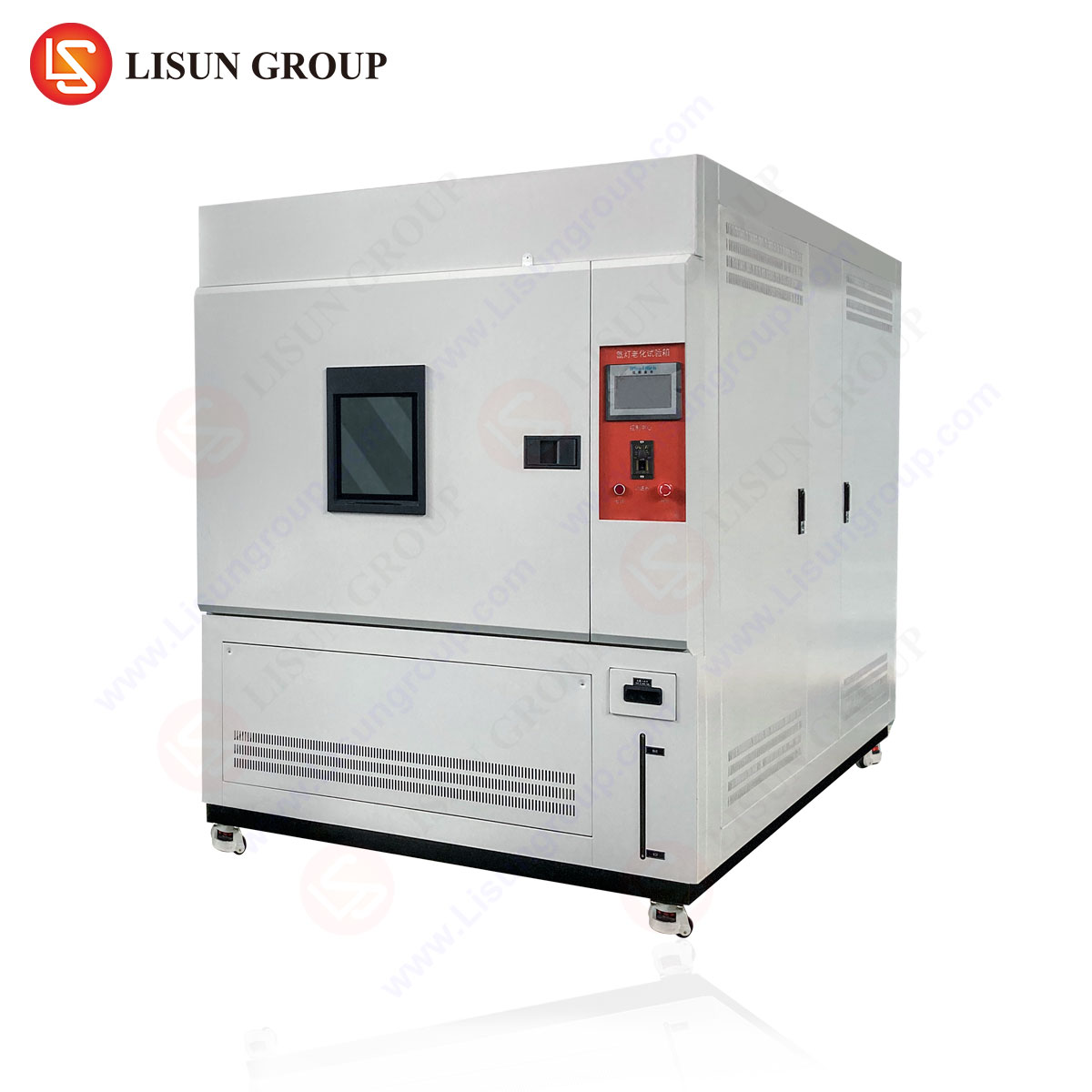
The LISUN XD-150LS Xenon Lamp Test Chamber is a sophisticated apparatus engineered for high-precision, reproducible accelerated weathering testing. Designed to meet or exceed the rigorous requirements of multiple international standards, including ASTM G155, ISO 4892-2, and SAE J2527, this chamber provides a controlled and consistent environment for evaluating material durability. Its design integrates advanced subsystems for illumination, climate control, and specimen handling to ensure that test results are both reliable and directly correlatable to real-world performance.
The chamber’s construction features a double-layer structure with an outer body of high-quality steel plate and an inner liner of SUS304 stainless steel, providing robust corrosion resistance and thermal stability. The insulation between these layers minimizes thermal exchange with the ambient laboratory environment, enhancing energy efficiency and temperature uniformity. A large, double-pane glass observation window allows for visual monitoring of specimens without interrupting the test cycle, while an internal rotary specimen rack ensures uniform exposure of all samples to the light source, a critical factor for eliminating positional bias in test results.
Deconstructing the Spectral Fidelity of the Xenon Arc Source
The heart of the XD-150LS is its air-cooled xenon arc lamp, a component selected for its stable output and long operational life. The spectral quality of the emitted light is not solely a function of the lamp itself but is critically modified by optical filters. The chamber is equipped with a selection of filter systems that allow users to tailor the SPD to specific application environments. For instance, a “Daylight” filter combination (typically including a Type Q/B filter per ASTM G155) is used to simulate direct noon sunlight, while a “Window Glass” filter (Type C) filters out the short-wave UV radiation that is blocked by ordinary window glass, making it ideal for testing materials destined for indoor use, such as those in office equipment or household appliances.
Irradiance control is a paramount feature. The XD-150LS employs a closed-loop irradiance control system that continuously monitors the light intensity at a user-selected wavelength (e.g., 340 nm or 420 nm) and automatically adjusts the lamp’s power to maintain a preset level. This eliminates the performance decay associated with lamp aging and ensures that the total radiant exposure (measured in Joules per square meter) delivered to the specimens is precise and repeatable from test to test. This level of control is essential for generating quantitative data that can be used for comparative analysis and predictive modeling.
Integrated Climatic Control and Hydro-Cycling Mechanisms
Beyond spectral output, the synergistic effects of temperature and moisture are primary drivers of material degradation. The XD-150LS integrates a highly responsive climatic control system. Temperature is managed via a forced-air circulation system and a high-capacity heating element, while a refrigeration unit, often operating on an environmentally compliant refrigerant, provides cooling capacity. This allows for a wide range of controllable black panel temperatures (BPT), which can be set to simulate anything from a cool, high-altitude environment to the extreme heat load of a sun-baked automotive dashboard.
Relative humidity (RH) is controlled with similar precision, typically through a system of water boilers and dehumidification coils. The ability to program specific RH setpoints, often ranging from 10% to 98%, is crucial for testing hygroscopic materials or for simulating cycles of dew formation. Furthermore, the chamber includes a water spray system. This system is not primarily for cooling but is used to simulate rain or thermal shock. Spray cycles can be programmed to introduce demineralized water onto the specimens, which can cause mechanical erosion of surfaces, leach out additives, and induce stress cracking through rapid thermal contraction.
Application-Specific Testing Protocols Across Industries
The versatility of the XD-150LS is demonstrated by its application across diverse industrial sectors, each with unique performance criteria.
-
Automotive Electronics and Exterior Components: Automotive components, from exterior polymer trims and coatings to under-hood electronic control units (ECUs), must withstand extreme conditions. Testing protocols often involve extended cycles of high irradiance, high temperature (e.g., 70°C BPT), and intermittent water spray to simulate years of sun and weather exposure, ensuring that dashboards do not crack, colors do not fade, and electrical connections remain secure.
-
Consumer Electronics and Telecommunications Equipment: The casings, displays, and keyboards of smartphones, routers, and laptops are subject to constant exposure to ambient light and handling. Testing here may focus on colorfastness and surface texture integrity using filtered xenon light to simulate indoor lighting conditions behind window glass. This ensures that a product’s aesthetic appeal is maintained throughout its expected lifespan.
-
Aerospace and Aviation Components: Materials used in aircraft interiors and external components are tested to exceptionally high standards. The XD-150LS can be used to validate the performance of composite materials, cockpit display panels, and wire insulation, often following standards like Airbus AITM or Boeing BSS, which specify stringent combinations of UV exposure, thermal cycling, and humidity.
-
Electrical Components and Cable Systems: Switches, sockets, and insulating materials for cables must retain their dielectric strength and mechanical flexibility. Accelerated weathering tests evaluate the propensity for polymer embrittlement, tracking resistance, and the loss of plasticizers, which could lead to failure in critical applications within industrial control systems or building infrastructure.
-
Medical Devices and Lighting Fixtures: For medical device housings and the diffusers of LED lighting fixtures, maintaining optical clarity and material integrity is non-negotiable. Testing protocols assess yellowness index (YI) shift, transmittance loss, and the potential for haze formation, ensuring that performance is not compromised by prolonged exposure to their own light output or environmental conditions.
Quantitative Analysis and Data Correlation Methodologies
The output of a xenon arc test is only as valuable as the data derived from it. Testing is not merely about observing gross failures but about quantifying subtle changes in material properties. Standard practice involves the periodic removal of specimens for evaluation against a suite of metrics. These include:
- Colorimetry: Measurement of Delta E (ΔE) using a spectrophotometer to quantify color shift.
- Gloss Measurement: Tracking the change in specular reflectance at 20°, 60°, or 85° angles to assess surface micro-roughening.
- Mechanical Testing: Evaluating the retention of tensile strength, elongation at break, or impact resistance.
- Visual Inspection: Documenting surface phenomena like chalking, cracking, blistering, or mold growth according to standardized pictorial scales (e.g., ASTM D1654 for corrosion).
Correlation of accelerated test hours to real-world exposure is a complex, empirically derived process. A common, though highly generalized, rule of thumb is that 450-500 kJ/m² of radiant exposure at 340 nm is roughly equivalent to one year of average outdoor exposure in a temperate climate like Florida or Arizona. However, accurate correlation requires establishing a “damage envelope” by testing materials with known outdoor performance histories and creating predictive models based on the specific failure modes of interest.
Operational Considerations and Calibration Regimen
To ensure the integrity of test data, a rigorous regimen of operational maintenance and calibration is mandatory. The xenon lamp itself is a consumable item with a finite life, typically requiring replacement after 1,000 to 1,500 hours of operation to maintain spectral fidelity. Regular calibration of the irradiance sensor is critical, as is the replacement of optical filters when they show signs of clouding or degradation.
Furthermore, the uniformity of light and temperature across the specimen plane must be periodically verified. The use of demineralized or deionized water for both humidity generation and spray cycles is essential to prevent mineral deposits from contaminating specimens and damaging the chamber’s internal components. A well-documented and adhered-to preventative maintenance schedule is the cornerstone of laboratory accreditation under standards like ISO/IEC 17025.
Conclusion: The Role of Precision Testing in Product Development
In an era defined by global supply chains and intense competition, the ability to predict and assure long-term material performance is a significant competitive advantage. The LISUN XD-150LS Xenon Lamp Test Chamber provides a scientifically rigorous platform for achieving this. By offering precise control over the three primary vectors of environmental degradation—light, heat, and moisture—it enables engineers and scientists to make informed decisions about material selection, formulation optimization, and product design. The data generated empowers manufacturers across the electrical, electronic, automotive, and aerospace sectors to enhance product quality, reduce warranty claims, and accelerate the development of more durable and reliable goods for the global market.
Frequently Asked Questions (FAQ)
Q1: What is the primary difference between a xenon arc chamber and a UV weatherometer?
A xenon arc chamber reproduces the full spectrum of sunlight, including UV, visible, and IR light, and is typically coupled with precise control of temperature and relative humidity. This makes it suitable for simulating a wide range of outdoor and indoor environments. A UV weatherometer primarily utilizes fluorescent UV lamps that emit a narrow band of UV radiation and often relies on condensation for moisture simulation. It is generally a less expensive but also less spectrally accurate tool, often used for quality control and screening rather than for precise lifetime prediction.
Q2: How often should the xenon lamp and filters in the XD-150LS be replaced?
The replacement interval is not strictly time-based but is dependent on operational hours and performance verification. The xenon lamp typically has a useful life of 1,000 to 1,500 hours. Optical filters should be inspected regularly for discoloration or haze and replaced as needed, often every 1,000 to 2,000 hours. The definitive guide is the chamber’s calibration data; a drift in irradiance that cannot be corrected by the control system indicates that a lamp or filter replacement is due.
Q3: Can the XD-150LS be used to test the operational performance of electronic devices, not just materials?
Yes, it is capable of this application. The chamber can be used for combined environmental stress testing of functional electronic devices, such as automotive ECUs, telecommunications routers, or industrial sensors. In this use case, the device is powered on and monitored for functional failures while being subjected to cyclic exposure of light, heat, and humidity. This tests not only the housing materials but also the device’s internal electronics and software under simulated environmental stress.
Q4: Why is demineralized water required for the humidity and spray systems?
The use of tap or mineral-rich water would lead to the deposition of scale and mineral residues on several critical components. This includes the optical filters (blocking light and altering the spectrum), the humidity generator (clogging nozzles and sensors), the specimen surfaces (contaminating them and affecting measurements), and the chamber’s interior (causing corrosion). Demineralized water prevents these issues, ensuring test validity and protecting the chamber from damage.
Q5: How is test duration determined for a new material with no prior weathering data?
Initial test duration is often determined by the relevant industry standard or customer specification. In the absence of such guidance, a tiered or bracketing approach is adopted. Multiple sets of specimens are exposed for different durations (e.g., 300, 600, and 1000 hours). After each interval, the specimens are evaluated against performance criteria. This approach helps establish the “time-to-failure” for the material and builds a dataset for correlating accelerated test hours with real-world service life for future development cycles.
