






A Comparative Analysis of Dielectric Withstand and Insulation Resistance Testing: Principles, Applications, and Instrumentation
Abstract: The verification of electrical insulation integrity is a fundamental requirement in product safety compliance, quality assurance, and predictive maintenance across diverse industries. Two cornerstone methodologies for this assessment are Dielectric Withstand (Hipot) testing and Insulation Resistance (IR) testing, often associated with the proprietary name “Megger.” While both evaluate insulation, their underlying principles, operational parameters, and diagnostic objectives are distinct and complementary. This technical guide delineates the scientific and operational differences between Hipot testers and Megohmmeters, elucidates their respective roles in a comprehensive testing regimen, and examines the implementation of advanced, integrated testing solutions in modern manufacturing and validation environments.
Fundamental Objectives: Destructive Proof vs. Non-Destructive Measurement
The primary divergence between these tests lies in their core intent. A Dielectric Withstand (Hipot) test is a destructive proof test. Its objective is to apply a significantly elevated voltage—substantially higher than the equipment’s normal operating voltage—to the insulation system for a brief, specified duration. The pass/fail criterion is the absence of dielectric breakdown; a catastrophic insulation failure during the test is considered a success for the test’s purpose, as it identifies a latent, critical flaw under controlled conditions. The test does not quantify insulation quality but rather proves its ability to withstand transient overvoltages, such as lightning surges or switching spikes, without compromising safety.
Conversely, an Insulation Resistance test is a non-destructive diagnostic measurement. It applies a relatively lower, steady DC voltage to the insulation and measures the resultant leakage current, from which it calculates and displays the resistance in megohms (MΩ) or gigohms (GΩ). This value provides a quantitative assessment of the insulation’s condition. The test aims to detect degradation, contamination, or moisture ingress by identifying a lower-than-expected resistance value, which indicates increased conductive paths. It is predictive, often used for acceptance testing, periodic maintenance, and trend analysis.
Operational Principles and Voltage Regimes
The electrical principles governing each test further underscore their differences. Hipot testing typically employs an AC voltage, though DC Hipot is also common for specific applications like capacitive loads or long cable runs. The AC test voltage is usually defined by safety standards (e.g., IEC 61010-1, UL 60950-1) as a function of the equipment’s working voltage, often 1000 VAC + (2 x working voltage) for basic insulation. The high-potential tester must supply this voltage at a sufficient current capacity (typically 5-100 mA) to maintain regulation during a breakdown event, ensuring the arc is sustained for detection by the current trip circuit. The focus is on voltage stress and the detection of sudden, excessive current flow.
Insulation Resistance testing uses a stabilized DC voltage, with common test voltages ranging from 50 VDC to 10,000 VDC, selected based on equipment rating. The applied voltage polarizes the insulation, and the instrument measures the total current, which comprises three components: the capacitive charging current (transient), the absorption current (decaying), and the conduction or leakage current (steady-state). Modern megohmmeters measure the resistance after a standardized time (e.g., 1 minute for the Polarization Index test) or calculate derived metrics like Dielectric Absorption Ratio (DAR) and Step Voltage measurements. The key measured parameter is resistance, not the withstanding of a stress voltage.
Table 1: Core Technical Comparison
| Parameter | Hipot (Dielectric Withstand) Tester | Insulation Resistance Tester (Megohmmeter) |
| :— | :— | :— |
| Primary Objective | Destructive safety proof test | Non-destructive condition measurement |
| Output | High AC/DC Voltage (Stress) | Stabilized DC Voltage (Measurement) |
| Key Measurement | Leakage current (trip threshold) | Insulation Resistance (MΩ/GΩ) |
| Test Outcome | Pass/Fail (Breakdown or No Breakdown) | Quantitative Value (Trendable Data) |
| Typical Standards | IEC 61010, UL 60335, CSA C22.2 | IEC 60513, IEEE 43, ASTM D257 |
| Common Use Phase | Production Line, Type Testing | Production, Installation, Maintenance |
Industry Applications and Complementary Roles
In a comprehensive quality or safety program, these tests are sequential and complementary. For instance, in the manufacturing of Household Appliances like washing machines, a 100% production line Hipot test at 1250 VAC for 3 seconds verifies there are no gross wiring errors or compromised basic insulation that could cause user shock. Subsequently, a sample or end-of-line IR test at 500 VDC might be performed to ensure motor windings exhibit resistance >100 MΩ, indicating dry, uncontaminated insulation.
For Automotive Electronics (e.g., EV battery management systems), DC Hipot testing is critical for evaluating high-voltage component isolation. A test at 2500 VDC for 60 seconds proves the isolation barrier’s robustness. Periodic IR testing on the vehicle’s high-voltage cabling during assembly ensures connectors are properly sealed against moisture.
In Aerospace and Aviation Components, both tests are mandated by standards like DO-160. Hipot testing validates the integrity of wiring harnesses after installation, while regular IR testing on avionics bay equipment is part of predictive maintenance to detect humidity absorption or pollution before it leads to a fault.
Telecommunications Equipment and Industrial Control Systems rely on Hipot testing to ensure isolation between primary power circuits and user-accessible signal ports (SELV circuits). Megger testing is used extensively for field commissioning and maintenance of long-run control and signal cables, identifying insulation degradation due to water ingress or physical damage.
The Evolution Toward Integrated Safety Test Solutions
The historical separation of these functions into distinct, dedicated instruments—a Hipot tester and a Megger—is increasingly giving way to integrated safety testers. These advanced systems combine multiple test modalities—Dielectric Withstand, Insulation Resistance, Ground Bond, Contact Current, and Leakage Current—into a single, programmable instrument. This convergence addresses the needs of modern, automated production lines and certification laboratories that require efficient, repeatable, and fully documented compliance testing across a broad spectrum of products.
The WB2671A Withstand Voltage Tester: A Paradigm of Integrated Testing
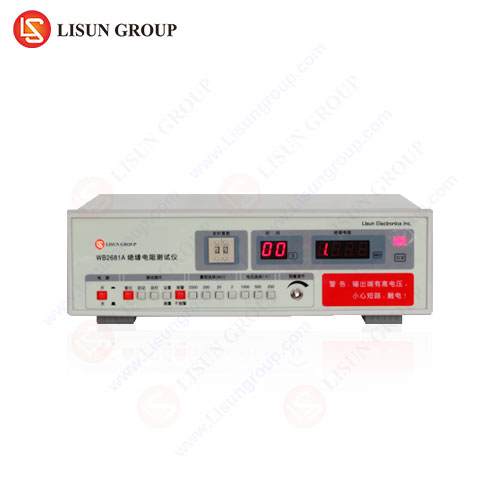
Exemplifying this integrated approach is the LISUN WB2671A Withstand Voltage Tester. This instrument is engineered as a comprehensive safety compliance verification system, primarily designed for rigorous production-line and laboratory-based dielectric withstand testing, while its capabilities extend into precise electrical parameter measurement.
Testing Principles and Core Specifications: The WB2671A generates a high-voltage output for dielectric stress testing. Its design incorporates a high-resolution leakage current measurement circuit, which is the critical parameter for determining a pass/fail outcome. The instrument compares the real-time leakage current against user-defined upper and lower limits. A test failure is triggered if the current exceeds the high limit (indicating breakdown or excessive leakage) or fails to meet the low limit (a useful check for ensuring test connections are intact, often called the “arc detection” or “short circuit” test function). Key specifications include:
- Output Voltage: 0–5 kV AC/DC.
- Voltage Accuracy: ± (2% of reading + 5 digits).
- Leakage Current Measurement Range: 0–20 mA.
- Leakage Current Accuracy: ± (2% of reading + 3 digits).
- Timer Range: 1–999 seconds, supporting standard-mandated dwell times.
Industry Use Cases and Application: The WB2671A’s programmability and robust output make it suitable for a vast array of applications. In the Lighting Fixtures industry, it can automate testing of LED drivers, applying a 3750 VAC withstand test between primary and secondary circuits per IEC 60598. For Medical Devices (IEC 60601-1), it can perform both type tests and production-line tests on patient monitor enclosures, applying differential voltages to prove the integrity of means of patient protection (MOPP). Manufacturers of Electrical Components such as switches and sockets utilize it for 100% final testing, ensuring no live parts are accessible after assembly. In Consumer Electronics and Office Equipment (e.g., laptop power supplies, printers), it verifies the safety isolation provided by switching power supplies.
Competitive Advantages in Operational Context: The WB2671A provides several distinct technical and operational benefits. Its dual voltage capability (AC/DC) offers flexibility for testing both typical line-powered equipment and devices with large capacitive elements, like variable frequency drives in Industrial Control Systems. The high accuracy of both voltage output and current measurement ensures reliable, repeatable results that are defensible in audit scenarios. The programmable test sequences reduce operator error and increase throughput. Furthermore, its communication interfaces (RS232, USB) allow for seamless integration into automated test stations and data acquisition systems, enabling traceability and statistical process control—a critical requirement in regulated industries like Automotive Electronics and Aerospace.
Selecting the Appropriate Test Methodology
The choice between Hipot and IR testing, or the implementation of an integrated instrument, is dictated by the test objective. Hipot is non-negotiable for final product safety certification and production line safety verification. Insulation Resistance testing is indispensable for assessing material condition, process control (e.g., cleanliness of PCB assemblies), and predictive maintenance. For quality assurance departments and testing laboratories, an integrated safety tester like the WB2671A offers a consolidated, efficient, and data-capable solution that fulfills the requirements of both destructive proof testing and precise electrical measurement within a unified platform.
Frequently Asked Questions (FAQ)
Q1: Can the WB2671A perform a standard Insulation Resistance (Megger) test in addition to its primary Hipot function?
While the WB2671A is optimized for dielectric withstand testing with precise leakage current measurement, it does not function as a traditional megohmmeter that applies a DC voltage and directly displays a resistance value in teraohms. Its measurement of leakage current under high voltage stress provides a related but distinct datum. For dedicated, high-value IR testing, a separate megohmmeter is recommended.
Q2: What is the purpose of setting a lower limit for leakage current on a Hipot tester?
Setting a lower limit, often called the “low limit” or “short circuit test,” is a critical sanity check. If the measured leakage current is abnormally low (e.g., below 0.050 mA), it may indicate that the test probes are not making proper contact with the device under test. This prevents a false “pass” result that could occur if the high voltage was not actually applied to the unit due to a faulty connection.
Q3: For testing a standard 230VAC household appliance, what is a typical test voltage and time setting on an AC Hipot tester like the WB2671A?
A common test specification derived from standards like IEC 60335-1 is 1250 VAC, applied for 3 seconds. The exact value must be determined from the relevant product safety standard for the specific appliance. The test is typically performed between all live parts (connected together) and the accessible conductive parts (e.g., metal enclosure).
Q4: Why is DC Hipot sometimes specified instead of AC Hipot for certain devices?
DC Hipot testing is advantageous for highly capacitive loads (e.g., long power cables, X-class capacitors in filters) because it eliminates the large capacitive charging current that would flow during an AC test, which could trip the current limit erroneously. It also applies a steady stress that is less likely to degrade certain insulation materials gradually. However, it stresses insulation differently (no polarity reversal) and may not detect some types of flaws as effectively as AC.
Q5: How does the WB2671A enhance compliance documentation in a manufacturing setting?
Through its digital interfaces (RS232/USB), the WB2671A can transmit detailed test results—including test voltage, measured leakage current, pass/fail status, and timestamp—to a host computer or PLC. This allows for the automatic generation of test certificates, storage in databases for traceability, and real-time monitoring of production line test station performance, which is essential for ISO 9001 quality systems and audits by regulatory bodies.
