







Fundamental Principles of Dielectric Strength Evaluation in Electrical Systems
The dielectric withstand test, commonly termed the high-potential (hipot) test or voltage withstand test, constitutes a fundamental and non-destructive electrical safety verification procedure. Its primary objective is to assess the integrity of an electrical product’s insulation system by applying a significantly elevated voltage—substantially higher than its normal operating voltage—for a prescribed duration. This rigorous evaluation is designed to confirm that the insulation possesses sufficient dielectric strength to withstand transient overvoltages, such as those from switching surges or lightning strikes, without experiencing breakdown or excessive leakage current. The core principle hinges on the insulation’s ability to resist the flow of current under extreme electrical stress. A successful test indicates that the insulation has adequate clearance and creepage distances, is free from gross contaminants, and lacks major manufacturing defects like pinholes, cracks, or compromised seals that could lead to catastrophic failure, electric shock, or fire hazard in field operation.
The test methodology involves connecting the high-voltage output of a specialized withstand voltage tester between mutually insulated parts of the device under test (DUT). Typically, this means applying the high voltage to all live conductors (e.g., line and neutral) connected together, while the test return path is connected to the accessible conductive parts, such as the earthed metal enclosure. For double-insulated or all-insulated equipment (Class II), the voltage is applied between live parts and a metal foil wrapped closely around the external insulating enclosure. The applied test voltage, which can be alternating current (AC) or direct current (DC), is gradually ramped up from zero to the specified test level, held for the required time (commonly 60 seconds for type tests), and then smoothly ramped down. Throughout this period, the test instrument meticulously monitors the leakage current flowing through the insulation. The test is deemed a pass if the insulation does not break down (i.e., no flashover or puncture occurs) and the measured leakage current remains below the predetermined trip limit.
Critical Applications Across Regulated Industries
The dielectric withstand test is mandated across a vast spectrum of industries where electrical safety and reliability are non-negotiable. Its application is a cornerstone of product safety certification schemes globally, including UL, CSA, CE (per Low Voltage Directive), CCC, and PSE.
Electrical and Electronic Equipment & Industrial Control Systems: For industrial machinery, programmable logic controllers (PLCs), motor drives, and power supplies, the test verifies the isolation between primary power circuits, secondary control circuits, and grounded frames. This ensures operator safety and prevents malfunctions due to insulation failure in harsh industrial environments characterized by vibration, humidity, and conductive dust.
Household Appliances and Consumer Electronics: From refrigerators and washing machines to laptop chargers and televisions, hipot testing validates the safety of user-accessible parts. It checks the insulation between the mains input and the touchable metal chassis or plastic surfaces, directly protecting consumers from electric shock.
Automotive Electronics and Aerospace Components: The automotive industry, particularly with the rise of electric vehicles (EVs), employs stringent dielectric tests for battery management systems, onboard chargers, and motor inverters. In aerospace, components must endure not only standard voltages but also conditions of reduced atmospheric pressure, which lowers the dielectric strength of air, making rigorous testing imperative for flight-critical systems.
Lighting Fixtures and Electrical Components: LED drivers, ballasts, and complete luminaires are tested to ensure isolation between the high-voltage driver circuitry and the metal heat sink or housing. Discrete components like switches, sockets, and connectors undergo testing to guarantee they can safely interrupt or carry current without internal breakdown.
Medical Devices and Telecommunications Equipment: Patient-connected medical devices, such as dialysis machines or MRI scanners, require exceptionally high levels of insulation reliability to protect patients from micro-shocks. In telecom, central office equipment and power-over-Ethernet (PoE) devices are tested to ensure isolation between telecom lines and AC mains, safeguarding both infrastructure and personnel.
Cable and Wiring Systems: Finished cables (e.g., building wire, data cables) are routinely subjected to dielectric withstand tests as part of production line (100%) testing to detect insulation flaws, thin wall sections, or contaminants introduced during extrusion or handling.
Governing Standards and Test Voltage Determination
Test parameters are not arbitrary; they are meticulously defined by international and national safety standards. The selection of test voltage (AC or DC), its magnitude, application duration, and leakage current limits are strictly governed by the applicable standard for the product category.
Key standards include:
- IEC/EN 60335-1: Household and similar electrical appliances.
- IEC/EN 60950-1 / IEC/EN 62368-1: Information technology and audio/video equipment (the latter being the newer hazard-based standard).
- IEC/EN 60601-1: Medical electrical equipment.
- IEC/EN 61010-1: Safety requirements for electrical equipment for measurement, control, and laboratory use.
- UL 60950-1, UL 62368-1: The UL equivalents for IT/AV equipment in North America.
- ISO 6469-3 & LV 123: Specifically for electric vehicle safety.
The test voltage is typically derived from the equipment’s rated voltage, its insulation class (Functional, Basic, Supplementary, Double/Reinforced), and the pollution degree of its intended environment. A common formula for AC test voltage for basic insulation, as per many standards, is: Test Voltage (Vrms) = (2 × Rated Voltage) + 1000V. For example, a 230V appliance may be tested at 1460V rms. DC withstand voltages are often used for testing capacitive loads like long cables or large power supplies, where the DC value is typically calculated as the AC peak value (√2 × Vrms) or a higher multiple, considering the absence of dielectric losses present under AC stress.
The WB2671A Withstand Voltage Tester: Engineered for Precision and Compliance
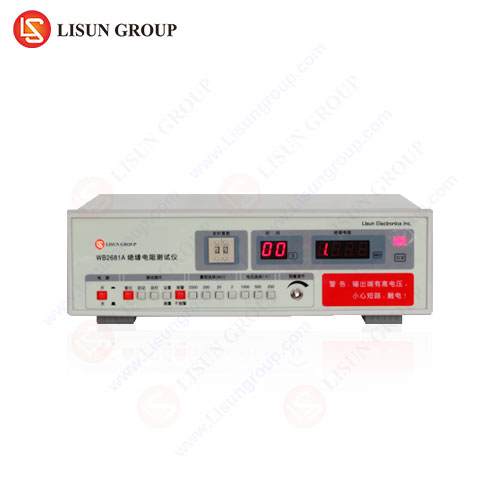
The LISUN WB2671A Withstand Voltage Tester represents a sophisticated implementation of these testing principles, designed to meet the exacting demands of modern safety laboratories and production lines. It integrates advanced measurement technology with robust safety features to deliver reliable and repeatable compliance testing across the industries previously enumerated.
Core Specifications and Testing Principles:
The WB2671A is a fully programmable AC/DC dielectric withstand and insulation resistance tester. Its key specifications include an extensive output voltage range (AC: 0–5kV / 0–10kV / 0–20kV; DC: 0–6kV / 0–12kV / 0–24kV, model dependent) with high resolution and regulation accuracy. The instrument features a wide, precise leakage current measurement range from 0.10µA to 20.00mA, enabling it to detect even marginal insulation weaknesses. Its testing principle involves a digitally controlled, high-frequency inverter system to generate the stable, low-distortion high-voltage output. The microcontroller unit (MCU) continuously samples the true RMS voltage and current, comparing them against user-defined upper and lower limits for voltage, and upper limits for leakage current (with both RMS and peak detection available). The test sequence—comprising ramp-up time, dwell time, and ramp-down time—is fully configurable, allowing simulation of real-world stress conditions as required by certain standards.
Industry Use Cases and Application Scenarios:
In a medical device manufacturing facility, the WB2671A would be used for 100% production line testing of patient monitor power supplies, applying a 4000V AC test to verify reinforced isolation. An automotive electronics supplier might employ its DC hipot function to test the isolation resistance of an EV traction inverter module between the high-voltage DC bus and the coolant jacket, using a 5000V DC test per LV 123. A lighting manufacturer would utilize the instrument’s programmable ramp function to gradually stress the insulation of an LED driver, monitoring for sudden current jumps indicative of corona discharge or impending breakdown. For cable producers, the fast test cycle and robust pass/fail judgment of the WB2671A enable efficient in-line testing of every meter of produced wire.
Competitive Advantages in Technical Design:
The WB2671A distinguishes itself through several engineered advantages. Its dual-range high-voltage measurement system provides exceptional accuracy across the entire voltage span. The inclusion of a real-time clock (RTC) allows for timestamping of every test record, which is critical for audit trails in regulated industries. Advanced arc detection algorithms can identify momentary breakdowns that might be missed by simple current threshold monitoring. The instrument’s comprehensive I/O interface (RS232, RS485, USB, LAN, HANDLER) facilitates seamless integration into automated test stations (ATE) and manufacturing execution systems (MES). Furthermore, its design emphasizes operator safety with hardware-based over-current protection, a zero-start interlock, and a secure ground connection system, ensuring compliance with laboratory safety protocols.
Interpretation of Test Results and Failure Analysis
A dielectric withstand test yields a binary outcome—pass or fail—but the underlying data is rich with diagnostic information. A pass result, with leakage current well below the threshold, confirms the insulation’s immediate integrity at the test voltage level.
A failure is typically categorized as either a breakdown (a sudden, dramatic increase in current causing the tester to trip on over-current) or an excessive leakage current (current exceeding the preset limit without a complete breakdown). Breakdowns indicate catastrophic flaws: punctured PCB materials, bridged creepage distances, or severe contamination. Excessive leakage, often a more subtle finding, can point to degraded insulation, moisture ingress, partial carbonization paths, or the presence of semi-conductive contaminants. In humid environments, surface leakage may cause a false failure; pre-conditioning (drying) the DUT per standard procedures is often required.
Analysis of the leakage current waveform (when available on advanced testers) can offer further insights. A steadily increasing current during the dwell time may suggest dielectric absorption or heating effects, while a jagged waveform could indicate intermittent corona discharge. Such nuanced analysis transforms the hipot test from a simple go/no-go check into a powerful tool for quality control and design validation.
Integration into Quality Assurance and Production Workflows
Effective implementation of dielectric withstand testing extends beyond the selection of a competent tester. It requires integration into a holistic quality assurance framework. In Research & Development, the test is used for design verification, margin testing (pushing voltage beyond spec to find the breakdown point), and qualification of insulating materials. During type testing for certification, tests are performed on representative samples to the exact clauses of the standard.
In mass production, the test strategy must balance thoroughness with throughput. 100% testing is common for safety-critical items like medical devices or appliance power cords. For other products, statistical process control (SPC) may be employed, with rigorous auditing. The programmability of instruments like the WB2671A allows for creating optimized test profiles—shorter dwell times (e.g., 1-2 seconds) for production lines while maintaining the necessary stress voltage. Crucially, test records, including DUT identification, test parameters, measured leakage current, and timestamps, must be archived to demonstrate due diligence and facilitate traceability in the event of a field incident or audit.
FAQ Section
Q1: What is the primary difference between AC and DC dielectric withstand testing, and when should each be used?
AC testing stresses insulation in a manner similar to operational stress, experiencing both capacitive and resistive leakage currents. It is the standard test for most equipment operating on AC mains. DC testing applies a constant stress, resulting primarily in resistive leakage. It is preferred for capacitive loads (e.g., long cables, large power supply filters) as it avoids large capacitive charging currents that could nuisance-trip an AC tester. DC testing can also be more revealing of certain volumetric insulation defects. The choice is often dictated by the relevant product safety standard.
Q2: How is the appropriate leakage current trip limit determined for a specific product?
The trip limit is not arbitrary. It is typically derived from the allowable leakage current limits specified in the end-product safety standard (e.g., IEC 62368-1 specifies touch current limits). The hipot test limit is set lower than this to provide a safety margin, often in the range of 0.5mA to 10mA for most equipment. For medical devices (IEC 60601-1), the limits are far more stringent, often in the microamp range. The limit must be calculated considering the test voltage and the acceptable risk.
Q3: Can the WB2671A perform sequenced testing, such as combining insulation resistance (IR) and hipot tests?
Yes, advanced testers like the WB2671A are capable of programming complex test sequences. A common sequence is to first perform an insulation resistance test (e.g., 500V DC, measure resistance in MΩ) to establish a baseline, immediately followed by a dielectric withstand test (e.g., 3000V AC for 60 seconds), and then a second IR test to check for any degradation caused by the high-voltage stress. This sequence is a powerful method for comprehensive insulation evaluation.
Q4: Why is a “ramp up” and “ramp down” function important in a withstand voltage test?
A controlled ramp-up (e.g., 500 V/s) prevents the sudden application of high voltage, which can generate transient surges that may damage sensitive components or cause unnecessary stress on the insulation. A gradual ramp-down safely discharges capacitive energy stored in the DUT, protecting both the operator and the equipment. Some standards explicitly require a controlled rate of voltage increase.
Q5: How does the WB2671A ensure operator safety during testing?
The instrument incorporates multiple safety layers: a hardware-based over-current protector that acts independently of the software; a zero-start interlock circuit that prevents high-voltage output if the control voltage is not at zero; a secure ground terminal that must be properly connected to earth for operation; and often, high-voltage warning lamps and physical enclosures for the output terminals. These features are designed to meet the safety requirements for test equipment itself, such as those in IEC 61010-1.
