








Understanding Motor Hi-Pot Testing: A Guide to Dielectric Strength Verification
Introduction to Dielectric Integrity in Electromechanical Systems
The operational reliability and safety of any motor, from a miniature servo in a medical device to a multi-megawatt industrial drive, are fundamentally contingent upon the integrity of its electrical insulation system. This insulation, comprising enamel on windings, slot liners, phase papers, and impregnating varnishes, forms a dielectric barrier between live conductors and grounded components, such as the stator core or housing. Over time, this barrier is subjected to a confluence of degrading stresses: thermal cycling, mechanical vibration, environmental contaminants (moisture, oil, dust), and electrical transients. These factors can induce microscopic cracks, delamination, or pinholes, creating potential failure pathways. Dielectric Withstand Voltage testing, commonly termed High-Potential or Hi-Pot testing, serves as the definitive quality assurance and preventive maintenance procedure to verify that this insulation barrier possesses adequate strength to withstand operational and fault-overvoltage conditions without breakdown.
Foundational Principles of Dielectric Withstand Testing
At its core, the Hi-Pot test is a non-destructive (or, more accurately, a proof-test that is non-destructive if the insulation is sound) application of a significantly elevated voltage between a motor’s current-carrying conductors and its grounded frame. The test voltage, substantially higher than the motor’s rated operating voltage, is applied for a specified duration, typically one minute as per many international standards. The underlying principle is probabilistic: insulation weaknesses contain localized regions of reduced dielectric strength. The application of a high electric field stress across these regions will cause a sudden, uncontrolled increase in conduction current—a dielectric breakdown—thereby identifying the fault. A passing unit will demonstrate only a small, stable leakage current, comprised of capacitive charging current and a conductive component through the insulation’s bulk volume and surface.
The test voltage magnitude is not arbitrary; it is meticulously defined by industry standards such as IEC 60034, IEC 60204-1, UL 1004, and ANSI/IEEE 43. These standards prescribe formulae based on the motor’s rated voltage. For example, a common requirement for AC motors is *(2 Un) + 1000 V*, where Un* is the rated RMS voltage. For a 480V AC motor, this yields a test voltage of 1960 V RMS. For DC motors or after repair, different multipliers may apply. The test rigorously validates the insulation’s ability to endure transient overvoltages and ensures a sufficient margin of safety, guarding against electric shock hazards and catastrophic failures that could lead to fire, production downtime, or personal injury.
Critical Test Parameters and Failure Mode Analysis
Successful execution and interpretation of a Hi-Pot test require precise control and understanding of several key parameters beyond the simple application of voltage. The voltage ramp rate is critical; a controlled, gradual increase (e.g., 500 V/s) prevents capacitive inrush currents from being misinterpreted as a failure and avoids imposing undue transient stress on healthy insulation. The dwell time at the full test voltage, usually 60 seconds, allows for the stabilization of polarization currents and the detection of time-dependent weaknesses.
The primary failure indicator is an excessive or rapidly escalating leakage current. Test instruments monitor this current in real-time, comparing it against a user-set trip limit. A sudden current surge, often accompanied by a visible or audible arc, indicates a clear dielectric breakdown—a hard fault. More subtle are soft failures, where leakage current gradually creeps beyond the acceptable threshold, indicating degraded but not yet punctured insulation, often due to moisture or contamination. Distinguishing the steady capacitive charging current from a true resistive leakage component is a fundamental capability of advanced testers. Furthermore, the test must account for environmental conditions, particularly humidity, as surface moisture can drastically lower surface insulation resistance, leading to false failures. Pre-test drying or recording of ambient conditions is often necessary for valid results.
Industry-Specific Applications and Standards Compliance
The universality of dielectric strength verification makes Hi-Pot testing a cornerstone across diverse sectors, each with nuanced requirements.
- Household Appliances & Consumer Electronics: Motors in washing machines, refrigerators, and power tools are tested to standards like IEC 60335 to ensure user safety from electric shock, even under fault conditions such as a failed bearing causing rotor-stator contact.
- Automotive Electronics: With the proliferation of electric vehicles, testing high-voltage traction motors (operating at 400V or 800V DC) and ancillary motors (e.g., for HVAC, pumps) is critical. Standards such as ISO 6469 and LV 123 mandate stringent dielectric tests to ensure reliability in harsh, vibrating environments.
- Medical Devices: Motors in infusion pumps, surgical tools, and imaging systems must comply with IEC 60601-1, which stipulates rigorous dielectric tests to guarantee patient and operator safety, often requiring higher test voltages for “applied parts” that contact the patient.
- Aerospace & Aviation: Motors for flight control actuators, environmental control systems, and fuel pumps are tested per DO-160 or AS4324. The focus is on reliability under extreme pressure, temperature, and humidity variations, where insulation failure is not an option.
- Industrial Control Systems & Electrical Components: Contactors, solenoids, transformers, and industrial motor drives are validated per IEC 60947 and IEC 61800-5-1. Testing here ensures system integrity in electrically noisy industrial environments prone to voltage spikes.
- Lighting Fixtures, Telecommunications, and Office Equipment: Ballasts, power supplies, and internal motors in printers or servers are tested to prevent fire and shock hazards, adhering to standards like IEC 60598 and IEC 60950.
The WB2671A Withstand Voltage Tester: Engineered for Precision and Compliance
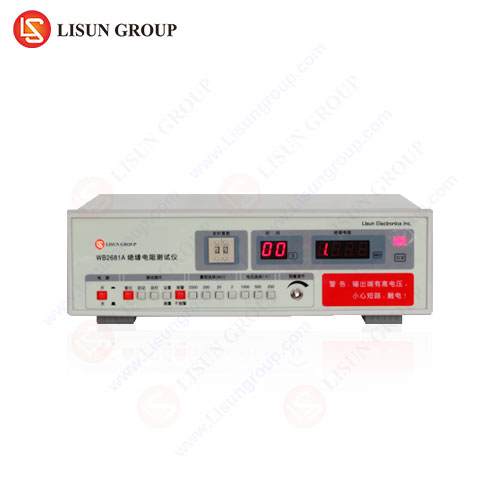
For laboratories and production lines requiring reliable, standards-compliant dielectric strength verification, the LISUN WB2671A Withstand Voltage Tester represents a sophisticated instrument designed to meet global testing requirements. It integrates advanced voltage generation, precise measurement, and comprehensive safety features into a single platform.
Core Specifications and Testing Principles:
The WB2671A generates a stable, programmable high-voltage AC output, typically ranging from 0 to 5 kV or 0 to 20 kV, depending on the model, with a distortion rate of less than 3% to ensure a pure sinusoidal waveform as required by standards. Its current measurement resolution can reach 0.1 µA, enabling the detection of minute leakage currents indicative of early-stage insulation degradation. The instrument operates on the principle of comparing the measured leakage current against up to five preset limits (e.g., lower alarm, upper alarm, and trip limits). It features a programmable voltage ramp function, allowing users to define the rise time to the target voltage, thereby eliminating false trips due to inrush currents.
Industry Use Cases:
In an automotive electronics component plant, the WB2671A is used for 100% production line testing of electric power steering motor stators, applying 2.5 kV AC to verify isolation between windings and the laminated core. A medical device manufacturer employs it in a quality audit lab to perform routine dielectric tests on batch samples of dialysis pump motors per IEC 60601-1, documenting the exact leakage current for traceability. A cable and harness producer uses the tester to validate the insulation of wiring assemblies destined for aerospace applications, ensuring no breakdown occurs at the mandated test voltage after exposure to environmental conditioning.
Competitive Advantages:
The WB2671A distinguishes itself through several key attributes. Its high accuracy and stability (typically ±3% for voltage, ±5% for current) ensure repeatable, audit-ready results. The comprehensive safety interlock system, including a zero-start protection (output voltage only rises from 0V after a start command) and a hardware-based over-current relay, protects both the operator and the device under test. Advanced judgment algorithms can differentiate between true resistive leakage and displacement current, reducing false failure rates. Furthermore, its programmability and support for external communication interfaces (RS232, USB, LAN) allow for seamless integration into automated test stations and production line data acquisition systems, a critical requirement in high-volume manufacturing environments for consumer electronics and electrical components.
Interpreting Results and Establishing a Quality Assurance Protocol
A passing Hi-Pot test result confirms that, at the time of testing, the insulation system possesses dielectric strength above the specified threshold. It is a go/no-go test for immediate safety. However, for predictive maintenance, trending the leakage current value over time can be more informative than a simple pass/fail. A gradual increase in leakage current, while still below the trip threshold, can signal ongoing insulation degradation due to thermal aging or contamination, prompting scheduled intervention before an in-service failure.
A formal Quality Assurance protocol must define the test voltage, ramp rate, dwell time, and acceptable leakage current limit based on the applicable standard and the specific motor design. It must specify test points (e.g., all windings connected together to frame, between phases). Crucially, the protocol must include pre-test procedures: verifying the motor is de-energized, discharging capacitive elements, ensuring the test area is secure, and confirming the tester is calibrated. Failed units must be clearly tagged, isolated, and subjected to root cause analysis—whether it be a manufacturing defect, damage in handling, or environmental exposure.
Mitigating Risks and Ensuring Operator Safety
Hi-Pot testing involves hazardous voltage levels. A rigorous safety protocol is non-negotiable. The test area must be physically secured with barriers and warning signs. The use of a test fixture with an interlocked safety cage, which automatically cuts high-voltage output when opened, is highly recommended. Operators must be thoroughly trained on the hazards and emergency procedures. The equipment itself, like the WB2671A, must incorporate multiple safety layers: a “dead-man” switch requiring continuous operator pressure, a visible and audible alarm during testing, and a secure earth-ground connection. Prior to testing, the motor must be electrically isolated from any other equipment, and after testing, its terminals must be shorted to ground to dissipate any residual charge.
Conclusion
Dielectric Withstand Voltage testing remains an indispensable methodology for validating the intrinsic safety and reliability of electric motors and a vast array of electrical equipment. It is a direct, quantitative assessment of an insulation system’s ability to perform its primary protective function. When executed with precision instruments, in strict adherence to recognized standards and comprehensive safety protocols, Hi-Pot testing forms a critical pillar of product qualification, manufacturing quality control, and field-based preventive maintenance programs. It is the definitive check that stands between a robust, reliable electromechanical system and potential catastrophic failure.
Frequently Asked Questions (FAQ)
Q1: What is the difference between AC and DC Hi-Pot testing, and when should each be used?
AC Hi-Pot testing is the most common method, applying a power-frequency high voltage (e.g., 50/60 Hz). It stresses the insulation in a manner similar to operational stress and is typically required by safety standards for final product acceptance. DC Hi-Pot testing applies a high DC voltage. It draws much lower current, making it suitable for testing highly capacitive loads like long cables. It is often used for field testing of installed equipment and for diagnostic testing, as the steady DC voltage can help identify specific types of insulation weaknesses without the capacitive current component.
Q2: Can a motor pass a Hi-Pot test but still fail in operation due to insulation issues?
Yes. A Hi-Pot test is a spot check at a specific point in time. It verifies the insulation can withstand a high overvoltage for a short duration but does not assess long-term endurance. Insulation that is thermally degraded, mechanically damaged but not yet bridged, or contaminated with a conductive substance that is dry during the test may pass. However, under continuous operational stress (heat, vibration, humidity), these latent defects can rapidly develop into a full breakdown. Hi-Pot should be complemented with other tests like insulation resistance (IR) and polarization index (PI) for a more complete diagnostic picture.
Q3: How does the LISUN WB2671A handle the large capacitive charging current of a big motor or a long cable, preventing a false failure?
The WB2671A incorporates intelligent judgment algorithms. During the initial voltage ramp-up, the instrument monitors the current but typically uses a separate, higher “ramp” or “inrush” current limit. More importantly, it can differentiate between the rapidly stabilizing capacitive current (which is 90 degrees out of phase with the voltage in an AC test) and the in-phase resistive leakage current. The trip judgment is primarily based on the resistive component, ensuring that a large but harmless charging current does not cause a false test failure.
Q4: After a motor fails a Hi-Pot test, is it always permanently damaged?
Not necessarily. A “hard” failure involving a visible arc and a sustained low-resistance path usually causes permanent carbonization and damage, requiring repair. However, a “soft” failure triggered by surface moisture or contamination may be reversible. If the leakage current is only slightly over the limit and the motor is dried or cleaned, a retest may be successful. The cause of the failure must be investigated before concluding the unit is damaged beyond use.
Q5: What calibration requirements are necessary for a Hi-Pot tester like the WB2671A?
To ensure measurement traceability and compliance with quality systems like ISO/IEC 17025, the WB2671A should undergo periodic calibration by an accredited laboratory. Calibration typically verifies the accuracy of the output voltage (across its range) and the leakage current measurement at several key points. The calibration interval is usually annual but can be adjusted based on usage frequency and the criticality of the testing application. The instrument’s internal safety features, like the over-current relay, should also be verified during calibration.
