








Understanding Live-to-Earth Resistance: Standards and Safety Measurements
Introduction to Insulation Integrity and Grounding Efficacy
The operational safety and long-term reliability of electrical and electronic equipment are fundamentally predicated on the integrity of its insulation system and the efficacy of its protective earth connection. Among the critical parameters quantifying this safety barrier is the live-to-earth resistance, a measure that defines the impedance between active, current-carrying parts and accessible conductive surfaces that are intended to be earthed. Inadequate live-to-earth resistance presents a severe hazard, potentially leading to leakage currents, insulation breakdown, and under fault conditions, the failure of protective devices to operate within safe time limits, thereby exposing users to electric shock and increasing fire risk. Consequently, rigorous testing of this parameter is not merely a quality assurance step but a mandatory compliance requirement across global regulatory frameworks. This article delineates the technical principles, governing standards, measurement methodologies, and practical applications of live-to-earth resistance testing, with a focus on ensuring end-product safety across diverse industrial sectors.
Fundamental Principles of Live-to-Earth Resistance Testing
Live-to-earth resistance testing, often integrated within a suite of electrical safety tests, applies a direct current (DC) or a low-frequency alternating current (AC) voltage between a defined point in the live circuit (e.g., phase, neutral after a specified test link) and the equipment’s earth terminal or accessible conductive parts. The resultant current flow is measured, and resistance is calculated via Ohm’s law. The test evaluates two primary, interrelated characteristics: the insulation resistance of materials separating live parts from earthed metal, and the continuity and quality of the protective earth conductor itself.
A high resistance value indicates robust insulation and a low-resistance earth path, ensuring that under normal conditions, leakage current is minimal, and during a fault, the circuit protective device (e.g., fuse, circuit breaker) will operate swiftly to disconnect the supply. Conversely, a low measured resistance signifies potential degradation. This could stem from insulation compromised by environmental factors (humidity, contamination, thermal aging), mechanical damage, poor manufacturing (pinched wires, faulty components), or an inadequately installed earth connection characterized by high-impedance terminations or corroded contacts. The test is typically performed at an elevated voltage, significantly higher than the equipment’s rated operating voltage, to stress the insulation system and reveal weaknesses that might not be apparent under normal working conditions.
Regulatory Standards and Compliance Thresholds
Compliance with international and national standards is non-negotiable for market access. These standards prescribe test voltages, duration, environmental conditions (often requiring preconditioning in a humidity chamber), and minimum acceptable resistance values. Key standards include:
- IEC 62368-1: The hazard-based safety standard for audio/video, information, and communication technology equipment. It specifies insulation resistance tests, often at 500 V DC, with typical pass thresholds in the megohm range (e.g., >1 MΩ for basic insulation, >2 MΩ for reinforced insulation).
- IEC 60335-1: The foundational standard for the safety of household and similar electrical appliances. It mandates insulation resistance tests, commonly at 500 V DC, applied after a humidity treatment, with minimum acceptable values often specified as 1 MΩ for functional insulation and 2 MΩ for protective insulation between live parts and accessible earthed parts.
- IEC 60601-1: The critical standard for medical electrical equipment, where patient safety is paramount. It imposes stringent insulation resistance and earth continuity requirements, with test voltages up to 1500 V DC for certain classifications and very high resistance thresholds.
- UL Standards (e.g., UL 60950-1, now largely superseded by UL 62368-1 in the US): While harmonized with IEC standards, UL may have specific additional requirements or recognized component criteria.
The minimum acceptable resistance is not arbitrary; it is calculated based on the allowable earth leakage current and the test voltage. For instance, applying 500 V DC and requiring a maximum leakage of 0.5 mA under test conditions yields a minimum resistance of 1 MΩ (R = V/I = 500 / 0.0005). Standards meticulously define the test points, often requiring tests between live parts and earthed accessible parts, and between live parts of opposite polarity.
Measurement Methodologies and Instrumentation Requirements
Accurate measurement necessitates specialized instrumentation designed to apply stable, calibrated high voltage and measure minute currents with precision. Modern grounding resistance testers, also known as electrical safety analyzers or hipot/insulation testers, perform this function. Key instrument specifications include:
- Test Voltage Range and Accuracy: Must cover standard voltages (e.g., 50 V, 100 V, 250 V, 500 V, 1000 V DC) with high accuracy (typically ±3%).
- Resistance Measurement Range and Resolution: Capable of measuring from low milliohms (for earth continuity) to high gigohms, with clear resolution across scales.
- Output Current and Short-Circuit Current: Sufficient current capacity to charge capacitive loads quickly and maintain voltage stability, with protection against short circuits.
- Test Duration and Sequencing: Programmable test times (e.g., 60 seconds as per many standards) and the ability to sequence tests (e.g., earth continuity followed by insulation resistance).
- Safety Features: Includes warning indicators, interlock capabilities, and discharge circuits to protect the operator after testing capacitive equipment.
The test procedure involves connecting the instrument’s high-voltage output to the equipment’s live parts (via a plug or direct connection), its return lead to the earth terminal, and ensuring the equipment is in a specified test state (e.g., power switch on). The voltage is applied for the stipulated duration while the instrument measures the resistive current.
Industry-Specific Applications and Risk Profiles
The criticality of live-to-earth resistance testing varies across industries, dictated by the operational environment, user interaction, and consequence of failure.
- Household Appliances & Consumer Electronics: High-volume production demands fast, reliable testing for products like washing machines, refrigerators, and power adapters. Failure can lead to widespread consumer risk.
- Medical Devices: The most stringent domain. A defibrillator, patient monitor, or surgical laser must exhibit exceptionally high insulation integrity to protect both the patient (who may have reduced skin impedance) and the clinician from micro-shock or macro-shock.
- Automotive Electronics: With the rise of electric vehicles (EVs) and advanced driver-assistance systems (ADAS), components like battery management systems, onboard chargers, and sensors operate at high voltages. Insulation breakdown here can cause vehicle failure or fire.
- Lighting Fixtures (LED Drivers, High-Bay Lighting): Often installed in metallic structures or damp locations, robust live-to-earth resistance is vital to prevent energization of the fixture casing.
- Industrial Control Systems & Aerospace Components: Operate in electrically noisy, sometimes harsh environments. Insulation must withstand vibration, thermal cycling, and contamination while ensuring control system reliability and personnel safety.
- Telecommunications & Office Equipment: Central servers, routers, and power distribution units (PDUs) have multiple power supplies and metallic chassis, requiring verification of isolation from mains input.
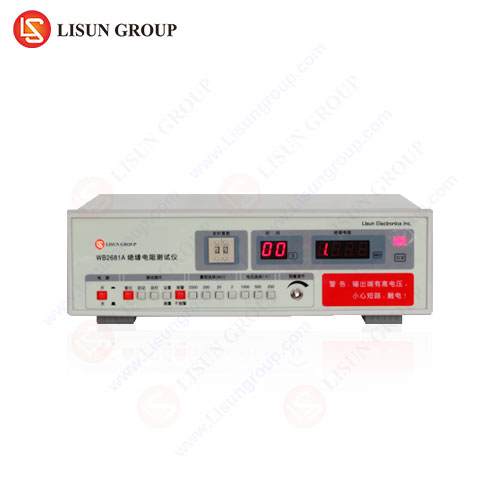
The Role of Advanced Test Equipment: LISUN WB2678A Grounding Resistance Tester
To meet the exacting demands of these diverse applications, test equipment must combine precision, robustness, and user-centric design. The LISUN WB2678A Grounding Resistance Tester exemplifies such an instrument, engineered for comprehensive electrical safety testing.
Testing Principles and Core Specifications:
The WB2678A operates on the precise DC voltage injection principle for insulation resistance measurement. It generates a selectable, highly stable DC test voltage. For live-to-earth resistance testing, its key specifications include:
- Insulation Resistance Test Range: 0.010 MΩ to 100.0 GΩ, providing coverage from basic continuity verification to ultra-high insulation integrity checks.
- Test Voltages: 50 V, 100 V, 250 V, 500 V, 1000 V DC, covering all major standard requirements.
- Accuracy: Typically ±3% for resistance, ensuring reliable pass/fail judgments.
- Output Short-Circuit Current: Sufficient to ensure voltage stability on capacitive loads common in modern switch-mode power supplies and long cable runs.
- Earth Continuity Test: Often integrated, with a low-resistance measurement capability (e.g., 0.001 Ω to 1.000 Ω) at a high test current (typically 3A, 10A, or 30A AC/DC), verifying the integrity of the protective earth path prior to insulation testing.
Industry Use Cases:
In a medical device manufacturing line, the WB2678A’s programmable test sequences can automatically perform a high-current earth bond test followed by a 1500 V DC insulation resistance test, logging all data for audit trails. For an automotive electronics supplier, its 1000 V DC range is essential for testing EV charging components against ISO 6469-3 or LV214 standards. A lighting manufacturer benefits from its ability to quickly test thousands of LED drivers at 500 V DC, with a clear pass/fail indicator for production line efficiency.
Competitive Advantages:
The instrument’s advantages lie in its integration, reliability, and safety. It consolidates multiple safety tests (earth continuity, insulation resistance, functional checks) into a single, calibrated unit, reducing workstation footprint and complexity. Its robust construction and clear interface minimize operator error. Advanced models feature data storage, programmable limits, and interfaces for automated test systems, making it suitable for both quality lab validation and high-speed production line testing. The precision of its voltage source and measurement circuitry ensures that measurements are not only repeatable but also traceably accurate, a necessity for compliance documentation.
Interpreting Test Results and Troubleshooting Failures
A failed live-to-earth resistance test requires systematic investigation. The primary steps include:
- Verification of Test Setup: Confirm correct connections, equipment state (power switches, test links), and environmental conditions (humidity).
- Isolation of Subassemblies: Disconnect internal modules (e.g., power supply board, motor, heater) one by one to identify the faulty component.
- Visual Inspection: Look for obvious damage, contamination (dust, flux, moisture), or poor solder joints.
- Component-Level Testing: Test individual suspicious components (Y-capacitors, transformers, optocouplers) for insulation breakdown.
Common root causes include:
- Bridged Creepage/Clearance: Conductive debris or improper PCB layout reducing isolation distances.
- Degraded Insulation: Thermal aging of magnet wire in transformers or motors.
- Faulty Filtering Components: Short-circuited line-filter Y-capacitors connected between line and earth.
- Environmental Ingress: Humidity absorption by PCB substrates or plastic enclosures.
Future Trends in Safety Testing and Standardization
The evolution of technology drives changes in testing paradigms. The proliferation of Energy Efficiency (EE) regulations and IoT-connected devices introduces new complexities, such as testing in low-power sleep modes where traditional test voltages might damage sensitive semiconductors. Future test equipment may incorporate adaptive voltage ramps or pulsed DC methods. Furthermore, the global harmonization of standards like IEC 62368-1, which replaces older, product-specific standards, demands more flexible testers that can be easily reconfigured for different hazard-based safety engineering principles. The integration of data analytics into test stations, enabled by instruments with digital outputs, allows for statistical process control (SPC) and predictive quality analysis, moving from simple pass/fail to proactive manufacturing intelligence.
Conclusion
Live-to-earth resistance measurement remains a cornerstone of electrical product safety, a non-destructive yet highly revealing assessment of an equipment’s fundamental protective design. Its rigorous application, guided by international standards and enabled by precise instrumentation such as the LISUN WB2678A Grounding Resistance Tester, is indispensable for manufacturers across the electrical and electronic industries. By ensuring robust insulation and earth integrity, this practice mitigates the risks of electric shock and fire, safeguarding end-users and underpinning the reliability of the modern technological ecosystem. As products become more complex and standards evolve, the principles of thorough, accurate safety testing will only grow in importance.
FAQ Section
Q1: What is the difference between a Grounding Resistance Tester and a standard multimeter when measuring earth continuity?
A standard digital multimeter (DMM) uses a low test current (typically a few milliamps) to measure resistance, which can give misleadingly low readings for earth connections due to film oxidation or poor contact pressure. A dedicated Grounding Resistance Tester like the WB2678A applies a high test current (e.g., 10A or 25A), which “burns through” minor surface imperfections, providing a true representation of the resistance that would be present under actual fault current conditions, as required by safety standards.
Q2: Why must insulation resistance tests sometimes be performed after a humidity conditioning procedure?
Many standards (e.g., IEC 60335-1) require a humidity treatment (e.g., 48 hours at 93% relative humidity) prior to testing. This is because insulation weaknesses, such as insufficient creepage distances or hygroscopic materials, may not be apparent in a dry state. The humidity stress reveals these latent defects by lowering surface resistivity, ensuring the product is safe for use in real-world damp environments.
Q3: Can the WB2678A tester be used for both production line and laboratory design verification testing?
Yes, its design caters to both environments. For the production line, its fast stabilization time, clear pass/fail indicators, and robust construction enable high-throughput testing. For the design verification or quality laboratory, its high accuracy, wide measurement ranges, programmable test sequences, and data logging capabilities provide the detailed analysis and documentation required for compliance reporting and failure investigation.
Q4: How do I select the correct test voltage for my product according to a specific standard?
The test voltage is primarily dictated by the equipment’s rated voltage and the type of insulation being tested (basic, supplementary, double, or reinforced). The applicable standard (e.g., IEC 62368-1, Table G.1) provides a direct mapping. For example, for equipment with a rated voltage up to 150 Vrms, basic insulation is often tested at 500 V DC. The WB2678A offers the standard voltage set (50V-1000V DC) to cover these requirements. Always consult the definitive version of the relevant standard for the final authority.
Q5: What safety precautions are essential when performing live-to-earth resistance tests?
Operators must be trained in high-voltage safety. The equipment under test must be completely isolated from the mains supply. Use insulated test probes and leads. Ensure the tester is properly grounded. After testing capacitive equipment, verify the instrument has fully discharged the stored energy before handling test leads or the product. The WB2678A incorporates discharge circuits and warnings, but procedural safety is paramount.
