








The Critical Role of Leakage Current in Electrical Safety Evaluation
The proliferation of electrical and electronic equipment across industrial, commercial, and domestic environments has rendered electrical safety a paramount concern. Among the various parameters assessed during safety testing, leakage current remains one of the most critical, as it directly quantifies the risk of electric shock to an end-user. Leakage current, the unintended flow of electrical current from a live part to an accessible conductive part or to earth, is an inherent phenomenon in all operational equipment. Its management and measurement are therefore foundational to product design, certification, and compliance with international safety standards. This article provides a comprehensive analysis of leakage current standards, their underlying principles, and the sophisticated methodologies employed for their verification, with a specific focus on the technical capabilities of the LISUN WB2675D Leakage Current Tester.
Fundamental Mechanisms and Pathways of Leakage Current
Leakage current arises from fundamental electrical properties and is not necessarily indicative of a fault condition. Its primary pathways can be categorized to understand its origin and potential hazard.
Conductive Leakage occurs through the insulation materials that separate live parts from accessible metal enclosures. No insulation is perfect; all dielectric materials exhibit a finite, though typically high, resistance. Under operating voltages, a small current, known as leakage current, will flow through this resistance. The magnitude of this current is inversely proportional to the insulation resistance and is influenced by factors such as humidity, temperature, and material degradation over time.
Capacitive Leakage is a consequence of inherent parasitic capacitances within equipment. Any two conductors separated by an insulator form a capacitor. In a power supply, for instance, the primary and secondary windings of the transformer are separated by insulation, creating a coupling capacitance. Similarly, long cables or large metal chassis can exhibit capacitance to earth. This capacitance provides a path for alternating current to flow, even with high-quality insulation. The current magnitude is proportional to the voltage, frequency, and the value of the coupling capacitance (I = V * 2πfC). This is particularly significant in switch-mode power supplies (SMPS) common in consumer electronics and information technology equipment, where high-frequency operation can lead to substantial capacitive leakage.
A third pathway, Protective Conductor Current, refers to the current that intentionally flows through the grounding conductor (earth wire) in permanently connected or Class I equipment. While this current is normally shunted safely to ground, a compromised grounding system can create a hazardous situation, making its accurate measurement essential.
International Regulatory Framework and Standardization
A complex web of international and national standards governs the permissible limits of leakage current, with variations based on equipment type, application environment, and the nature of patient or user contact. These standards are not arbitrary; they are based on physiological studies of the human body’s response to electrical current.
Key standards include IEC 60601-1 for medical electrical equipment, which imposes the most stringent limits due to the direct application of equipment to patients who may have impaired natural defences. Leakage current limits for medical devices are categorized into earth leakage, enclosure leakage, and patient leakage, with typical limits in the range of 100 µA to 500 µA under normal conditions.
For information technology equipment (ITE) and office equipment, the IEC 60950-1 standard (largely superseded by IEC 62368-1) sets the framework. IEC 62368-1, an hazard-based safety standard, defines allowable touch current limits based on Energy Source Classes. For household appliances, IEC 60335-1 is the primary standard, specifying measurement networks that simulate human impedance for both AC and DC components of the current.
The automotive industry, with its rapid shift towards electrification, adheres to standards such as ISO 6469-3 for electrically propelled road vehicles, which addresses voltage class-specific leakage current requirements to ensure safety in high-voltage traction systems. Similarly, the aerospace industry (e.g., DO-160 for environmental conditions) and telecommunications (e.g., ITU-T K.xx series) have their own rigorous sets of requirements.
Compliance with these standards is not merely a legal formality; it is a critical step in mitigating liability, ensuring market access, and, most importantly, safeguarding human life.
Advanced Measurement Methodologies and Simulated Human Impedance
Accurate measurement of leakage current requires more than a simple ammeter. The human body presents a complex impedance to electric current, which is frequency-dependent. To standardize measurements, international standards define specific measurement networks, or “weighting circuits,” that replicate this impedance. The most common of these is the “Measuring Device for Touch Current” as defined in IEC 60990.
This network typically comprises a combination of resistors and capacitors that present an impedance of approximately 1.5 kΩ to 2 kΩ in series with a 500 Ω resistor for DC and low-frequency AC, becoming more conductive at higher frequencies. This reflects the physiological reality that the human body is more susceptible to harm from currents at power-line frequencies (50/60 Hz) and above. Sophisticated leakage current testers do not merely measure current; they apply this standardized frequency-weighted impedance to the measurement, providing a result that correlates directly with the perceived shock hazard.
Measurements are performed under both normal operating conditions and after a single fault condition, such as the interruption of the neutral supply or the loss of protective earth. This single-fault philosophy is a cornerstone of modern electrical safety engineering, ensuring that a single component failure does not lead to a hazardous situation.
The LISUN WB2675D Leakage Current Tester: A Technical Analysis
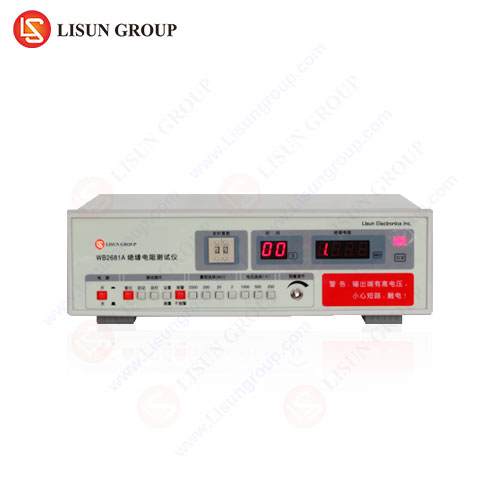
The LISUN WB2675D Leakage Current Tester represents a state-of-the-art instrument designed to meet the rigorous demands of modern compliance testing across the industries previously mentioned. Its design incorporates the necessary measurement networks and control systems to automate and de-risk the testing process.
Testing Principles and Specifications:
The WB2675D operates by applying the standardized measurement networks as per IEC 60990, IEC 60601-1, and other derivative standards. It can accurately measure both AC and DC leakage currents, a critical feature given the increasing prevalence of DC power systems in automotive electronics and renewable energy applications. The instrument typically features a high-resolution measurement range from microamperes (µA) to milliamperes (mA), capable of detecting currents far below the regulatory limits.
Key specifications often include:
- Measurement Range: 0 – 20 mA AC/DC.
- Accuracy: High precision, often better than ±(3% + 5 digits).
- Test Voltage: A programmable output, for instance, from 0 – 250V AC, allowing for testing at rated voltage and above.
- Measurement Networks: Integrated networks for touch current, patient leakage, and alternative network selections as required by different standards.
- Data Logging: Integrated memory and communication interfaces (e.g., RS232, USB, Ethernet) for traceability and integration into automated production test stations.
Industry Use Cases and Applications:
- Medical Devices: For pre-compliance and type-testing of patient monitors, surgical tools, and diagnostic imaging systems to the strict earth and patient leakage limits of IEC 60601-1.
- Household Appliances: Verifying that washing machines, refrigerators, and kettles do not exceed touch current limits under both normal and fault conditions as per IEC 60335-1.
- Automotive Electronics: Testing on-board chargers, DC-DC converters, and high-voltage wiring harnesses for electric vehicles to ensure isolation and compliance with ISO 6469-3 and LV214.
- Lighting Fixtures: Assessing LED drivers and complete luminaires, particularly those with metal housings, for capacitive and conductive leakage.
- Industrial Control Systems: Ensuring that programmable logic controllers (PLCs), motor drives, and human-machine interfaces (HMIs) are safe for operator interaction in industrial environments.
Competitive Advantages:
The WB2675D’s advantages lie in its integration, accuracy, and user safety. Unlike assembling a test setup from discrete components (isolation transformer, variac, measurement network, and precision meter), the WB2675D provides a unified, calibrated system. This reduces setup time, minimizes potential for operator error, and enhances measurement reproducibility. Its robust construction and safety interlocks protect the operator during high-voltage testing. Furthermore, its programmability allows for the creation of standardized test sequences, which is invaluable in a production line environment where consistency and speed are critical.
Mitigation Strategies for Excessive Leakage Current
When leakage current measurements exceed permissible limits, engineers must employ mitigation strategies. A primary method is the enhancement of insulation, either by increasing creepage and clearance distances on PCBs or by specifying materials with higher dielectric strength. For capacitive leakage, which is difficult to eliminate entirely, the use of a grounded electrostatic shield between primary and secondary windings in transformers is highly effective. In medical devices and sensitive industrial controls, the implementation of “patient-isolated” or “double-insulated” (Class II) designs, which do not rely on a functional earth connection, is a fundamental safety approach. For equipment with high earth leakage, such as large IT servers or industrial motor drives, ensuring a low-impedance, reliable grounding system is non-negotiable.
Conclusion
The science of leakage current measurement is a sophisticated discipline sitting at the intersection of electrical engineering, human physiology, and regulatory compliance. A deep understanding of its mechanisms, the international standards framework, and the advanced tools required for its quantification is essential for any organization involved in the design, manufacture, or certification of electrical equipment. Instruments like the LISUN WB2675D Leakage Current Tester embody the technological response to this need, providing the precision, safety, and standardization required to validate product safety in a global marketplace. As technology continues to evolve, with higher operating frequencies and increasing power densities, the challenges associated with controlling leakage current will only intensify, making rigorous testing more critical than ever.
FAQ Section
Q1: Why is it necessary to use a specialized leakage current tester like the WB2675D instead of a standard multimeter?
A standard multimeter measures current through a low-impedance path, which would short-circuit the leakage current and provide a false, non-hazardous reading. A leakage current tester like the WB2675D incorporates the standardized human body impedance network (e.g., from IEC 60990), providing a measurement that accurately reflects the current that would actually flow through a person, which is the true indicator of shock hazard.
Q2: How does the WB2675D tester handle the testing of medical devices with applied parts?
The WB2675D is equipped with specific measurement modes and networks tailored to IEC 60601-1. It can differentiate between earth leakage current, enclosure leakage current, and patient leakage current. For applied parts, it uses the appropriate patient simulation impedance to measure the current that could flow through a patient, which is subject to the most stringent limits.
Q3: In a production line setting, can the WB2675D be automated for high-throughput testing?
Yes, the WB2675D typically features programmable test sequences and standard communication interfaces such as RS232, USB, or Ethernet. This allows it to be integrated into automated test executives. A production line operator can initiate a pre-defined test with a single action, and the instrument can automatically apply voltage, measure leakage current, compare the result against a pass/fail limit, and output the result to a host computer for data logging and traceability.
Q4: What is the significance of performing a leakage current test after a “single fault condition”?
The single-fault condition is a core safety philosophy that ensures equipment remains safe even if one primary safety feature fails. For leakage current, a common single-fault test is opening the neutral supply while the line remains connected. This can cause the equipment enclosure to rise to a hazardous voltage if the design is inadequate. Testing under this condition verifies that leakage currents remain within safe limits, proving the robustness of the product’s safety design.
Q5: For equipment with a high-inrush current, such as switching power supplies, does this affect the leakage current measurement?
The inrush current, being a transient phenomenon at power-on, is typically distinct from the steady-state leakage current. Modern testers like the WB2675D are designed to measure the steady-state RMS or frequency-weighted value of the leakage current after any initial transients have settled. The measurement circuit is filtered to ignore brief surges and focus on the continuous current that presents a sustained shock hazard.
