







Understanding Hipot Testing for Electrical Safety: Principles, Applications, and Technological Implementation
The Foundational Role of Dielectric Withstand Testing in Product Safety
Electrical safety constitutes a non-negotiable pillar in the design, manufacture, and certification of virtually all electrotechnical products. Among the suite of validation procedures employed, Dielectric Withstand testing, commonly termed Hipot testing (derived from “High Potential”), stands as a critical and mandatory assessment for verifying the integrity of electrical insulation. This test’s primary objective is to ensure that a product’s insulation system is adequately robust to withstand transient overvoltages and operational stresses without breakdown, thereby preventing electric shock hazards, fire risks, and equipment failure. The test involves applying a significantly higher-than-normal AC or DC voltage between conductive parts and the grounding system for a specified duration. A failure is indicated by an insulation breakdown, manifested as a sudden, uncontrolled flow of current exceeding a predefined threshold. Regulatory bodies and international standards, such as IEC 60335, IEC 60601, UL 60950, and ISO 26262, mandate rigorous Hipot testing, making it an indispensable gatekeeper for market access across global jurisdictions.
Physiological Hazards and the Insulation Barrier
The human body’s vulnerability to electrical current underpins the necessity for rigorous insulation testing. Currents as low as a few milliamperes can induce involuntary muscular contractions, while slightly higher magnitudes may lead to respiratory paralysis, ventricular fibrillation, or sustained myocardial contraction. The insulation barrier—comprising materials like plastics, ceramics, polymers, and air gaps—serves as the primary defense against these hazards. However, insulation can degrade due to manufacturing defects (e.g., pinched wires, contaminated PCB substrates, inadequate creepage/clearance distances), environmental stressors (thermal cycling, humidity, chemical exposure), or long-term operational wear. Hipot testing proactively identifies these latent weaknesses by applying a severe but controlled electrical stress, simulating conditions far beyond normal operation or typical power line surges, thereby verifying the safety margin engineered into the product.
Comparative Analysis of AC versus DC Hipot Testing Methodologies
The selection between AC and DC Hipot testing is dictated by the application, product type, and relevant standards. Each methodology presents distinct advantages and limitations. AC Hipot testing applies a sinusoidal voltage at power frequency (e.g., 50/60 Hz) between the live parts and ground. This method most accurately simulates real-world operational and fault conditions, as the alternating voltage stresses the insulation capacitively and resistively, testing both the insulation material and the geometry (creepage and clearance). It is the preferred and often required method for most line-powered equipment, including household appliances, industrial controls, and lighting fixtures.
Conversely, DC Hipot testing applies a unidirectional high voltage. Its principal advantage lies in its low current requirement; since the capacitive charging current is negligible once the voltage is stabilized, the test equipment can be smaller and less powerful. This makes it suitable for testing components with high intrinsic capacitance, such as long runs of power cables, wiring harnesses in automotive and aerospace applications, and large rotating machinery like motors and generators. However, a key limitation is that a DC field distributes stress according to resistivity, potentially not revealing flaws that an AC field would stress due to permittivity differences. Furthermore, DC testing can potentially charge and trap energy within the insulation, posing a residual shock hazard post-test. The choice is therefore not arbitrary but a technical decision based on the device under test’s (DUT) characteristics and the failure modes of concern.
Standards Compliance and Test Parameter Determination
Adherence to published safety standards is not merely a best practice but a legal and liability imperative. These standards meticulously define test parameters, including test voltage magnitude, application duration, trip current limits, and environmental preconditions. Test voltages are typically derived from the product’s rated working voltage, insulation class, and application environment. A common formula in many standards is to apply 1000 VAC plus twice the working voltage for basic insulation. For example, a 230V household appliance might be tested at 1250 VAC or 1768 VDC (using a typical √2 multiplier for AC to DC conversion). The test duration is usually 60 seconds for type tests, though production-line testing often employs a 1-3 second “flash test” to maintain throughput without compromising safety integrity. The leakage current trip threshold is equally critical, often set in a range from 0.5 mA to 10 mA, depending on the standard and product risk classification. Medical devices (IEC 60601) typically enforce stricter limits (e.g., 0.5 mA patient leakage) compared to industrial equipment.
Operational Workflow and Failure Mode Analysis
A standardized Hipot test procedure mitigates operator error and ensures result reproducibility. The workflow commences with a comprehensive pre-test inspection of the DUT and test equipment, including verification of grounding and calibration status. The DUT is de-energized, and all user-accessible conductive parts are interconnected to form the test electrode. The high-voltage output is then connected between this electrode and the DUT’s power supply terminals (typically shorted). After setting the voltage, ramp rate, dwell time, and current limit per the applicable standard, the operator initiates the test. A controlled ramp-up prevents voltage transients that could damage sound insulation. During the dwell period, the instrument monitors the real resistive leakage current. A pass condition is maintained if the current remains below the trip threshold for the entire duration. A failure, indicated by an over-current trip, necessitates root-cause analysis. Failure modes include dielectric breakdown (a permanent carbonized path), corona discharge (partial ionization in air voids), or surface tracking (degradation across contaminated surfaces). Distinguishing between a genuine insulation breach and a false trip due to capacitive inrush current is a function of advanced test equipment design.
Introduction to the LISUN WB2671A Withstand Voltage Test Instrument
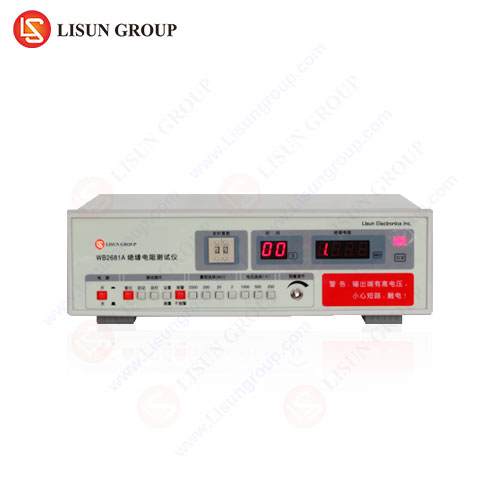
For engineering laboratories and production lines requiring precise, reliable, and compliant dielectric withstand testing, the LISUN WB2671A represents a sophisticated solution. This fully programmable AC/DC Hipot tester is engineered to meet the exacting demands of international safety standards across diverse industries. Its core function is to generate, measure, and control high-voltage outputs with high accuracy while providing comprehensive safety interlocks and data logging capabilities.
Key Specifications:
- Test Voltage: AC: 0–5 kV / 0–20 kV (model dependent); DC: 0–6 kV / 0–28 kV.
- Voltage Accuracy: ± (2% of reading + 0.2% of full scale).
- Leakage Current Range: AC: 0.10–20.00 mA; DC: 0.10–10.00 mA.
- Current Accuracy: ± (2% of reading + 2 digits).
- Timer Range: 1–999 seconds.
- Ramp Time: Programmable from 1–999 seconds.
- Output Frequency: 50/60 Hz or variable 40–70 Hz for specialized testing.
- Interfaces: RS232, USB, LAN for remote control and data integration into factory networks.
Testing Principles Embodied in the WB2671A Design
The WB2671A operationalizes the core principles of Hipot testing through its integrated architecture. A microcontroller unit (MCU) manages the user-defined test parameters, commanding a high-voltage transformer (for AC) and a voltage multiplier circuit (for DC) to generate the precise output. A high-precision voltage divider and sensing circuit provide closed-loop feedback for voltage regulation. The critical leakage current measurement is performed by a dedicated high-resolution current sensor located on the ground return path. The instrument differentiates between the reactive capacitive current (which is harmless) and the resistive leakage current (which indicates insulation quality) using real-time vector analysis in AC mode. Advanced algorithms provide arc detection, identifying short-duration breakdowns that might not sustain a current high enough to trigger the main limit but still indicate a flaw. The unit incorporates multiple hardware safety features: a zero-start interlock ensures output begins at 0V, a high-voltage relay disconnects the output immediately upon test completion or failure, and external interlock terminals allow integration with safety cages.
Industry-Specific Application Scenarios
The versatility of the WB2671A allows it to be deployed across a vast spectrum of industries, each with unique testing paradigms.
- Household Appliances & Consumer Electronics: Testing insulation between live parts (heating elements, motor windings) and accessible metal chassis in products like refrigerators, washing machines, and power adapters to IEC 60335.
- Medical Devices: Performing patient-protection leakage tests and dielectric withstand on isolated patient connections (e.g., ECG leads, surgical tools) as per IEC 60601’s stringent limits.
- Automotive Electronics: Validating the insulation integrity of high-voltage components in electric and hybrid vehicles (battery packs, inverters, charging ports) against ISO 26262 and LV214 standards, often using DC hipot.
- Aerospace & Aviation: Testing wiring harnesses, avionics boxes, and power distribution units for dielectric strength per DO-160 standards, where reliability under varying atmospheric pressures is critical.
- Lighting Fixtures & Electrical Components: Ensuring safety in LED drivers, ballasts, switches, and sockets, where compact designs push creepage and clearance boundaries.
- Industrial Control & Telecommunications: Verifying insulation in PLCs, motor drives, servers, and network equipment, which must endure industrial noise and surge events.
- Cable & Wiring Systems: Performing routine production-line flash testing on power cords and data cables.
Competitive Advantages in Precision Manufacturing
The WB2671A offers distinct advantages in modern manufacturing and quality assurance environments. Its programmability enables the storage of hundreds of test profiles for different product lines, reducing setup time and operator error. The high accuracy of both voltage and current measurement ensures compliance audits are supported by reliable data. The inclusion of both AC and DC outputs in a single unit provides exceptional flexibility, eliminating the need for multiple dedicated testers. Robust data logging and communication interfaces facilitate traceability, a key requirement in industries like medical devices and automotive, where every unit test record must be archived. Furthermore, its safety-centric design—with clear pass/fail indicators, emergency stop, and interlock support—protects both the operator and the DUT during high-voltage application.
Interpreting Results and Mitigating Common Testing Artifacts
Correct interpretation of Hipot test results is paramount. A stable leakage current reading well below the limit indicates robust insulation. A reading that is stable but unusually high, though still passing, may suggest aging insulation or contamination, warranting further investigation. A sudden trip is a clear failure. However, technicians must be aware of artifacts. False failures can occur from capacitive inrush when testing large winding assemblies or long cables; a slower ramp rate or using DC hipot can mitigate this. Environmental humidity can lower surface resistivity, increasing leakage current; preconditioning in a controlled environment may be necessary. Contact issues with test probes can cause arcing, misinterpreted as insulation failure. The WB2671A’s arc detection and programmable ramp functions are specifically designed to help operators discriminate between these artifacts and genuine failures.
Integration into Automated Production Test Systems
In high-volume manufacturing, the WB2671A transcends its role as a benchtop instrument to become a component within an automated test station. Via its RS232, USB, or LAN interfaces, it can be commanded by a host computer or PLC. A typical sequence involves the host controller signaling the tester to load a specific profile, initiating the test, and then querying for the pass/fail result and actual leakage current value. This data is then married with the unit’s serial number in a database for full traceability. This integration is essential in industries like automotive electronics and aerospace, where every component’s test history must be digitally retained for the product’s lifecycle.
FAQ Section
Q1: What is the key difference between a “Withstand Voltage” test and an “Insulation Resistance” test?
A: A Withstand Voltage (Hipot) test is a stress test. It applies a high voltage to determine if the insulation will break down, providing a pass/fail result based on a leakage current limit. An Insulation Resistance (IR) test is a quality test. It applies a lower DC voltage (typically 500V or 1000V) to measure the actual resistance of the insulation in megaohms or gigaohms, quantifying its condition. Both are complementary but serve different purposes in a safety test regimen.
Q2: Can the LISUN WB2671A be used for testing medical devices that require patient leakage current measurements?
A: While the WB2671A is primarily designed for dielectric withstand testing, medical device testing per IEC 60601 requires specialized equipment to measure very low leakage currents (microampere range) under various normal and single-fault conditions. The WB2671A is ideal for the dielectric strength portion of the test. For comprehensive medical safety testing, a dedicated medical electrical safety analyzer, such as those also offered by LISUN, would be required to perform all necessary leakage current measurements.
Q3: Why does the test voltage sometimes need to be applied for 60 seconds in a lab but only 1-2 seconds on a production line?
A: The 60-second duration in type testing (design validation) is intended to provide a prolonged stress to uncover marginal insulation that might withstand a short shock. In production-line “flash” testing, the goal is to detect catastrophic faults (e.g., a direct short) with high throughput. Statistical process control ensures the manufacturing process is capable; the flash test acts as a final safety net. The shorter time is a practical compromise that maintains safety screening without creating a production bottleneck.
Q4: Is it safe to perform a Hipot test on a repaired or returned unit?
A: Extreme caution must be exercised. Hipot testing applies severe stress. On a used or repaired unit, insulation may already be degraded. Applying a full type-test voltage could cause a breakdown that did not previously exist. A recommended practice is to first perform a non-destructive Insulation Resistance test. If the IR value is acceptable, a Hipot test may be performed, but often at a reduced voltage (e.g., 80% of the original test voltage) as a maintenance test, unless the standard for repair explicitly mandates the full test.
