








Understanding High Voltage and Insulation Testing for Electrical Safety
The Fundamental Role of Dielectric Withstand Testing
Electrical safety in manufactured components and finished products is not an aspirational goal but a non-negotiable requirement. At the core of this mandate lies the integrity of insulation systems, which serve as the primary barrier against electric shock, fire risk, and equipment failure. High Voltage (Hi-Pot) or Dielectric Withstand Testing is the definitive methodology for assessing this integrity. This non-destructive test subjects an insulation barrier to a voltage significantly higher than its normal operating rating for a specified duration. The objective is not to degrade the insulation but to verify its ability to withstand transient overvoltages—such as those from switching surges or lightning strikes—without breakdown. A failure during this test, indicated by an excessive leakage current, reveals latent defects: contaminants, inadequate creepage and clearance distances, pinched wires, or compromised dielectric material. Consequently, this test is a critical gatekeeper in product safety certification and quality assurance protocols across global industries.
Quantifying Insulation Integrity: Leakage Current and Breakdown Mechanisms
The principle of dielectric withstand testing is predicated on applying a stress and measuring the response. When a high voltage is applied across an insulation system, a small, predictable current, known as leakage current, will flow. This current comprises three components: capacitive charging current (which decays rapidly), absorption current (related to dielectric polarization), and conduction current (the true leakage through the insulation). A test instrument must accurately distinguish this steady-state conduction current from the transient inrush currents. An insulation failure, or breakdown, occurs when the applied electric field exceeds the dielectric strength of the material, creating a conductive path. This is often a cascading effect where initial microscopic defects lead to localized heating, carbonization, and ultimately, a flashover or short circuit. Standards such as IEC 60335-1 (household appliances), IEC 60601-1 (medical devices), and UL 60950-1 (IT equipment) specify precise test voltages (often 1000V AC + twice the operating voltage for basic insulation) and maximum allowable leakage currents. These parameters are not arbitrary; they are derived from rigorous risk assessments of operational environments and fault conditions.
Industry-Specific Applications and Risk Mitigation
The application of dielectric withstand testing is ubiquitous, though its implementation varies by sector due to divergent operational stresses and safety-criticality.
In Medical Devices, particularly patient-connected equipment like dialysis machines or monitors, insulation failure can lead to micro-shock hazards, directly endangering life. Testing here is performed with stringent leakage limits, often below 100µA. Aerospace and Aviation Components face extreme environmental conditions—wide temperature swings, pressure differentials, and vibration—that can compromise insulation over time. Hi-Pot testing validates that connectors and wiring harnesses can endure these stresses without arcing. Automotive Electronics, especially in electric vehicles, involves high-voltage battery systems (400V-800V DC). Testing here focuses on isolating these traction circuits from the vehicle chassis and low-voltage systems, using both AC and DC Hi-Pot methods.
For Household Appliances and Consumer Electronics, the risk is primarily fire and user shock. Testing a power supply in a television or the internal wiring of a washing machine ensures safety even during mains voltage spikes. Telecommunications Equipment and Industrial Control Systems are tested to ensure isolation between data/power lines and earth, preventing damage from surges propagating through networks. Lighting Fixtures, particularly LED drivers, require verification of isolation between primary and secondary circuits. Even passive Electrical Components like switches, sockets, and Cable and Wiring Systems undergo batch testing to confirm the absence of manufacturing flaws in their dielectric barriers.
The WB2671A Withstand Voltage Tester: A Technical Analysis
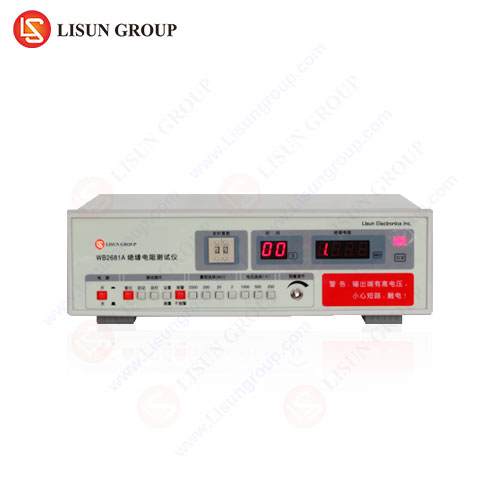
The LISUN WB2671A Withstand Voltage Tester embodies the engineering required to execute these critical tests with precision, reliability, and operator safety. It is a microprocessor-controlled instrument designed for both laboratory and production line environments, capable of performing AC (0-5kV/10kV) and DC (0-6kV/12kV) withstand voltage tests as well as insulation resistance tests.
Core Specifications and Testing Principles:
The instrument’s design addresses key challenges in Hi-Pot testing. Its high-resolution digital meter provides clear readouts of voltage and leakage current. A critical feature is its adjustable leakage current upper and lower limit alarms. Setting a precise upper limit (e.g., 0.50 mA as per a specific standard) allows for pass/fail judgment, while a lower limit can detect open test circuits—a common false-pass scenario. The WB2671A incorporates a rapid cut-off mechanism, terminating the test within 10ms upon detection of a breakdown, thereby minimizing damage to the unit under test (UUT). Its programmable test time (1-99s) and ramp-up function allow for controlled voltage application, reducing transient stresses that could damage otherwise good insulation.
Industry Use Cases and Application:
In a medical device manufacturing line, the WB2671A would be programmed to apply 1500V AC for 60 seconds to a surgical tool’s power supply, with a failure threshold of 0.10 mA. Any breakdown would immediately halt production for that batch. An automotive electronics supplier might use the DC output mode to test a DC-DC converter for an electric vehicle, applying 3000V DC to verify isolation between input and output. A cable manufacturer would use the instrument in a batch-testing jig, applying a high voltage to the conductor while submerged in water (the shield), quickly identifying insulation pinholes.
Competitive Advantages and Operational Safety:
The WB2671A’s advantages are rooted in its robust safety architecture and measurement integrity. It features a zero-start interlock, ensuring voltage is only applied after the test is properly initiated, protecting the operator. The output is short-circuit protected, and the test terminal is physically designed to limit accessible energy. Its calibration mode and stable voltage output, with low distortion (<3%), ensure that measurements are traceable and repeatable—a necessity for audit compliance against standards like ISO/IEC 17025. The intuitive interface, with clear fault indicators (Audible, Visual, Display), reduces operator error in high-throughput environments like consumer electronics or office equipment assembly.
Standards Compliance and Test Protocol Design
Adherence to international standards is not merely about regulatory compliance; it provides a scientifically validated framework for test protocol design. The WB2671A is engineered to facilitate compliance with major global standards including IEC, ISO, UL, CSA, and GB. A test engineer must derive test parameters from the applicable standard for the product category. For instance:
| Product Category | Typical Standard | Test Voltage (Example) | Max Leakage Current (Example) | Duration |
|---|---|---|---|---|
| Class I Household Appliance | IEC 60335-1 | 1000V + 2x Operating Voltage | 0.25 mA – 0.75 mA | 60 s |
| IT Equipment | IEC 60990-1 | 1500V AC | 0.25 mA | 60 s |
| Medical Equipment (BF Type) | IEC 60601-1 | 1500V AC | 0.10 mA | 60 s |
| Automotive HV Component | LV 123 | 2x Working Voltage + 1000V DC | < 1 mA per standard | 120 s |
The protocol must also define the test points (e.g., live parts to accessible conductive parts) and the conditioning of the UUT (e.g., at room temperature and humidity). The WB2671A’s programmability allows these precise conditions to be stored and recalled, ensuring consistency.
Interpreting Results and Failure Analysis
A “pass” result indicates the insulation withstood the applied stress without exceeding the leakage current limit, providing high confidence in its immediate integrity. A “fail” result is a critical quality event demanding systematic analysis. The nature of the failure—a sudden, large current spike suggests a hard short (bridged gap), while a gradual creep in leakage current may indicate surface contamination or moisture ingress. Post-failure, the UUT should be inspected for physical evidence: carbon tracking, pinholes, or melted insulation. Root cause analysis might trace the fault to a specific production stage, such as improper potting in an industrial control transformer or a defective capacitor in a lighting fixture driver. This feedback loop is essential for continuous manufacturing process improvement.
Integrating Testing into a Comprehensive Safety Regime
It is imperative to recognize that dielectric withstand testing is one element of a holistic electrical safety testing regimen. It is frequently complemented by Insulation Resistance testing (measuring resistance in MΩ or GΩ at a lower DC voltage), Ground Bond testing (verifying the integrity of protective earth connections), and Functional Run-in testing. The WB2671A’s inclusion of insulation resistance testing (up to 1000 MΩ at 500V DC) makes it a versatile tool for this broader suite. A comprehensive testing strategy, executed with reliable instrumentation, forms the bedrock of product safety, protecting end-users, safeguarding brand reputation, and ensuring compliance in a globally regulated marketplace.
FAQ Section
Q1: What is the difference between AC and DC dielectric withstand testing, and when should each be used?
AC testing stresses the insulation in a manner similar to operational AC voltage, making it ideal for most line-powered equipment like household appliances and telecommunications gear. It is more effective at detecting flaws related to layered or distance-based insulation. DC testing applies a constant stress, resulting in lower leakage currents and less capacitive loading. It is suitable for high-capacitance loads (like long cables), DC-powered components (automotive EV systems), and for diagnostic testing where minimal stress is desired.
Q2: How is the appropriate test voltage and leakage current limit determined for a specific product?
These parameters are strictly defined by the relevant safety standard for the product category (e.g., IEC, UL, ISO). The standard specifies formulas based on working voltage, insulation type (basic, supplementary, reinforced), and product application. The leakage current limit is typically set to a value that indicates a definitive breakdown path while ignoring harmless capacitive coupling. Engineers must consult the governing standard; the WB2671A allows these precise values to be programmed.
Q3: Can a dielectric withstand test damage a good unit under test?
When performed correctly using a controlled instrument like the WB2671A, the risk is minimal. The test is designed to be non-destructive. However, applying voltage too quickly (without a ramp) or using an excessively high voltage beyond the standard can overstress insulation. The rapid cut-off feature of professional testers is crucial to limit energy discharge during an incipient failure, preventing catastrophic damage that could obscure the failure’s root cause.
Q4: Why does the WB2671A feature both an upper and lower leakage current limit alarm?
The upper limit is standard, detecting insulation breakdown. The lower limit is a critical safety feature that detects an open test circuit. If a test lead is disconnected or makes poor contact, the measured leakage current will be zero, which could falsely indicate a “pass.” The lower limit alarm triggers a failure in this scenario, ensuring no unit bypasses testing due to a setup error.
Q5: How often should a withstand voltage tester like the WB2671A be calibrated?
Calibration intervals are determined by the user’s quality system, typically based on usage frequency, environmental conditions, and requirements of standards like ISO 9001. For production-line testing, annual calibration is common. The instrument should also undergo a routine performance check (e.g., using a calibrated load) more frequently to ensure ongoing accuracy and reliability.
