








Understanding Grounding System Testing: Principles, Methodologies, and Technological Implementation
The Critical Role of Grounding in Modern Electrical Safety
Grounding, or earthing, constitutes a fundamental safety and functional prerequisite across all sectors of electrical and electronic engineering. Its primary objective is the establishment of a low-impedance path to earth, facilitating the safe dissipation of fault currents, lightning strikes, and static discharges. A robust grounding system ensures equipment chassis and non-current-carrying metallic parts remain at or near earth potential, thereby mitigating the risk of electric shock to personnel. Beyond safety, effective grounding is indispensable for electromagnetic compatibility (EMC), providing a reference plane that minimizes noise, prevents signal integrity degradation in sensitive circuits, and ensures the reliable operation of microprocessors in industrial control systems, telecommunications equipment, and medical devices. The failure of a grounding system can precipitate catastrophic consequences, ranging from equipment malfunction in aerospace and aviation components to life-threatening scenarios in healthcare environments.
Deconstructing Grounding Resistance: A Technical Foundation
The efficacy of a grounding system is quantitatively expressed through its grounding resistance, measured in ohms (Ω). This parameter is not a simple DC resistance but a complex impedance encompassing the resistance of the grounding electrode, the contact resistance between the electrode and surrounding soil, and the soil’s own resistivity. Soil resistivity (ρ), measured in ohm-meters, is the paramount variable, influenced by moisture content, mineral composition, temperature, and compaction. A lower grounding resistance denotes a more efficient system. Regulatory standards, such as IEC 60364, NFPA 70 (National Electrical Code), and IEEE Std 81, prescribe maximum permissible resistance values, often between 1Ω and 25Ω, contingent upon the application’s criticality. For instance, telecommunications base stations and substation grids typically mandate resistances below 5Ω, while standard building services may allow values up to 25Ω.
Methodological Approaches to Grounding Resistance Measurement
Several established techniques exist for measuring grounding resistance, each with distinct applications and limitations. The selection of an appropriate methodology is contingent upon site conditions, system configuration, and the required precision.
The Fall-of-Potential Method: This classical three-pole method is the most referenced technique for testing single, isolated grounding electrodes. It employs a dedicated tester to inject a known alternating current (I) between the electrode under test (E) and a remote current probe (C). A second potential probe (P) is placed at various intervals along a straight line between E and C. The voltage (V) between E and P is measured, and grounding resistance (R = V/I) is calculated. By plotting resistance against probe spacing, a plateau region identifies the true resistance. This method requires sufficient space for probe placement, a condition often unattainable in urban or congested industrial sites.
The Selective Measurement Technique: This advanced four-pole method is indispensable for testing grounding systems within live, multi-connected networks, such as those found in complex industrial plants or data centers. It allows for the measurement of an individual electrode’s resistance without necessitating its disconnection from the overall grounding grid. A specialized clamp meter applies a test voltage to the electrode via one clamp, while a second clamp measures the resultant current loop. This technique eliminates the need for auxiliary probes and disconnection, enhancing operational safety and efficiency.
The Stakeless / Clamp-On Method: Utilizing a single clamp-on device, this technique is optimal for rapid, periodic verification of ground loops and interconnected rods in low-voltage systems, such as those for lighting fixtures or office equipment. It measures the complete series resistance of a ground loop by inducing a test signal and measuring the magnetic field generated by the resultant current. While exceptionally convenient, its accuracy can be compromised in the presence of parallel grounding paths or excessively high loop resistances.
Introducing the LISUN WB2678A Grounding Resistance Tester: A Synthesis of Precision and Versatility
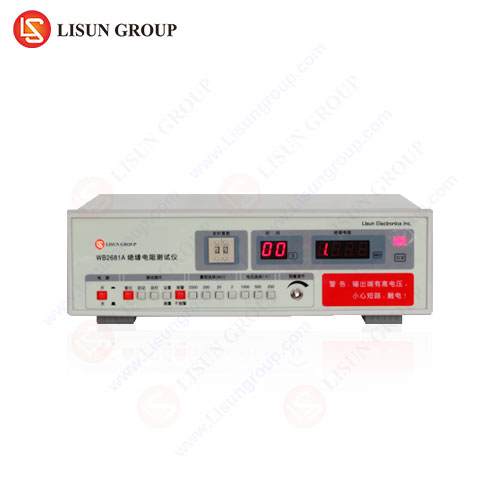
The LISUN WB2678A Grounding Resistance Tester embodies a contemporary engineering solution designed to address the multifaceted challenges of modern grounding system verification. It integrates the Fall-of-Potential (3-pole), 4-pole, and Selective (clamp-on) measurement methods into a single, ruggedized instrument, providing unparalleled adaptability for field engineers.
Core Specifications and Testing Principles:
The WB2678A operates on a dual-frequency automatic current reversal (ACR) test signal principle, typically at 128 Hz, to mitigate the influence of stray earth currents and electrochemical effects that can distort measurements at power-line frequencies (50/60 Hz). Its high noise rejection ratio ensures stable readings in electromagnetically hostile environments, such as near variable-frequency drives in industrial control systems or high-voltage switchyards.
- Measurement Ranges: 0.00Ω to 30.00kΩ (grounding resistance); 0.0Ω to 1000Ω (soil resistivity); 0.00mA to 30.0A AC (leakage/ground current via clamp).
- Test Voltage: 50V max, ensuring operator safety during testing.
- Data Logging: Integrated memory for storing thousands of measurement results with timestamp and location data, crucial for longitudinal compliance tracking.
- Environmental Robustness: IP54-rated enclosure for protection against dust and water ingress, suitable for field use in diverse conditions from manufacturing floors to outdoor telecommunications sites.
Industry-Specific Use Cases and Applications:
- Electrical Components & Household Appliances: Production-line verification of protective earth continuity on switches, sockets, and appliance chassis to comply with IEC 62368-1 and IEC 60335-1. The selective clamp function allows testing without breaking production flow.
- Automotive Electronics & Aerospace: Validating the grounding integrity of avionics racks, vehicle ECU mounting points, and bonding straps. Low-resistance grounding is critical for mitigating electromagnetic interference (EMI) that can disrupt sensor signals and communication buses.
- Medical Devices & Telecommunications: Periodic maintenance testing of isolated ground points for sensitive MRI or CT scanner rooms, and validation of tower grounding grids for cellular base stations to protect against lightning-induced surges.
- Cable & Wiring Systems: Assessing the effectiveness of the grounding system for cable sheaths and conduits in power distribution networks, ensuring fault currents are safely diverted.
- Lighting Fixtures & Consumer Electronics: Installation verification for outdoor luminaire grounding and factory safety tests on power supplies and metal-housed electronics.
Competitive Advantages in Practice:
The WB2678A’s primary advantage lies in its methodological integration. A field technician can first use the stakeless clamp for a rapid survey of a building’s ground risers. Upon identifying a suspect circuit, they can deploy the 4-pole selective method to isolate and measure a specific panel ground without de-energizing equipment. Finally, for a new electrode installation, the full Fall-of-Potential test can be conducted to generate a certified report. This eliminates the need for multiple instruments, reducing capital expenditure and measurement uncertainty from instrument calibration variances.
Adherence to International Standards and Best Practices
Grounding testing is not an arbitrary activity but is governed by a stringent framework of international standards. The WB2678A is designed to facilitate compliance with key directives:
- IEC 61010-1: Safety requirements for electrical equipment for measurement, control, and laboratory use.
- IEC 61557-5: Requirements for equipment for testing, measuring or monitoring of protective measures – Resistance to earth.
- IEEE Std 81-2012: Guide for Measuring Earth Resistivity, Ground Impedance, and Earth Surface Potentials of a Grounding System.
- Industry-Specific Standards: Such as RTCA/DO-160 for aviation, ISO 6469-3 for electric vehicles, and AAMI NFPA 99 for healthcare facilities.
Best practice dictates a regimen of initial verification upon installation, periodic routine testing (annually or biannually), and testing after any significant modification or severe weather event. Documentation of resistance values, soil moisture conditions at the time of test, and electrode location is essential for trend analysis and predictive maintenance.
Interpreting Results and Mitigating High Resistance
A measurement yielding a resistance value above the specified threshold necessitates corrective action. Common remediation strategies include:
- Increasing Electrode Surface Area: Installing additional rods connected in parallel. The combined resistance follows the law of parallel resistances, though with diminishing returns due to mutual interference of conductive spheres of influence.
- Chemical Soil Treatment: Applying conductive backfill materials, such as bentonite or specialized conductive concrete, to lower the soil resistivity immediately surrounding the electrode. This method requires consideration of long-term chemical stability and environmental regulations.
- Deep-Driven Electrodes: Utilizing longer rods to reach deeper, more stable soil layers with consistently lower resistivity, often bypassing superficial dry or rocky strata.
- Grounding Grids or Plates: For high-current applications like substations, deploying a buried mesh of interconnected conductors to create a large, low-resistance equipotential plane.
The choice of mitigation is an economic and engineering decision based on site geology, available space, and the criticality of the grounded system.
Conclusion: Grounding Integrity as a Non-Negotiable Imperative
In an era defined by the proliferation of sensitive electronics and an unwavering commitment to operational safety, the integrity of grounding systems transcends mere regulatory compliance. It represents a foundational pillar of system reliability, data integrity, and human safety. Advanced, integrated testing instruments like the LISUN WB2678A Grounding Resistance Tester empower engineers and technicians across industries—from medical device manufacturing to aerospace assembly—to perform comprehensive, accurate, and efficient assessments. By adopting a rigorous, standards-based testing protocol supported by versatile technology, organizations can proactively manage risk, ensure uninterrupted operation, and uphold the highest standards of safety and performance in an electrically interconnected world.
Frequently Asked Questions (FAQ)
Q1: Can the LISUN WB2678A measure grounding resistance on a live system without disconnecting the electrode?
Yes, through its integrated Selective (clamp-on) measurement method. The tester utilizes a specialized clamp to inject a test signal and measure the resultant current on the grounding conductor in situ. This allows for the assessment of individual electrode performance within a connected network without the need for hazardous disconnection, making it ideal for preventive maintenance in facilities like data centers or industrial plants.
Q2: What is the significance of the dual-frequency (e.g., 128 Hz) test signal used by instruments like the WB2678A?
Stray voltages and currents at the common power frequency (50/60 Hz) can induce significant error in grounding measurements. A dual-frequency or frequency-shifted test signal (such as 128 Hz) allows the instrument’s filtering algorithms to distinguish the injected test signal from ambient electrical noise. This Automatic Current Reversal (ACR) technology dramatically improves measurement stability and accuracy in electrically noisy environments typical of industrial control systems or utility substations.
Q3: How often should a grounding system be tested, and what factors influence this frequency?
The testing interval is dictated by applicable standards, site-specific risk assessments, and environmental factors. A common baseline is annual testing for critical infrastructure (telecom, medical, aviation) and biannual testing for commercial installations. More frequent testing is warranted in corrosive soil conditions, areas with high lightning activity, or following any physical disturbance to the grounding infrastructure or major electrical system modification.
Q4: For a new electrode installation, why is the Fall-of-Potential method considered more definitive than a simple clamp-on test?
The Fall-of-Potential method is a “primary” test that directly measures the impedance between the electrode and “true earth” by using remote auxiliary probes. It accounts for the entire resistivity sphere of the electrode. A clamp-on test measures the resistance of a complete loop, which includes parallel paths and may not reflect the true electrode-to-earth impedance if other low-resistance paths exist. For certification of a new, isolated electrode, the Fall-of-Potential method is the prescribed standard.
Q5: In a manufacturing context for household appliances, how can the WB2678A streamline safety testing?
On a production line, the protective earth (PE) continuity of every appliance must be verified. The WB2678A’s low-resistance ohmmeter function (often at a test current of 10A or 25A as per IEC 62368-1) can be integrated into a test jig to perform a high-current, pass/fail continuity check. Its data logging capability can automatically record serial numbers and test results for quality assurance and regulatory audit trails, significantly speeding up the process compared to manual recording with basic meters.
