







Understanding Ground Resistance: What is the Optimal Value for Your System?
The Fundamental Role of Grounding in Electrical Safety and Performance
Grounding, or earthing, constitutes a foundational principle within electrical engineering, serving the dual critical purposes of personnel safety and equipment integrity. At its core, a grounding system provides a low-impedance path for fault currents to safely dissipate into the earth, thereby facilitating the rapid operation of overcurrent protection devices and preventing hazardous voltage potentials on equipment enclosures. Beyond safety, a robust ground reference is indispensable for the stable operation of sensitive electronic circuits, mitigating electromagnetic interference (EMI), and ensuring signal fidelity in data transmission systems. The efficacy of any grounding installation is quantitatively expressed through its ground resistance, measured in ohms (Ω). This parameter directly influences the system’s ability to perform its intended functions under both normal and fault conditions.
Defining Ground Resistance and Its Measurement Principles
Ground resistance is not a simple DC resistance but the impedance offered by the earth electrode, its connections, and the surrounding soil to the flow of fault current at power frequency. It is a complex function of soil resistivity, electrode geometry, depth of burial, and seasonal moisture content. The measurement is typically performed using a fall-of-potential method or its derivative techniques. This method employs a test current injected between the electrode under test (EUT) and a remote current probe, while a potential probe is placed at various intervals between them to map the voltage gradient. The ground resistance is derived from Ohm’s Law (R=V/I) at a distance where the voltage gradient becomes minimal, indicating the true resistance of the electrode system. Accurate measurement requires specialized instrumentation capable of generating a test signal, measuring minute voltage drops, and rejecting spurious noise—a capability embodied in modern grounding resistance testers.
Regulatory Frameworks and Industry-Specific Thresholds
The question of an “optimal” ground resistance value is not answered by a single universal figure but is dictated by a confluence of international standards, national electrical codes, and application-specific requirements. These standards establish maximum permissible limits to ensure safety and functionality.
- General Electrical Safety (NEC, IEC 60364): The National Electrical Code (NEC) in the United States and the IEC 60364 series internationally often specify that the resistance of a single electrode should be 25 ohms or less. This is a common benchmark for residential and commercial power systems.
- Lightning Protection Systems (IEC 62305, NFPA 780): For effective dissipation of lightning strike energy, significantly lower resistance is mandated, often 10 ohms or less. In areas of high soil resistivity or for critical structures, targets of 5 ohms or lower are frequently pursued.
- Telecommunications (ITU-T K.27, IEEE 142): Central offices and cell tower sites require very low ground resistance, typically between 1 and 5 ohms, to protect sensitive switching equipment, ensure reference potential for communication lines, and guard against lightning-induced surges.
- Medical Facilities (IEC 60601-1): Hospitals and clinics, particularly in areas housing electromedical equipment, enforce stringent grounding requirements to prevent micro-shock hazards. System resistance is often required to be below 1 ohm, with redundant grounding and regular verification.
- Industrial Control & Aerospace: Manufacturing facilities with programmable logic controllers (PLCs) and aviation ground support equipment require low-noise, low-resistance grounds (often <5 Ω) to prevent erratic control behavior and data corruption. Aerospace component testing facilities may have even more rigorous specifications.
A summary of common thresholds is presented below:
| Industry / Application | Typical Standard Reference | Maximum Ground Resistance Target | Primary Rationale |
|---|---|---|---|
| General Building Power | NEC 250.53, IEC 60364-5-54 | ≤ 25 Ω | Personnel safety, overcurrent device operation |
| Telecommunications Site | ITU-T K.27, IEEE 142 | ≤ 5 Ω (often ≤ 1-2 Ω) | Equipment protection, signal reference, lightning |
| Medical Treatment Rooms | IEC 60601-1-7 | ≤ 1 Ω | Patient safety (micro-shock prevention) |
| Industrial Control Systems | IEEE 1100 | ≤ 5 Ω | Noise reduction, control system stability |
| Lightning Protection | IEC 62305-3 | ≤ 10 Ω (often ≤ 5 Ω) | Efficient lightning current dissipation |
| Household Appliance Testing | IEC 60335-1 | Test to verify continuity & low resistance | Safety certification, fault current path integrity |
The Criticality of Low Ground Resistance Across Sectors
The consequences of inadequate ground resistance vary by sector but uniformly underscore its importance.
In Electrical and Electronic Equipment and Consumer Electronics manufacturing, a high-resistance ground on a test bench can lead to erroneous leakage current measurements during safety compliance testing (e.g., per IEC 62368-1), potentially allowing unsafe products to pass or failing safe ones. For Household Appliances, the integrity of the protective earth conductor within the power cord and internal wiring is paramount; verification requires measuring the resistance of this path, which must be sufficiently low to allow fault current to trip the circuit breaker.
Within Automotive Electronics, particularly in electric vehicle (EV) charging infrastructure, ground resistance at the charging station must be exceptionally low to ensure any fault is cleared instantaneously, protecting both the vehicle’s high-voltage battery system and the user. Lighting Fixtures, especially high-intensity outdoor or industrial luminaires, require robust grounding to prevent enclosure energization due to insulation failure.
Telecommunications Equipment and data centers are highly susceptible to ground potential rise. A poor ground can lead to differences in earth reference between interconnected devices, causing data errors, hardware damage from surges, and compromised shielding effectiveness against EMI. For Medical Devices, the stakes are highest. An impedance that is too high in the equipotential bonding system of an operating room can create a dangerous potential difference between, for instance, an electrosurgical unit and a cardiac monitor, posing a lethal risk to the patient.
In Aerospace and Aviation Components, grounding of test rigs and simulation equipment must be meticulously controlled to avoid introducing noise that could skew sensor data or control signals during component validation. The grounding of Cable and Wiring Systems themselves—ensuring the continuity and low resistance of their protective earth conductors—is a fundamental test before installation or as part of routine maintenance in industrial plants.
Achieving and Verifying Optimal Ground Resistance: The Role of Precision Instrumentation
Specifying a target resistance is merely the first step. Achieving it involves proper electrode design (using rods, plates, or meshes), soil conditioning, and professional installation. However, verification through accurate measurement is the only definitive proof of system performance. This demands instrumentation that is not only precise but also adaptable to complex field conditions.
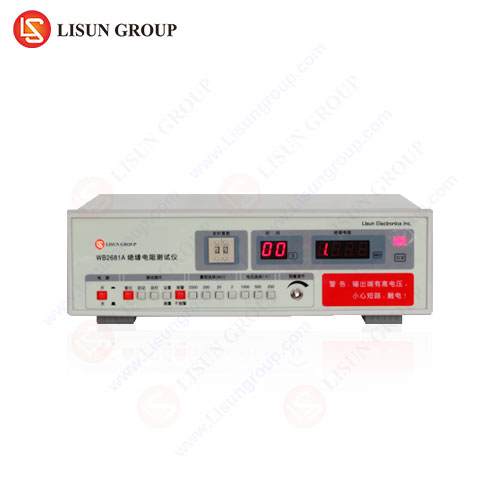
The LISUN WB2678A Grounding Resistance Tester is engineered to meet this exacting requirement. It operates on the classic three-pole fall-of-potential principle but incorporates advanced signal processing to ensure reliability. The instrument generates a precise test current and measures the resulting voltage drop with high resolution, automatically calculating and displaying the ground resistance value.
Key Specifications and Competitive Advantages:
- Measurement Range and Resolution: With a broad measuring range typically from 0.00 Ω to 30.00 kΩ, the WB2678A offers high resolution at the critical low end (0.01 Ω) necessary for verifying medical or telecom grounds, while also capable of diagnosing poor connections in higher-resistance systems.
- Noise Rejection and Testing Frequency: Electrical substations and industrial sites are rich in 50/60 Hz noise. The WB2678A utilizes a specific testing frequency (e.g., 128 Hz/111 Hz) and narrowband filtering to effectively reject power frequency interference, ensuring stable readings in electrically noisy environments.
- Auxiliary Electrode Resistance Check: A common source of measurement error is high resistance in the current or voltage probe connections. This instrument includes a function to verify the resistance of the auxiliary test spikes (C and P), alerting the operator to poor contact before a measurement is taken, thus safeguarding data integrity.
- Data Logging and Connectivity: For compliance documentation and trend analysis, the ability to store measurements is crucial. The WB2678A often features data storage and PC interface capabilities, allowing technicians to generate formal test reports for audits in sectors like aerospace component manufacturing or medical device production facilities.
- Robust Design for Field Use: Built to withstand the rigors of site work, its design prioritizes durability, clear display visibility in various lighting conditions, and safety in accordance with international overvoltage category standards.
In practice, a technician verifying the grounding grid for a new industrial control system cabinet farm would use the WB2678A to confirm a value below 5 Ω. A service engineer at a telecommunications base station would employ it during periodic maintenance to ensure the ring ground still meets the sub-2-ohm specification despite seasonal soil drying. In a factory producing electrical components like switches and sockets, quality assurance teams use similar testers to perform 100% checks on the continuity and resistance of the protective earth terminal in every unit.
The Economic and Safety Imperative of Regular Ground Testing
Ground resistance is not a static parameter. It degrades over time due to corrosion of electrodes, loosening of connections, and changes in soil moisture and temperature. A system that measured 8 ohms at installation can easily degrade to 30 ohms over several years, silently compromising its safety margin. Therefore, establishing an optimal value is only part of a lifecycle management strategy. A regimen of periodic testing—annually or biannually, and after any major electrical storm or construction activity—is essential to maintain system integrity.
The cost of a precision grounding tester is negligible compared to the liabilities it mitigates: equipment loss from surge damage, production downtime due to control system faults, data corruption in IT networks, catastrophic product recalls for safety failures, or, most gravely, loss of life from electric shock. Investing in accurate measurement technology and rigorous testing protocols is a direct investment in operational resilience, regulatory compliance, and fundamental safety.
Frequently Asked Questions (FAQ)
Q1: Can the LISUN WB2678A be used to test the continuity of the protective earth conductor inside a piece of office equipment, like a printer or photocopier?
Yes, absolutely. While often used for earth electrodes, the low-end resolution (0.01 Ω) of the WB2678A makes it suitable for continuity testing of protective conductors per safety standards such as IEC 60990. It can accurately measure the resistance from the equipment’s earth pin to any accessible conductive part, ensuring the integrity of the internal grounding path.
Q2: How does the instrument compensate for high soil resistivity when testing a single ground rod?
The WB2678A does not directly compensate for soil resistivity. High soil resistivity is a site condition that results in higher ground resistance readings. The instrument’s role is to accurately measure that resultant resistance. If the measured value exceeds the target (e.g., 25 Ω), it indicates the need for mitigation strategies, such as installing additional rods in parallel, using longer rods, or employing soil enhancement materials to effectively lower the overall system resistance.
Q3: What is the significance of the “Noise Check” or “Auxiliary Spike Resistance” function on such testers?
This function is critical for measurement validity. It tests the contact resistance of the current (C) and potential (P) auxiliary spikes with the earth. If these resistances are too high, they can introduce significant error into the measurement circuit, leading to falsely high or unstable ground resistance readings. The WB2678A’s check function alerts the operator to drive the spikes deeper, add water, or choose a new location before proceeding, ensuring the data collected is reliable.
Q4: For a large grounding grid at a telecommunications facility, is the standard 3-pole fall-of-potential method sufficient, or are other techniques needed?
For large, complex grids, the standard 3-pole method may require the current probe to be placed impractically far away (often 5-10 times the diagonal of the grid). In such cases, the WB2678A, supporting the 3-pole method, is suitable for routine checks of individual electrode bonds or smaller subsystems. For a full system measurement of a large grid, specialized techniques like the 4-pole method (which eliminates test lead resistance) or the clamp-on method (for measuring interconnected systems without disconnection) might be employed, often requiring additional or different instrumentation.
