








Fundamental Principles of Earth Electrode Function and Performance Metrics
The efficacy of an earth electrode system is predicated on its ability to dissipate fault currents into the surrounding soil with minimal impedance. The resistance offered by the earth electrode, its connecting conductors, and the volume of soil immediately surrounding it is collectively termed ground resistance. This parameter is not a simple attribute of the electrode itself but a complex function of the soil’s electrical properties, predominantly its resistivity. Soil resistivity, measured in ohm-meters (Ω·m), varies significantly with composition, moisture content, dissolved electrolytes, and temperature. A low ground resistance is critical for ensuring that during a fault condition, the voltage rise on equipment enclosures remains within safe limits, thereby protecting personnel and preventing damage to sensitive electronic apparatus. The performance metric is quantified as the resistance between the electrode and a point at a theoretically infinite distance, known as remote earth. Achieving and verifying a low-resistance path to earth is a non-negotiable requirement across all sectors of electrical engineering.
Analyzing Soil Resistivity for Optimal Electrode System Design
Prior to the installation of any grounding system, a comprehensive soil resistivity analysis is imperative. This analysis informs the design by predicting the performance of various electrode configurations and depths. The most prevalent method for this investigation is the Wenner four-pin method, a technique standardized by IEEE Standard 81. In this configuration, four equally spaced test electrodes are driven into the earth in a straight line. A test current (I) is injected between the two outer electrodes, and the resulting voltage drop (V) is measured between the two inner electrodes. The soil resistivity (ρ) is then calculated using the formula ρ = 2πaR, where ‘a’ is the inter-electrode spacing in meters and ‘R’ is the measured resistance (V/I). By progressively increasing the spacing ‘a’, data on how resistivity changes with depth is obtained, allowing for the creation of a soil model. This model is essential for determining whether deep-driven rods, ground plates, or chemical ground enhancement materials are required to achieve the target resistance, particularly in challenging environments such as rocky terrain or arid climates.
The Fall-of-Potential Method for Validating Installed Electrode Integrity
For verifying the ground resistance of a single installed electrode, such as a driven rod, the Fall-of-Potential method is the benchmark technique. This three-pole test requires the electrode under test (E), a current probe (C), and a potential probe (P). The current probe is placed at a sufficient distance from the electrode under test to ensure it is in a region of remote earth, typically a distance of 10 times the length of the electrode. The potential probe is then moved between the E and C electrodes in increments, and a resistance reading is taken at each location. When these readings are plotted, they form a curve that plateaus. The resistance value at the center of this plateau represents the true ground resistance of the electrode. Placing the potential probe at the 62% point between E and C is a common rule-of-thumb derived from the electrical potential theory around a hemispherical electrode, providing a sufficiently accurate measurement for most field applications. This method is critical for post-installation verification and periodic maintenance checks.
Advanced Techniques for Complex and Constrained Grounding Systems
In urban environments or at large industrial facilities with complex, interconnected grounding grids, the Fall-of-Potential method becomes impractical due to space constraints and mutual interference between electrodes. Alternative techniques have been developed to address these challenges. The Selective Method allows for the testing of a single electrode without disconnecting it from the grounding grid by using a current clamp and a dedicated test probe. This is particularly useful for testing ground rods within a building’s perimeter ground ring. The Stakeless or Clamp-On method utilizes a specialized tester that induces a known voltage onto the grounding conductor via one half of a current transformer and simultaneously measures the resulting current with the other half. This method provides a direct reading of the total resistance of the ground path, including the electrode and the connection to earth, without the need for auxiliary stakes. It is exceptionally efficient for rapid surveys of multiple grounding points, though it may be influenced by parallel paths.
Instrumentation and Operational Protocols for Precision Ground Testing
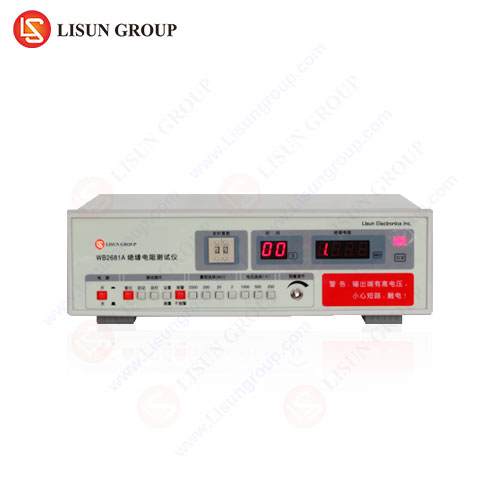
Modern ground resistance testers are sophisticated instruments designed for accuracy, safety, and ease of use. A prime example is the LISUN WB2678A Grounding Resistance Tester, an instrument engineered to comply with international safety and performance standards. Such devices typically employ a dual-integrator design for noise rejection, a critical feature in electrically noisy environments. They operate by generating a specific test frequency or a variable-frequency signal to avoid interference from power-line harmonics and other stray earth currents. The WB2678A, for instance, offers a selectable test frequency of 128 Hz/111 Hz, which helps mitigate the effects of 50 Hz or 60 Hz power system interference. Operational protocols demand strict adherence to safety procedures, including verifying the absence of voltage on the test electrode, using personal protective equipment, and ensuring test leads are in good condition. The instrument’s specifications, such as a measurement range from 0.00 Ω to 2000 Ω with a resolution of 0.01 Ω and a basic accuracy of ±(2.0%+3dgt), define its capability to deliver reliable data across a wide spectrum of applications.
Application-Specific Grounding Verification in Critical Industries
The requirement for reliable grounding spans a diverse range of industries, each with unique standards and failure consequences. In the medical device sector, standards like IEC 60601-1 mandate extremely low earth resistance for patient-connected equipment to prevent micro-shock hazards. For telecommunications equipment, a robust ground is the first line of defense against lightning-induced surges, protecting sensitive switching and routing hardware. Within automotive electronics, particularly in electric vehicle charging infrastructure, grounding integrity ensures user safety and system reliability. The aerospace and aviation components industry requires grounding systems that can withstand extreme environmental conditions while providing a reference for avionics and lightning strike dissipation. Industrial control systems, which manage critical processes, rely on grounding to maintain signal integrity for sensors and actuators and to safely clear faults on motor drives and PLCs. In each case, the grounding resistance tester is the primary tool for validation and compliance.
LISUN WB2678A: A Technical Examination of Capabilities and Deployment
The LISUN WB2678A Grounding Resistance Tester embodies the technical requirements for modern ground verification. Its design incorporates a 4-wire measurement principle, which eliminates the influence of test lead resistance, a significant source of error when measuring very low resistances. This is paramount when testing the grounding systems of electrical components like high-current circuit breakers or the bonding in cable and wiring systems where resistances must be in the milli-ohm range. The instrument offers multiple testing modes: 2-wire for simple checks, 3-wire for the standard Fall-of-Potential method, and 4-wire for high-precision applications. Its robust construction, with an IP40 rating, makes it suitable for field use in various environments, from a factory floor for household appliance production lines to outdoor substations. A key competitive advantage is its data hold function and maximum reading capture, which facilitates operation in hard-to-read locations and ensures that transient values are not missed. Furthermore, its ability to measure soil resistivity directly, by calculating the value based on the Wenner method inputs, streamlines the site assessment process for engineers designing grounding systems for lighting fixtures or telecommunications tower bases.
Specifications Table: LISUN WB2678A Grounding Resistance Tester
| Parameter | Specification |
|---|---|
| Grounding Resistance Range | 0.00Ω ~ 20.00Ω / 0.0Ω ~ 200.0Ω / 0Ω ~ 2000Ω |
| Grounding Voltage Range | 0.0V ~ 200.0V (50Hz/60Hz) |
| Resolution | 0.01Ω / 0.1Ω / 1Ω |
| Basic Accuracy | ±(2.0%+3dgt) |
| Test Frequency | 128 Hz / 111 Hz (Selectable) |
| Test Current | > 20mA (128 Hz) |
| Open Circuit Voltage | ~ 40V max |
| Measurement Method | 2-Wire, 3-Wire, 4-Wire Selective |
| Data Hold / Max Value Hold | Yes |
| Safety Standards | IEC 61010-1, CAT III 300V |
Mitigating Measurement Anomalies and Environmental Interference
Accurate ground resistance measurement is often compromised by real-world conditions. Stray currents and voltages in the earth, often from nearby power systems or cathodic protection, can induce errors. Modern testers combat this with high noise rejection ratios; the WB267A, for example, can maintain accuracy with an AC voltage of up to 20V present in the ground circuit. Another common anomaly is the presence of conductive structures buried parallel to the test setup, such as metallic pipes or concrete-encased electrodes, which can distort the electrical field and lead to false readings. Proper probe placement, as dictated by the 62% rule, is the primary mitigation, but in severely congested areas, the stakeless method may be the only viable option. High soil resistivity itself can be a challenge, as it can require impractically high test currents or voltages to obtain a stable reading. In such scenarios, using a tester with a high open-circuit voltage and selectable test frequencies is necessary to penetrate the high-impedance soil layer.
Adherence to International Standards and Regulatory Compliance Frameworks
Grounding testing is not merely a best practice but a codified requirement in numerous international standards. These standards define the safety and performance benchmarks for equipment and systems. Key standards include:
- IEC 60364-6: Low-voltage electrical installations – Part 6: Verification.
- IEEE Std 81: Guide for Measuring Earth Resistivity, Ground Impedance, and Earth Surface Potentials of a Grounding System.
- NFPA 70 (NEC), Article 250: National Electrical Code requirements for grounding and bonding.
- IEC 61010-1: Safety requirements for electrical equipment for measurement, control, and laboratory use.
Compliance with these standards, which the LISUN WB2678A is designed to facilitate, is mandatory for obtaining certification for products like office equipment, consumer electronics, and household appliances. It provides auditable proof that a product’s grounding system has been validated to the required safety levels, mitigating liability and ensuring market access.
Frequently Asked Questions (FAQ)
Q1: What is the primary advantage of using a 4-wire testing method over a 3-wire method?
The 4-wire method employs separate pairs of leads for injecting current and sensing voltage. This configuration negates the resistance of the test leads and their contact points with the electrodes from the final measurement. It is essential for achieving high-precision readings, particularly when the ground resistance value is very low (e.g., less than 0.5 Ω), as is often required for the grounding of electrical substations or large industrial control systems.
Q2: Can the LISUN WB2678A be used to test the integrity of equipment grounding conductors (the green wire) in a fixed installation?
Yes, the instrument is well-suited for this application. Using the 2-wire or 4-wire method, it can measure the resistance of the protective earth conductor from the equipment’s mains inlet to the grounding terminal. This verifies the continuity and quality of the safety ground path for devices such as industrial machinery, medical devices, and large household appliances, ensuring compliance with safety standards that specify maximum allowable resistance for these conductors.
Q3: Why is the selection of test frequency (128 Hz or 111 Hz) important?
The selection allows the operator to avoid interference from the predominant power system frequencies (50 Hz and 60 Hz) and their harmonics. By choosing a test frequency that is not an integer multiple of the local mains frequency, the instrument’s filtering algorithms can more effectively reject this noise, resulting in a more stable and accurate resistance reading. This is crucial in industrial plants or telecommunications centers where stray earth currents are common.
Q4: What does a “grounding voltage” measurement indicate, and why is it performed?
The grounding voltage function measures any pre-existing AC voltage potential between the earth electrode and the remote earth potential probe. This is a critical safety and preparatory step. A high grounding voltage (e.g., >10V) can indicate hazardous stray currents or a faulty installation and may damage the tester or give unreliable resistance readings. The measurement should always be performed first; if the voltage is too high, the cause must be investigated and mitigated before proceeding with the resistance test.
