








Fundamental Principles of Electrical Grounding and Safety
A reliable grounding system is a non-negotiable cornerstone of electrical safety and system integrity across every sector of modern technology. Its primary function is to provide a controlled, low-resistance path for fault currents and transient overvoltages to safely dissipate into the earth. Without this path, stray currents can elevate metal enclosures and structural components to hazardous voltages, presenting severe electrocution risks, precipitating equipment failure, and causing catastrophic data loss. The efficacy of this system is quantified by its ground resistance, a measure of the opposition encountered by electrical current as it flows from the grounding electrode, through the surrounding soil, and into the earth mass. Minimizing this resistance is paramount, as a lower value ensures that fault currents are shunted away efficiently, allowing protective devices like circuit breakers and fuses to operate promptly. The consequences of inadequate grounding are far-reaching, from subtle data corruption in telecommunications equipment to life-threatening scenarios in medical devices and aviation components.
Quantifying Earth Resistance: The Fall-of-Potential Method
The most recognized and scientifically validated technique for measuring the resistance of a grounding electrode is the Fall-of-Potential method, often executed using a precision ground rod tester. This method is governed by the fundamental principles of Ohm’s Law applied to a complex, multi-layered earth medium. The test configuration involves three primary points: the Earth Electrode under test (X), a Current Probe (C) placed a significant distance away, and a Potential Probe (P) driven into the soil at a strategic point between them.
During operation, the ground rod tester injects a known alternating current (I) between the X and C terminals. This current flows through the earth, establishing an electrical field. The instrument then measures the voltage drop (V) between the X and P terminals. By calculating the ratio V/I, the tester determines the effective resistance of the grounding system. The critical aspect of this method is the placement of the Potential Probe. It must be located at a point where it is outside the effective resistance areas of both the test electrode and the current probe. Achieving this “62% rule” or performing a potential gradient test ensures that the measured voltage represents the true potential rise of the electrode under test, yielding an accurate resistance value. This methodology is explicitly detailed in standards such as IEEE Std. 81 and is the benchmark for verifying grounding system performance in high-stakes environments like electrical substations and cellular tower bases.
Instrumentation for Ground Integrity Verification: The Modern Ground Rod Tester
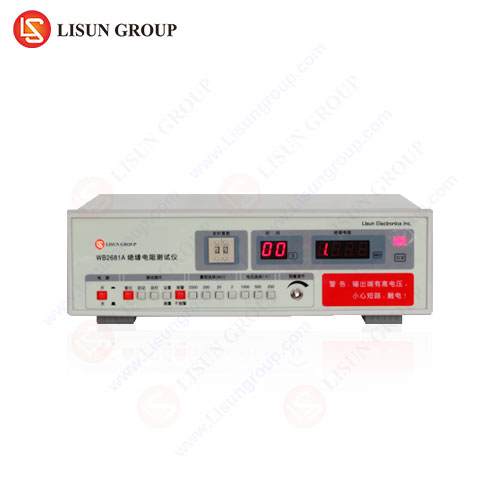
Contemporary ground rod testers, such as the LISUN WB2678A Grounding Resistance Tester, are sophisticated instruments engineered for accuracy, safety, and operational efficiency. These devices have evolved from bulky, manually-operated units into compact, microprocessor-controlled systems capable of performing complex measurements with minimal user intervention. The core architecture of a modern tester typically includes a constant-current AC signal generator, a high-sensitivity voltage sensing circuit, a digital signal processor (DSP) for filtering noise, and a clear digital display.
The LISUN WB2678A, for instance, incorporates advanced features to overcome common field challenges. Its ability to operate at multiple testing frequencies helps to reject interference from power-line harmonics and other stray earth currents, a common issue in industrial and telecommunications settings. Furthermore, instruments of this class often include auxiliary functions for measuring soil resistivity—a critical parameter for designing new grounding systems—and for verifying the continuity of ground conductor connections. Safety is integral to their design, with robust enclosures and circuitry rated to withstand transient overvoltages, ensuring operator protection and equipment durability when testing in electrically noisy environments.
Operational Analysis of the LISUN WB2678A Grounding Resistance Tester
The LISUN WB2678A represents a specific implementation of these principles, designed to meet the rigorous demands of compliance testing and preventive maintenance across diverse industries. Its operational capabilities are defined by a set of key specifications that dictate its application scope and performance limits.
Key Specifications of the LISUN WB2678A:
- Grounding Resistance Range: 0.00Ω to 20.00Ω (with a resolution of 0.01Ω) and 20.0Ω to 200.0Ω.
- Soil Resistivity Range: 0.00Ωm to 1999Ωm.
- Test Signal: Approximately 820Hz, 3mA constant current.
- Accuracy: ±(2% of reading + 5 digits).
- Noise Rejection: Capable of suppressing interference with a signal-to-noise ratio of 80dB.
The testing principle of the WB2678A is a refined application of the Fall-of-Potential method. It generates a stable 820Hz, 3mA AC current, which is injected into the earth circuit. This specific frequency is chosen to be sufficiently different from the standard 50/60Hz power frequency, allowing the instrument’s internal DSP filters to effectively isolate the test signal from ambient electrical noise. This is a critical advantage when testing in facilities with heavy machinery, variable-frequency drives, or near high-voltage power lines. The device measures the resulting voltage drop and automatically calculates and displays the resistance value. Its capability to measure soil resistivity directly, using the Wenner four-pin method, provides invaluable data for engineers designing or expanding grounding grids for new data centers, manufacturing plants, or renewable energy installations.
Industry-Specific Applications for Grounding Verification
The necessity for precise ground resistance testing permeates virtually all fields of electrical and electronic engineering.
- Telecommunications Equipment: Base stations and data centers require extremely low ground resistance (often below 5Ω) to protect sensitive switching equipment from lightning-induced surges and to ensure a stable reference potential for high-speed digital signals, preventing bit errors and hardware damage.
- Medical Devices: In hospitals and clinics, patient-connected equipment such as MRI machines, dialysis units, and surgical monitors must be grounded to imperceptibly low resistance levels. This is mandated by standards like IEC 60601-1 to prevent micro-shock hazards to patients who may be connected to internal electrical pathways.
- Automotive Electronics: While vehicles themselves are mobile, the manufacturing, testing, and charging infrastructure for electric vehicles (EVs) demands robust grounding. EV charging stations, in particular, must have a verified ground connection to safeguard users during the high-power transfer process.
- Aerospace and Aviation Components: Grounding systems for hangars, radar installations, and communication towers are critical for lightning protection. Furthermore, the assembly and testing of avionics require static-dissipative workstations with verified ground paths to prevent electrostatic discharge (ESD) damage to sensitive components.
- Industrial Control Systems: Programmable Logic Controllers (PLCs), motor drives, and distributed control systems (DCS) in factory automation are vulnerable to electrical noise on ground lines. Verifying a clean, low-resistance ground ensures operational reliability and prevents spurious shutdowns that can halt production lines.
- Lighting Fixtures: High-mast lighting, streetlights, and architectural lighting systems, especially those with metal poles, require effective grounding to protect against insulation failures and lightning strikes, ensuring public safety.
Methodological Protocols for Accurate Field Measurements
Achieving a measurement that is both accurate and representative of the grounding system’s true performance requires adherence to a strict methodological protocol.
- Pre-Test Site Assessment: Visually inspect the ground electrode and connecting conductors for signs of corrosion or physical damage. Verify that the electrode is disconnected from the live electrical system to prevent equipment damage and ensure operator safety.
- Probe Placement Strategy: For the Fall-of-Potential test, the current probe (C) should be placed at a distance of at least five times the diagonal length of the grounding system under test (e.g., for a single rod, 5 times its length). A greater distance is preferable. The potential probe (P) is then placed at incremental distances between X and C (e.g., 20%, 40%, 60%, 80% of the C distance) to plot a resistance curve and identify the true plateau, or simply at the traditional 62% point as a starting reference.
- Connection and Instrument Setup: Connect the test leads to the WB2678A: the X terminal to the electrode under test, the P terminal to the potential probe, and the C terminal to the current probe. Ensure all connections are secure and free of corrosion. Power on the instrument and select the grounding resistance measurement mode.
- Execution and Data Interpretation: Initiate the test. The WB2678A will display the measured resistance. It is prudent to take multiple readings with slight variations in the P probe position to confirm a stable reading, indicating a valid measurement. Record the result along with environmental conditions like soil moisture and temperature, as these factors influence resistivity.
Mitigating Common Sources of Measurement Error
Several factors can compromise the validity of a ground resistance measurement, and a competent technician must be equipped to identify and mitigate them.
- Proximity to Parallel Grounds: If the test electrode is connected to other underground metallic structures (pipes, cable sheaths, other ground rods), the measured value will be a composite of the entire network, not the individual rod. Temporary isolation may be necessary for a true assessment.
- High Soil Resistivity: Rocky, sandy, or dry soil has inherently high resistivity, making it difficult to achieve a low resistance reading. This is a design issue often remedied with multiple rods, ground enhancement materials, or deeper-driven electrodes.
- Stray Earth Currents and Electromagnetic Interference (EMI): As noted, the WB2678A’s frequency-selective measurement and high noise rejection are designed to counter this. If interference persists, testing at a different frequency (if available) or averaging over a longer period can help.
- Insufficient Probe Spacing: The most common error is failing to place the current probe far enough away. This causes the resistance spheres of the electrode and the probe to overlap, leading to an artificially low and inaccurate reading.
Regulatory Frameworks and Compliance Standards
Grounding system performance is not a matter of best practice but of legal and regulatory compliance. A multitude of international and national standards dictate the required resistance values and testing methodologies.
- National Electrical Code (NFPA 70): Mandates that the resistance of a single electrode exceeding 25Ω must be supplemented by an additional electrode.
- IEEE Std. 81-2012: The definitive “Guide for Measuring Earth Resistivity, Ground Impedance, and Earth Surface Potentials of Grounding Systems.”
- IEC 61557-5: Specifies the performance requirements for equipment used to measure the resistance of equipment grounding conductors and earth electrodes.
- Telecommunications: Standards from bodies like ATIS and Telcordia often specify resistance values below 5Ω for central office and cell site grounding.
Compliance with these standards, verified using a certified instrument like the LISUN WB2678A, is essential for obtaining occupancy permits, passing safety inspections, and validating equipment warranties.
Technical Advantages of Modern Testing Apparatus
When evaluating a ground rod tester, several technical differentiators separate basic models from professional-grade instruments. The LISUN WB2678A incorporates design features that directly address the limitations of legacy equipment. Its use of a constant-current test signal ensures stability across varying soil conditions. The digital filtering and high noise rejection ratio provide confidence in measurements taken in electrically hostile environments, such as industrial plants or near railway electrification systems. The inclusion of soil resistivity calculation as a built-in function eliminates the need for manual calculations or a separate meter, streamlining the workflow for engineers who are both testing existing systems and designing new ones. The robust construction and clear, intuitive interface reduce the potential for operator error and enhance the instrument’s longevity in demanding field service conditions.
Frequently Asked Questions (FAQ)
Q1: What is the maximum ground resistance value considered “safe” or acceptable?
There is no single universal value, as acceptability is determined by the application and governing local electrical codes. The NEC suggests that a single electrode with a resistance over 25Ω requires a supplemental electrode. However, for sensitive sites like telecommunications facilities or hospital operating rooms, specifications often demand a value of 5Ω or even 1Ω. Always consult the project specifications and applicable local standards.
Q2: Can the WB2678A be used to test the grounding of a single electrical outlet in a building?
No, the WB2678A is designed for testing dedicated grounding electrodes like rods, plates, and grids using the 3-pole Fall-of-Potential method. Testing the safety of a power outlet’s ground wire is typically performed with a different class of instrument, such as a socket tester or a loop impedance tester, which measures the Earth Fault Loop Impedance.
Q3: Why does my ground resistance measurement fluctuate significantly during a test?
Significant fluctuation typically indicates strong external electrical interference or poor contact with the soil. Ensure all test lead connections are tight and that the auxiliary probes (especially the potential probe P) are driven into moist soil. Using the WB2678A’s noise rejection capability should stabilize the reading. If fluctuation persists, try repositioning the current probe (C) to a greater distance.
Q4: How does soil moisture and temperature affect ground resistance measurements?
Soil resistivity is highly dependent on moisture content and temperature. Dry, frozen soil can have dramatically higher resistivity than damp, warm soil. Therefore, the worst-case scenario for a grounding system is often during a dry freeze. It is good practice to test under a variety of seasonal conditions and to design the system to meet specifications under the most adverse expected conditions.
Q5: What is the primary purpose of the soil resistivity measurement function?
Soil resistivity data is the foundational input for designing a new or expanded grounding system. By taking measurements at different depths and locations, an engineer can model the soil structure and calculate the number, depth, and arrangement of ground rods required to achieve a target resistance before installation begins, saving significant time and cost.
