








Fundamental Principles of Earth Electrode Resistance
The primary function of an earth electrode, or grounding system, is to provide a predetermined path for fault currents to dissipate into the mass of the earth. This action serves to protect personnel from electric shock, ensure the correct operation of protective devices, and provide a reference potential for electrical systems and electronic equipment. The efficacy of this system is quantified by its earth resistance, a measure of the opposition encountered by current flowing from the electrode into the surrounding soil. This resistance is not a property of the electrode alone, but a composite value of the entire path, including the electrode-to-soil contact resistance, the resistance of the soil itself in the immediate vicinity of the electrode, and the resistance of the surrounding earth volume.
The fundamental principle governing earth resistance measurement is derived from Ohm’s Law. In practice, a known current (I) is injected into the earth via the electrode under test, and the resulting voltage potential (V) developed between the electrode and a reference point in the earth is measured. The earth resistance (R) is then calculated as R = V/I. Achieving an accurate measurement requires a sophisticated understanding of soil resistivity and the deployment of auxiliary test electrodes to isolate the specific resistance of the grounding system under evaluation. Soil resistivity, measured in ohm-meters (Ω·m), is a critical variable that depends on soil composition, moisture content, temperature, and chemical concentration, making it a dynamic and often non-uniform parameter.
Methodologies for Measuring Grounding System Integrity
Several established methodologies exist for measuring earth resistance, each with specific applications and limitations. The most prevalent technique, and the one employed by modern digital testers like the LISUN WB2678A, is the Fall-of-Potential method. This method necessitates the use of two auxiliary electrodes: a current electrode (C) placed a significant distance from the earth electrode under test (E), and a potential electrode (P) driven into the earth at various intervals along a straight line between E and C. By plotting the resistance value against the distance of P from E, a curve is generated. The region where this curve plateaus indicates the true resistance of the earth electrode, as the influence of the other electrodes is minimized.
For scenarios where deploying auxiliary electrodes over large distances is impractical, such as in dense urban substations or for testing telecommunication tower footings, the Clamp-On method is often utilized. This technique uses a specialized transformer that clamps around the grounding conductor, inducing a test current and measuring the resulting voltage without the need for disconnection or auxiliary stakes. However, its accuracy is contingent upon the existence of a low-resistance parallel path to ground, which is not always present. A third method, the Selective or Stakeless method, integrated into advanced testers, allows for the measurement of a specific earth electrode within a complex, multi-electrode grounding grid by using a current clamp to isolate the test current path, thereby enhancing precision in interconnected systems.
Architectural Design of a Modern Grounding Resistance Tester
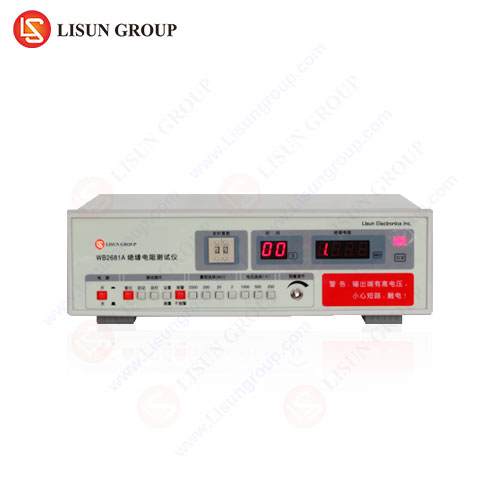
A contemporary grounding resistance tester, such as the LISUN WB2678A, is a sophisticated instrument engineered for precision, safety, and operational efficiency. Its architectural design incorporates several key subsystems. A stable, alternating constant-current source is fundamental, typically operating at a frequency distinct from the power line frequency (e.g., 128 Hz or 111 Hz) to mitigate the effects of stray AC currents and galvanic (DC) noise in the soil. This ensures that the measured signal can be effectively isolated and processed.
The instrument’s measurement core consists of high-impedance input circuits for voltage sensing and precision analog-to-digital converters. These components work in concert to accurately measure the often minute voltage drops across the test electrodes. Advanced digital signal processing (DSP) algorithms are then applied to filter out noise and calculate the resistance value. The user interface typically combines a rotary switch for function selection, a large, high-contrast LCD for data display, and tactile buttons for operational control. The physical construction is ruggedized, featuring robust casing and sealed connectors to withstand harsh field environments. Internally, robust surge protection circuits are incorporated to safeguard the instrument’s sensitive electronics from transient overvoltages that may be encountered during testing on power systems.
Operational Specifications of the LISUN WB2678A Analyzer
The LISUN WB2678A Grounding Resistance Tester is engineered to deliver high-precision measurements across a wide range of applications. Its specifications reflect a design philosophy centered on versatility and reliability in demanding field conditions.
| Specification Category | Detailed Parameters |
|---|---|
| Grounding Resistance | Measurement Range: 0.00Ω to 2000Ω Accuracy: ±(2% + 5 digits) for 0.00Ω-20.00Ω; ±(2% + 3 digits) for 20.0Ω-200.0Ω; ±(4% + 3 digits) for 200Ω-2000Ω |
| Soil Resistivity | Measurement Range: 0.00Ωm to 9999kΩm Calculation: ρ = 2πaR (where ‘a’ is probe spacing) |
| AC Earth Voltage | Measurement Range: 0.0V to 200.0V Frequency Bandwidth: 40Hz to 200Hz, < 5% Total Harmonic Distortion (THD) |
| Test Frequency | 128 Hz / 111 Hz (Automatic or Manual Selection) |
| Test Current | > 20mA (for resistance measurements) |
| Open Circuit Voltage | ~50V (AC) |
| Safety Standards | Compliant with IEC 61010-1 (CAT III 600V) |
The instrument’s capability to measure soil resistivity directly is a critical feature for engineers designing new grounding systems, as it allows for the precise calculation of the required electrode type, depth, and configuration to achieve a target resistance value before installation commences.
Ensuring Measurement Accuracy in Electrically Noisy Environments
A significant challenge in field measurements is the presence of electrical noise, which can severely distort readings. This noise can originate from power line harmonics, stray ground currents from other equipment, or telluric currents. The WB2678A incorporates multiple strategies to mitigate these effects. The use of a specific test frequency (128 Hz/111 Hz) allows the instrument’s digital filters to reject the predominant 50/60 Hz power line interference. Furthermore, its high test current capability (>20mA) ensures a strong signal-to-noise ratio, allowing the valid measurement signal to be clearly distinguished from background noise.
The instrument’s ability to measure AC earth voltage prior to resistance testing is a crucial diagnostic step. By quantifying the existing voltage between the H (E) and S (P) terminals, an operator can assess the noisiness of the environment. If this voltage exceeds a safe or practical threshold, it may indicate a compromised measurement location or the need to investigate the source of the stray voltage before proceeding. Advanced synchronization and phase-sensitive detection within the DSP further enhance noise immunity, ensuring reliable data acquisition even in electrically hostile substations or industrial plants.
Application in Electrical Safety and Equipment Compliance
The verification of low earth resistance is a non-negotiable requirement for electrical safety and equipment compliance across numerous industries. In the domain of Household Appliances and Consumer Electronics, international safety standards such as IEC 60335-1 mandate rigorous ground continuity and earth bond testing to prevent shock hazards should a fault occur. A product like the WB2678A is used in quality assurance labs to verify that the grounding point on a washing machine, air conditioner, or power tool exhibits a sufficiently low resistance to ensure protective circuit breakers will operate correctly.
For Electrical and Electronic Equipment manufacturers, including those producing Industrial Control Systems, Office Equipment, and Electrical Components (e.g., switches, sockets, distribution boards), the integrity of the protective earth terminal is paramount. The tester is employed in production line end-of-test cycles to validate that every unit shipped meets the stipulated safety criteria, often with programmable pass/fail limits for automated testing protocols. In the Automotive Electronics sector, as vehicles incorporate higher-voltage systems for electrification, the grounding of charging infrastructure and onboard power electronics must be validated to standards like ISO 6469-3, making precise earth resistance measurement a critical step in the manufacturing and installation process.
Critical Role in Telecommunications and Power Infrastructure
The reliability of Telecommunications Equipment and power infrastructure is intrinsically linked to effective grounding. Telecommunication base stations, data centers, and signal repeater towers require exceptionally low earth resistance to provide a reference plane for sensitive digital electronics, to protect equipment from lightning-induced surges, and to dissipate fault currents. The WB2678A, with its high-accuracy ranges and noise rejection capabilities, is instrumental in the commissioning and periodic maintenance of these sites. Its ability to perform selective testing is particularly valuable for isolating and measuring individual ground rods within a complex multi-tower grounding grid without the need for physical disconnection.
In power generation and distribution substations, the grounding grid is a critical safety system. Its failure can lead to dangerous step and touch potentials. Regular testing with a precision instrument is required to ensure the grid’s resistance remains within design specifications over time, accounting for factors like soil drying, corrosion, and seasonal variation. The tester’s robust construction and high-voltage safety rating (CAT III 600V) make it suitable for use in these high-energy environments.
Specialized Uses in Aerospace and Medical Device Manufacturing
In highly specialized fields such as Aerospace and Aviation Components and Medical Devices, grounding requirements extend beyond personnel safety to encompass the mitigation of electromagnetic interference (EMI) and the assurance of signal integrity. For Medical Devices, standards such as IEC 60601-1 stipulate strict limits on earth leakage currents and mandate robust grounding systems. The WB2678A is used to validate the grounding integrity of device chassis, surgical tables, and diagnostic imaging equipment, ensuring that no hazardous voltages are present and that the equipment operates without introducing spurious noise into sensitive biomedical signals.
Aerospace applications demand similar rigor. The grounding of avionics bays, flight control systems, and communication equipment on aircraft must be meticulously verified to prevent malfunctions caused by static discharge or lightning strikes. The precision and reliability of the measurement data provided by instruments like the WB2678A are essential for certifying components against stringent standards like DO-160. In the manufacturing of Cable and Wiring Systems, the tester is used to verify the continuity and resistance of the grounding conductor within power and control cables, a fundamental parameter for the safe operation of the entire electrical system they will serve.
Comparative Analysis of Testing Techniques and Instrument Selection
Selecting the appropriate testing methodology is as crucial as selecting the instrument itself. The Fall-of-Potential method, enabled by the WB2678A, is considered the benchmark for accuracy and is the preferred method for certifying new installations or for detailed investigative work. Its primary drawback is the requirement for sufficient space to place the auxiliary electrodes at the correct distances, which can be a limitation in congested sites.
The Clamp-On method offers unparalleled speed and convenience for periodic checks on installed electrodes that are part of a larger, interconnected grounding network, such as those found on utility poles or within building foundations. However, its fundamental limitation is its inability to provide a measurement if there is no alternative return path for the induced current, rendering it ineffective for isolated electrodes. The Selective method represents a hybrid approach, combining the use of auxiliary stakes with a current clamp to isolate individual electrodes within a network, thus offering a good balance of accuracy and convenience for maintenance in complex grids. The WB2678A’s design, which supports the standard 3-pole and 4-pole Fall-of-Potential methods as well as selective testing, provides the versatility needed for a comprehensive grounding assessment program.
Interpretation of Test Results and Diagnostic Procedures
Obtaining a measurement is only the first step; correct interpretation is vital. A resistance value that is higher than expected or one that shows a significant increase from a previous baseline measurement indicates a problem. Potential causes include poor connections at the electrode, corrosion of the conductor, a reduction in soil conductivity due to freezing or drought, or physical damage to the grounding system.
A systematic diagnostic procedure is recommended. This begins with verifying the test setup: ensuring all connections are clean and tight, and that the auxiliary electrodes have been placed at adequate distances. If the initial reading is high, the operator can pour water around the auxiliary electrodes to improve contact resistance and retest. For a more in-depth analysis, measuring soil resistivity at varying probe spacings (using the Wenner four-pin method) can provide a soil resistivity profile, revealing changes with depth that may inform decisions about driving electrodes deeper or using chemical treatments to lower the overall resistance. The data logging capabilities of advanced testers facilitate trend analysis, allowing engineers to track the performance of a grounding system over time and schedule proactive maintenance before performance degrades to a critical level.
Frequently Asked Questions
What is the fundamental difference between the 3-pole and 4-pole measurement methods?
The 3-pole method is suitable for most standard applications where the resistance of the test leads and their connections is negligible compared to the earth resistance being measured. The 4-pole method introduces a separate pair of leads specifically for sensing the voltage potential. This configuration eliminates the voltage drop caused by the resistance of the current-injection leads and their contact points, providing a more accurate measurement, particularly when testing very low-resistance grounding grids or when using long test leads where lead resistance could become a significant source of error.
Why does the measured earth resistance value sometimes fluctuate during testing?
Fluctuations can be attributed to several factors. The presence of variable stray AC currents in the ground is a common cause. Changes in the contact resistance between the auxiliary electrodes and the soil, potentially due to soil particle movement or varying moisture content, can also induce instability. Furthermore, if the potential probe is placed within the effective resistance areas of either the electrode under test or the current probe, the measurement will be unstable and inaccurate. Ensuring proper electrode spacing and using the instrument’s noise-filtering capabilities are key to obtaining a stable reading.
How often should a grounding system be tested and certified?
The frequency of testing is dictated by the criticality of the installation, local electrical safety codes, and the observed rate of degradation. Critical infrastructure like power substations and telecommunication towers typically require annual testing. Commercial and industrial facilities may follow a 1 to 3-year cycle. It is strongly recommended to perform a baseline test upon initial installation and then after any significant geological event (e.g., drought, flood, earthquake) or major construction activity nearby that could disturb the soil or damage the grounding conductors.
Can the WB2678A be used to test the integrity of lightning protection systems?
Yes, absolutely. A lightning protection system (LPS) is fundamentally a specialized form of grounding system designed to safely conduct immense surge currents to earth. The same principles of low earth resistance apply. The WB2678A is used to measure the resistance of the lightning down-conductor earth electrodes. Ensuring these electrodes have a sufficiently low resistance is critical to preventing dangerous side-flashing and voltage build-up that could damage structures and equipment during a lightning strike. Compliance with standards such as IEC 62305 often mandates specific resistance values for LPS earth termination systems.
