








Understanding Acceptable Ground Resistance Levels in Electrical Systems
The Critical Role of Grounding in System Integrity and Safety
Grounding serves as a foundational pillar within any electrical or electronic system, providing a critical reference point for voltage stabilization and a controlled, low-impedance path for fault currents. Its primary objectives are threefold: to ensure personnel safety by preventing hazardous voltage potentials on equipment enclosures, to guarantee the reliable operation of protective devices such as circuit breakers and fuses, and to establish a stable reference plane that mitigates electromagnetic interference (EMI) for sensitive circuitry. The efficacy of a grounding system is inversely proportional to its resistance to earth; a lower ground resistance equates to a more effective and safer system. Consequently, the quantification and validation of this resistance parameter is not merely a recommended practice but a non-negotiable requirement enshrined in international and national electrical codes, safety standards, and equipment certification protocols.
Defining Acceptable Thresholds: A Standards-Based Framework
The establishment of “acceptable” ground resistance levels is not arbitrary but is derived from rigorous engineering analysis of fault current magnitude, protective device coordination, and step/touch potential hazards. These thresholds are codified within standards promulgated by organizations such as the International Electrotechnical Commission (IEC), the Institute of Electrical and Electronics Engineers (IEEE), the National Fire Protection Association (NFPA) via the National Electrical Code (NEC), and Underwriters Laboratories (UL). The specific target value is highly context-dependent, varying with system voltage, fault current capacity, and the sensitivity of the connected equipment.
A commonly cited benchmark for electrical power systems and building installations is a maximum resistance of 25 ohms, as referenced in NEC Article 250.53. This value is predicated on ensuring sufficient fault current flows to rapidly actuate overcurrent protection devices. For more sensitive applications, such as telecommunications central offices, substations, or sites with sensitive medical imaging equipment, target values often drop to 5 ohms or even 1 ohm. In the realm of electronic equipment manufacturing and testing—spanning industrial control systems, automotive electronics, and aerospace components—product safety standards (e.g., IEC 62368-1, IEC 60601-1) frequently mandate that the protective earth resistance of the equipment itself, measured from any accessible conductive part to the earth pin of the supply plug, shall not exceed 0.1 ohms or 0.2 ohms. This stringent requirement ensures that in the event of an internal insulation failure, the fault current is shunted safely to ground without elevating the chassis to a dangerous potential, even with high-impedance earth connections downstream.
Consequences of Inadequate Grounding Resistance
Deviations from prescribed ground resistance limits precipitate a cascade of operational and safety failures. Elevated resistance directly impairs the performance of overcurrent protective devices. A high-impedance path restricts fault current, potentially preventing circuit breakers from tripping within their designed time-current curve, thereby allowing persistent arcing, thermal damage, and fire initiation. From a safety perspective, insufficient grounding can lead to hazardous step and touch potentials, where voltage gradients in the earth or on equipment surfaces present severe electrocution risks to personnel.
For electronic systems, poor grounding manifests as performance degradation rather than catastrophic failure, though the implications can be equally severe. In telecommunications equipment and data centers, ground loops and elevated common-mode noise can induce bit errors, data corruption, and network downtime. Within automotive electronics, electromagnetic compatibility (EMC) is paramount; inadequate grounding can exacerbate electromagnetic emissions and susceptibility, disrupting controller area network (CAN) bus communications or sensor accuracy. Medical devices, particularly those classified as Applied Parts Type CF for cardiac applications, demand exceptionally low leakage currents, which are directly contingent upon a robust, low-resistance ground connection. In aerospace and aviation components, where reliability is mission-critical, grounding deficiencies can lead to intermittent faults, static discharge damage, or interference with navigation and communication systems.
Methodologies for Ground Resistance Measurement
Accurate assessment of grounding system integrity necessitates specialized instrumentation and methodologies. The most prevalent technique, the Fall-of-Potential method, involves a dedicated ground resistance tester. This instrument injects a known alternating current (I) between the electrode under test (E) and a remote current probe (C). A second potential probe (P) is placed at successive intervals along a straight line between E and C, measuring the voltage drop (V). Ground resistance (Rg) is derived from Ohm’s Law (Rg = V/I). The three-terminal test configuration is standard for evaluating single grounding electrodes or small systems.
For large, complex grounding grids—such as those at substations, cellular tower bases, or industrial plants—the more advanced four-terminal or clamp-on testing methods may be employed. The selection of test frequency is also crucial; many modern testers use a frequency other than the power line frequency (50/60 Hz) to avoid interference from stray ground currents, a feature essential for accurate measurements in electrically noisy environments like manufacturing facilities or urban infrastructure.
Instrumentation for Precision: The WB2678A Grounding Resistance Tester
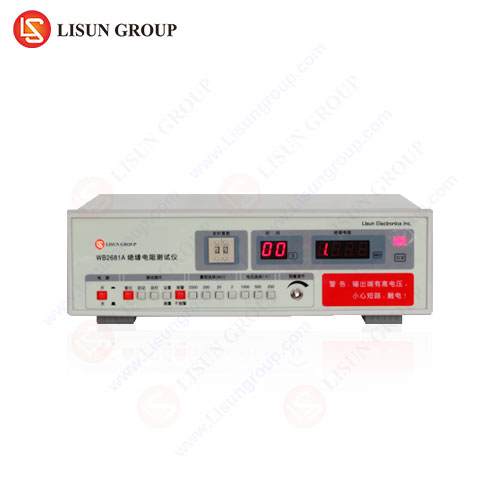
The accurate verification of ground resistance, both for installed electrodes and the protective earth continuity of manufactured equipment, demands instrumentation of high precision, robustness, and operational clarity. The LISUN WB2678A Grounding Resistance Tester exemplifies such a tool, engineered to address the rigorous demands of compliance testing across multiple industries.
The WB2678A operates on the classic 3-pole or 2-pole Fall-of-Potential measurement principle, offering a selectable test frequency to mitigate the influence of AC interference. Its measurement range is extensive, typically spanning from 0.00 Ω to 30.00 kΩ, with a resolution of 0.01 Ω in its lowest range, making it suitable for verifying both the sub-ohm requirements of appliance safety and the higher-resistance values of soil electrodes. The instrument incorporates a significant open-circuit voltage and short-circuit current, ensuring reliable measurements even on high-impedance or long test lead setups. Key features often include data hold, MAX/MIN/AVG recording, and an audible continuity buzzer for quick checks. Its design prioritizes user safety, with robust construction and compliance with relevant measurement category (CAT) ratings for overvoltage protection.
Industry-Specific Applications and Compliance Verification
The utility of precise ground resistance testing permeates the entire lifecycle of electrical and electronic goods, from R&D and production line testing to field installation and periodic maintenance.
In the Electrical and Electronic Equipment and Household Appliances sectors, production lines utilize testers like the WB2678A to perform 100% protective earth continuity tests on products such as refrigerators, washing machines, and power tools. A typical test involves applying a low-voltage, high-current AC signal between the appliance’s earth pin and all accessible conductive surfaces, verifying resistance is below 0.1 Ω or 0.2 Ω as per IEC 60335-1. This non-destructive test is a mandatory checkpoint before certification marks (UL, CE, GS) can be applied.
For Automotive Electronics manufacturers, grounding integrity is vital for EMC and functional safety (ISO 26262). Testers verify the resistance of grounding straps from the engine block to chassis, or within electronic control unit (ECU) mounting points, ensuring a reliable reference plane that minimizes noise and ensures sensor signal fidelity.
Lighting Fixture producers, especially for high-power LED luminaires or outdoor fixtures, must ensure Class I products have a robust earth connection. The WB2678A can test the connection from the luminaire’s earth terminal to its metal housing, guarding against corrosion or poor assembly leading to high resistance.
Within Industrial Control Systems panels, the bonding resistance between door panels, cabinet frames, and the main grounding busbar must be minimal to ensure equipotential bonding, a critical defense against arc flash hazards and for shielding sensitive PLCs and drives from interference.
Telecommunications Equipment installers use ground resistance testers to validate the tower or shelter ground grid before equipment installation, targeting sub-5-ohm resistance to protect sensitive base station electronics from lightning-induced surges and to maintain signal integrity.
Medical Device manufacturers adhere to the stringent requirements of IEC 60601-1. Testers like the WB2678A are employed in quality assurance labs to measure patient leakage currents, which are intrinsically linked to the protective earth resistance of the device. A failure to maintain below 0.1 Ω could result in leakage currents exceeding the 10 μA limit for CF-type equipment.
Aerospace and Aviation Components require exhaustive testing for flightworthiness. Grounding resistance checks are performed on avionics chassis, antenna mounts, and fuel system components to prevent static discharge and ensure proper lightning strike current dissipation, as outlined in standards like DO-160.
For Cable and Wiring System producers, the tester can verify the continuity and resistance of the grounding conductor within a cable assembly, a critical parameter for power distribution cables.
Strategic Advantages of Modern Ground Resistance Test Instrumentation
The competitive landscape for test and measurement equipment rewards instruments that deliver not only accuracy but also operational efficiency, durability, and data integrity. Advanced testers offer distinct advantages. Their digital signal processing and noise rejection algorithms enable stable, repeatable readings in electromagnetically hostile industrial environments where analog meters would be unreadable. Ergonomic design, clear backlit displays, and simple two- or three-button operation reduce operator error and training time on high-throughput production lines. Data logging capabilities, sometimes with Bluetooth connectivity, allow for the automatic recording of test results, creating auditable trails for quality management systems (ISO 9001) and regulatory compliance documentation. The robust construction, with protective holsters and high-impact casings, ensures longevity in field service conditions, from construction sites to utility substations. Finally, compliance with international safety standards (IEC 61010) for measurement categories provides assurance that the instrument itself will not become a hazard when testing energized systems or in proximity to high-energy transients.
Establishing a Proactive Grounding Integrity Program
A systematic approach to grounding extends beyond initial installation verification. A comprehensive program includes design specification review, acceptance testing upon installation, and a schedule of periodic retesting. Environmental factors—soil composition, moisture content, temperature fluctuations, and chemical corrosion—can degrade grounding electrode performance over time. Therefore, grounding systems for critical infrastructure should be tested at regular intervals, such as annually or biannually, with results trended to predict maintenance needs. The integration of precise, reliable test equipment like the WB2678A into this program transforms grounding maintenance from a reactive, compliance-driven task into a proactive, data-informed component of asset management and risk mitigation.
Frequently Asked Questions (FAQ)
Q1: What is the primary difference between testing the resistance of a grounding electrode (earth rod) and the protective earth continuity of an appliance?
The tests measure different parts of the system with different target values. Electrode testing (e.g., using the 3-pole method) evaluates the resistance between the metal rod and the surrounding soil, with targets often between 1-25 Ω. Protective earth continuity testing applies a high current (typically 10A or 25A) between the appliance’s earth pin and its exposed conductive parts to verify the integrity of the internal bonding, with a pass/fail threshold usually at 0.1 Ω or 0.2 Ω. The WB2678A is capable of performing both types of measurements.
Q2: Why does the WB2678A use an AC test signal instead of DC for resistance measurement?
Using AC, specifically at a frequency different from the power line (e.g., 128 Hz, 111 Hz), prevents polarization effects that can occur at the electrode-soil interface with DC, which would give inaccurate readings. Furthermore, the selected frequency helps the instrument’s filters reject interference from 50/60 Hz power systems and their harmonics, ensuring accuracy in noisy electrical environments.
Q3: Can the WB2678A be used to test grounding in energized or live environments?
The instrument is designed to measure ground resistance by injecting its own test signal. It must be connected to de-energized electrodes or systems for safety and accuracy. However, its input circuits are designed with protection to withstand typical induced voltages and transients encountered near live power systems, as indicated by its Measurement Category (CAT) rating. Always consult the user manual for specific safety precautions and voltage limits.
Q4: How often should the grounding resistance of a fixed installation be re-tested?
The frequency is dictated by the criticality of the installation and local regulations. For commercial and industrial power systems, annual testing is a common baseline. For telecommunications sites, substations, and hospital critical power systems, testing may be semi-annual or following any major electrical storm or ground disturbance. A best practice is to establish a baseline measurement at installation and monitor for trends of increasing resistance over subsequent tests.
Q5: What are the consequences of using test leads that are too long, too thin, or damaged?
Inferior test leads introduce additional series resistance and are more susceptible to induced noise, both of which can significantly corrupt measurement accuracy, leading to falsely high resistance readings. Always use the manufacturer-specified test leads and accessories, and regularly inspect them for insulation damage or connector corrosion to ensure measurement integrity.
