







The Essential Guide to Hipot Testing for Product Safety Compliance
Introduction to Dielectric Withstand Verification
In the global landscape of electrical and electronic product manufacturing, ensuring end-user safety and regulatory compliance is a non-negotiable prerequisite. Among the suite of validation procedures mandated by international safety standards, the Dielectric Withstand Voltage Test, commonly termed the “Hipot” (High Potential) test, stands as a cornerstone evaluation. This test serves as a critical stress assessment, verifying the adequacy of a product’s electrical insulation system to withstand transient overvoltage conditions without breakdown. Its primary objective is not to evaluate operational performance under normal conditions, but to proactively identify latent defects—such as insufficient creepage and clearance distances, insulation voids, contaminated PCB traces, or compromised component integrity—that could lead to electric shock, fire hazard, or equipment failure during the product’s operational lifecycle. This guide provides a comprehensive technical examination of hipot testing methodologies, applicable standards, and implementation strategies across diverse industries, with a focus on achieving robust safety compliance.
Fundamental Principles of Dielectric Strength Evaluation
The core principle of a hipot test involves applying a significantly elevated AC or DC voltage between components that are normally isolated from each other during operation—typically between current-carrying conductors (live parts) and accessible conductive parts (ground or enclosure). This applied voltage stress is maintained for a specified duration, as defined by the relevant product safety standard. The test apparatus, a hipot tester, meticulously monitors the resultant leakage current flowing through the insulation. A passing result is indicated when the insulation withstands the applied voltage without experiencing a dielectric breakdown, and the measured leakage current remains below a prescribed threshold.
The selection between AC and DC hipot testing is dictated by the application and standard requirements. AC testing, performed at power frequency (e.g., 50/60 Hz), subjects the insulation to a stress that closely simulates real-world operational and fault conditions, including peak voltage stresses. It is the predominant method for most line-powered equipment. DC hipot testing applies a unidirectional high voltage, which results in a purely resistive leakage current, eliminating capacitive charging currents. This makes it suitable for testing components with high intrinsic capacitance, such as long cable runs, large motors, or complex power supplies in medical devices and industrial controls, where AC testing would necessitate an impractically high current capacity from the tester.
Interpretation of Standards: IEC, UL, and Other Regulatory Frameworks
Hipot testing parameters are not arbitrary; they are rigorously defined by international and national safety standards. Key standards include the IEC 60335 series for household appliances, IEC 60601 for medical electrical equipment, IEC 60950 (superseded by IEC 62368-1 for ICT/AV equipment), and IEC 61010 for laboratory and industrial control equipment. Underwriters Laboratories (UL) standards, such as those in the UL 60065, UL 60950, and UL 61010 series, largely harmonize with IEC requirements but may contain specific national deviations.
These standards specify the test voltage (often a function of the working voltage plus a margin, e.g., 1000 V + 2 x working voltage), the application duration (commonly 60 seconds for type tests, 1 second for production-line tests), and the maximum permissible leakage current (typically ranging from 0.5 mA to 10 mA depending on the product class and standard). For instance, IEC 60601-1 for medical devices stipulates particularly stringent leakage current limits due to the direct patient connection scenarios. A thorough understanding and correct application of the specific clause within the applicable standard is paramount for valid compliance testing.
The WB2671A Withstand Voltage Tester: A Technical Analysis
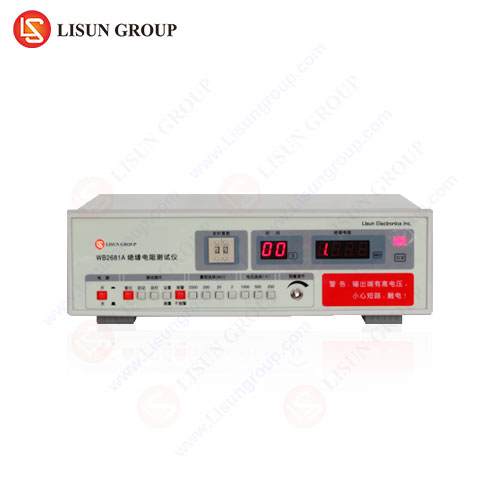
For manufacturers requiring precise, reliable, and safe hipot testing, instrumentation such as the LISUN WB2671A Withstand Voltage Test System provides a dedicated solution. The WB2671A is engineered to perform comprehensive AC and DC dielectric strength tests, integrating advanced measurement capabilities with operator safety features.
The instrument operates on the principle of applying a user-programmable high voltage to the Device Under Test (DUT) while continuously sampling the leakage current via a precision measurement circuit. Its microcontroller compares the real-time current against the preset upper limit (trip current). If the current exceeds this limit or if an arc (flashover) is detected, the tester automatically and instantaneously (within milliseconds) cuts off the output voltage, classifies the test as a failure, and provides visual and audible alarms. This rapid shutdown is critical for preventing damage to marginally defective units and for maintaining laboratory safety.
Specifications and Functional Capabilities of the WB2671A System
The WB2671A is characterized by a suite of technical specifications designed for laboratory and high-volume production environments:
- Test Voltage: AC: 0–5 kV / 0–20 kV (model dependent); DC: 0–6 kV / 0–24 kV (model dependent).
- Voltage Accuracy: Typically ± (2% of reading + 0.5% of full scale).
- Current Measurement Range: From microamperes (µA) to milliamperes (mA), with high resolution for detecting subtle insulation degradation.
- Ramp Function: Allows programmable voltage rise time (ramp-up) and fall time (ramp-down), essential for testing capacitive loads like automotive wire harnesses or switch-mode power supplies without causing inrush current trips.
- Dwell Time: Programmable test duration from 1 to 999 seconds.
- Arc Detection: High-frequency sensing circuitry to identify partial discharges or sparking, a failure mode not always caught by simple current threshold monitoring.
- Interfaces: Typically includes RS232, USB, or GPIB for integration into automated test stations and data logging systems, crucial for traceability in medical device and aerospace component manufacturing.
Industry-Specific Applications and Use Case Scenarios
The universality of insulation safety makes hipot testing relevant across a vast spectrum of industries, each with nuanced requirements.
- Household Appliances & Consumer Electronics: Testing the insulation between the mains input and the accessible metal chassis of a refrigerator, washing machine, or television to comply with IEC 60335. The WB2671A’s fast test cycle supports high-throughput production lines.
- Automotive Electronics: Verifying the isolation strength of high-voltage components in electric and hybrid vehicles (e.g., battery management systems, DC-DC converters) against the vehicle chassis, per standards like ISO 6469 and LV 214.
- Lighting Fixtures: Ensuring safety in LED drivers and luminaires, where the isolation between primary and secondary circuits or between live parts and the metallic heat sink is critical.
- Medical Devices: Performing stringent tests on patient-connected equipment (e.g., dialysis machines, ultrasound systems) as per IEC 60601-1, where sub-milliampere leakage current limits are mandatory. The accuracy and reliability of the WB2671A’s current measurement are vital here.
- Aerospace & Aviation Components: Testing wiring systems, sensors, and in-flight entertainment systems to rigorous standards like DO-160, where reliability under varying atmospheric pressures is key.
- Electrical Components & Wiring Systems: Quality verification of switches, sockets, connectors, and finished cable assemblies to ensure no pin-hole defects or contamination in the insulation.
Strategic Advantages in Compliance Testing Regimes
Implementing a dedicated tester like the WB2671A offers several distinct advantages over makeshift high-voltage setups. First is measurement integrity; the device is calibrated and designed specifically for insulation resistance measurement, ensuring results are trustworthy for audit and certification purposes. Second is operator and DUT safety; built-in features like zero-start protection (output cannot be enabled unless the voltage is at zero), emergency stop, and secure test enclosures mitigate high-voltage hazards. Third is process efficiency; programmable test sequences, pass/fail binning, and data output streamline production testing, reducing human error and test time. Finally, it provides future-proofing; the ability to test to a wide range of voltages and currents allows a single instrument to be used across multiple product lines or for future designs.
Methodological Considerations and Test Execution Protocols
Proper test execution extends beyond simply connecting probes and pressing start. Pre-test procedures must include verifying the DUT is de-energized and discharged. Test connections must be secure, often employing shielded test leads to minimize environmental interference. The DUT should be placed on an insulated surface. For products with functional earth terminals, these must be connected during the test. It is a common practice to perform a “flash test” (a 1-second application of the full test voltage) on the production line after a more thorough 60-second design verification test in the engineering lab.
A critical, often overlooked, aspect is environmental conditioning. Some standards require testing under high humidity conditions, as moisture can significantly reduce insulation resistance. Furthermore, the test should be performed on a representative sample of production units, including those built with minimum allowable creepage and clearance as per the design.
Troubleshooting Common Hipot Test Failure Modes
A hipot test failure necessitates a root-cause analysis. A sudden, catastrophic current surge typically indicates a direct short or a gross insulation breach. A steady leakage current that is above the limit but stable may point to surface contamination (dust, flux residue) or insufficient clearance in a humid environment. An intermittent failure, where the test passes and fails inconsistently, often suggests a loose connection, a moving part making occasional contact, or a marginal insulation thickness. Using the WB2671A’s ramp function can help characterize the failure by observing the voltage at which leakage current begins to increase non-linearly, indicating the onset of insulation stress.
Integrating Hipot Testing into a Comprehensive Safety Regime
While indispensable, the dielectric withstand test is one element of a holistic safety assessment. It should be complemented by other tests such as insulation resistance testing (measuring leakage at a lower DC voltage, e.g., 500V DC), ground bond testing (verifying the integrity of protective earth connections with a high current, low voltage source), and functional safety evaluations. A robust compliance strategy involves understanding the interplay between these tests and applying them at appropriate stages in the product lifecycle—from design validation and type testing to routine production line checks and periodic field maintenance.
Conclusion
The hipot test remains a fundamental, non-negotiable verification of a product’s electrical safety integrity. Its correct application, guided by pertinent standards and executed with precise instrumentation such as the LISUN WB2671A Withstand Voltage Tester, provides manufacturers with a definitive assessment of insulation adequacy. By proactively identifying latent faults—from compromised medical device isolation to contaminated automotive control modules—this test serves as a critical barrier, preventing products with potential shock or fire hazards from reaching the end user. As technology evolves with higher operating voltages and increased power density, particularly in automotive and industrial sectors, the role of rigorous dielectric strength testing will only grow in importance, ensuring that safety remains commensurate with innovation.
FAQ Section
Q1: What is the primary difference between AC and DC hipot testing, and when should each be used?
AC hipot testing applies a high voltage at power frequency (e.g., 50/60 Hz), stressing the insulation similarly to real-world AC mains conditions and testing for peak voltage withstand. It is standard for most line-operated equipment. DC hipot testing applies a unidirectional high voltage, eliminating capacitive charging currents. It is preferred for testing components with high intrinsic capacitance (e.g., long cables, large motors, power supply filters) and is often used for field testing or on equipment where AC testing is impractical due to high reactive current draw.
Q2: How do I determine the correct test voltage and leakage current limit for my product?
These parameters are strictly defined by the applicable product safety standard (e.g., IEC 60335, IEC 60601-1). The test voltage is typically a formula based on the working voltage of the product (e.g., 1000 V + 2 x working voltage). The leakage current limit, or “trip current,” is also specified in the standard and varies by product class and application (e.g., a Class I medical device may have a limit below 0.5 mA, while a household appliance may allow 5 mA). Always consult the specific clause within the relevant standard.
Q3: Can the WB2671A tester be integrated into an automated production test system?
Yes. The LISUN WB2671A typically features standard communication interfaces such as RS232, USB, or GPIB. These allow the tester to be controlled remotely by a host computer or PLC, to receive start/stop commands, and to output test results (pass/fail, actual leakage current, etc.). This enables seamless integration into automated test stations for high-volume manufacturing, ensuring traceability and eliminating manual result recording.
Q4: What does “ramp function” mean on a hipot tester, and why is it important?
The ramp function allows the operator to program a controlled rise time from zero voltage to the final test voltage, and a controlled fall time at the end of the test. This is critically important when testing capacitive loads. A sudden application of high voltage can cause a large, momentary inrush charging current that may exceed the leakage current limit and cause a false failure. A gradual ramp-up allows the capacitance to charge smoothly, ensuring the measured current is the true insulation leakage current, not the capacitive charging current.
Q5: A unit passed the engineering validation test but fails on the production line. What are likely causes?
This discrepancy can stem from several factors. Test Condition Variance: The production test may be a 1-second “flash test” at a higher voltage than the 60-second design test, or environmental conditions (humidity) may differ. Fixture/Connection Issues: Poor or inconsistent test probe contact on the production line can cause arcing. Process-Induced Defects: The production process may introduce defects not present in hand-built prototypes, such as pinched wires, solder splashes, or stress cracks from automated assembly. A systematic investigation comparing all test parameters and inspecting the failure point is required.
