







A Methodological Framework for Selecting Leakage Current Test Equipment
The verification of electrical safety is a non-negotiable prerequisite in the design, qualification, and production of virtually all electrically powered devices. Among the suite of mandatory safety tests, leakage current measurement stands as a critical assessment of a product’s insulation integrity and its potential risk of causing electric shock under both normal and single-fault conditions. The selection of an appropriate leakage current tester is therefore not merely a procurement decision but a fundamental technical choice that impacts compliance, product reliability, and end-user safety. This article delineates a structured framework for selecting such instrumentation, grounded in applicable standards, operational requirements, and the specific demands of the device under test (DUT).
Fundamental Principles and Regulatory Imperatives of Leakage Current Measurement
Leakage current, in the context of safety testing, refers to the unintentional flow of electrical current from a live part of the equipment to accessible conductive parts or to ground. This current can be conductive through insulation, capacitive across barriers, or a combination thereof. The primary objective of testing is to ensure this current remains below hazardous levels defined by international and national standards, such as IEC 60601-1 for medical equipment, IEC 60990 for touch current measurement, IEC 62368-1 for audio/video and IT equipment, and region-specific derivatives like UL 62368-1 or EN 62368-1.
Testing methodologies are precisely prescribed. Key measurements include touch current (current flowing through a human body simulation network when contacting an accessible part), protective conductor current (current flowing in the protective earth conductor), and patient leakage current (specific to medical devices). A competent tester must accurately apply the correct measurement network (e.g., the standardized human body impedance models defined in IEC 60990) and perform tests under various conditions: normal operation, after moisture pretreatment, and with simulated fault scenarios such as open neutral or reversed polarity.
Critical Selection Parameters for Leakage Current Test Systems
Selecting a tester requires a multi-parameter analysis that aligns instrument capabilities with both regulatory and production-floor realities.
Measurement Range and Resolution: The instrument must offer a measurement range that comfortably encompasses the applicable limits (typically from microamperes to milliamperes) with resolution fine enough to reliably confirm compliance well below the maximum allowable threshold. For instance, verifying a 0.5 mA limit requires a resolution significantly finer than 0.1 mA.
Compliance with Standardized Networks: The tester must incorporate the precise weighting networks (e.g., Figure 1, Figure 4, Figure 5, Figure 7, Figure 13 as per IEC 60990 and IEC 60601-1) within its circuitry. The accuracy of these networks is paramount, as they simulate the frequency-dependent impedance of the human body, ensuring measurements reflect actual risk.
Test Voltage and Frequency Range: The instrument must supply the correct rated voltage (e.g., 110% of nominal supply voltage) at the required frequency (e.g., 50/60 Hz, or up to 1 kHz for certain equipment) to stress the DUT appropriately. Variable frequency capability is increasingly important for testing devices with switch-mode power supplies or variable-speed drives.
Automation and Sequencing Capabilities: In production or quality assurance environments, the ability to program test sequences—automatically applying different supply configurations (normal, reversed, open circuit), measuring multiple current types, and logging results—is essential for throughput, repeatability, and audit trails.
Safety and Integration Features: The tester itself must be a safe instrument, providing isolation, over-current protection, and secure fixturing for the DUT. Connectivity (RS232, USB, LAN, GPIB) for integration into factory data collection systems (e.g., MES) and handler control is a critical modern requirement.
The WB2675D Leakage Current Tester: A Technical Analysis
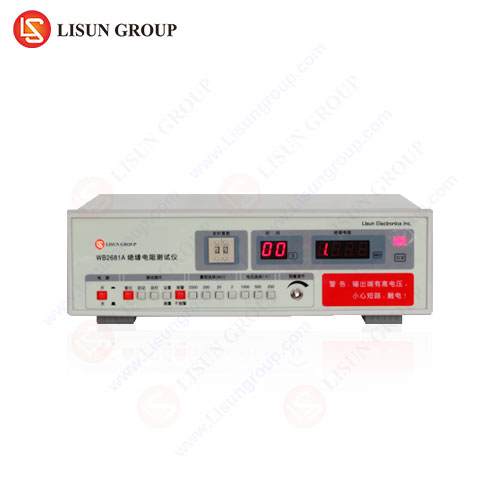
The LISUN WB2675D Leakage Current Tester exemplifies a modern instrument designed to meet the complex demands outlined above. It is engineered as a comprehensive solution for verifying compliance with major international safety standards across a diverse industrial landscape.
Core Specifications and Testing Principles: The WB2675D operates on the direct measurement principle, applying the test voltage through its internal source and measuring the resulting current via its precision sensing circuitry and embedded standardized networks. Its key specifications include a wide leakage current measurement range from 0.001 mA to 20 mA, with high accuracy (typically ±2%). It provides a programmable AC test voltage from 0 to 300 V at 45-65 Hz, accommodating most global single-phase supply conditions. Crucially, it integrates multiple measurement modes including Touch Current (with selectable networks), Protective Conductor Current, and Alternative Leakage tests, automating the sequence prescribed by standards.
Industry-Specific Application Use Cases:
- Medical Devices (IEC 60601-1): It performs critical earth leakage, enclosure leakage, and patient leakage measurements, including tests on applied parts, with the necessary isolation and sequencing for pre-compliance and production testing of patient monitors, surgical tools, and diagnostic imaging subsystems.
- Household Appliances & Consumer Electronics (IEC 62368-1, IEC 60335-1): The tester automates the evaluation of touch current from accessible metal parts or user-interface surfaces on products like refrigerators, coffee makers, gaming consoles, and televisions, under both normal and fault conditions.
- Lighting Fixtures and LED Drivers: It assesses leakage from luminaires, especially Class II (double-insulated) fixtures and those with metal housings, where capacitive coupling can induce perceptible and potentially hazardous currents.
- Automotive Electronics (ISO 6469, LV standards): For components in electric and hybrid vehicles, it tests leakage from high-voltage bus bars, charging systems, and inverter assemblies to the vehicle chassis, ensuring safety in a demanding electrical environment.
- Industrial Control Systems & Components: The instrument verifies the safety of motor drives, PLCs, contactors, and switches, where industrial voltages and harsh environments place significant stress on insulation systems.
Competitive Advantages in Operational Context: The WB2675D distinguishes itself through several integrated features. Its programmable test sequencer allows users to define multi-step procedures (e.g., apply voltage, measure for 5 seconds, reverse polarity, measure again) which eliminates operator error and ensures strict procedural adherence. The large, intuitive display presents both numerical readings and clear pass/fail indicators. Its robust communication suite facilitates seamless integration into automated test stations, enabling full traceability. The inclusion of a high-precision, true RMS measurement circuit ensures accurate readings even with non-sinusoidal leakage currents common in modern electronics, a point where simpler, average-responding meters may fail.
Integration into Quality Assurance and Production Workflows
The role of a leakage current tester extends beyond the R&D lab. In a high-volume manufacturing setting, test speed, reliability, and data management are paramount. A system like the WB2675D functions as a key node in a quality data network. Upon test initiation, it can automatically apply the required stress, perform the measurement, compare the result against preset limits (which can be locked for compliance), and output a digital result. This result can be timestamped and logged alongside the DUT’s serial number, providing an immutable record for regulatory audits and quality trend analysis.
For components like cables, wiring systems, sockets, and switches, the tester provides a final safety verification before shipment. In the aerospace and telecommunications sectors, where equipment must endure wide temperature and humidity swings, leakage current testing post-environmental stress screening is critical, requiring an instrument that is both precise and robust.
Conclusion: A Selection Framework Summarized
The selection of a leakage current tester is a systematic process. The engineer or procurement specialist must first identify the governing standards for the DUT, which dictate the required measurement networks, test voltages, and limits. The operational environment—R&D, type approval, or high-speed production—defines the necessary level of automation, speed, and data integration. Instrumental specifications such as measurement accuracy, range, and built-in test sequences must then be evaluated against these requirements.
A device such as the LISUN WB2675D represents a calibrated response to these multifaceted demands, offering the standardized measurement rigor required for certification alongside the automated, integrable functionality demanded by modern manufacturing. Its design acknowledges that leakage current testing is not an isolated check but a vital, data-rich link in the chain of electrical safety assurance across industries.
FAQ Section
Q1: Why is it necessary to test leakage current at 110% of the rated supply voltage?
Testing at 110% of nominal voltage is a standard requirement (e.g., in IEC 62368-1) that applies a safety margin to account for potential overvoltage conditions in real-world power networks. It ensures the insulation system remains safe and leakage currents remain within limits even during typical line voltage fluctuations, providing a more robust assessment of safety.
Q2: Can a single tester like the WB2675D be used for both medical (IEC 60601-1) and IT equipment (IEC 62368-1) testing?
Yes, provided the instrument incorporates the specific measurement networks and test sequences mandated by both standards. The WB2675D, for example, includes the various networks (Figure 5, Figure 13, etc.) and programmable modes necessary to perform touch current, protective conductor current, and patient leakage current tests, making it applicable across these and other similar standards.
Q3: What is the significance of the “True RMS” measurement capability in leakage current testing?
Many modern electronic devices, due to their switch-mode power supplies, generate leakage currents that are non-sinusoidal. An average-responding meter, calibrated for pure sine waves, will under-report the true magnitude of such complex waveforms. A True RMS (Root Mean Square) measuring circuit accurately calculates the heating effect of any waveform, ensuring the measured value correctly represents the actual risk, which is a fundamental requirement of safety standards.
Q4: How does automated test sequencing improve compliance and reliability?
Manual testing is prone to procedural errors, such as applying test voltages in the wrong order, for incorrect durations, or misrecording results. Automated sequencing, as found in programmable testers, enforces the exact procedure defined by the standard every time. This eliminates operator variance, guarantees the test is performed correctly, and creates a consistent, auditable digital record, vastly improving both compliance assurance and test result reliability.
