







Selecting the Right Leakage Current Test Equipment: A Technical Analysis
Introduction to Leakage Current and Regulatory Imperatives
Leakage current, defined as the unintended flow of electrical current from a live conductor to earth or to another conductive part under normal operating conditions, represents a critical safety parameter across virtually all sectors of electrical and electronic manufacturing. Its presence, if excessive, poses significant risks of electric shock, equipment malfunction, and potential fire hazards. Consequently, rigorous testing is not merely a quality assurance step but a fundamental compliance requirement mandated by international safety standards such as IEC 60601-1 for medical devices, IEC 60950-1/62368-1 for IT and audio/video equipment, IEC 60335-1 for household appliances, and the various national adaptations of these norms, including UL, CSA, and GB standards.
The selection of appropriate test equipment is therefore a decision of substantial technical and commercial consequence. An ill-suited instrument can lead to non-conformity, product recalls, or, more critically, the release of unsafe products into the market. This article provides a detailed, objective framework for evaluating and selecting leakage current test equipment, with a focus on the technical parameters, operational methodologies, and application-specific considerations that define a competent testing solution.
Fundamental Testing Methodologies and Simulated Body Networks
Accurate leakage current measurement necessitates the emulation of the human body’s impedance to electrical current. This is achieved through standardized measurement circuits, or “simulated body networks,” defined within safety standards. The three primary measurement modes are:
- Touch Current (Contact Current): Measured between any accessible conductive part of the Equipment Under Test (EUT) and earth via a measuring network that simulates the impedance of the human body from hand to hand or hand to foot. This is the most common measurement for Class I (earthed) equipment.
- Protective Conductor Current: The current flowing in the protective earth conductor of a Class I appliance. This measurement assesses the integrity of the earthing path and is crucial for high-power devices.
- Applied Part Leakage Current: A specialized measurement for medical devices, assessing current flowing from applied patient parts (e.g., electrodes, probes) to earth or other applied parts.
A sophisticated tester must incorporate these distinct measurement networks—typically defined as networks A, B, D, and others per IEC 60601-1—and allow for their correct application based on the standard being enforced. The choice of network directly impacts the measured value, making instrument versatility paramount for laboratories handling diverse product categories.
Critical Technical Specifications for Equipment Evaluation
When specifying a leakage current tester, several core technical parameters demand careful scrutiny. These specifications determine the instrument’s applicability, accuracy, and long-term utility.
Measurement Range and Resolution: The dynamic range must accommodate both the stringent low-current limits of sensitive electronics (e.g., microamps for medical devices) and the higher operational currents of industrial equipment. A broad range, such as 0.001 mA to 20 mA, with high resolution at the lower end, is essential for cross-industry applicability.
Voltage Source and Frequency Range: The tester must supply a stable, adjustable AC power source to the EUT, typically from 0 to the rated voltage (e.g., 250V). Furthermore, with the proliferation of variable-frequency drives and switch-mode power supplies, the ability to measure leakage current across a frequency spectrum (e.g., DC, 50/60 Hz, and up to 1 kHz or higher) is increasingly critical. Standards specify weighting factors for frequencies above 1 kHz, which the instrument must apply automatically.
Compliance with Evolving Standards: The instrument’s design must adhere to the latest editions of relevant standards, including the specific requirements for test setup, network impedance, and measurement timing (e.g., measurements at 110% of rated voltage). Forward compatibility, through software updates or modular design, protects against premature obsolescence.
Accuracy and Stability: Stated accuracy, often expressed as a percentage of reading plus a number of counts, must be traceable to national standards. Long-term drift and stability under varying environmental conditions (temperature, humidity) are equally important for maintaining calibration integrity.
Operational Safety and Integration Features: Given that tests are performed at hazardous voltages, built-in safety interlocks, isolation, and robust construction are non-negotiable. Features for laboratory integration, such as programmable interfaces (GPIB, RS232, Ethernet), remote control software, and data logging capabilities, significantly enhance throughput and facilitate automated production line testing.
Application-Specific Considerations Across Key Industries
The optimal tester configuration varies significantly depending on the primary industry of application.
- Medical Devices (IEC 60601-1): Requires the most comprehensive set of measurements, including earth leakage, enclosure leakage, patient leakage, and patient auxiliary current under both normal and single-fault conditions. A tester must seamlessly switch between multiple simulated body networks (A, B, D, F) and often requires specialized fixtures for applied parts.
- Household Appliances & Electrical Equipment (IEC 60335-1, IEC 60990): Focus is primarily on touch current and protective conductor current. Testing often involves complex leakage paths through water, metal casings, and user-accessible controls. Robustness to handle higher currents and the ability to test under various moisture conditions (via spray tests) may be necessary.
- Automotive Electronics & Aerospace Components: While often derivative of broader EMC/safety standards, testing here emphasizes extreme environmental robustness (vibration, thermal cycling) and may involve specific DC leakage tests for 12/24/48V systems. The tester may need to interface with bespoke test fixtures simulating vehicle chassis grounds.
- Lighting Fixtures (IEC 60598) and Consumer Electronics: These products often use switch-mode power supplies, generating high-frequency leakage currents. A tester’s ability to accurately measure and properly weight these high-frequency components is essential to avoid false failures.
- Industrial Control Systems & Telecommunications Equipment: Emphasis is on reliability and the ability to perform long-duration leakage tests to monitor stability. Remote monitoring and alarm functions for unattended test racks are valuable features.
- Electrical Components and Wiring Systems: Testing here may involve applying probes to individual components (switches, sockets, terminal blocks) or measuring insulation integrity along cable lengths, requiring flexible test lead setups and possibly higher voltage sources for dielectric testing in combination with leakage measurement.
Analysis of the WB2675D Leakage Current Tester as an Integrated Solution
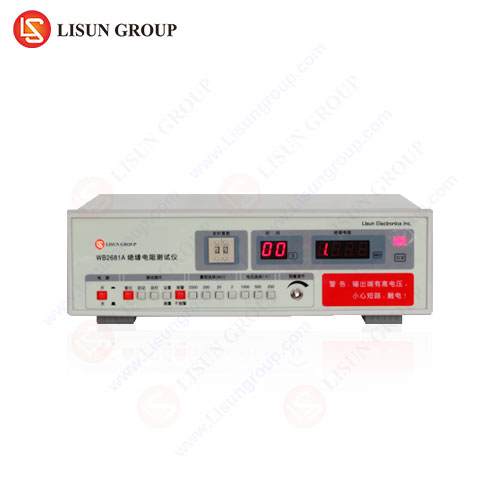
To contextualize the selection criteria, we examine the WB2675D Leakage Current Tester, a device engineered to address the multifaceted requirements outlined above. Its design philosophy centers on precision, versatility, and operational safety, making it a pertinent case study for a competent test instrument.
Core Specifications and Testing Principle:
The WB2675D integrates a precision measurement core with a programmable AC power source. It operates on the principle of direct measurement via internal simulated body networks, automatically applying the correct network impedance based on the selected test standard and measurement type (Touch Current, Protective Conductor Current, etc.). The instrument applies the test voltage to the EUT and measures the resultant current flow through the specified network, displaying the true RMS value with applied frequency weighting as per IEC 60990 and related standards.
Table 1: Key Specifications of the WB2675D Leakage Current Tester
| Parameter | Specification |
| :— | :— |
| Leakage Current Range | 0.001 mA ~ 20.00 mA (multiple auto-ranging scales) |
| Basic Accuracy | ±(1.5% of reading + 5 counts) |
| Test Voltage | 0 ~ 250V AC, programmable in 0.1V steps |
| Voltage Frequency | 45.0 Hz ~ 65.0 Hz (50/60 Hz nominal), with extended frequency measurement capability |
| Measurement Networks | Incorporates networks for Touch Current, Protective Conductor Current, and applied part leakage, compliant with IEC 60990, IEC 60601-1, etc. |
| Test Modes | Standard, Variable Voltage, Surge, and Timing modes |
| Output Interface | RS232, USB, LAN for remote control and data transfer |
| Safety Features | Interlock terminal, emergency stop, over-current/voltage protection |
Industry Use Cases and Application:
In a medical device manufacturing setting, the WB2675D can be programmed to execute a full sequence of leakage tests per IEC 60601-1: normal condition, reversed polarity, and single-fault conditions (open neutral, open earth), logging all results for audit trails. For a household appliance producer, its Surge Test mode can capture the peak leakage current occurring at the moment of power-on, a critical but often overlooked parameter. When testing an LED driver for the lighting industry, its accurate RMS measurement and high-frequency weighting ensure that switch-mode supply leakage is assessed correctly, preventing unnecessary design revisions due to measurement artifact.
Competitive Advantages in Context:
The instrument’s advantages are realized in its synthesis of capabilities. Its programmable test sequences reduce operator error and increase throughput in high-volume production environments for consumer electronics and office equipment. The integrated variable voltage source eliminates the need for a separate variac, simplifying the test bench and ensuring synchronized voltage and measurement. The comprehensive safety interlock system meets the stringent requirements of certified test laboratories, particularly for aerospace component validation where test protocols are rigorous. Furthermore, its communication interfaces allow for seamless integration into automated test systems for automotive electronics modules or industrial control panel verification, enabling statistical process control and direct database reporting.
Strategic Selection and Implementation Protocol
The final selection process should be systematic. First, audit the applicable standards for all products to be tested, creating a definitive list of required measurements, networks, and test conditions. Second, benchmark instrument specifications against this list, giving priority to accuracy, standard compliance, and necessary measurement types. Third, evaluate operational workflow—consider ease of use, programmability, and data management features relative to the expected test volume and operator skill level. Fourth, assess long-term viability through vendor support, calibration service availability, and potential for software updates to accommodate new standards.
Implementation requires a controlled environment. A dedicated, grounded test station with clear signage is mandatory. Operators must be trained not only on the instrument but also on the underlying safety principles. Regular calibration, traceable to national standards, is the cornerstone of measurement credibility. The instrument should be incorporated into a quality management system, with test procedures documented and results archived for the product’s lifecycle.
Conclusion
Selecting leakage current test equipment is a technical decision with direct implications for product safety, regulatory compliance, and market access. The process demands a thorough understanding of the relevant standards, the electrical characteristics of the products under test, and the capabilities of modern test instrumentation. By prioritizing measurement accuracy, standard-specific functionality, operational safety, and integration flexibility, organizations can invest in a test solution that not only fulfills immediate compliance needs but also adapts to evolving product lines and regulatory landscapes. A device such as the WB2675D exemplifies how integrated design can address the complex, multi-industry challenge of reliable leakage current measurement, serving as a core component of a robust product safety verification regime.
Frequently Asked Questions (FAQ)
Q1: What is the significance of measuring leakage current at 110% of rated input voltage?
A1: Testing at 110% of rated voltage is a standard requirement (e.g., in IEC 60335-1, IEC 60601-1) that simulates a worst-case grid overvoltage condition. It ensures that the product’s insulation and grounding systems maintain safety margins even during minor supply fluctuations, providing an additional layer of protection for the end-user.
Q2: Can the WB2675D tester be used for production line automated testing?
A2: Yes. With its programmable test sequences, pass/fail judgment capabilities, and standard communication interfaces (RS232, USB, LAN), the WB2675D can be integrated into automated test stations. It can be controlled by production line software to perform tests, retrieve results, and sort products automatically, which is essential for high-volume manufacturing in industries like consumer electronics or electrical components.
Q3: How does the tester account for high-frequency leakage currents from switch-mode power supplies?
A3: The instrument employs true RMS measurement technology and incorporates the frequency weighting characteristics specified in standards like IEC 60990. It accurately measures the composite current across a broad frequency spectrum and applies the correct weighting factor to the high-frequency components, ensuring the final displayed value reflects the physiologically relevant leakage current as perceived by the human body.
Q4: Why are different simulated body networks (e.g., Network A vs. Network D) needed, and does the WB2675D select them automatically?
A4: Different networks simulate different pathways of current through the human body (e.g., hand-to-hand, hand-to-foot, or through a medical applied part). The correct network is mandated by the product standard. The WB2675D requires the operator to select the desired test function (e.g., “Touch Current” or “Patient Leakage”), and it internally applies the corresponding standardized network impedance; it does not automatically detect the network, as this is a normative selection based on the test being performed.
Q5: Is regular calibration necessary for a leakage current tester, and what is involved?
A5: Absolutely. Regular calibration, typically annually or as defined by your quality procedures, is critical to maintain measurement traceability and accuracy. Calibration involves verifying and adjusting the instrument’s voltage output, current measurement accuracy, and network impedance against a higher-order standard in a certified metrology laboratory. Using an uncalibrated tester invalidates compliance testing and poses a safety and quality risk.
