







Establishing Definitive Pass/Fail Criteria for High-Potential (Hipot) Testing: A Foundational Framework for Electrical Safety Validation
Introduction to Dielectric Withstand Verification
High-potential testing, commonly termed Hipot or dielectric withstand testing, constitutes a non-destructive, pass/fail electrical safety evaluation mandated for virtually all electrically energized products. Its primary objective is the verification of adequate insulation integrity, ensuring that no catastrophic breakdown or excessive leakage current occurs when the equipment is subjected to elevated voltages significantly above its normal operating rating. The establishment of unambiguous, scientifically grounded, and standards-compliant pass/fail criteria is not merely a procedural step but a critical risk-mitigation activity. These criteria form the legal and technical boundary between safe and potentially hazardous products, directly impacting user safety, regulatory compliance, and brand integrity. This analysis delineates the core components of effective Hipot test pass/fail parameters, examining their derivation from international standards, implementation methodologies, and practical considerations across diverse industrial sectors.
Deconstructing the Core Parameters of Hipot Test Failure
A test failure is not a singular event but a manifestation of one or more specific insulation system deficiencies. Pass/fail criteria must therefore be designed to detect these discrete failure modes with high reliability.
Dielectric Breakdown: This is the most severe and unambiguous failure mode. It occurs when the applied electric field exceeds the insulating material’s intrinsic dielectric strength, causing a sudden, irreversible loss of insulating properties, typically evidenced by a sustained arc or a dramatic, uncontrolled increase in current. The test instrument must rapidly terminate output upon detection to prevent damage to the unit under test (UUT) and the tester itself. The criterion is binary: any breakdown constitutes failure.
Excessive Leakage Current: A more nuanced and commonly applied criterion. While all insulation systems exhibit some small capacitive and resistive leakage current, an abnormally high reading indicates insulation degradation, contamination, inadequate creepage/clearance distances, or the presence of parasitic paths. The pass/fail threshold for leakage current is not intrinsic; it is derived from safety standards, product-specific risk assessments, and historical test data. It may be specified as a peak or RMS current value.
Corona Discharge and Partial Discharge Inception: In high-voltage applications, particularly for aerospace, automotive, and telecommunications systems, ionization of air pockets within or around insulation can occur before full breakdown. This corona or partial discharge erodes insulation over time. Advanced Hipot testers can monitor for the high-frequency current pulses characteristic of these events, setting failure thresholds based on discharge magnitude or repetition rate.
Derivation of Thresholds from International Safety Standards
Pass/fail criteria are not arbitrarily assigned; they are rigorously prescribed by international and national safety standards. These standards, such as IEC 62368-1 (Audio/Video, Information & Communication Technology), IEC 60335-1 (Household Appliances), IEC 60601-1 (Medical Electrical Equipment), and ISO 6469-3 (Electric Road Vehicles), define the test voltage, application duration, frequency, and maximum permissible leakage current.
The test voltage is typically calculated as a multiple of the UUT’s working voltage plus a constant. For example, a basic insulation for mains-powered equipment (230VAC) might be tested at 1,500 VAC or 2,120 VDC for 60 seconds, as per standard formulae. The leakage current limit is equally critical. For medical devices (IEC 60601-1), patient-applied parts have exceptionally stringent limits (e.g., 10µA under normal conditions, 50µA under single-fault conditions), while industrial control equipment may permit higher thresholds. The table below illustrates typical derivations.
Table 1: Example Hipot Test Parameter Derivation from Standards
| Product Category | Relevant Standard | Typical Test Voltage (Example) | Typical Leakage Current Limit | Duration |
| :— | :— | :— | :— | :— |
| Household Toaster | IEC 60335-1 | 1,250 VAC | 0.25 mA | 60 s |
| IT Power Supply | IEC 62368-1 | 3,000 VAC | 0.25 mA | 60 s |
| Patient Monitor (Type BF Applied Part) | IEC 60601-1 | 1,500 VAC | 10 µA (NC) | 60 s |
| Automotive Traction Cable | ISO 6469-3 | 2 * Working Voltage + 1,000 VDC | Specified by mfr. | 60 s |
| LED Driver Module | IEC 61347-1 | 4U + 2,000 V | 0.5 mA | 60 s |
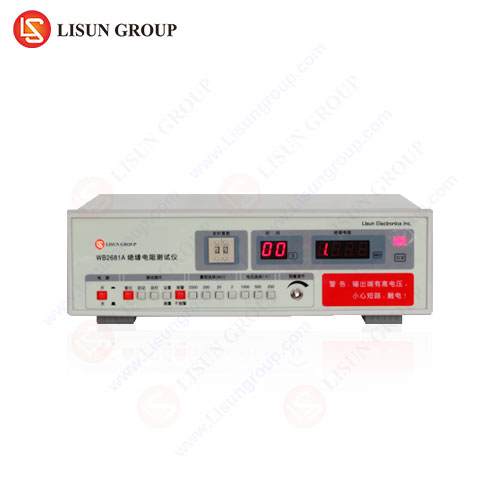
Instrumentation Capabilities and Criteria Enforcement: The Role of the WB2671A Withstand Voltage Tester
The accurate and reliable enforcement of pass/fail criteria is wholly dependent on the precision and capabilities of the test instrumentation. A sophisticated device like the LISUN WB2671A Withstand Voltage Test System exemplifies the technological requirements for modern criteria enforcement. Its design directly addresses the critical parameters of the test.
The WB2671A generates a stable, programmable AC (0-5kV) or DC (0-6kV) test voltage with low distortion, ensuring the specified stress is accurately applied. For leakage current measurement, it employs high-resolution circuitry capable of detecting currents from microampere to milliampere levels, a range essential for covering everything from medical devices to industrial machinery. The pass/fail decision is made by comparing the real-time measured leakage current against up to 24 preset limit values (Hi Limit, Lo Limit, Arc Limit), which can be associated with different test steps or product types.
Crucially, the instrument incorporates a high-sensitivity arc detection circuit. This feature identifies sudden, brief current surges indicative of a corona or the initial stages of breakdown—events a simple over-current limit might miss. By setting a sensitive arc detection threshold (adjustable based on the UUT’s inherent capacitance), the WB2671A can fail a unit showing pre-breakdown activity, providing a more conservative and predictive safety assessment. Its programmable test sequences, including ramping, dwelling, and decaying, allow for the simulation of real-world stress conditions and the observation of insulation behavior under varying voltage profiles.
Industry-Specific Considerations for Criteria Application
The application of these universal principles varies significantly across industries, driven by unique operational environments, risk profiles, and regulatory landscapes.
Medical Devices (IEC 60601-1): Criteria are exceptionally conservative. Beyond standard withstand tests, differential leakage current measurements (earth, patient, auxiliary) with ultra-low thresholds (µA level) are mandatory. The WB2671A’s low-current measurement accuracy is vital here. Testing often includes “moisture conditioning” pretreatments, and pass/fail must hold under both normal and single-fault conditions.
Automotive Electronics (ISO 6469-3, LV 124): The focus extends beyond 12V systems to high-voltage traction systems (400V+). DC Hipot testing is predominant. Criteria must account for high environmental stress (thermal cycling, vibration). Test voltages are often specified as a function of the working voltage, and leakage current limits are tightly controlled to prevent energy dissipation in fault conditions.
Aerospace & Aviation (DO-160, AS4373): Testing addresses extreme altitude-induced pressure reductions, which lower air dielectric strength. Pass/fail criteria for “low-pressure” Hipot tests are essential. Corona extinction voltage (the voltage at which discharges cease as voltage decreases) is often a specified pass criterion alongside simple withstand.
Household Appliances & Consumer Electronics: High-volume production necessitates fast, reliable testing. Here, test duration is often reduced from 60 seconds to 1-2 seconds using a higher voltage (e.g., 120% of the standard test voltage), as permitted by standards. The pass/fail decision must be extremely rapid and reliable, leveraging the fast response and programmable sequencing of automated testers.
Lighting Fixtures & Electrical Components: Testing often involves unusual geometries (sockets, switches, lamp housings). Criteria must consider surface creepage across insulating materials. A “flashover” across an external air path may be considered a failure, even if the internal insulation is sound, necessitating proper test fixture design to isolate the test points.
Beyond the Binary: Interpreting Marginal Results and Statistical Process Control
A simplistic pass/fail interpretation can obscure valuable quality intelligence. A unit that passes but exhibits leakage current consistently at 90% of the limit is qualitatively different from one measuring 10%. Advanced test systems facilitate statistical process control (SPC) by logging all test data—not just pass/fail status.
Trend analysis of leakage current over time can reveal gradual insulation degradation due to process changes, material lot variations, or environmental contamination in the production area. Establishing upper and lower control limits for leakage current within the pass band allows for proactive intervention before failures occur. This transforms the Hipot test from a final safety gate into a powerful process monitoring tool, ensuring long-term product reliability and manufacturing consistency.
Mitigating Nuisance Failures through Test Parameter Optimization
Improperly set criteria can lead to “nuisance failures,” where good units are rejected due to test artifacts rather than genuine defects. Common causes and mitigations include:
- Inrush Current: Capacitive loads (long cables, large transformers) draw a momentary charging current that can exceed a set current limit. The solution is to implement a short initial delay or a “ramp-up” function in the voltage application, allowing capacitive charging to complete before the measurement period begins.
- Environmental Humidity: Surface leakage due to ambient humidity can cause failure. Controlling the test environment or using guarding techniques to shunt surface currents away from the measurement circuit is necessary.
- Test Fixture Design: Poorly designed fixtures can create unintended leakage paths. The use of proper insulation, shielding, and guarding is critical to ensure the test stresses only the intended isolation barriers within the UUT.
Conclusion: The Synthesis of Criteria, Standards, and Instrumentation
The establishment of definitive pass/fail criteria for Hipot testing is a multidisciplinary exercise in applied electrical safety. It requires a deep understanding of insulation failure modes, a rigorous interpretation of applicable international standards, and careful consideration of product-specific use cases and environmental factors. The criteria are ultimately enforced by the test instrumentation, whose accuracy, programmability, and advanced detection capabilities—such as those embodied in the LISUN WB2671A Withstand Voltage Test System—determine the validity and repeatability of the safety assessment. By moving beyond a binary pass/fail paradigm to embrace trend analysis and SPC, manufacturers can leverage dielectric withstand testing not only as a compliance checkpoint but as a cornerstone of a robust, proactive product safety and quality assurance regime.
Frequently Asked Questions (FAQ)
Q1: Can the WB2671A perform both AC and DC withstand voltage tests, and what are the technical considerations for choosing one over the other?
A1: Yes, the WB2671A is capable of both AC (0-5kV) and DC (0-6kV) output. AC testing is generally preferred for products operating on AC mains, as it stresses insulation in a manner similar to operational stress and is more sensitive to detecting flaws in layered or capacitive insulation. DC testing is used for DC-based products (e.g., automotive EV systems), for testing capacitive loads where AC would draw excessive reactive current, and for diagnostic testing where the lower current allows for the detection of specific failure modes without damaging the UUT.
Q2: How is the arc detection function calibrated, and what level of sensitivity is typically required for testing consumer electronic power supplies?
A2: Arc detection calibration involves setting a threshold for the rate and magnitude of a sudden current spike. It is not a fixed value but is adjusted relative to the inherent capacitive charging current of the UUT. For a typical switch-mode power supply, the sensitivity might be set to detect a current pulse of a few milliamperes occurring within microseconds. The WB2671A allows for adjustable arc detection levels to prevent nuisance tripping on benign transients while remaining sensitive to dangerous partial discharges.
Q3: Our production line tests medical device cables. The leakage current limits are very low (10µA). How does the WB2671A ensure measurement accuracy at this microamp level, and what fixture precautions are necessary?
A3: The WB2671A utilizes high-precision, low-drift measurement circuitry with guarded inputs to achieve accuracy in the microamp range. For fixture design, strict guarding is paramount. All conductive surfaces of the fixture that contact the cable under test must be connected to the instrument’s guard terminal. This shunts any surface leakage currents (e.g., from humidity on the fixture) directly to ground, preventing them from flowing through the sensitive measurement circuit and ensuring only the current through the cable’s insulation is measured.
