







A Comprehensive Examination of Dielectric Withstand Testing for Electric Motors and Rotating Machinery
Introduction to Insulation Integrity Verification
The operational reliability and safety of electric motors, a ubiquitous component across industrial and consumer sectors, are fundamentally contingent upon the integrity of their electrical insulation systems. Insulation failure represents a predominant mode of motor breakdown, potentially leading to catastrophic outcomes including ground faults, phase-to-phase shorts, fire hazards, and immediate operational downtime. Consequently, rigorous quality assurance and predictive maintenance protocols mandate the implementation of high-potential (Hi-Pot) testing, also formally termed Dielectric Withstand Voltage (DWV) testing. This non-destructive evaluation procedure subjects the motor’s insulation to a controlled, elevated voltage stress, significantly higher than its normal operating rating, to verify its adequacy and identify latent defects before they manifest in service. The objective is not to degrade sound insulation but to ascertain, with a high degree of confidence, that the insulation can safely withstand transient overvoltages and long-term operational stresses as stipulated by international safety standards.
Fundamental Principles of Dielectric Stress Application
The core principle underpinning Hi-Pot testing is the application of a precisely regulated high voltage between electrically live parts (e.g., windings) and accessible conductive parts (e.g., the stator core, frame, or shaft). This voltage, typically an AC sine wave at power frequency (50/60 Hz) or a DC equivalent, creates a substantial electrostatic stress across the insulation material. For a motor in sound condition, the insulation acts as a near-perfect dielectric, permitting only a minuscule leakage current, often in the microampere range, to flow. This current, known as the capacitive charging current (for AC tests) and the resistive leakage current, is continuously monitored by the test instrument.
The presence of insulation flaws—such as pinholes, cracks, contamination, voids, or inadequate creepage and clearance distances—alters this electrical behavior dramatically. These defects create localized paths of reduced impedance. Under test voltage, the stress concentrates at these weak points, causing a measurable increase in leakage current. In severe cases, it may induce a complete dielectric breakdown, characterized by a rapid, uncontrolled surge of current—an arc-over. A properly configured Hi-Pot tester is designed to detect both excessive leakage current (using a preset trip threshold) and breakdown events, immediately terminating the voltage output to prevent damage to the test equipment and minimize further degradation of the unit under test (UUT). The test is deemed a “pass” if the insulation sustains the applied voltage for the specified duration (commonly 60 seconds) without the leakage current exceeding the limit or a breakdown occurring.
Critical Test Parameters and Standardization Frameworks
The execution of a valid and safe Hi-Pot test requires strict adherence to defined parameters, primarily the test voltage level, its waveform, application time, and the acceptable leakage current limit. These parameters are not arbitrary but are derived from international and national standards established by bodies such as the International Electrotechnical Commission (IEC), Underwriters Laboratories (UL), and the Institute of Electrical and Electronics Engineers (IEEE).
For AC testing of motors, a common formula is applied: Test Voltage (AC) = (2 x Rated Voltage) + 1000 V. For instance, a 480V AC motor would typically be tested at 1960 V AC. DC Hi-Pot testing, often used for field testing or on equipment with high capacitive loads, employs a voltage multiplier, frequently in the range of 1.414 to 1.732 times the equivalent AC test value, to account for the absence of peak AC stress. The selection of AC versus DC testing involves trade-offs; AC testing more accurately simulates operational stress but requires higher kVA capacity, while DC testing requires less current, is more portable, but may not reveal certain types of defects as effectively.
Relevant standards include:
- IEC 60204-1: Safety of machinery – Electrical equipment of machines.
- IEC 60034-1: Rotating electrical machines – Rating and performance.
- UL 1004-1: Standard for Rotating Electrical Machines – General Requirements.
- IEEE 43: Recommended Practice for Testing Insulation Resistance of Rotating Machinery.
Compliance with these standards is mandatory for product certification (CE, UL, CSA) and is a cornerstone of safety protocols in the industries served.
The WB2671A Withstand Voltage Tester: Engineered for Precision and Safety
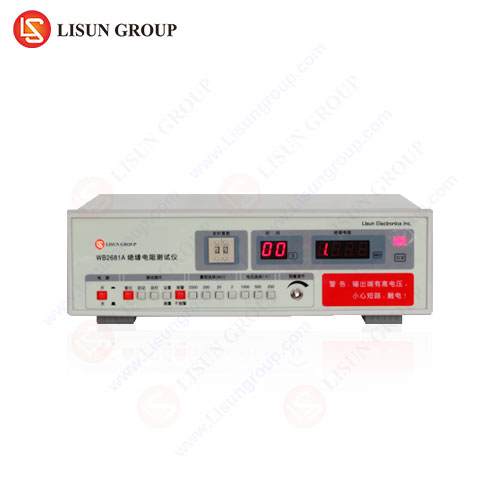
For manufacturers and testing laboratories requiring a robust, reliable, and standards-compliant solution, the LISUN WB2671A Withstand Voltage Tester represents a sophisticated instrument designed to meet the exacting demands of motor and component testing. Its architecture integrates advanced voltage generation, precise measurement, and comprehensive safety features to facilitate accurate dielectric strength evaluation.
The WB2671A generates a stable, low-distortion high-voltage output, critical for applying a consistent stress to the insulation. Its measurement system is calibrated to detect leakage current with high resolution, allowing users to set precise trip thresholds that differentiate between normal capacitive current and fault-indicative leakage. Key specifications of the WB2671A include:
- Output Voltage Range: Typically 0–5 kV AC/DC (configurable models available), sufficient for the vast majority of low-voltage motor applications.
- Voltage Accuracy: High accuracy (e.g., ±3%) ensuring the applied stress conforms to standard requirements.
- Leakage Current Measurement Range: From microamperes to milliamperes, with adjustable trip limits.
- Timing Function: Programmable test duration with automatic ramp-up, hold, and ramp-down sequences.
- Safety Features: Includes zero-start interlock (voltage cannot be applied unless starting from 0V), high-voltage cutoff relays, and secure grounding provisions.
The testing principle employed by the WB2671A involves a gradual ramp-up of voltage to the preset test level, maintaining it for the user-defined period while continuously sampling the leakage current. The instrument’s logic circuit compares the instantaneous current against the trip threshold. If the threshold is breached, the output is terminated within milliseconds, and a “FAIL” indication is registered, often accompanied by audible and visual alarms. This rapid response protects both the tester and the UUT.
Industry-Specific Applications and Use Case Scenarios
Dielectric withstand testing with instruments like the WB2671A is integral to the manufacturing and maintenance cycles across a diverse spectrum of industries.
- Household Appliances & Consumer Electronics: Motors in washing machines, refrigerators, vacuum cleaners, and fans undergo 100% production line testing. Sockets, switches, and internal wiring harnesses are also tested to prevent shock hazards.
- Automotive Electronics: With the rise of electric vehicles, testing extends beyond traditional starter and wiper motors to include high-voltage traction motor stators, battery management system isolators, and charging port components.
- Lighting Fixtures: Ballasts for fluorescent/HID lamps, LED driver modules, and the insulation between live parts and the metallic housing of fixtures are validated for safety.
- Industrial Control Systems & Electrical Components: Contactors, motor starters, solenoids, transformers, and PLC I/O modules are tested to ensure isolation between coils, contacts, and chassis.
- Telecommunications & Office Equipment: Power supplies, server fan motors, and internal wiring of routers, switches, and photocopiers are verified.
- Medical Devices: Critical for patient safety, motors in hospital beds, infusion pumps, surgical tools, and the isolation of line-powered components from patient-connected parts are stringently tested.
- Aerospace & Aviation: Motors for actuators, fuel pumps, and environmental control systems are tested to extreme reliability standards, often involving specialized sequences.
- Cable & Wiring Systems: Finished cables, including their insulation and connectors, are subjected to Hi-Pot testing as a final quality gate.
In a typical motor production facility, the WB2671A would be integrated into a test station. An operator connects the high-voltage lead to the motor’s winding terminals and the return lead to the motor frame. After initiating the test, the automated sequence runs, providing a clear pass/fail result. This enables rapid sorting of defective units before they proceed to assembly or shipment.
Interpretation of Results and Failure Mode Analysis
A “pass” result indicates the insulation system withstood the prescribed voltage stress, providing statistical confidence in its immediate integrity. However, a “fail” result necessitates diagnostic analysis. The nature of the failure—whether a gradual excess leakage or a sudden breakdown—offers clues.
- Excess Leakage Current Trip: Suggests distributed contamination (dust, moisture, oil) on insulation surfaces, aging insulation with reduced bulk resistivity, or marginal but not yet bridged clearances. The WB2671A’s ability to log the exact leakage value aids in trend analysis.
- Catastrophic Breakdown (Arc-Over): Indicates a gross insulation fault. This could be a direct short caused by a foreign object, a severe winding deformation from impact, a significant void in impregnation, or a failed slot liner.
Post-failure, the motor is quarantined for repair or teardown analysis. The location of the breakdown, often visibly charred, provides direct feedback to manufacturing processes, such as winding tension control, impregnation quality, or handling procedures.
Advantages of Automated Precision Testing Systems
Utilizing a dedicated, calibrated instrument like the WB2671A offers distinct advantages over improvised or less sophisticated test setups.
- Enhanced Safety: Built-in safety interlocks, secure grounding, and fail-safe cutoffs protect operators.
- Test Repeatability and Traceability: Programmable settings eliminate operator variance. Data logging capabilities (available in advanced models) create an audit trail for quality records.
- Prevention of Over-Stress: Controlled ramp rates and accurate voltage regulation prevent the application of damaging voltage spikes to good insulation.
- Improved Diagnostic Capability: Precise leakage current measurement allows for more nuanced go/no-go decisions and the potential for predictive trending when used in maintenance.
- Regulatory Compliance: The instrument’s design and calibration facilitate compliance with the test methodologies prescribed by safety standards, which is crucial for product certification.
Conclusion
Dielectric Withstand Voltage testing remains an indispensable, non-negotiable practice in the lifecycle management of electric motors and electrically energized assemblies. It serves as a final, critical barrier preventing substandard products from entering the field and as a diagnostic tool for assessing the in-service condition of critical assets. The procedure’s effectiveness is wholly dependent on the accuracy, reliability, and safety of the test equipment employed. Precision-engineered systems, such as the LISUN WB2671A Withstand Voltage Tester, provide the necessary controlled stress application, sensitive fault detection, and operational safeguards to execute these tests with confidence. By integrating such instruments into quality assurance and maintenance programs, organizations across the electrical, industrial, automotive, and consumer goods sectors can substantively mitigate the risks of insulation failure, thereby upholding their commitments to product safety, operational reliability, and regulatory adherence.
FAQ Section
Q1: What is the primary difference between an AC and a DC Hi-Pot test for a motor winding, and when should each be used?
AC testing applies a stress that alternates polarity, closely simulating operational conditions including the stress on turn-to-turn insulation. It is the preferred method for type tests and production line testing of most components. DC testing applies a unidirectional stress, drawing only leakage current (not capacitive current), making it suitable for testing highly capacitive loads like long cables or for field maintenance testing where portable, lower-current equipment is advantageous. Standards often specify the appropriate test type.
Q2: Can the WB2671A tester be used for routine maintenance testing of motors already installed in the field?
Yes, the WB2671A is suitable for field testing, provided it is used in accordance with appropriate maintenance standards (e.g., IEEE 43). For in-service equipment, the test voltage is often derated (e.g., 65-80% of the factory test voltage) to avoid accelerating the aging of sound but aged insulation. A DC test is commonly used in this context. Always ensure the equipment is completely de-energized, isolated, and discharged before connecting the tester.
Q3: How is the “leakage current trip threshold” determined for a specific motor being tested?
The threshold is not arbitrary. It is typically derived from the product’s safety standard, the manufacturer’s engineering specifications, or empirical data. It must be set high enough to allow the normal capacitive charging current of the specific motor to pass but low enough to trip on a meaningful insulation degradation. For many standard products, a common threshold is 5 mA or 10 mA. The WB2671A allows this limit to be user-adjusted based on the known characteristics of the unit under test.
Q4: Does a passing Hi-Pot test guarantee the motor’s insulation will not fail in the future?
No. A Hi-Pot test is a spot check that verifies the insulation’s dielectric strength at the moment of testing. It cannot predict future failures due to thermal aging, mechanical vibration, moisture ingress, or chemical contamination that may occur during service. It is a verification of current condition, not a warranty of future performance. It is most powerful when used as part of a comprehensive quality or condition monitoring program.
Q5: What safety precautions are paramount when operating a Hi-Pot tester like the WB2671A?
Essential precautions include: ensuring the UUT is de-energized and discharged; using the instrument’s safety interlock features; establishing a secure equipment ground connection; operating within a controlled access area or using safety enclosures; never touching test leads or the UUT during testing; and following a strict procedural checklist for setup and connection. Operator training on high-voltage hazards is mandatory.
