







Ensuring Operational Safety and Compliance: The Critical Role of Ground Bond Testing in Modern Manufacturing
Introduction to Protective Conductor Continuity Verification
In the manufacturing of electrically powered products, the integrity of the protective earth (grounding) connection is a non-negotiable safety parameter. A compromised ground path can transform a commonplace appliance into a lethal hazard, exposing users to the risk of electric shock and creating conditions conducive to electrical fires. Ground bond testing, formally known as protective conductor continuity testing, is the quality assurance process designed to validate this critical safety pathway. This non-destructive test verifies that a low-resistance connection exists between any accessible conductive part of a device and its earth termination point, ensuring that fault currents are safely diverted. Within industrial production lines and certification laboratories, the ground bond tester serves as the definitive instrument for quantifying this essential characteristic, directly supporting compliance with international safety standards such as IEC 60335, IEC 60950, UL 507, and numerous others.
Fundamental Electrophysical Principles of Ground Bond Measurement
The operational premise of a ground bond tester is rooted in Ohm’s Law (V=IR). The instrument applies a known alternating current (AC), typically at mains frequency (50/60 Hz) or a low-frequency AC, across the protective earth conductor. This current, significantly higher than that used in standard continuity checks—often 10A, 25A, or as specified by safety standards—is necessary to simulate stress conditions and overcome contact resistance from oxides or film layers that a low-current test might bypass. The tester then precisely measures the voltage drop across the conductor under this load. By calculating the quotient of measured voltage and applied current, the instrument determines the AC resistance of the ground path. This AC resistance measurement is paramount, as it accounts for potential impedance effects not present in a simple DC resistance check, providing a more accurate and safety-relevant assessment of the conductor’s ability to carry fault current under real-world operating conditions.
Architectural and Functional Specifications of the WB2678A Grounding Resistance Tester
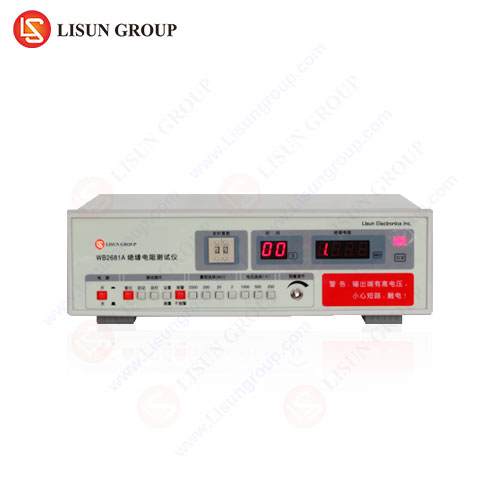
The LISUN WB2678A Grounding Resistance Tester embodies a modern implementation of these testing principles, engineered for reliability and integration within demanding manufacturing environments. Its design prioritizes measurement accuracy, operational safety, and user-defined configurability to meet diverse application protocols.
The core specifications of the WB2678A define its operational envelope. It delivers a selectable test current of 3A, 10A, or a programmable value up to 30A AC, accommodating the requirements of various product categories and standards. The measurement range for ground resistance is from 1.00 mΩ to 600.0 mΩ, with a basic accuracy of ±(1% of reading + 5 digits), ensuring precise quantification even of very low-resistance bonds. The open-circuit voltage is limited to a maximum of 12V AC, enhancing operator safety during testing. A critical safety feature is its built-in detection of incorrect wiring, such as reversed connections or open circuits, which halts the test and alerts the operator, preventing false passes. The instrument incorporates both a high-limit alarm and a low-limit alarm, allowing for pass/fail judgments based on a user-defined resistance threshold (typically between 50 mΩ and 200 mΩ, as per applicable standard) and a lower limit to detect suspiciously low readings that may indicate a short circuit.
Its test duration is programmable from 0.1 to 999.9 seconds, supporting both quick verification and extended stress tests. Data logging capabilities and remote control via interfaces such as RS232 or GPIB facilitate integration into automated production test systems and quality management software. The robust construction and clear digital display with backlight ensure usability in both laboratory and factory floor settings.
Deployment Across Manufacturing Sectors: Specific Industry Use Cases
The application of ground bond testing is ubiquitous across industries producing electrical and electronic goods. The WB2678A’s flexibility makes it suitable for this wide spectrum.
In Electrical and Electronic Equipment and Industrial Control Systems, panels, motor drives, and power supplies must have all chassis points, mounting plates, and cable glands reliably bonded to the main earth terminal. Testing verifies that welded, bolted, or braided connections maintain integrity after assembly and vibration.
For Household Appliances like washing machines, refrigerators, and ovens, any external metal casing or accessible conductive part must be securely earthed. Production-line testing with an instrument like the WB2678A ensures every unit will safely conduct fault current away from the user, a fundamental requirement under IEC 60335.
Automotive Electronics presents a challenging environment with constant vibration. Ground bond testing of electronic control units (ECUs), infotainment systems, and charging components validates that grounding straps and connections will not degrade over the vehicle’s lifespan, preventing malfunctions and ensuring passenger safety.
Lighting Fixtures, particularly high-power industrial, commercial, or outdoor fixtures with metal bodies, require rigorous testing. The test confirms that the luminaire’s housing is properly connected to the earth pin of its connector, crucial for safety during installation and maintenance.
Medical Devices demand exceptionally high reliability. For patient-connected equipment or devices with conductive enclosures, a robust ground bond is a primary safety means. Testing here follows stringent medical standards (e.g., IEC 60601-1) and often requires detailed documentation, supported by the tester’s data logging.
In Aerospace and Aviation Components, the stakes are extreme. Ground bond testing ensures avionics racks, in-flight entertainment systems, and other components are properly integrated into the aircraft’s grounding network, which is vital for both safety and electromagnetic compatibility (EMC).
Telecommunications Equipment and Office Equipment (servers, routers, photocopiers) are tested to ensure that all sub-assemblies and shields are bonded, preventing ground loops, mitigating EMI, and safeguarding users from faults in internal power supplies.
Testing Electrical Components such as industrial switches, sockets, and connectors verifies that their earth terminals provide a reliable, low-resistance path when installed in a larger system.
Finally, for Cable and Wiring Systems, the test can be used to verify the continuity and resistance of the earth conductor within a power cable assembly before it is integrated into a final product.
Competitive Advantages in Precision Manufacturing and Compliance
The WB2678A offers several distinct advantages in a competitive manufacturing landscape. Its programmability across a wide current range (3-30A) allows a single instrument to be configured for multiple product lines, reducing capital expenditure and calibration overhead. The high accuracy and resolution at low milliohm levels provide confidence in measurements, essential for products where the safety margin is critically defined by a resistance threshold. The inclusion of sophisticated detection circuits for wiring errors eliminates a common source of false acceptance, directly reducing the risk of non-compliant products reaching the market. Furthermore, its design for systems integration via standard communication interfaces allows it to function as a component within a fully automated test station, enabling 100% production testing with traceable records for each unit—a key requirement in regulated industries like medical devices and automotive.
Integration with Automated Production Test Systems
Modern high-volume manufacturing necessitates the integration of safety testers like the WB2678A into automated sequences. In such an environment, the tester is controlled by a central programmable logic controller (PLC) or industrial PC running test executive software. Robotic handlers or conveyor systems present the device under test (DUT), probes make contact with specified test points, and the WB2678A executes the programmed test—applying the correct current, measuring resistance, comparing to limits, and returning a pass/fail result. This result can trigger sorting mechanisms or be logged with a serial number and timestamp to a database. This seamless integration ensures testing consistency, eliminates operator variability, and provides an auditable trail for quality assurance and regulatory submissions.
Interpretation of Test Results and Failure Analysis
A passing test result indicates that the measured AC resistance of the protective earth path is below the maximum allowable limit specified by the relevant safety standard. This confirms the electrical integrity of the bonding.
A failure, where resistance exceeds the high-limit threshold, necessitates immediate investigation. Common root causes include: incomplete crimping or termination of the earth wire; loose fasteners such as screws or nuts securing the earth conductor; corrosion or contamination at contact surfaces; poor-quality welding or soldering of grounding straps; or a missing earth connection entirely. A failure against the low-limit alarm may indicate an incorrect test setup where the probe is shorted directly to the live or neutral conductor, or an internal fault in the DUT. Systematic analysis of failure modes, enabled by the precise data from the tester, drives corrective actions in design, component selection, and assembly processes, ultimately enhancing product safety and manufacturing yield.
FAQ Section
Q1: Why is a high test current (e.g., 25A) used instead of a simple multimeter’s continuity function?
A: A multimeter uses a low current (typically a few mA) which may not overcome high-resistance films or oxides at contact points, yielding a deceptively good reading. A high-current test, as performed by the WB2678A, stresses the connection similarly to a real fault condition, heating the path and providing a true measure of its impedance under load, as mandated by safety standards.
Q2: How is the appropriate resistance pass/fail limit determined for my product?
A: The limit is defined by the applicable product safety standard (e.g., IEC, UL, EN). Common limits range from 0.1 Ω (100 mΩ) to 0.25 Ω (250 mΩ), but the specific value depends on the product type, its rated current, and the standard’s clauses. The manufacturer’s certification agency typically provides the definitive limit for compliance.
Q3: Can the WB2678A be used for both production-line testing and laboratory design validation?
A: Yes. Its programmability, accuracy, and data output capabilities make it suitable for both applications. In the lab, it can be used to verify prototype designs and establish test parameters. The same parameters can then be deployed on the production floor, ensuring consistency from design verification to mass manufacturing.
Q4: What is the significance of the “wiring error detection” feature?
A: This feature prevents catastrophic test errors. If an operator incorrectly connects the test leads (e.g., to live and neutral instead of earth), the tester will abort the test and issue a warning. This prevents a false “pass” result on a product with no functional ground connection, which would represent a severe safety oversight.
Q5: How often should a ground bond tester like the WB2678A be calibrated?
A: Calibration intervals are determined by the manufacturer’s quality system, often aligned with ISO 17025 requirements. A typical interval is annually, but more frequent intervals may be dictated by usage intensity, regulatory requirements, or internal quality procedures to ensure ongoing measurement traceability and reliability.
