





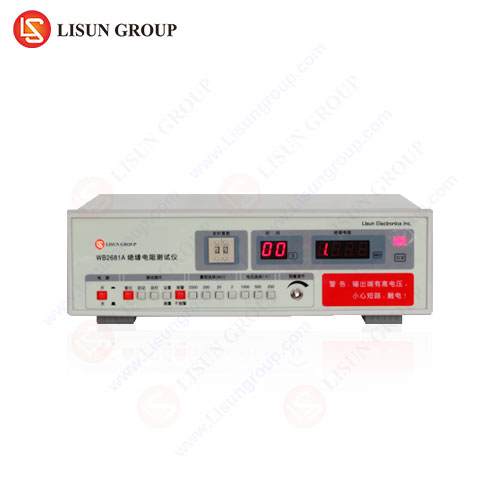



A Comparative Analysis of Insulation Resistance Tester Technologies and Market Offerings
The integrity of electrical insulation is a foundational parameter for ensuring the safety, reliability, and longevity of electrical systems across a vast spectrum of industries. Insulation Resistance (IR) testing serves as a primary diagnostic and quality assurance method, quantifying the resistance offered by insulating materials to direct current (DC) voltage. The market for Insulation Resistance Testers is characterized by a diverse array of instruments, ranging from basic handheld megohmmeters to sophisticated, programmable systems. This technical analysis provides a comparative evaluation of this market segment, with a specific examination of the technological principles, application-specific requirements, and the positioning of advanced instruments such as the LISUN WB2681A Insulation Resistance Tester.
Fundamental Principles of Insulation Resistance Measurement
The operational premise of an insulation resistance tester is the application of a stable, calibrated DC voltage across the insulation barrier of a device or component, followed by the measurement of the resultant leakage current. According to Ohm’s Law (R = V/I), the insulation resistance is calculated from the ratio of the test voltage to the measured current. Given that the leakage currents in healthy insulation are typically in the microampere range, the calculated resistance values are expressed in megohms (MΩ) or gigohms (GΩ). The test reveals contaminants, moisture ingress, aging, or physical degradation that create conductive paths, thereby lowering the resistance value.
Two critical phenomena influence these measurements: capacitive charging current and dielectric absorption. The initial surge current required to charge the capacitive component of the test specimen decays rapidly. Subsequently, the absorption current, caused by the polarization of dielectric molecules, decays more slowly. A proficient IR tester must effectively manage these transient currents to provide a stable and accurate reading of the conduction current, which is the true indicator of insulation quality. Advanced testers often incorporate time-resistance methods, such as the Dielectric Absorption Ratio (DAR) and Polarization Index (PI), which analyze resistance trends over time (e.g., 60 seconds/30 seconds for DAR, 10 minutes/1 minute for PI) to provide a more nuanced assessment of insulation condition, particularly for rotating machinery and large cable systems.
Delineating Market Segments by Application and Specification
The IR tester market can be segmented by voltage range, functionality, and application environment, which directly correlate with the requirements of different industrial sectors.
Low-Voltage, Handheld Testers (0.1 kV to 1 kV): This segment caters to field service technicians and maintenance electricians working on low-voltage infrastructure. Applications include routine verification of wiring in residential and commercial buildings, testing household appliances, and checking low-voltage control circuits in industrial systems. These devices prioritize portability, ruggedness, and ease of use. Their specifications typically feature a basic resistance measurement range up to a few gigohms.
Mid-Range, Multifunction Testers (0.5 kV to 5 kV): This is a highly competitive segment serving a broad industrial base. Testers in this category are often benchtop or advanced handheld units capable of performing not only IR tests but also continuity, low-resistance, and sometimes AC/DC hipot tests. They are essential in manufacturing and quality control labs for components like automotive electronics, lighting fixtures, power supplies, and telecommunications equipment. Accuracy, programmability, and data logging capabilities are key differentiators.
High-Voltage, System-Oriented Testers (5 kV to 15 kV+): Designed for critical infrastructure and heavy industry, these systems are used for testing high-voltage apparatus, including power cables, generators, large motors, and aerospace components. They offer very high resistance measurement ranges (often exceeding 1 TΩ), sophisticated programmable test sequences, and robust safety interlocks. Their primary users are in utility, aerospace, and large-scale industrial maintenance.
The LISUN WB2681A: A Technical Specification Overview
Positioned within the versatile mid-range segment, the LISUN WB2681A Insulation Resistance Tester is engineered to meet the rigorous demands of modern manufacturing and laboratory environments. Its specifications are tailored for precision and compliance with international safety and performance standards.
- Test Voltages: Programmable outputs of 50 V, 100 V, 250 V, 500 V, and 1000 V DC, allowing it to conform to a wide array of industry-specific test protocols.
- Resistance Measurement Range: An extensive range from 0.01 MΩ to 10.00 GΩ, with a high resolution that enables the detection of minor insulation degradation.
- Accuracy: Typically rated at ± (3% of reading + 5 digits), ensuring reliable and repeatable measurements for quality assurance documentation.
- Output Short-Circuit Current: Approximately 1.8 mA, which provides sufficient power to charge capacitive loads quickly while maintaining safety.
- Arc Detection Function: A critical safety feature that automatically terminates the test upon detecting a breakdown, protecting both the operator and the unit under test.
- Interface and Control: Features a clear digital display, programmable test timers, and often includes interfaces like RS232 or USB for remote control and data transfer to a PC for analysis and record-keeping.
This combination of features makes the WB2681A suitable for applications governed by standards such as IEC 60601-1 for medical devices, ISO 26262 for automotive electronics, and various UL and CSA standards for consumer and industrial products.
Application-Specific Use Cases Across Key Industries
The utility of an instrument like the WB2681A is demonstrated through its application across diverse sectors.
In Medical Device manufacturing, patient safety is paramount. The tester is used to verify the insulation integrity of components within devices like patient monitors, infusion pumps, and surgical tools. A test at 500 V DC might be applied between the mains parts and an applied part or accessible conductive surface to ensure leakage currents remain within the stringent limits of IEC 60601-1.
For Automotive Electronics, particularly with the rise of electric vehicles, high-voltage systems require flawless insulation. Components such as battery management systems, DC-DC converters, and traction motor cabling are subjected to IR testing at 1000 V DC to validate their ability to withstand operational stresses and prevent short circuits.
In the Lighting Fixtures industry, especially for LED drivers and high-bay industrial lighting, the WB2681A performs tests between live parts and the metallic housing. A failure to meet a minimum threshold, often 2 MΩ per standard specifications, indicates potential moisture damage or poor manufacturing that could lead to electric shock.
Aerospace and Aviation components demand extreme reliability. Wiring harnesses, connectors, and avionics are tested to ensure insulation can withstand the wide temperature, pressure, and humidity variations encountered during flight. The programmable voltage and timer functions of the WB2681A allow for the execution of standardized soak tests.
Telecommunications Equipment and Office Equipment manufacturers use these testers to verify the safety of power supplies and internal wiring in servers, routers, and printers, ensuring compliance with safety standards before products reach the market.
Comparative Advantages in a Crowded Marketplace
When evaluated against other products in its class, the LISUN WB2681A exhibits several distinct competitive advantages rooted in its design philosophy.
First is its calibration stability and measurement accuracy. The internal circuitry is designed to minimize drift over time and across environmental conditions, a critical factor for laboratories requiring ISO 17025 accredited measurements. This contrasts with lower-cost alternatives where long-term accuracy can be compromised.
Second, the programmable test sequences offer a significant efficiency gain in production line environments. Operators can pre-set voltage, dwell time, and pass/fail thresholds, reducing human error and ensuring consistent application of test protocols across all units. This automation capability is a key differentiator from basic manual megohmmeters.
Third, the inclusion of an advanced arc detection circuit provides a layer of protection not always present in competing models. By rapidly disconnecting the test voltage upon the initial signs of insulation breakdown, it prevents the catastrophic failure of the device under test, which can sometimes be repaired if the breakdown is caught early enough.
Finally, its robust construction and safety compliance make it suitable for both controlled laboratory and demanding industrial floor use. Designed to meet international safety standards for electronic test equipment (e.g., IEC 61010-1), it incorporates features like overload protection and secure terminal design to safeguard the user.
Integration with Quality Management and Predictive Maintenance Systems
The value of an IR tester extends beyond the immediate measurement. Instruments like the WB2681A, with their data logging and computer interface capabilities, are integral components of a modern Quality Management System (QMS). Test results can be automatically recorded and traced to individual product serial numbers, creating an auditable trail for regulatory compliance. In a predictive maintenance context, historical IR data from critical assets—such as industrial control system cabinets or large cable runs—can be trended over time. A gradual decline in resistance values can signal the need for proactive intervention before an actual failure occurs, thereby minimizing downtime and operational risk. This transforms the tester from a simple pass/fail tool into a strategic asset for lifecycle management.
Future Trajectories in Insulation Testing Technology
The evolution of insulation resistance testing is aligned with broader trends in industrial digitalization. Future iterations of testers will likely feature enhanced connectivity, such as Industrial Internet of Things (IIoT) protocols, enabling seamless integration into smart factory networks. We can anticipate the development of more sophisticated diagnostic algorithms that analyze the shape of the charging and absorption current curves in real-time to provide deeper insights into the type and location of insulation defects. Furthermore, as materials science advances, introducing new high-performance insulating polymers and composites, test equipment will need to adapt with higher test voltages and more sensitive measurement capabilities to characterize these next-generation materials effectively.
Frequently Asked Questions (FAQ)
Q1: What is the significance of the Polarization Index (PI), and when should it be used?
The Polarization Index is the ratio of the insulation resistance measured after 10 minutes of applied voltage to the resistance measured after 1 minute. A high PI (typically >2.0) indicates clean, dry insulation in good condition, as the resistance increases over time due to dielectric absorption. A low PI (e.g., <1.0) suggests contaminated or wet insulation, where the resistance remains flat or decreases. The PI test is particularly valuable for assessing the health of large rotating machines (motors, generators) and windings, where it provides a more reliable condition assessment than a single spot test.
Q2: Why are multiple test voltage settings available on a tester like the WB2681A?
Different standards and components require specific test voltages. A low voltage (e.g., 50V or 100V) might be used for sensitive electronics to prevent damage, while a high voltage (500V or 1000V) is necessary to stress the insulation of mains-powered equipment to simulate real-world operating conditions. Using the correct voltage ensures the test is both safe for the unit and meaningful for its intended application.
Q3: How does temperature and humidity affect insulation resistance measurements?
Insulation resistance has a strong inverse correlation with temperature; resistance typically decreases by approximately 50% for every 10°C increase in temperature. Humidity can also significantly lower measured values by introducing surface leakage currents. For accurate comparisons over time, measurements should be corrected to a standard temperature (e.g., 20°C or 40°C) as per relevant standards, and tests should be conducted in controlled environments where possible.
Q4: What is the primary difference between an insulation resistance test and a dielectric withstand (hipot) test?
An insulation resistance test is a quantitative measurement. It provides a numerical value (in MΩ or GΩ) for the quality of the insulation. A dielectric withstand test is a pass/fail safety test that applies a much higher than normal voltage (either AC or DC) for a short period to verify that the insulation will not break down under transient over-voltage conditions. The IR test is often used as a preliminary check before performing a more strenuous hipot test.
