








Insulation Resistance Test and HV Test: A Comparative Guide for Electrical Safety Validation
Introduction to Dielectric Integrity Assessment
The verification of dielectric integrity constitutes a foundational pillar in the design, manufacturing, and maintenance of electrical and electronic equipment. Failure of insulation systems can lead to catastrophic outcomes, including equipment destruction, fire hazards, and severe safety risks to personnel. Two principal methodologies dominate this validation landscape: the Insulation Resistance (IR) Test and the High-Voltage (HV) Withstand or Dielectric Strength Test. While often discussed in tandem, their objectives, underlying principles, and applications are distinct yet complementary. This guide provides a detailed comparative analysis of these critical tests, elucidating their roles within a comprehensive safety testing regimen. The discourse is framed within the context of global standards—such as IEC 60335, IEC 60601, IEC 61010, and UL standards—which mandate specific requirements for products across diverse sectors including Household Appliances, Medical Devices, and Automotive Electronics.
Fundamental Principles of Insulation Resistance Measurement
The Insulation Resistance Test is a non-destructive, quantitative evaluation of an insulation system’s quality. It operates on the principle of applying a relatively low, steady-state DC voltage—typically ranging from 50 V to 1,000 V for most equipment, and up to 5 kV or 10 kV for high-voltage apparatus—across the insulation barrier. The resultant current flow, primarily comprising leakage current and capacitive charging current (which decays to zero), is measured. The insulation resistance (R) is then calculated via Ohm’s Law (R = V / I). This value, often expressed in megaohms (MΩ) or gigaohms (GΩ), serves as a direct indicator of the insulation’s ability to impede electron flow.
The test reveals contamination, moisture ingress, aging, and physical degradation. It is frequently performed as a “Megger” test, named after a common instrument. Key measurement variants include the Spot Reading Test (a single resistance value at a specific time), the Time-Resistance Test (plotting resistance over minutes to assess absorption characteristics and identify moisture), and the Dielectric Absorption Ratio (DAR) or Polarization Index (PI), which compare resistance values at different time intervals (e.g., 60 seconds/30 seconds for DAR, 10 minutes/1 minute for PI). A rising resistance over time indicates healthy, “dry” insulation, while a flat or decreasing curve suggests issues.
The Role and Mechanism of High-Voltage Withstand Testing
In stark contrast, the High-Voltage Withstand Test is a pass/fail, stress-testing procedure designed to verify that the insulation can safely endure transient overvoltages and peak operating stresses without breakdown. Its principle is straightforward but severe: apply an AC or DC voltage significantly higher than the equipment’s normal operating voltage—often 1,000 V AC plus twice the operating voltage for basic insulation, as per many standards—for a specified short duration, usually 60 seconds. The test is intended to simulate lightning strikes, switching surges, or other voltage transients.
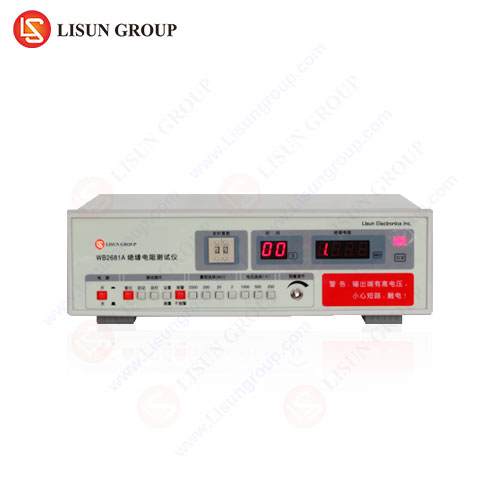
The primary monitored parameter is not resistance, but leakage current under this high stress. A test instrument, such as the LISUN WB2671A Withstand Voltage Tester, applies the voltage and precisely measures the current flowing through the insulation. If the current exceeds a pre-set trip limit (e.g., 5 mA, 10 mA, or 100 mA as defined by the relevant standard), or if a complete dielectric breakdown (arc) occurs, the test fails. This confirms a weakness or a breach in the insulation that could lead to failure under abnormal conditions. It is a definitive test of dielectric strength but is inherently more stressful on the component than an IR test.
Comparative Analysis: Objectives, Applications, and Limitations
A side-by-side examination clarifies the distinct roles of each test.
Objective:
- IR Test: To measure the quality of insulation, providing a quantitative metric of its condition. It is diagnostic and trending-oriented.
- HV Test: To prove the dielectric strength of insulation, providing a qualitative pass/fail verdict on its ability to withstand high stress. It is a safety proof test.
Nature:
- IR Test: Non-destructive under normal conditions; used for preventive maintenance and quality control.
- HV Test: Destructive in outcome if the insulation fails; potentially cumulative in effect, causing microscopic degradation even if a pass is achieved. It is a type test and routine production test.
Output:
- IR Test: A numerical value (MΩ, GΩ) or a ratio (PI, DAR).
- HV Test: A binary result (Pass/Fail) based on leakage current threshold.
Typical Applications:
- IR Test: Incoming inspection of materials (e.g., cable sheathing, transformer windings), predictive maintenance of motors and generators, quality checks on Electrical Components like switches and sockets, and verification of Telecommunications Equipment and Office Equipment boards for cleanliness.
- HV Test: Mandatory safety certification for Household Appliances (e.g., between live parts and accessible metal), final production testing of Medical Devices, validation of Automotive Electronics modules for surge immunity, and type testing of Lighting Fixtures and Aerospace and Aviation Components.
Limitations:
- IR Test: Cannot guarantee the insulation will withstand high-voltage surges. Values are highly temperature and humidity dependent.
- HV Test: Does not provide information on the gradual degradation or moisture content of insulation. A passing result does not indicate the insulation’s “health,” only its immediate strength.
Industry-Specific Testing Protocols and Standards References
Different industries prioritize and sequence these tests based on product risk and lifecycle.
- Electrical and Electronic Equipment / Industrial Control Systems: IEC 61010-1 mandates both dielectric strength tests (e.g., 1,500 V AC for 60s for overvoltage category II) and, for some protective impedance, insulation resistance measurements (≥ 2 MΩ at 500 V DC). Production lines often perform a fast, high-potential test on every unit, with periodic IR sampling.
- Household Appliances: IEC 60335-1 requires a dielectric strength test as a type test and routine test. Insulation resistance is measured (≥ 2 MΩ for Class I appliances, ≥ 7 MΩ for Class II) typically after a humidity treatment, serving as a precondition check before the HV test.
- Medical Devices: IEC 60601-1 has stringent requirements. It specifies HV test voltages based on working voltage and insulation type (e.g., 1,500 V AC for basic insulation at 230 V mains). Patient leakage currents, closely related to insulation quality, are also critically measured, often requiring specialized equipment.
- Automotive Electronics: ISO 16750-2 and LV 124 define rigorous environmental and electrical tests. HV withstand tests simulate load dump and other transients (e.g., applying several hundred volts to power supply lines). IR testing is used for validation of high-voltage components in electric vehicles.
- Cable and Wiring Systems: Both tests are fundamental. IR testing per IEC 60227 measures conductor-to-conductor and conductor-to-sheath resistance. HV tests involve applying AC or DC high voltage (e.g., 3.5 kV AC for 5 minutes for 600/1000V cables) to prove no breakdown occurs.
The LISUN WB2671A Withstand Voltage Tester: A Technical Examination
For rigorous and compliant HV testing across these varied industries, precision instrumentation is paramount. The LISUN WB2671A Withstand Voltage Tester exemplifies a solution engineered for this critical role. It is designed to perform AC and DC dielectric strength tests with high accuracy and operator safety.
Testing Principles and Core Specifications:
The WB2671A operates by generating a user-defined high AC or DC voltage via a precision-controlled transformer and conversion circuitry. It applies this voltage across the Device Under Test (DUT) and monitors the real-time leakage current with a high-resolution measurement system. The instrument’s core function is to compare this current against a programmable limit. If the limit is exceeded, the test is instantly terminated (trip), and the unit is flagged as a failure. Key specifications include:
- Output Voltage Range: Typically 0–5 kV AC/DC (model-dependent variants may offer higher ranges).
- Voltage Accuracy: High accuracy, often within ±(1-3)% of reading.
- Leakage Current Measurement Range: From microamperes (μA) to milliamperes (mA), with precise resolution.
- Trip Current Setting: Programmable across the measurement range, allowing compliance with various standards (e.g., 5 mA for IT equipment, 10 mA for appliances).
- Timer: Programmable test duration from 1–99 seconds, meeting the common 60-second requirement.
- Arc Detection: Advanced models incorporate arc detection circuitry to identify momentary breakdowns that may not sustain a current above the trip limit.
Industry Use Cases:
The WB2671A is deployed on production lines and in quality labs for final safety verification. In Consumer Electronics manufacturing, it tests the isolation between primary and secondary circuits of power adapters. For Electrical Components like relays or connectors, it validates clearance and creepage distances. Lighting Fixtures manufacturers use it to test between the live pin of the lamp holder and the accessible metal body. Its reliability makes it suitable for the high-throughput, zero-defect demands of Automotive Electronics suppliers.
Competitive Advantages:
The WB2671A’s design emphasizes safety, accuracy, and usability. Features such as a zero-start interlock (prevents voltage application unless starting from 0V), a high-voltage warning indicator, and secure grounding provisions protect the operator. Its stable output and precise measurement ensure repeatable results, critical for certification and audit compliance. The intuitive interface, often featuring a digital display for voltage, current, and time, reduces setup errors. Compared to simpler or older testers, its programmability and compliance with international safety standards for test equipment (like IEC 61010) provide a significant operational and assurance advantage.
Integrating IR and HV Testing into a Cohesive Quality Strategy
A robust electrical safety program does not choose between IR and HV testing; it strategically employs both. A common and effective sequence is:
- Initial IR Test: Performed on new or maintained equipment to establish a baseline “health” reading. A low IR value may indicate contamination, obviating the need for a potentially damaging HV test.
- HV Withstand Test: Conducted to verify dielectric strength, provided the IR value is acceptable. This is the definitive safety proof.
- Post-HV IR Test: Sometimes performed after a withstand test to ensure the high stress did not cause latent damage that degraded the insulation resistance.
This integrated approach is evident in motor maintenance: an IR/PI test assesses winding condition during overhaul, while an HV test validates the integrity of new insulation post-repair. In factory acceptance testing for Industrial Control Systems, both tests are sequentially executed per the project specification.
Conclusion: Complementary Pillars of Safety Assurance
The Insulation Resistance Test and the High-Voltage Withstand Test serve as complementary, non-interchangeable pillars of electrical safety assurance. The IR test is the physician’s diagnostic tool, quantifying wellness and tracking degradation over time. The HV test is the stress-test, proving the system can survive a crisis. Understanding their distinct principles, applications, and limitations is essential for engineers, quality professionals, and technicians across the Electrical and Electronic Equipment landscape. Employing precise, reliable, and safe instrumentation, such as the LISUN WB2671A for HV testing, ensures that these critical evaluations are performed to the highest standard, ultimately safeguarding product integrity, user safety, and brand reputation.
Frequently Asked Questions (FAQ)
Q1: Can a product pass an HV withstand test but still have poor insulation?
A1: Yes, it is possible but indicative of a borderline condition. The HV test is a pass/fail test at a specific moment. Insulation that is degraded or moist but not yet fully compromised may still withstand the short-duration high stress without exceeding the leakage current limit. This is why the IR test, which is sensitive to gradual degradation, is an important complementary check.
Q2: What is the significance of the “trip current” setting on an instrument like the WB2671A?
A2: The trip current is the maximum allowable leakage current during the HV test. It is not a universal value but is defined by the safety standard applicable to the product under test (e.g., IEC 60335-1 may specify 10 mA for certain household appliances). Setting the correct trip current is critical for a compliant test; a setting too high may allow unsafe products to pass, while a setting too low may cause false failures.
Q3: Why are both AC and DC HV test capabilities important?
A3: Different standards and component types require different test voltages. AC testing is most representative of mains-frequency stress and tests insulation uniformly. DC testing is used for components with high capacitance (like long cables) where AC testing would draw excessive capacitive current, and for testing after repair where DC is less likely to propagate existing partial discharges. A versatile tester like the WB2671A accommodates all requirements.
Q4: How often should HV withstand testing be performed on equipment in the field?
A4: For in-service equipment, HV testing is generally not recommended as a routine maintenance test due to its potentially cumulative damaging effect on insulation. It is primarily a type test and production line test. Field maintenance relies more on non-destructive IR/PI testing to trend insulation condition. HV testing in the field is typically only performed after major repairs or rewinds, following the specific manufacturer’s or standard’s guidance.
Q5: What are key safety precautions when operating a withstand voltage tester?
A5: Essential precautions include: ensuring the DUT and tester are properly grounded; using clearly marked, insulated test leads and safety enclosures; implementing a system to prevent accidental contact with live electrodes (e.g., interlocked test fixtures); setting the voltage and trip current correctly before starting; and following a strict procedural checklist to ensure the test area is clear before energizing.
