







The Critical Role of Live Earth Resistance Testing in Product Safety Compliance
The assurance of electrical safety in a globalized marketplace is predicated upon a foundation of rigorous, standardized testing. Among the most fundamental and non-negotiable verification procedures mandated by international safety standards is the earth continuity or protective earth resistance test. For manufacturers operating under the auspices of the IEC 60335 series of standards for household and similar electrical appliances, this test transcends a mere compliance checkbox; it is a direct measurement of a product’s primary defense against electric shock under fault conditions. This article provides a comprehensive technical examination of the live earth resistance test as per IEC 60335, detailing its principles, methodologies, and critical implementation across diverse industries. Furthermore, it analyzes the instrumental role of modern test equipment, exemplified by the LISUN WB2678A Grounding Resistance Tester, in achieving reliable, efficient, and standards-compliant verification.
Fundamental Principles of Protective Earthing and Shock Hazard Mitigation
The core safety philosophy embedded within IEC 60335 and related standards is the concept of basic and fault protection. Basic protection, often achieved through insulation and enclosures, prevents contact with live parts under normal operating conditions. Fault protection, however, is designed to safeguard users in the event of a basic insulation failure. Protective earthing is the cornerstone of this fault protection strategy. It involves the intentional connection of accessible conductive parts—such as the metal chassis of a washing machine, the enclosure of an industrial control panel, or the housing of a medical device—to the earth via a protective earth conductor.
When a fault occurs, such as a live conductor detaching and contacting the earthed metal enclosure, a low-impedance path is created. This path facilitates a substantial fault current to flow directly to earth, bypassing the user. The magnitude of this current must be sufficiently high to rapidly activate the circuit’s overcurrent protection device (e.g., a fuse or circuit breaker), thereby disconnecting the supply. The efficacy of this entire system is critically dependent on one parameter: the resistance of the protective earth connection. A high-resistance connection impedes fault current flow, potentially resulting in a delayed or absent disconnection. This failure can lead to the enclosure becoming energized at a hazardous voltage relative to earth, presenting a severe and immediate risk of electric shock. The live earth resistance test quantifies this risk by directly measuring the resistance of the earth continuity path under a defined test current.
IEC 60335 Test Methodology: Voltage, Current, and Resistance Thresholds
IEC 60335-1, the overarching standard, specifies the precise requirements for the earth continuity test in Clause 27.5. The test is performed by applying a voltage from a no-load source not exceeding 12 V AC or DC, and passing a test current derived from the rated current of the appliance’s protective device or a default value, typically 1.5 times the rated current or 25 A, whichever is higher, for a duration sufficient to obtain a stable reading. The standard mandates a maximum permissible resistance, which is generally 0.1 Ω for appliances with a power supply cord, and 0.2 Ω for fixed appliances, though specific product standards (Part 2 of IEC 60335) may stipulate alternative values.
The choice of a 12 V maximum open-circuit voltage is a critical safety feature, ensuring the test itself does not become a hazard during laboratory or production line application. However, the test must be performed at a significant current—often 10 A, 25 A, or higher—to simulate real-world fault conditions and to account for non-linear resistance phenomena that may not be apparent at lower measurement currents. This is where the distinction between a simple multimeter measurement and a compliant earth bond test becomes clear. A multimeter using a low test signal may fail to detect high-resistance joints caused by oxidation, poor crimps, or loose connections that would manifest under high fault current.
Instrumentation Requirements for Compliant Verification: The LISUN WB2678A
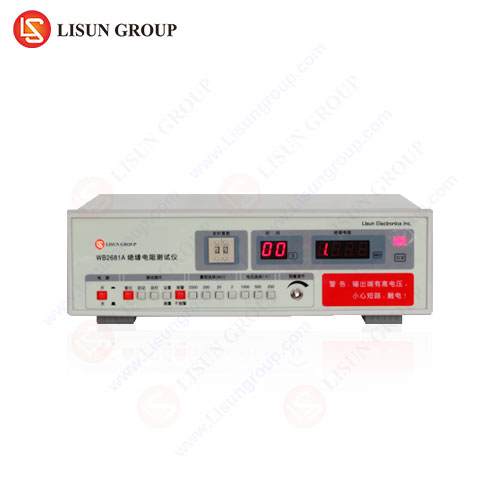
Performing a compliant test necessitates specialized instrumentation designed to meet the exacting parameters of the standard. A suitable earth bond tester must provide a regulated AC or DC test current at the specified levels, measure the resulting voltage drop with high accuracy, and calculate the resistance while maintaining operator safety. The LISUN WB2678A Grounding Resistance Tester is engineered specifically for this application domain.
The WB2678A operates on the fundamental four-wire (Kelvin) measurement principle. This methodology employs separate pairs of leads for current injection and voltage sensing, thereby eliminating the inherent resistance of the test leads and contact points from the final measurement. This is paramount for achieving accurate readings in the milliohm range, as lead resistance can often be of the same order of magnitude as the permissible limit. The instrument is capable of delivering a selectable test current, commonly up to 30.0 A AC, aligning with the upper requirements of IEC 60335 and other similar standards like IEC 60950-1 (IT equipment) and IEC 60601-1 (medical equipment).
Key Specifications of the LISUN WB2678A Relevant to IEC 60335 Testing:
- Test Current: 3.0 A / 10.0 A / 30.0 A AC (user-selectable).
- Resistance Measurement Range: 0.001 Ω to 1.200 Ω (at 30 A).
- Accuracy: Typically ±(2% of reading + 5 digits) within the specified range.
- Open-Circuit Test Voltage: < 12 V AC, ensuring compliance with the safety voltage limit.
- Test Duration: Adjustable or continuous, allowing for both quick verification and stability checks.
- Safety Features: Includes checks for open-circuit, short-circuit, and improper connection, alongside overload and over-temperature protection.
The instrument’s design facilitates integration into both laboratory benchtop and high-volume production line environments. Its ability to store test results and interface with external systems supports quality traceability and statistical process control (SPC), which are essential for modern manufacturing quality management systems.
Cross-Industry Application and Critical Use Cases
The imperative for a robust earth continuity path extends far beyond household appliances. The principles of IEC 60335 are echoed in product-family standards across virtually every sector involving electrical equipment.
- Household Appliances & Consumer Electronics: This is the direct domain of IEC 60335. Every Class I appliance—from refrigerators and washing machines to electric kettles and food processors—must undergo 100% production-line testing. A failure here represents a direct consumer hazard.
- Medical Devices (IEC 60601-1): Patient-connected equipment imposes even stricter safety requirements. The earth resistance test ensures that leakage currents are safely shunted to ground, protecting both patient and operator from micro-shock and macro-shock hazards. The high accuracy of an instrument like the WB2678A is non-negotiable.
- Information Technology & Telecommunications Equipment: Routers, servers, and base station units often have large, accessible metal chassis. Standards like IEC 62368-1 require verification of the protective earth integrity to ensure safety during handling and maintenance.
- Industrial Control Systems & Automotive Electronics: Control panels, motor drives, and charging equipment for electric vehicles operate at higher powers and in harsh environments. Vibration and thermal cycling can degrade connections over time, making periodic verification with a high-current tester essential for preventative maintenance.
- Lighting Fixtures: Large commercial LED luminaires and high-intensity discharge fixtures with metal bodies require a reliable earth connection, especially when installed in conductive environments or at height where maintenance poses additional risk.
- Aerospace and Aviation Components: While governed by specific standards like DO-160, the requirement for verifying the integrity of grounding paths for avionics racks and in-flight entertainment systems is analogous, demanding instruments with high reliability and precision.
- Electrical Components and Wiring Systems: The test is applied to the fundamental building blocks: industrial plugs and sockets, distribution boards, and cable assemblies must themselves have a low-resistance earth path before being incorporated into larger systems.
Comparative Advantages in Modern Manufacturing and Testing Regimes
In a production environment, speed, reliability, and data integrity are as crucial as technical compliance. Traditional testing methods using variable transformers and separate meters are slow, prone to operator error, and lack data logging. A dedicated, automated tester like the LISUN WB2678A provides distinct competitive advantages.
Firstly, it enhances throughput. Pre-programmed test currents and automatic pass/fail judgment based on user-set limits (e.g., 0.1 Ω ± a tolerance) allow for rapid testing cycles. Secondly, it improves reliability and reduces false rejects. The four-wire Kelvin measurement eliminates lead resistance errors, ensuring that a good product is not failed due to poor probe contact. Built-in detection for open circuits prevents a “false pass” on a completely disconnected earth wire. Thirdly, it ensures traceability. The ability to log and output test results for each unit tested is critical for audit compliance, recall management, and quality trend analysis. Finally, its operator safety features, including the low open-circuit voltage and protective enclosures, align with workplace safety regulations.
Interpretation of Results and Troubleshooting Guidance
A test result exceeding the stipulated limit (e.g., >0.1 Ω) necessitates immediate investigation and corrective action. The fault typically lies within the earth continuity path. Systematic troubleshooting should examine:
- Connection Points: The integrity of crimped terminals, screw terminals, and welded or brazed joints. Oxidation, loose fasteners, or insufficient contact pressure are common culprits.
- The Protective Earth Conductor: Inadequate wire gauge, damaged strands, or partial breakage can increase resistance.
- Contact Surfaces: Paint, anodization, or corrosion on contact surfaces between components (e.g., between a motor housing and the main appliance chassis) can insulate the path. Dedicated grounding studs or star washers are often required.
- Path Routing: Ensure no protective devices (e.g., fuses or switches) are incorrectly placed in the earth conductor.
A stable reading within the limit confirms the integrity of the physical connection under the test conditions, validating the product’s primary fault protection mechanism.
FAQ Section
Q1: Can the LISUN WB2678A be used for testing medical devices to IEC 60601-1?
Yes, absolutely. The IEC 60601-1 standard for medical electrical equipment specifies an earth resistance test with parameters (test current, voltage, limits) functionally identical to those in IEC 60335. The WB2678A, with its 30 A AC test current capability, milliohm-range accuracy, and safety features, is fully suitable for production-line and type-test verification of medical devices.
Q2: Why is a high test current (like 25A) necessary when a multimeter can measure low resistance?
A multimeter uses a very low test current, typically a few milliamps. This cannot detect certain high-resistance faults, such as a “dry” or oxidized joint, which may behave linearly at low current but exhibit high resistance at the high current of an actual fault. The high-current test simulates the real fault condition, ensuring the earth path will perform as required in a safety-critical event.
Q3: How often should earth bond test equipment like the WB2678A be calibrated?
Calibration intervals depend on usage frequency, environmental conditions, and quality system requirements (e.g., ISO 9001). For equipment used in critical safety testing and production acceptance, an annual calibration cycle by an accredited laboratory is a common industry practice. Regular performance checks using a calibrated reference artifact are also recommended between formal calibrations.
Q4: Does the WB2678A support testing of fixed (hard-wired) appliances with a 0.2 Ω limit?
Yes. The instrument’s measurement range extends well beyond both 0.1 Ω and 0.2 Ω limits. The user can freely set the upper pass/fail threshold in the instrument’s settings to 0.2 Ω (or any other value required by a specific product standard) to automatically flag non-compliant units during testing.
