







A Comprehensive Guide to Hipot Testing: Principles, Standards, and Implementation for Electrical Safety Verification
Introduction to Dielectric Withstand Verification
Dielectric withstand testing, commonly termed “Hipot” (High Potential) testing, constitutes a fundamental and non-negotiable procedure in the validation of electrical safety for virtually all powered devices and components. Its primary objective is to verify the integrity of electrical insulation, ensuring it can safely contain and isolate hazardous voltages under both normal and single-fault conditions. This test simulates electrical stress beyond typical operational levels, deliberately applying a high voltage between conductive parts and exposed metallic enclosures to detect potential breakdown paths. Failure to adequately perform this verification can result in catastrophic outcomes, including electric shock, fire, equipment damage, and non-compliance with international regulatory frameworks. Consequently, the selection and application of a precise, reliable, and standards-compliant hipot tester are critical decisions for design engineers, quality assurance teams, and certification laboratories across the global manufacturing ecosystem.
Fundamental Principles of Dielectric Strength Assessment
The core operational principle of a hipot tester is deceptively simple: apply a known, elevated AC or DC voltage across the insulation barrier of a Device Under Test (DUT) and measure the resultant leakage current. The test voltage, significantly higher than the DUT’s rated operational voltage, stresses the insulation system. A robust insulation system will exhibit only a minimal, predictable leakage current, primarily capacitive in nature. An insulation flaw—such as a pinhole, crack, contaminant, or insufficient creepage/clearance distance—creates a lower-impedance path, causing the leakage current to exceed a predefined safety threshold, which the tester detects as a failure.
The choice between AC and DC testing hinges on application-specific requirements. AC testing, typically at power frequencies of 50/60 Hz, subjects the insulation to peak voltage stresses and cyclical polarization, effectively testing for weaknesses related to material fatigue and peak voltage endurance. It is the standard for most final product safety tests, such as for household appliances or lighting fixtures. DC testing applies a steady-state high voltage, resulting in a primarily resistive leakage current. It is often employed for capacitive loads like long cables, wiring systems, and high-voltage semiconductor components, as it avoids large capacitive charging currents that can mask true leakage. DC testing is also used in production environments for its inherent lower risk of damage to sensitive components should an arc occur.
International Standards and Regulatory Compliance Mandates
Hipot testing is not an arbitrary practice but is rigorously defined by a complex matrix of international and national standards. Compliance with these standards is mandatory for market access and product certification. Key standards bodies include the International Electrotechnical Commission (IEC), Underwriters Laboratories (UL), the Canadian Standards Association (CSA), and the European Committee for Electrotechnical Standardization (CENELEC).
The foundational standard is IEC 61010-1 (Safety requirements for electrical equipment for measurement, control, and laboratory use), which specifies test voltages, durations, and leakage current limits for various equipment categories. For household and similar electrical appliances, IEC 60335-1 is paramount. Medical electrical equipment is governed by the stringent requirements of IEC 60601-1, which often mandates enhanced insulation systems and more rigorous testing protocols. Information technology equipment falls under IEC 60950-1 (superseded but still referenced) and IEC 62368-1, the newer hazard-based safety standard. Automotive electronics must satisfy various OEM specifications and standards like ISO 6469-3 for electric vehicle safety, which includes specific dielectric withstand requirements for high-voltage propulsion systems.
These standards dictate critical test parameters: the magnitude of the test voltage (often 1000V AC + 2x rated voltage, or specific values from tables), the application duration (typically 60 seconds for type tests, 1-3 seconds for production line tests), and the maximum allowable leakage current (usually ranging from 0.5 mA to 10 mA depending on the product class and standard). A modern hipot tester must be capable of being configured to these exacting requirements and provide auditable proof of compliance.
The WB2671A Withstand Voltage Tester: A Technical Analysis
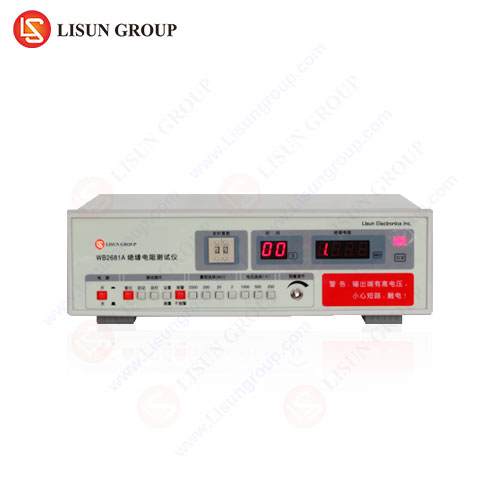
The LISUN WB2671A Withstand Voltage Tester exemplifies the integration of precision, safety, and user-centric design required for modern compliance testing. It is engineered to perform comprehensive AC/DC dielectric withstand and insulation resistance tests, serving as a critical tool for R&D validation, quality control, and certification laboratory applications across diverse industries.
Specifications and Functional Capabilities:
- Test Voltages: AC: 0–5 kV / 0–10 kV / 0–20 kV; DC: 0–5 kV / 0–10 kV / 0–20 kV (model dependent), with voltage accuracy typically within ±(2% + 5 digits).
- Leakage Current Measurement: AC: 0.10–2.00 mA / 0.10–20.00 mA; DC: 0.10–2.00 mA / 0.10–10.00 mA, with high-resolution detection.
- Output Waveform Distortion: ≤3% for AC output, ensuring a pure sine wave that meets standard requirements for accurate stress application.
- Timing Function: Programmable test duration from 1–99 seconds, with manual and remote start/stop capabilities.
- Arc Detection: Advanced arc detection circuitry identifies momentary breakdowns that may self-recover but indicate a latent insulation weakness—a critical feature for components like wire harnesses, connectors, and printed circuit boards.
- Ramp Function: Allows for programmable voltage ramp-up and ramp-down times, protecting sensitive DUTs from transient surges and providing more nuanced diagnostic data.
- Interfaces: Equipped with RS232, USB, and GPIB (optional) for seamless integration into automated test systems and data logging software, essential for traceability in medical device or aerospace component manufacturing.
Testing Principles Embodied: The WB2671A operates on the direct measurement principle. Its high-voltage transformer and precision regulation circuitry generate the stable, high-accuracy test voltage. A high-impedance measurement circuit in series with the DUT continuously monitors the real leakage current. The instrument compares this value against the user-set upper limit. Concurrently, it monitors for sudden current spikes indicative of arcing. A failure in either category triggers an immediate shutdown of the high voltage and a visual/audible alarm, ensuring operator safety and preventing further damage to the DUT.
Industry-Specific Application Scenarios
- Household Appliances & Lighting Fixtures: Final safety testing of products like refrigerators, washing machines, and LED drivers to IEC 60335-1 and IEC 60598-1. The WB2671A verifies that insulation between live parts and the accessible metal chassis can withstand routine overvoltage events.
- Automotive Electronics: Testing of electric vehicle battery pack insulation, motor controllers, onboard chargers, and wiring systems. The DC withstand function is crucial for testing high-voltage DC buses (e.g., 400V or 800V systems) per ISO 6469-3 and OEM specifications.
- Medical Devices: Rigorous testing of patient-connected equipment like dialysis machines, MRI components, and surgical tools to IEC 60601-1. The tester’s high accuracy, data logging, and programmable ramps are essential for documenting the integrity of Means of Patient Protection (MOPP).
- Aerospace & Aviation Components: Verification of wiring, flight control systems, and in-flight entertainment systems to standards like DO-160. The instrument’s reliability and precise measurement are non-negotiable in this failure-intolerant environment.
- Electrical Components & Cables: Incoming inspection and production testing of switches, sockets, relays, and cable assemblies. The arc detection feature is particularly valuable for identifying marginal insulation in connectors or damaged cable insulation that might pass a simple continuity check.
Competitive Advantages in Operational Context
The WB2671A’s design addresses common pain points in safety testing. Its low waveform distortion ensures compliance with standards that specify a “substantially sinusoidal” waveform, avoiding false failures or, worse, missed failures due to improper stress. The programmable ramp function prevents inrush currents from tripping the test on capacitive loads, a common issue when testing long cables or power supplies with large Y-capacitors. The inclusion of both remote control interfaces and robust front-panel controls provides flexibility for both automated production line integration and benchtop R&D use. Furthermore, its comprehensive protection suite—including short-circuit, over-current, and over-voltage protection—safeguards both the operator and the instrument, reducing downtime and operational risk.
Designing an Effective and Safe Hipot Test Procedure
A successful test regimen extends beyond equipment possession. A formal procedure must be documented, encompassing:
- Pre-Test Verification: Calibration of the tester, inspection of test leads and fixtures for damage, and confirmation of a “known-good” and a “known-bad” sample to validate the test setup.
- DUT Preparation: The DUT must be in its final, assemblable state. All covers normally removed by the end-user should be off; all covers requiring a tool should be on. For products with power switches, they should be in the “on” position.
- Connection Methodology: The high-voltage lead is connected to all primary circuit points (live and neutral, tied together). The return lead is connected to all accessible conductive parts, typically the protective earth terminal and any user-accessible metal. Ensure all grounding connections are secure.
- Parameter Setting: Precisely set the test voltage, limit current, and test time according to the applicable standard. For production, a reduced time (e.g., 1-3 seconds) at the full voltage is often permissible.
- Execution and Monitoring: Initiate the test, observing for any signs of arcing (audible snapping, visible flash) or instrument failure indication. The operator must be trained to never touch the DUT or fixtures during the test.
- Post-Test Protocol: After a pass, safely discharge capacitive DUTs. After a fail, clearly isolate the unit, investigate the root cause (e.g., poor spacing, contamination, faulty component), and document the findings.
Interpreting Results and Diagnosing Insulation Failures
A “FAIL” result necessitates root cause analysis. A sustained high leakage current suggests a solid insulation breakdown or severe contamination. An arc detection failure indicates a momentary flashover, often due to marginal creepage/clearance distances, an air gap, or a partial void in solid insulation. It is critical to differentiate between a genuine product failure and a “test setup failure” caused by factors like moisture condensation, dust on the test bench, or an ungrounded DUT fixture. Environmental controls and proper laboratory practice are essential to result integrity.
Integrating Hipot Testing into a Broader Safety Regime
Dielectric withstand testing is one pillar of a complete electrical safety test suite. It is most effectively deployed in conjunction with:
- Ground Bond Testing: Verifies the integrity and low resistance of the protective earth connection, ensuring fault currents have a safe path to trip the over-current device.
- Insulation Resistance Testing: Applies a DC voltage (typically 500V) to measure the insulation resistance in ohms or megohms, providing a quantitative measure of insulation quality, often used for predictive maintenance.
- Functional Run Tests: Ensuring the product operates correctly after being subjected to high-voltage stress.
A coordinated test sequence—often Ground Bond, then Insulation Resistance, then Hipot—provides a comprehensive safety assessment. Modern, combined testers like the WB2671A, which integrate these functions, streamline workflow and improve efficiency in production environments.
Conclusion
The imperative for rigorous electrical safety verification is universal across manufacturing sectors. Hipot testing remains the definitive method for stress-testing insulation systems and uncovering latent faults that could compromise user safety. Mastery of its principles, adherence to evolving international standards, and the deployment of capable, accurate, and safe instrumentation such as the LISUN WB2671A Withstand Voltage Tester are fundamental responsibilities for organizations committed to product integrity, regulatory compliance, and the prevention of electrical hazards. As technology advances, particularly with higher voltage systems in automotive and industrial applications, the role of precise dielectric testing will only grow in critical importance.
FAQ Section
Q1: What is the primary difference between AC and DC hipot testing, and when should each be used?
A: AC testing applies a sinusoidal high voltage, stressing insulation with both peak voltage and cyclical polarization; it is the standard for most finished products (appliances, IT equipment) per safety standards. DC testing applies a steady voltage, ideal for highly capacitive loads (long cables, large filters) as it avoids large charging currents. DC is also often used in production for its lower risk of damage during an arc. The choice is dictated by the relevant product safety standard.
Q2: How is the appropriate test voltage and leakage current limit determined for a specific product?
A: These parameters are strictly defined by the applicable safety standard (e.g., IEC 61010-1, IEC 60335-1). The test voltage is typically a function of the product’s rated voltage, insulation class, and application. For example, a Class I appliance rated at 230V might require a test of 1250V AC. The leakage current limit, often between 0.5 mA and 10 mA, is also specified by the standard based on product type and touch current criteria. The manufacturer’s compliance engineering team is responsible for identifying and applying the correct standard.
Q3: The WB2671A features an “Arc Detection” function. What does this detect that a standard leakage current limit might miss?
A: Standard leakage current monitoring detects a sustained over-current condition. Arc detection identifies sudden, momentary spikes in current caused by a brief dielectric breakdown that may then “re-seal” or stop conducting. This indicates a marginal insulation weakness, such as a tiny air gap or contaminant, that could deteriorate over time into a full failure. It is a more sensitive diagnostic tool, especially critical for components like wire harnesses, connectors, and PCBs.
Q4: Is it safe to perform a hipot test on a product that has failed a previous test or has been damaged?
A: No. A product that has already demonstrated an insulation failure should never be subjected to a repeat hipot test without first being repaired and requalified. Reapplying high voltage to a known fault can cause further degradation, potentially leading to a more hazardous failure mode, such as carbon tracking that creates a permanent conductive path, or causing the insulation to fail catastrophically during the test.
Q5: Can the WB2671A be integrated into an automated production test system?
A: Yes. The WB2671A is equipped with standard communication interfaces including RS232 and USB. This allows it to be controlled remotely by a host computer or PLC, receive test parameters, execute tests, and return pass/fail results and measured data (voltage, current). This enables seamless integration into automated test stations for high-volume production environments, such as those for automotive components or consumer electronics, ensuring traceability and consistency.
