








Fundamental Principles of Dielectric Strength Evaluation
The High Voltage Withstand test, commonly referred to as the Hipot test (derived from “High Potential”), is a foundational non-destructive electrical safety verification procedure. Its primary objective is the empirical validation of an electrical insulation system’s integrity, ensuring it can safely contain and isolate operational voltages while withstanding transient overvoltages and environmental stresses. The test is predicated on the application of a significantly elevated voltage, substantially higher than the device’s normal operating voltage, between current-carrying conductors and conductive accessible parts, typically the chassis or ground. This deliberate over-stressing of the dielectric material serves to uncover latent manufacturing defects, contaminants, or design flaws that could precipitate premature insulation failure, electric shock hazards, or fire risks during the product’s operational lifecycle.
The underlying physics involves the dielectric strength of the insulating material, defined as the maximum electric field strength the material can endure intrinsically without experiencing electrical breakdown. During a Hipot test, the applied voltage creates a potent electric field across the insulation. If the insulation contains flaws—such as pinholes, cracks, insufficient creepage and clearance distances, or conductive contaminants—the electric field intensity at these locations can exceed the local dielectric strength. This results in a sudden, uncontrolled conduction of current, known as a dielectric breakdown or flashover, which is detected as a catastrophic failure. A more subtle failure mode is the presence of excessive leakage current, where a small but significant current flows through or across the surface of the insulation, indicating degraded but not yet fully compromised dielectric properties. Consequently, the test apparatus must not only generate high voltage but also precisely monitor and limit the leakage current, comparing it against a pre-set, safety-critical threshold.
Comparative Analysis of AC and DC Hipot Testing Methodologies
The selection between alternating current (AC) and direct current (DC) Hipot testing is a critical decision governed by the application, standards, and the device under test (DUT). Each methodology presents distinct advantages and operational considerations.
AC Hipot Testing applies a sinusoidal high voltage, typically at power frequency (50/60 Hz), between the conductors and ground. This method most accurately simulates the real-world operational stress experienced by insulation in AC-powered equipment. The continuous polarity reversal of the AC voltage exerts stress on both the internal and external insulation boundaries, making it highly effective at detecting flaws related to capacitive coupling and surface tracking. However, the test equipment for AC testing is generally larger and more complex, as it requires a high-voltage transformer. Furthermore, the capacitive loading of the DUT can draw significant reactive current, which must be distinguished from the resistive leakage current to avoid false failure indications.
DC Hipot Testing applies a constant, non-polarity-reversing high voltage. Its principal advantage lies in its lower apparent leakage current due to the absence of capacitive charging current. This makes it suitable for testing highly capacitive loads, such as long runs of power cables, large motors, and complex electronic assemblies with significant filtering. The DC test is generally considered less stressful on the insulation over time, as it does not induce the same dielectric heating or partial discharge activity as AC. It is also the preferred method for field testing and for equipment where the test current must be minimized. A key consideration is that the test voltage for a DC Hipot is typically set at 1.414 to 1.7 times the equivalent AC RMS test voltage, reflecting the peak value of the AC waveform. While effective, it may be less sensitive to certain types of defects, such as those that are more readily excited by a reversing electric field.
Table 1: AC vs. DC Hipot Test Comparison
| Parameter | AC Hipot Test | DC Hipot Test |
| :— | :— | :— |
| Waveform | Sinusoidal (50/60 Hz) | Constant DC |
| Test Voltage Level | Lower (RMS value) | Higher (1.414-1.7 x AC RMS) |
| Leakage Current | Total (Resistive + Capacitive) | Primarily Resistive |
| Suitability | General-purpose, AC equipment | Capacitive loads, cables, field testing |
| Stress Type | Simulates operational stress | Steady-state electric field stress |
International Standards Governing Dielectric Withstand Verification
Compliance with international safety standards is not merely a regulatory hurdle but a fundamental requirement for global market access. These standards prescribe the test voltages, duration, and environmental conditions for the Hipot test, ensuring consistency and a universally accepted baseline for safety. Key standards include:
- IEC 60335-1: Pertains to the safety of household and similar electrical appliances.
- IEC 60601-1: The cornerstone standard for the basic safety and essential performance of medical electrical equipment, where failure carries extreme risk.
- IEC 60950-1 / IEC 62368-1: The latter is the hazard-based safety standard for audio/video, information, and communication technology equipment, superseding the former.
- IEC 60598-1: Governs the safety requirements for general lighting fixtures and luminaires.
- ISO 6469-3 & LV 214: Automotive standards for electric vehicles and automotive component validation, respectively, focusing on high-voltage systems.
- UL 60950-1 / UL 62368-1: The Underwriters Laboratories versions of the ICT equipment standards, widely adopted in North America.
These standards typically specify a test voltage based on the equipment’s rated operational voltage and its installation category. For instance, a Class I appliance (with a protective earth connection) might be tested at 1000 V AC plus twice the operating voltage for one minute. The standards also define acceptable leakage current limits, which are often in the range of 0.5 mA to 5.0 mA for medical and IT equipment, and up to 30 mA for certain household appliances.
The WB2671A Withstand Voltage Tester: System Architecture and Operational Capabilities
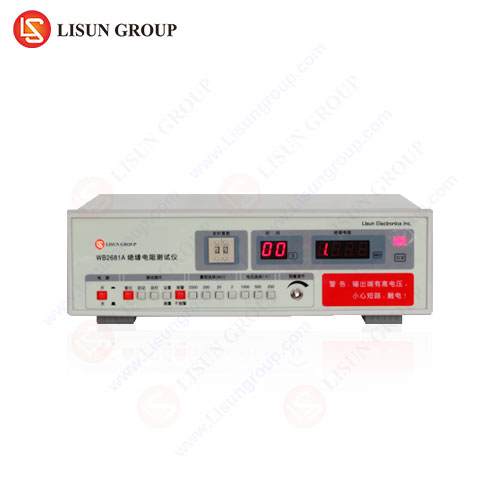
The LISUN WB2671A Withstand Voltage Tester embodies a modern, integrated solution for performing both AC and DC dielectric strength tests. Its design integrates high-voltage generation, precision measurement, and comprehensive safety interlocks into a single, user-configurable instrument. The system is engineered to meet the rigorous demands of research and development, production line quality control, and laboratory certification testing across the industries previously enumerated.
The core operational principle of the WB2671A involves a microcontroller-driven system that precisely controls a high-voltage transformer (for AC output) and a voltage multiplier circuit (for DC output). A high-resolution digital-to-analog converter (DAC) sets the target voltage, while feedback from a high-voltage divider ensures accuracy. The critical parameter of leakage current is measured using a high-precision analog-to-digital converter (ADC) across a sensing resistor. The instrument continuously compares this measured current against user-defined upper and lower limits. The test sequence is governed by programmable timers for ramp-up, dwell, and ramp-down phases, ensuring consistent and repeatable test conditions.
Key Specifications of the LISUN WB2671A:
- AC Withstand Voltage Output: 0–5 kV AC (or higher models available).
- DC Withstand Voltage Output: 0–6 kV DC.
- Voltage Accuracy: ± (3% of reading + 5 digits).
- Leakage Current Measurement Range: 0.010–20.00 mA AC/DC.
- Current Accuracy: ± (3% of reading + 5 digits).
- Timer Range: 1–999 seconds, configurable.
- Ramp Time: Adjustable from 1–999 seconds.
- Safety Features: High-voltage warning indicator, zero-start interlock, over-current protection, and remote test probe with emergency stop.
Application-Specific Test Protocols Across Industries
The versatility of a Hipot tester like the WB2671A is demonstrated by its application across diverse sectors, each with unique insulation challenges and verification protocols.
- Medical Devices (IEC 60601-1): Testing is exceptionally stringent due to the direct patient contact scenario. A defibrillator protector test, for instance, involves applying several kilovolts to ensure the device can withstand a defibrillator’s discharge. The WB2671A’s high accuracy in low leakage current measurement (down to 10 µA) is critical here, as permissible leakage can be exceptionally low.
- Automotive Electronics (LV 214): Components like battery management systems, inverters, and on-board chargers for electric vehicles must be tested for dielectric strength at voltages far exceeding the vehicle’s high-voltage bus (e.g., 400V or 800V). A DC Hipot test is often employed to stress the isolation barriers within these power-dense electronic control units (ECUs).
- Household Appliances (IEC 60335-1): A standard test for a washing machine motor involves applying 1250 V AC for 60 seconds between the windings and the earthed motor casing. The WB2671A can be integrated into a production line, where its programmable ramp time prevents in-rush currents from tripping the test, and its pass/fail judgment provides immediate feedback to operators.
- Lighting Fixtures (IEC 60598-1): LED drivers and their associated heat sinks require verification of the insulation between the primary AC circuit and the accessible secondary DC circuit and chassis. The test ensures that a fault in the driver does not energize the entire fixture.
- Aerospace and Aviation Components: Connectors and wiring systems are subjected to Hipot tests at altitudes where air density is lower, reducing dielectric strength. The WB2671A’s stable output is essential for replicating these conditioned tests, often performed in environmental chambers.
Integrating Hipot Testing into a Comprehensive Quality Assurance Regimen
The Hipot test is most effective when it is not an isolated event but an integral component of a multi-faceted Quality Assurance (QA) strategy. It should be performed after other manufacturing processes that could stress the insulation, such as winding, potting, or assembly, but before final functional testing. In a production environment, the speed and reliability of the test instrument are paramount. The WB2671A, with its fast voltage stabilization and rapid pass/fail decision-making, minimizes test cycle time, thereby increasing throughput.
Furthermore, data integrity and traceability are increasingly critical for QA. Modern testers offer communication interfaces (e.g., RS232, USB, LAN) allowing for the logging of every test result—including the actual leakage current and applied voltage—to a central database. This creates an auditable trail for compliance and facilitates statistical process control (SPC), enabling manufacturers to identify and rectify trends in insulation quality before they lead to field failures or product recalls.
Critical Safety Protocols and Operational Best Practices
The operation of Hipot testers involves potentially lethal voltages, mandating a rigorous and uncompromising approach to safety. The WB2671A incorporates multiple engineered safety controls, but their efficacy is dependent on strict operator adherence to protocols.
- Interlock Utilization: The test chamber or fixture must be equipped with a safety interlock that automatically cuts high-voltage output when accessed. The WB2671A supports remote interlock inputs for this purpose.
- Grounding and Earthing: The instrument and the DUT must be properly grounded. The test ground terminal of the WB2671A must be securely connected to the DUT’s protective earth terminal or chassis.
- Pre-Test Verification: Before connecting the DUT, a “test the tester” procedure should be performed using a known-good, high-value resistor to verify the instrument correctly trips at the set current limit.
- Post-Test Discharge: Capacitive DUTs can store a dangerous charge after a DC Hipot test. The WB2671A includes an automatic discharge circuit, but operators must verify discharge with a suitable voltmeter before handling the DUT.
- Operator Training: Personnel must be thoroughly trained not only in the operation of the equipment but also in understanding the hazards of high voltage and the established emergency procedures.
Advanced Diagnostics: Interpreting Leakage Current Signatures
A sophisticated analysis of the Hipot test involves looking beyond a simple pass/fail outcome. The behavior of the leakage current during the test can provide diagnostic insights into the condition of the insulation.
- A stable, low leakage current that is well within the limit indicates healthy, robust insulation.
- A steadily increasing leakage current over the duration of the test suggests dielectric absorption or the gradual formation of a conductive path, often due to moisture ingress or thermal degradation.
- A sudden, sharp spike in current followed by a recovery may indicate a transient flashover or the ionization of an air pocket within solid insulation.
- An instantly tripped over-current condition signifies a solid, low-resistance breakdown, such as a direct short caused by a major insulation breach.
The high-resolution current measurement of the WB2671A allows quality engineers to monitor these trends, facilitating root cause analysis for failures and enabling predictive maintenance for components tested over their lifecycle.
Frequently Asked Questions (FAQ)
Q1: What is the functional difference between the “upper limit” and “lower limit” for leakage current on the WB2671A?
The upper limit is the primary safety threshold; if the leakage current exceeds this value, the test fails, indicating insufficient insulation. The lower limit is used for applications where a minimum leakage current is expected. If the current remains below this limit, it may indicate an open circuit in the test setup, such as a disconnected high-voltage lead, allowing the tester to fail a “no test” condition.
Q2: Can the WB2671A be used for testing the insulation of multi-conductor cables and wiring harnesses?
Yes, it is well-suited for this application. The standard test protocol involves connecting the high-voltage lead to all conductors twisted together and applying voltage between them and a foil-wrapped shield or the harness chassis. This tests the insulation of each conductor to ground and between conductors simultaneously. For more granular fault isolation, a “point-to-point” test can be performed between individual conductor pairs.
Q3: How does the “ramp time” function enhance the test process?
A programmable ramp time (e.g., 5-10 seconds) allows the voltage to rise gradually to the set value. This prevents high in-rush currents caused by the capacitive charging of the DUT from causing a false failure. It also subjects the insulation to a less abrupt electrical stress, which can be beneficial for diagnosing certain types of progressive breakdown.
Q4: Our production line tests medical power supplies. Is the WB2671A’s accuracy sufficient for the sub-milliampere leakage current limits required by IEC 60601-1?
Absolutely. The WB2671A features a leakage current measurement range starting at 0.010 mA (10 µA) with a defined accuracy. This precision is explicitly designed to meet the stringent requirements of medical equipment testing, where patient leakage currents are often limited to 100 µA or less under normal conditions.
Q5: After a successful Hipot test, is it necessary to perform any subsequent electrical tests?
Yes, a Hipot test is a stress test and should ideally be followed by an insulation resistance (IR) test. The Hipot test verifies the insulation’s strength against immediate breakdown, while the IR test, performed at a lower DC voltage (e.g., 500V DC), measures the quality of the insulation in Megohms, confirming it has not been degraded by the high-voltage stress.
