








The Critical Role of Dielectric Withstand Testing in Modern Product Safety and Compliance
In the interconnected landscape of modern technology, the integrity of electrical insulation is a non-negotiable cornerstone of safety, reliability, and regulatory compliance. From the microprocessor in a medical ventilator to the power distribution system of an electric vehicle, every electrical component operates within a defined electrical field. The catastrophic failure of insulation—a dielectric breakdown—can lead to electric shock, fire, equipment damage, and systemic failure. Consequently, dielectric withstand testing, commonly known as high voltage (Hi-Pot) testing, has evolved from a quality control checkpoint to a fundamental engineering discipline. This article examines the technical principles, standardized methodologies, and critical applications of dielectric withstand testing, with a detailed analysis of its implementation in advanced instrumentation such as the LISUN WB2671A Withstand Voltage Tester.
Fundamental Principles of Dielectric Strength Evaluation
At its core, a dielectric withstand test is a non-destructive pass/fail evaluation designed to verify that an electrical insulation system can withstand a specified overvoltage for a predetermined duration without breakdown. The test applies a significantly higher voltage than the equipment’s normal operating voltage—typically 1.2 to 2 times the working voltage plus 1000 V, as stipulated by standards like IEC 61010-1 or UL 60950-1—across insulation barriers. This includes testing between live parts and accessible conductive parts (primary to earth) and between circuits of different potentials (secondary insulation).
The underlying principle is stress application. By subjecting the insulation to an intense electric field, any weaknesses, contaminants, insufficient creepage/clearance distances, or manufacturing defects (such as pinholes in transformer windings or cracked insulators) are forced to manifest as a breakdown. The key measured parameter is leakage current. Under test voltage, a small, predictable capacitive and resistive leakage current flows through the insulation. A test instrument continuously monitors this current. If the current exceeds a preset limit (the breakdown or trip current), it indicates that insulation integrity has been compromised, and the test fails. The critical variables are test voltage (AC or DC), ramp rate, dwell time, and trip current threshold, all of which must be meticulously calibrated and aligned with relevant safety standards.
Comparative Analysis of AC versus DC Withstand Voltage Testing
The selection of alternating current (AC) or direct current (DC) as the test medium is a consequential engineering decision, each with distinct physical effects and applications. AC withstand testing, typically performed at power frequency (50/60 Hz), most accurately simulates real-world operational stress. The continuously reversing polarity stresses the insulation volumetrically and is particularly effective at detecting flaws related to capacitive effects and layered insulation. It is the mandated test for most final product safety certifications for household appliances, lighting fixtures, and industrial control systems. However, AC testers require a high-voltage transformer, making them physically larger and presenting a higher short-circuit risk.
DC withstand testing applies a unidirectional voltage, resulting in primarily resistive leakage current. It is advantageous for testing capacitive loads like long cables, wiring harnesses in automotive electronics, and large rotating machines, as the required power supply is smaller and safer. DC testing is also less likely to damage components with inherent capacitance due to the absence of displacement current. A critical consideration is the “DC test voltage equivalence,” which is generally considered to be √2 times the specified AC RMS voltage (approximately 1.414x). For instance, a product requiring a 1500 VAC test might be tested at 2121 VDC. The choice is governed by end-product standards; telecommunications equipment and certain aerospace components often specify DC testing due to their operational profiles.
Instrumentation Architecture: The LISUN WB2671A As a Paradigm
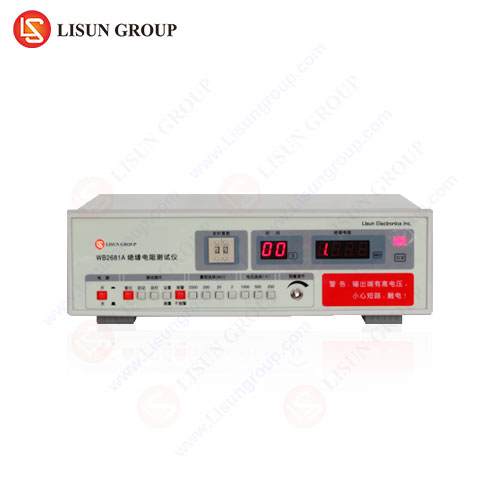
Modern dielectric withstand testers are sophisticated measurement systems integrating high-voltage generation, precision metrology, and comprehensive safety interlocks. The LISUN WB2671A exemplifies this architecture, designed to execute tests per IEC, ISO, UL, CSA, and GB standards. Its operational specifications define its application envelope.
Key Specifications of the LISUN WB2671A:
- Test Voltage Range: 0–5 kV AC (adjustable in 1 V steps).
- Voltage Accuracy: ± (2% of reading + 5 V).
- Leakage Current Range: 0.01–20.00 mA AC.
- Current Accuracy: ± (2% of reading + 3 digits).
- Timer Range: 1–999 seconds, with manual mode.
- Ramp Function: Programmable voltage rise time (1–999 seconds).
- Output Waveform Distortion: ≤ 3% THD.
The instrument’s principle of operation involves a microcontroller generating a control signal to a pulse-width modulation (PWM) circuit, which drives a high-frequency inverter. This inverter feeds a high-voltage transformer, whose output is the precise AC test voltage. A dedicated feedback loop with a high-accuracy voltage sensor ensures closed-loop control for stability. Simultaneously, a current sensor on the return path measures the total leakage current, which is filtered, amplified, and compared against the user-defined trip threshold. The inclusion of a programmable ramp function is critical for testing components like motors or medical device capacitors, allowing a controlled voltage increase to avoid inrush currents from capacitive charging from causing a false failure.
Industry-Specific Applications and Compliance Imperatives
The application of dielectric withstand testing is ubiquitous across industries, with test parameters meticulously tailored to product risk profiles and operational environments.
- Household Appliances & Consumer Electronics: For products like refrigerators, washing machines, and power adapters (IEC 60335-1), testing ensures safety against electric shock after years of thermal cycling and moisture exposure. Tests are performed between the mains input and all accessible metal parts.
- Automotive Electronics: The rise of electric and hybrid vehicles (under ISO 6469-3 and LV214) has intensified testing requirements. The WB2671A is used to validate the insulation of battery management systems, onboard chargers, and high-voltage wiring harnesses, where failure could result in catastrophic vehicle shutdown or electrocution risk.
- Lighting Fixtures (IEC 60598-1): LED drivers and high-intensity discharge (HID) ballasts are tested to ensure isolation between the mains and the low-voltage LED array or fixture housing, particularly in damp or outdoor environments.
- Medical Devices (IEC 60601-1): This standard imposes the most stringent leakage current limits. Dielectric testing of patient-coupled equipment like dialysis machines or ultrasound probes is vital, employing lower trip currents to protect vulnerable patients from even micro-shock.
- Aerospace & Aviation (DO-160, AS9100): Components must withstand not only operational voltages but also pressures and humidity extremes. Testing here validates insulation for flight control systems, avionics, and in-flight entertainment systems.
- Cable & Wiring Systems: Production-line testing of every meter of power or data cable for insulation flaws using a DC withstand voltage is a standard practice to prevent downstream failures in office equipment or industrial control panels.
Methodological Rigor and Standardized Test Protocols
Executing a valid withstand test requires a rigorous procedure beyond simply applying voltage. A standard protocol involves:
- Pre-Test Verification: Instrument calibration check, verification of test leads and safety enclosures.
- Connection: Secure connection of the high-voltage electrode to the live part(s) under test and the return electrode to the accessible conductive part. The equipment under test (EUT) must be in a “representative” state—often with switches closed and functional components bypassed or in a specific configuration.
- Parameter Setting: Input of the standard-mandated voltage, ramp time (if any), dwell time (commonly 60 seconds), and the critical trip current. This current limit is not arbitrary; it is derived from the product standard’s allowable leakage current limits, often with a safety margin.
- Execution: Initiating the test, during which the voltage ramps smoothly to the setpoint, holds, and then ramps down to zero. Any current excursion above the limit causes an immediate shutdown and failure indication.
- Post-Test Analysis: A pass result is recorded. A failure necessitates root-cause analysis: was it a genuine insulation flaw, a design error (insufficient clearance), or a test setup issue (contamination, moisture)?
Strategic Advantages of Integrated Test Systems
In a manufacturing or quality lab environment, standalone testers like the WB2671A offer distinct advantages. Their primary benefit is dedicated accuracy and reliability; as a single-function instrument, its design is optimized for the metrological demands of high-voltage measurement, free from compromises inherent in multifunction devices. Operational safety is enhanced through features like zero-start interlock (voltage cannot be output unless starting from 0V), automatic voltage discharge upon trip or completion, and clear, high-visibility warning indicators.
Furthermore, the compliance assurance provided by traceable calibration and adherence to standard-mandated waveform purity (low THD) is paramount for audit readiness. In production line settings, the instrument’s speed, programmability, and unambiguous pass/fail output facilitate integration into automated test sequences for electrical components like relays, switches, and sockets, dramatically improving throughput while maintaining a rigorous safety audit trail.
Mitigating Common Testing Artifacts and Ensuring Result Validity
A significant challenge in dielectric testing is distinguishing a genuine insulation failure from a test artifact. A primary artifact is the capacitive inrush current observed when testing components with high intrinsic capacitance (e.g., EMI filters, long cables). This transient current surge can exceed the trip threshold during the ramp-up phase, causing a false failure. The programmable ramp function directly addresses this, allowing a slow enough rise time for the capacitive charge current to decay before the final voltage is reached.
Environmental surface contamination (dust, flux residue) or ambient humidity can create conductive paths, increasing leakage current. Pre-test cleaning and conducting tests in a controlled environment per standard specifications (e.g., IEC 60068-2-78 for damp heat) are essential. Finally, improper grounding of the test fixture or EUT can create parallel leakage paths, skewing measurements. A robust test plan includes procedures to identify and eliminate these variables to ensure the result reflects the true dielectric strength of the product.
Conclusion
Dielectric withstand voltage testing remains an indispensable, non-negotiable validation of electrical product safety. Its scientific basis in electric field stress analysis, codified into a global framework of safety standards, provides a universal language for assessing insulation integrity. As technology advances into higher power densities and more demanding environments—from automotive megawatt charging to miniaturized implantable medical devices—the precision, safety, and reliability of the test instrumentation become ever more critical. Implementing a rigorous test regimen with capable, standards-compliant apparatus is not merely a regulatory hurdle; it is a fundamental engineering responsibility that safeguards end-users and underpins the reliability of the modern technological ecosystem.
Frequently Asked Questions (FAQ)
Q1: What is the critical difference between a “withstand voltage test” and an “insulation resistance test”?
A: They are complementary but distinct. A withstand voltage test is a stress test applying a high voltage for a short duration to force a breakdown, resulting in a pass/fail outcome based on leakage current. An insulation resistance test (often performed with a megohmmeter) is a diagnostic test applying a lower DC voltage (e.g., 500V) to measure the actual resistance of the insulation in megohms or gigohms. It provides a quantitative value that can trend over time to predict insulation degradation before it fails a Hi-Pot test.
Q2: Why would a product pass a DC withstand test but fail an AC test (or vice-versa)?
A: The different voltage forms stress insulation in different ways. AC voltage, due to its polarity reversal, is more effective at detecting defects involving delamination or voids in layered insulation and is more sensitive to capacitive effects. DC voltage primarily stresses resistive paths. A product with contamination creating a slightly conductive film might pass a DC test but fail an AC test where the capacitive current across the contaminant is significant. The applicable product standard dictates the correct test type.
Q3: How is the appropriate “trip current” limit determined for a specific product?
A: The trip current is not chosen arbitrarily. It is derived from the maximum allowable leakage current specified for that product class in its governing safety standard (e.g., IEC 60601-1 for medical devices). The test standard will define a test voltage and a corresponding leakage current limit. The tester’s trip threshold is set slightly above this limit to account for measurement tolerances and normal capacitive leakage but well below a current that would indicate breakdown.
Q4: Can dielectric withstand testing damage a functional electronic product?
A: When performed correctly per standard parameters, it is a non-destructive type test for design validation. However, the applied voltage is stressful. Repeated testing on the same unit, especially with incorrect parameters (excessive voltage or trip current), can cumulatively degrade insulation—a phenomenon known as “over-testing.” In production, each unit is typically tested once. Sensitive components like semiconductors may require protective measures, such as shorting them out during the test, as detailed in the test plan.
Q5: What does a “ramp time” function achieve, and when is it necessary?
A: The ramp time controls the rate (in volts per second) at which the test voltage increases from zero to the target. It is essential when testing capacitive loads (e.g., long cables, power supply filters). Without a ramp, the sudden application of voltage causes a high inrush charging current that can exceed the trip limit, causing a false failure. A controlled ramp allows this capacitive current to dissipate, ensuring the measured current during the dwell period is the true resistive leakage current.
