








The Critical Role of High-Voltage Megohmmeters in Modern Industrial Quality Assurance
The integrity of electrical insulation is a foundational pillar upon which the safety, reliability, and longevity of virtually all electrical and electronic systems depend. Insulation failure can precipitate catastrophic consequences, ranging from equipment damage and operational downtime to fire hazards and life-threatening electric shock. Consequently, the accurate assessment of insulation resistance (IR) is not merely a quality control step but a critical diagnostic and predictive maintenance procedure. The high-voltage megohmmeter, or insulation resistance tester, serves as the primary instrument for this essential task. This article delineates the operational principles, diverse applications, and technical specifications of these devices, with a specific examination of the LISUN WB2681A Insulation Resistance Tester as a representative of modern, advanced testing solutions.
Fundamental Principles of Insulation Resistance Measurement
At its core, the measurement of insulation resistance is an application of Ohm’s Law to a dielectric material. A high-voltage megohmmeter functions by applying a known, stabilized direct current (DC) voltage across the insulation barrier of a device or component and precisely measuring the minuscule leakage current that flows through it. The resistance is then calculated as the ratio of the applied voltage to the measured current. Given that the leakage currents in healthy insulation are typically in the nanoampere or microampere range, the resultant resistance values are exceptionally high, expressed in megohms (MΩ) or even teraohms (TΩ).
The applied DC voltage serves to stress the insulation in a controlled manner, simulating electrical stresses encountered during operation or transients. The measurement is not a simple DC resistance check; it provides profound insights into the material’s condition. Key measurement methodologies include:
- Spot Reading Test: A straightforward measurement where the insulation resistance value is recorded after a short, standardized application of the test voltage, typically 60 seconds. This provides a snapshot of the insulation’s condition at that moment.
- Dielectric Absorption Ratio (DAR) and Polarization Index (PI): These time-resistance tests are crucial for diagnosing the moisture content and overall health of insulation in larger electrical apparatus like motors and transformers. The test involves applying voltage and recording the insulation resistance at multiple time intervals (e.g., 15 seconds and 60 seconds for DAR; 1 minute and 10 minutes for PI). A rising resistance value over time indicates good, dry insulation, while a flat or decreasing trend suggests contamination or degradation. The PI, calculated as R10min/R1min, is a particularly valuable metric for assessing the suitability of windings for high-potential testing or continued service.
The selection of the appropriate test voltage is paramount and is typically governed by equipment ratings and international standards such as IEC 60204, IEC 60601, and UL 60950-1. Test voltages can range from 50 V DC for sensitive electronics to 10 kV DC or higher for high-voltage power cables and generators.
The LISUN WB2681A: A Synthesis of Precision and Robustness
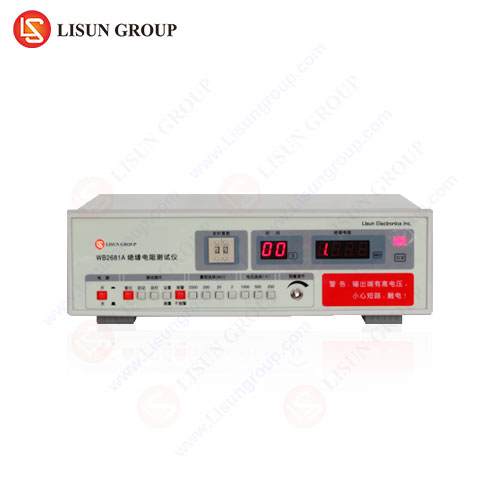
The LISUN WB2681A Insulation Resistance Tester embodies the technological evolution in this field, integrating high accuracy with user-centric design for demanding industrial environments. Its design philosophy centers on providing reliable, repeatable data across a broad spectrum of applications.
Key Technical Specifications:
- Test Voltages: 7 selectable ranges (50 V, 100 V, 250 V, 500 V, 1000 V, 2500 V, 5000 V).
- Insulation Resistance Measurement Range: 0.0 MΩ to 10 TΩ.
- Measurement Accuracy: Typically ±(3% +5 digits) for resistance, ensuring high fidelity in data acquisition.
- Output Voltage Accuracy: Better than ±(5% +10 V), guaranteeing the applied stress is as specified.
- Short-Circuit Current: Approximately 2 mA, providing sufficient power for charging capacitive loads while incorporating safety-limiting features.
- Additional Functions: Capable of measuring AC/DC voltage, low resistance, and continuity, making it a versatile diagnostic tool.
The instrument’s ability to source a stable high voltage and accurately measure the resultant picoampere-level currents is a testament to its advanced internal circuitry and shielding, which minimize the influence of external electromagnetic interference.
Validating Component Integrity in Manufacturing and Assembly
In the manufacturing sector, high-voltage megohmmeter testing is a non-negotiable step in the production line for a vast array of components and finished goods.
Electrical Components and Household Appliances: Components such as switches, sockets, relays, and circuit breakers must possess robust internal insulation to prevent tracking and short circuits. The WB2681A, with its 5000 V capability, can perform rigorous quality checks on these items, ensuring they meet the dielectric strength requirements of standards like IEC 61058. For household appliances—from refrigerators and washing machines to electric kettles—the test verifies the integrity of the insulation between live parts and accessible conductive surfaces. A test at 1250 V or 1500 V DC is commonly applied to confirm compliance with IEC 60335, safeguarding end-users from electric shock.
Automotive Electronics and Aerospace Components: The automotive industry, particularly with the rise of electric vehicles (EVs), demands extreme reliability from its electronic control units (ECUs), battery management systems, and high-voltage wiring harnesses. Insulation failure in an EV’s traction battery or drive inverter is a critical safety event. Megohmmeters are used to perform production-line tests on these systems, often at voltages significantly higher than their operating DC bus voltage (e.g., 400 V to 1000 V), to ensure a substantial safety margin. Similarly, in aerospace, every wire, connector, and avionic component is subjected to stringent IR testing to prevent failures that could compromise aircraft systems.
Lighting Fixtures and Office Equipment: Modern LED drivers and ballasts for commercial lighting operate at high voltages and must be safely isolated from the fixture’s chassis. The WB2681A performs this verification efficiently. In office equipment such as high-speed printers and copiers, which contain high-voltage power supplies for electrostatic processes, insulation testing ensures operational safety and prevents damage to sensitive logic boards.
Diagnostic and Prognostic Applications in Cable and Wiring Systems
Beyond production, high-voltage megohmmeters are indispensable for the installation and maintenance of cable infrastructure.
New Cable Installation and Commissioning: When new power or control cables are installed, they must be tested before being energized. A sequence of tests, including an insulation resistance test at a voltage appropriate for the cable’s rating (e.g., 5000 V for a 5 kV cable), is performed. This verifies that the cable was not damaged during pulling, splicing, or termination. The WB2681A’s high measurement range (up to 10 TΩ) is essential here, as new, high-quality polymeric or paper-insulated cables will exhibit extremely high resistance values.
Preventive Maintenance for Industrial Control Systems: The wiring within industrial control panels and the field cables connecting sensors, actuators, and motor control centers are constantly exposed to environmental stressors. Moisture, chemical vapors, dust, and thermal cycling degrade insulation over time. Periodic IR testing using a device like the WB2681A provides a quantitative measure of this degradation. A downward trend in IR values from baseline measurements is a clear indicator that maintenance or replacement is required before an in-service failure occurs. This is critical for maintaining the uptime of manufacturing processes, telecommunications equipment central offices, and industrial control systems.
Ensuring Patient and Operator Safety in Medical Devices
The medical device industry imposes some of the most rigorous electrical safety standards globally, governed by directives such as IEC 60601-1. The consequences of insulation failure in medical equipment are dire, as patients may be directly connected to devices or in proximity to them in a vulnerable state.
Medical equipment, including patient monitors, dialysis machines, surgical lasers, and MRI systems, undergoes exhaustive electrical safety testing (EST). A key part of this protocol is the “Mains Part to Applied Part” test, where a high DC voltage (e.g., 1500 V or 4000 V depending on the type of applied part) is applied between the power supply and any patient-connected parts. The WB2681A is ideally suited for this application, providing the precise voltage and accurate resistance measurement needed to verify that leakage currents remain within the strict, life-critical limits defined by the standard. Its ability to log and store test results is also valuable for quality assurance and regulatory compliance records.
Advanced Testing: Guard Terminal Utilization and Capacitive Discharge
For complex systems or components where surface leakage could skew the measurement of the volume resistance through the insulation, the guard terminal is a vital feature. The WB2681A includes this function. By connecting the guard terminal to a point that shunts surface leakage currents away from the measuring circuit, the instrument can isolate and measure only the current flowing through the insulation body. This is particularly important when testing multi-conductor cables, bushings, or any device where the insulator’s surface may be contaminated.
Furthermore, the tester is designed to safely handle capacitive loads, such as long cables or large motor windings. After a test, these components can store a significant amount of energy. The WB2681A incorporates an automatic discharge circuit that safely dissipates this stored charge upon completion of the test, protecting the operator from electric shock and the device under test from damage.
Frequently Asked Questions (FAQ)
Q1: What is the significance of the Polarization Index (PI), and how is it interpreted?
The Polarization Index is a dimensionless ratio of the insulation resistance measured at 10 minutes to the resistance measured at 1 minute. It is a diagnostic tool that helps eliminate the influence of temperature and provides a clearer picture of insulation cleanliness and dryness. A PI value greater than 2.0 generally indicates dry, clean insulation in good condition. A value between 1.0 and 2.0 is borderline and may warrant investigation, while a value below 1.0 suggests wet or contaminated insulation that requires immediate remedial action.
Q2: When testing a standard household appliance, what is the appropriate test voltage to apply?
The specific test voltage is dictated by the relevant safety standard (e.g., IEC 60335). For most Class I appliances (those with an earth ground), a test voltage of 1250 V DC is typical for testing between live parts and accessible earthed metal parts. For Class II appliances (double-insulated), a higher voltage, such as 2500 V or more, may be required for the reinforced or double insulation. Always consult the manufacturer’s test specifications and the applicable standard.
Q3: How does the guard terminal function on the WB2681A improve measurement accuracy?
The guard terminal provides a path for unwanted surface leakage currents to bypass the instrument’s measurement circuit. By connecting the guard to a conductive surface path that is parallel to the insulation being tested (e.g., the sheath of a cable or a dedicated guard ring on a bushing), these currents are shunted away. This ensures that the current measured by the instrument is predominantly the volume leakage current flowing through the insulation material, yielding a more accurate representation of its true condition.
Q4: Can the WB2681A be used to test live circuits?
No. Insulation resistance testing must only be performed on de-energized, isolated circuits. Applying a high DC voltage from a megohmmeter to a live circuit can damage the tester, the equipment under test, and pose a severe safety risk to the operator. Always verify that the circuit is de-energized using a voltage detector before connecting the megohmmeter.
Q5: Why is the short-circuit current specification of a megohmmeter important?
The short-circuit current (e.g., 2 mA for the WB2681A) indicates the current-sourcing capability of the tester. A higher available current allows the instrument to charge large capacitive loads (like long cables) more quickly, reducing the time required for the reading to stabilize. This improves testing efficiency in field applications. However, it is balanced with internal current-limiting resistance to ensure the test remains safe and does not excessively damage already-faulty insulation.
