








The Critical Role of High Voltage Insulation Testing in Modern Electrical Safety and Compliance
High voltage insulation testing represents a fundamental quality assurance and safety validation procedure within the electrical and electronic manufacturing sectors. This non-destructive testing methodology is designed to verify the integrity of dielectric materials, ensuring they can adequately isolate energized conductors and prevent catastrophic failure, electric shock, or fire under both normal operating conditions and foreseeable fault scenarios. The process subjects an insulating material or component to a voltage significantly higher than its rated operational voltage for a specified duration, thereby assessing its dielectric strength and the quality of its construction. As technological advancements push the boundaries of power density and miniaturization across industries, the imperative for robust, reliable, and standardized insulation testing has never been more pronounced.
Fundamental Principles of Dielectric Withstand Testing
The core objective of a dielectric withstand test, commonly known as a hipot test (high potential), is to ascertain that an insulating system possesses a sufficient margin of safety beyond its intended working voltage. The test is predicated on applying a predetermined high voltage—typically AC or DC—between a device’s current-carrying conductors and its accessible conductive parts, such as a grounded chassis or shield. This voltage stress is maintained for a standardized period, often one minute as per many international standards, though production-line testing may employ shorter durations with appropriately higher voltages.
During the test, the current flowing through the insulation is meticulously monitored. This current, known as the leakage current, is a critical parameter. A well-insulated component will exhibit only a very small, predictable leakage current, primarily capacitive in nature. A failure is indicated by a sudden, dramatic increase in current, signifying a breakdown of the dielectric material. This breakdown, or flashover, can occur through the bulk of the material, along its surface, or through the air to a grounded object. The test, therefore, does not merely check for gross faults like direct shorts; it is sensitive enough to identify latent defects such as poor creepage distances, contamination, pinholes in insulation, and compromised material integrity that could deteriorate over time and lead to premature field failure.
Comparative Analysis of AC and DC Hipot Testing Methodologies
The selection between alternating current (AC) and direct current (DC) for hipot testing is a critical decision influenced by the device under test (DUT), the nature of the insulation, and the relevant safety standards. Each methodology presents distinct advantages and limitations.
AC withstand voltage testing most accurately simulates real-world operational stress, as the peak voltage applied is √2 times the RMS value, creating a more strenuous condition for the insulation. The continuous polarity reversal of an AC field is particularly effective at identifying flaws related to capacitive coupling and surface tracking. However, AC testers require a high-voltage transformer, making them physically larger and more costly for equivalent voltage outputs compared to their DC counterparts. The reactive power demand can also be substantial.
DC hipot testing applies a continuous, unidirectional voltage stress. Its primary advantages include a much lower required current output from the tester, leading to smaller, more portable equipment, and a reduced risk of damage to the DUT in the event of a failure due to lower energy discharge. DC testing is also the only practical method for testing components with large inherent capacitance, such as long power cables, as it avoids the high charging currents associated with AC. A significant consideration, however, is that the test stress is not fully representative of AC operating conditions, and the constant field can attract contaminants, potentially masking certain types of defects.
The WB2671A Withstand Voltage Tester: A Benchmark in Production-Line Testing
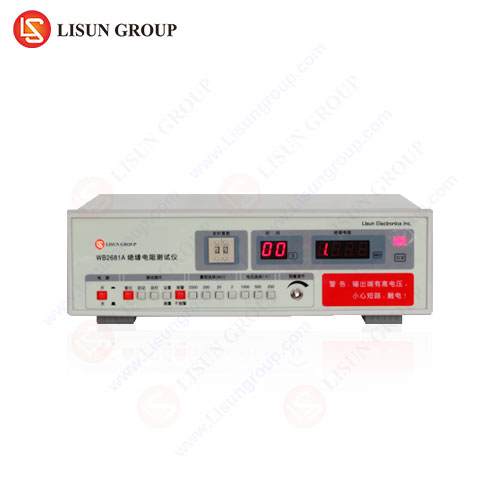
For high-volume manufacturing environments where reliability, speed, and operator safety are paramount, the LISUN WB2671A Withstand Voltage Test System provides a comprehensive solution. This instrument is engineered to deliver precise and compliant AC and DC hipot testing, integrating advanced safety features and user-programmable sequences to meet the rigorous demands of modern production lines.
The testing principle of the WB2671A involves the generation of a highly stable, programmable high-voltage output. The instrument’s core functionality is to ramp the voltage to a user-defined setpoint, hold it for a specified time, and continuously monitor the leakage current. A critical safety feature is its rapid cutoff capability; if the measured leakage current exceeds a pre-set limit, the tester will immediately terminate the high-voltage output within milliseconds, thereby preventing excessive damage to the DUT and mitigating safety hazards. The instrument’s design incorporates robust isolation and grounding protocols to protect the operator from high-voltage exposure.
Key Specifications of the LISUN WB2671A:
- Voltage Accuracy: ± (3% of reading + 5 digits)
- Current Measurement Accuracy: ± (3% of reading + 5 digits)
- Output Power: 100 VA
- AC Voltage Range: 0–5 kV
- DC Voltage Range: 0–6 kV
- Leakage Current Range: 0.5–100 mA
- Timer Range: 1–999 seconds
The competitive advantages of the WB2671A are evident in its design philosophy. Its high degree of accuracy ensures compliance with stringent international standards, while its robust output power allows for stable testing even on capacitive or inductive loads. The intuitive interface, often featuring a rotary encoder and a clear digital display, simplifies operation and reduces training time. Furthermore, its programmability enables the storage of multiple test profiles, which is indispensable for facilities testing a diverse range of products. Integrated interfaces for remote control and data logging facilitate seamless integration into automated production and quality management systems.
Application Across Critical Industrial Sectors
The application of dielectric withstand testing is ubiquitous across industries where electrical safety is non-negotiable. The WB2671A is deployed in a multitude of scenarios to validate product integrity.
In the domain of Household Appliances and Electrical Components, every device from a simple power supply to a complex refrigerator or washing machine must be tested. Tests are performed between the live/neutral pins of the power cord and the appliance’s accessible metal parts to ensure user safety. Components like switches, sockets, and circuit breakers are also rigorously tested to prevent internal arcing.
For Automotive Electronics, the shift to electric and hybrid vehicles has intensified the need for high-voltage validation. Components like battery management systems, DC-DC converters, and onboard chargers, which operate at several hundred volts, are subjected to DC hipot tests to ensure isolation between high-voltage tracts and the vehicle chassis, a critical safeguard against electrocution.
Lighting Fixtures, particularly LED drivers and high-intensity discharge (HID) ballasts, contain electronics that generate high voltages. Testing verifies the isolation between the internal circuitry and the external metal housing of a luminaire. Similarly, in Industrial Control Systems and Telecommunications Equipment, programmable logic controllers (PLCs), servo drives, and network switches are tested to ensure that transients or faults on signal or power lines do not breach the insulation and compromise the entire system.
The Medical Device industry imposes some of the most rigorous safety standards. Equipment such as patient monitors, diagnostic imaging systems, and surgical tools are tested with strict leakage current limits, often requiring specialized medical safety testers that build upon the core hipot principle with enhanced precision and reporting.
In Aerospace and Aviation Components, reliability under extreme environmental conditions is critical. Wiring harnesses, avionics, and power distribution units undergo withstand voltage testing to ensure performance amidst vibration, temperature cycling, and pressure changes. Office Equipment and Consumer Electronics, including laptops, printers, and smartphone chargers, are universally tested to ensure the isolation of the dangerous mains voltage from the low-voltage, user-accessible circuits and interfaces.
Navigating the Landscape of International Safety Standards
Compliance with international standards is not merely a legal formality but a blueprint for engineering safe and reliable products. These standards, developed by bodies like the International Electrotechnical Commission (IEC), Underwriters Laboratories (UL), and the International Organization for Standardization (ISO), provide explicit test parameters, including test voltage levels, duration, and permissible leakage current.
Key standards governing dielectric withstand testing include:
- IEC 60335-1: Household and similar electrical appliances.
- IEC 60601-1: Medical electrical equipment.
- IEC 60950-1 / IEC 62368-1: Information technology and audio/video equipment (the latter being the newer hazard-based standard).
- ISO 6469-3: Electrically propelled road vehicles – Safety specifications for traction systems.
- UL 1598: Luminaires.
These documents specify test voltages based on the equipment’s rated voltage, its installation category, and the required insulation grade (e.g., basic, supplementary, or reinforced). A thorough understanding of the applicable standard is prerequisite for configuring a tester like the WB2671A correctly, ensuring that the test is both valid for certification and meaningful for assessing the product’s safety margin.
Integrating Hipot Testing into a Comprehensive Quality Management System
To maximize its efficacy, dielectric withstand testing must be integrated as a core component of a holistic Quality Management System (QMS). It should not operate in isolation. In a production environment, the WB2671A can be linked to a central server for traceability, storing test results—including pass/fail status, actual leakage current, and applied voltage—for every unit produced. This data is invaluable for statistical process control (SPC), allowing quality engineers to identify and rectify negative trends in component quality or manufacturing processes before they lead to a spike in field failures.
Furthermore, the test sequence itself can be integrated with other verification steps. For instance, a production line may first perform a ground bond test to verify the integrity of the protective earth connection, followed immediately by the dielectric withstand test. This integrated approach ensures that all aspects of electrical safety are verified in a single, efficient workflow, providing a complete and auditable safety record for each finished product.
Frequently Asked Questions (FAQ)
Q1: What is the primary difference between an insulation resistance test (IR) and a dielectric withstand test (Hipot)?
While both assess insulation, they serve different purposes. An Insulation Resistance test uses a moderate DC voltage (typically 500V or 1000V) to measure the resistance of the insulation in Megohms or Gigohms, indicating its general condition and cleanliness. A Dielectric Withstand test applies a much higher voltage (AC or DC) to stress the insulation to its limits, verifying its dielectric strength and ensuring it will not break down under transient overvoltage conditions. The hipot test is a pass/fail safety check, while the IR test provides a quantitative metric for insulation quality.
Q2: Why would we choose to perform a DC hipot test instead of an AC test on our power supplies?
Power supplies, particularly those with switching transformers and large filter capacitors, present a highly capacitive load. An AC hipot test would require a tester with very high current output to overcome the capacitive charging current, which can be substantial. A DC hipot tester, by contrast, only needs to supply a small current to maintain the voltage after the initial capacitive charging surge, making the equipment smaller, safer, and more cost-effective. The DC test is equally effective at finding the same fundamental insulation faults.
Q3: How is the appropriate test voltage and leakage current limit determined for a new product?
The test voltage is primarily dictated by the relevant international safety standard for the product category (e.g., IEC 62368-1 for IT equipment). These standards provide formulas or tables based on the product’s rated voltage and insulation type. The leakage current limit is also often specified in these standards, but it can be further refined through risk analysis and historical test data. It is set high enough to avoid nuisance tripping from normal capacitive leakage but low enough to detect a genuine insulation weakness.
Q4: The WB2671A offers both AC and DC output. Can it perform a “DC Bias” test for components like Y-capacitors?
Yes, the dual-output capability of an instrument like the WB2671A makes it suitable for specialized tests such as the DC bias test for line-filtering capacitors (e.g., Y1, Y2 capacitors). This test involves applying a high AC voltage superimposed on a DC voltage, simulating the combined stress the component experiences in a circuit. The tester’s ability to independently control and apply both AC and DC voltages is essential for validating these critical safety components.
