








Ensuring Electrical Safety and Insulation Integrity: The High-Voltage Dielectric Strength Test for Lighting Products per IEC 60598
Introduction to Insulation Verification in Luminaires
The fundamental premise of electrical safety for any powered device, including lighting products, rests upon the integrity of its insulation system. This system, comprising both physical barriers (like plastic enclosures, ceramic holders, and internal creepage distances) and air gaps, is designed to prevent the uncontrolled flow of electrical current to accessible parts or between circuits of different potentials. A failure of this insulation can lead to catastrophic consequences, including electric shock, fire, or damage to connected equipment. For lighting fixtures, which are ubiquitous in residential, commercial, and industrial environments and often installed in proximity to conductive building structures or handled by end-users, verifying this integrity is non-negotiable. The high-voltage dielectric strength test, commonly termed the withstand voltage or hipot test, serves as the definitive, pass/fail verification of a product’s insulation robustness. Governed internationally by the IEC 60598 series of standards for “Luminaire Safety,” this test simulates extreme electrical stress conditions to ensure that products entering the market possess a sufficient safety margin beyond their normal operating voltages.
Theoretical Foundations of Dielectric Breakdown and Test Objectives
Dielectric strength is defined as the maximum electric field strength a material can withstand intrinsically without experiencing electrical breakdown. In practical terms for product testing, it is the highest voltage that the insulation between live parts and accessible conductive parts (or between separate circuits) can endure for a specified duration without allowing a disruptive discharge. The test is not intended to be destructive under normal circumstances for a compliant product; rather, it is a stress test applied at a level significantly higher than the rated voltage to uncover latent defects. Such defects may include insufficient creepage and clearance distances, pinholes in insulating materials, contaminants like dust or flux residues, compromised seals, or weaknesses introduced during the manufacturing process such as cracked housings or poorly molded components.
The primary objective, as stipulated in IEC 60598-1 (the general requirements standard), is to verify that the insulation provided is adequate. The test provides a quantitative measure of safety, ensuring that even under transient overvoltage conditions—such as those caused by switching surges or lightning-induced impulses on the mains supply—the luminaire will not become hazardous. It is a critical component of the type-test regimen required for certification by bodies like UL, CSA, TÜV, and Intertek.
IEC 60598 Test Parameters and Methodological Framework
Clause 10.2.2 of IEC 60598-1:2020 details the specific requirements for the dielectric strength test. The test is applied after the conditioning required by the humidity treatment test (Clause 10.2.1), which places the luminaire in a damp heat chamber to potentially weaken hygroscopic insulation and surface paths, thereby representing a worst-case scenario.
The test voltage is a function of the luminaire’s working voltage and its insulation class. For basic insulation, supplementary insulation, and reinforced insulation, the standard prescribes specific test voltages. For example, for a luminaire with a working voltage up to 150 V, the test voltage for basic insulation is typically 1000 V RMS (50/60 Hz) or 1414 V peak for a DC test. For reinforced insulation, the required voltage is higher, often double that of basic insulation for the same working voltage range. The test frequency is generally the power frequency, 50 Hz or 60 Hz, though the standard allows for the use of an essentially sinusoidal waveform of an equivalent peak value.
The voltage must be increased smoothly from zero to the specified test value to avoid transient overshoot, maintained for a duration of 60 seconds, and then decreased smoothly. The test is applied between:
- All live parts (connected together) and accessible conductive parts (connected together). Accessible parts are those that can be touched with a standard test finger.
- Live parts of separate circuits that require isolation from each other (e.g., primary mains circuit and a Class III SELV circuit).
A critical aspect of the test setup is the treatment of insulating linings and coverings. These are covered with a metal foil connected to the accessible parts side of the test circuit, simulating the condition where a user might bridge an insulating surface with a conductive object.
The pass criterion is the absence of flashover or breakdown. A flashover is a disruptive discharge over the surface of an insulation, while breakdown is a disruptive discharge through the insulation. The test equipment must be capable of detecting such failures, typically by monitoring the leakage current. If the current exceeds a preset trip level (often in the range of 5 mA to 100 mA, depending on the standard’s interpretation and risk assessment), the test is considered failed. It is imperative to note that a corona discharge or a single momentary spark that does not escalate into a sustained arc may not constitute a failure per the standard’s definitions, but such occurrences require careful engineering judgment.
Instrumentation for Compliance: The LISUN WB2671A Withstand Voltage Tester
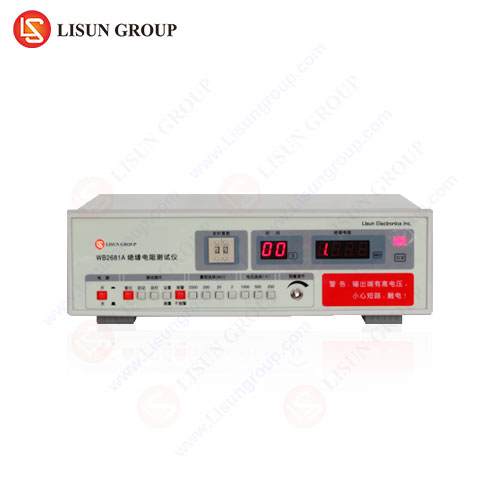
Executing this test with precision, repeatability, and safety requires specialized instrumentation. A modern withstand voltage tester must provide accurate high-voltage generation, sensitive failure detection, and robust safety features. The LISUN WB2671A Withstand Voltage Test System is engineered to meet these exacting demands for product validation and production line testing across industries, including lighting.
The WB2671A generates a stable, programmable AC or DC high-voltage output. For IEC 60598 testing, the AC mode is predominantly used. Its voltage output range, typically from 0 to 5 kV AC (with higher-range models available), comfortably covers the requirements for most lighting products. The instrument’s core function is to apply the specified voltage while continuously monitoring the real-time leakage current flowing through the device under test (DUT).
Key specifications of the WB2671A relevant to IEC 60598 testing include:
- Voltage Accuracy: High precision (e.g., ±3%) to ensure the applied stress exactly matches the certification requirement.
- Current Measurement Range: A low-end sensitivity down to microamperes (µA) to detect early insulation degradation, and a programmable trip threshold (e.g., 0.1 mA to 100 mA) to definitively identify a breakdown event.
- Ramp Function: Allows for smooth, controlled voltage rise and fall times, preventing inrush-related false failures.
- Dwell Timer: Accurately controls the 60-second test duration.
- ARC Detection: Advanced models feature arc detection algorithms that can identify intermittent breakdowns that might be missed by a simple current threshold.
- Safety Interlocks: Hardwired circuits that immediately cut high-voltage output if the test chamber door is opened or an emergency stop is activated.
The testing principle is straightforward yet critical: The instrument’s high-voltage output is connected to the live parts of the luminaire. Its return terminal is connected to the luminaire’s accessible metal parts and the applied metal foil. Upon initiation, it ramps the voltage, holds it, and monitors. A graph of voltage and current over time provides a valuable diagnostic trace; a sudden upward spike in current concurrent with a voltage collapse is the signature of insulation failure.
Cross-Industry Application of Dielectric Strength Testing Principles
While the focus here is on IEC 60598 for lighting, the fundamental principle of dielectric strength testing is universal across safety standards for electrical equipment. The configuration and parameters change, but the objective remains identical. The WB2671A and similar apparatus are thus workhorses in numerous validation and production labs.
- Household Appliances & Consumer Electronics (IEC 60335): Testing insulation between the mains supply and the outer metal casing of a refrigerator, washing machine, or television.
- Information Technology & Office Equipment (IEC 60950-1 / IEC 62368-1): Verifying isolation between the AC/DC power supply unit and the accessible low-voltage circuitry of a computer printer or monitor.
- Medical Devices (IEC 60601-1): Performing stringent tests, often at higher voltages, to ensure patient protection means (e.g., applied parts) are safely isolated from mains parts.
- Automotive Electronics (ISO 16750-2, LV214): While often DC-based, testing the insulation of high-voltage components in electric vehicles, such as battery management systems or DC-DC converters.
- Electrical Components: Validating the isolation of switches, sockets, connectors, and transformers between their terminals and mounting hardware.
- Industrial Control Systems: Ensuring programmable logic controllers (PLCs), motor drives, and sensors can withstand industrial power line transients.
In a lighting manufacturer’s context, the WB2671A would be used not only for final luminaire testing but also for incoming quality control of critical components like LED drivers, plastic diffusers, and socket assemblies. This end-to-end verification builds a comprehensive safety culture.
Operational Considerations and Test Execution Nuances
Successful execution of the dielectric test requires meticulous preparation. The DUT must be in its “as-used” state. For luminaires, this often means installed with its intended lamps (or lamp simulators), with wiring arranged in a representative manner. All covers must be fitted as in normal use. Non-conductive outer surfaces are wrapped in metal foil, pressed into contact using a specified force to avoid creating artificial air gaps.
The test environment should be controlled. High ambient humidity can lower the surface resistivity of insulating materials, potentially leading to surface leakage currents that may cause false trips if the current threshold is set too low. Conversely, very dry conditions might allow a higher voltage to be sustained temporarily, masking a marginal design. The post-humidity treatment test condition mandated by IEC 60598 directly addresses this environmental variable.
Interpreting the results requires technical acuity. The test is binary—pass or fail—but the root cause of a failure demands investigation. Was it a true bulk material breakdown? A surface tracking path along a contaminated PCB? A clearance violation made apparent only under high stress? Diagnostic tools within testers like the WB2671A, such as real-time current plotting, help differentiate between a sudden catastrophic failure and a gradual increase in leakage current, each pointing to different failure modes.
Competitive Advantages of Integrated Test Solutions
In a high-volume production environment, speed, reliability, and integration are paramount. Standalone hipot testers represent a baseline capability. The competitive advantage of a system like the LISUN WB2671A lies in its programmability, data logging, and potential for automation. Multiple test voltage and current limit profiles can be stored for different product lines, eliminating manual setup errors. Test results (Pass/Fail, actual leakage current, test voltage) can be logged to a database for traceability and quality trend analysis—a requirement increasingly emphasized in audit trails.
Furthermore, the instrument’s robust design and safety features minimize downtime and protect both the operator and the DUT from harm in the event of a sudden insulation failure. When integrated into a semi-automated test station with a safety enclosure, barcode scanner, and handler, it enables 100% production line testing with high throughput, a critical factor for lighting manufacturers serving global markets where compliance is a key market access requirement.
Conclusion
The high-voltage dielectric strength test is not merely a procedural checkbox in the IEC 60598 standard; it is a fundamental validation of a lighting product’s inherent safety. By subjecting the insulation system to a controlled, elevated stress, it reveals manufacturing defects and design flaws that could otherwise remain latent until causing harm in the field. The precision, safety, and efficiency with which this test is conducted depend heavily on the quality of the test instrumentation. Employing a capable and reliable withstand voltage tester is therefore an indispensable investment for any organization committed to producing safe, reliable, and globally compliant lighting products.
FAQ
Q1: Can the WB2671A perform both AC and DC withstand voltage tests, and which is required for IEC 60598?
A1: Yes, the LISUN WB2671A is capable of generating both AC and DC high-voltage outputs. For the dielectric strength test as specified in IEC 60598-1 Clause 10.2.2, an AC test voltage at power frequency (50/60 Hz) is the standard requirement. The DC test mode may be used for specific component validation or other standards but is not the normative method for final luminaire testing per IEC 60598.
Q2: What is a typical current trip threshold setting for testing a Class I (grounded) metal luminaire?
A2: The trip threshold is a critical setting that determines failure. IEC 60598-1 does not prescribe a fixed universal value; it states the test is passed if no flashover or breakdown occurs. In practice, a value between 5 mA and 10 mA RMS is commonly used for production testing as it safely detects catastrophic failures while ignoring minor capacitive leakage currents. The specific value should be justified by the manufacturer’s risk assessment and may be influenced by the product’s construction and the test lab’s interpretation. The WB2671A allows this threshold to be precisely set and locked.
Q3: How do you test a luminaire with a non-conductive (plastic) outer housing?
A3: Per IEC 60598-1, insulating external surfaces that could be bridged by a user are tested by covering them with a conductive metal foil. This foil is connected to the return terminal of the tester (the “ground” side). The high voltage is then applied to all live parts internally. This setup verifies that the plastic housing has sufficient bulk insulation and thickness to withstand the stress.
Q4: Is it necessary to test every single unit coming off the production line?
A4: While the dielectric strength test is a mandatory type test for certification, the need for 100% production line testing is a manufacturer’s decision based on risk management, customer requirements, and applicable regulatory frameworks. Many high-volume manufacturers implement 100% testing using automated systems like the WB2671A to ensure zero defect escape for safety-critical parameters. Sampling plans may be used for less critical parameters or with very mature and stable processes.
Q5: What is the consequence of applying a voltage ramp rate that is too fast?
A5: An excessively fast ramp rate can induce transient voltage overshoots, potentially applying a momentary voltage spike higher than the intended test level. This could cause an unnecessary breakdown in a marginally compliant product. More importantly, it can create high inrush currents due to the rapid charging of the DUT’s inherent capacitance, which may be misinterpreted by the tester as a resistive leakage current failure. A controlled ramp, typically between 100 V/s and 500 V/s, as facilitated by the WB2671A’s ramp function, is essential for a valid and repeatable test.
