








High-Current Withstand Voltage Testing: Principles, Applications, and Technological Implementation
Introduction to Dielectric Strength and High-Current Testing
Dielectric strength testing, commonly termed withstand voltage or hipot testing, constitutes a fundamental and non-negotiable validation procedure within the realm of electrical safety. Its primary objective is to verify the integrity of insulation systems, ensuring they can endure specified overvoltage conditions without breakdown, thereby preventing electric shock, fire hazards, and equipment failure. While traditional withstand voltage testers apply a high voltage and monitor for leakage current, a critical subset of applications demands an assessment not just of insulation integrity at a point in time, but of its robustness under fault conditions characterized by substantial current flow. This is the domain of High-Current Withstand Voltage Testing. This specialized procedure evaluates whether protective components, such as fuses, circuit breakers, or sacrificial conductive paths, will operate correctly to clear a fault before the insulation system sustains catastrophic damage or creates a safety risk. The test simulates a low-impedance fault condition, applying a high voltage while deliberately allowing—and measuring—a high current to pass, confirming the efficacy of the protective design.
The Distinctive Physics of High-Current Versus Standard Hipot Testing
Understanding the distinction between standard hipot and high-current withstand testing is essential for appropriate application. A standard dielectric withstand test, governed by standards such as IEC 61010-1, applies an AC or DC voltage significantly higher than the operational rating (e.g., 1500VAC for basic insulation) for a prescribed duration (typically 60 seconds). The pass/fail criterion is based on the magnitude of leakage current, which must remain below a strict threshold (often 5mA or 10mA). The test source is inherently current-limited to protect the equipment under test (EUT) and the operator; a breakdown results in the output voltage collapsing as the current limit is reached.
In contrast, a high-current withstand test, frequently specified in standards like UL 60335-1 for household appliances or automotive component specifications, has a divergent philosophy. Here, the test is designed to provoke a controlled failure in a protective element. The applied voltage remains high, but the current limit of the tester is set to a substantially higher value—commonly 100mA, 500mA, or even several amperes. The objective is not to see if the insulation holds indefinitely, but to verify that during a fault event where current can surge, the intended protective device (e.g., a fuse) will open the circuit decisively. The pass criterion often involves the tester maintaining the full output voltage while delivering the high current for a very short period (e.g., 1-2 seconds), after which the protective device must operate, indicated by a drop in current. Failure occurs if the insulation breaks down without the protective device operating, or if the device does not clear the fault within the expected time.
Critical Industry Applications and Regulatory Imperatives
The necessity for high-current withstand voltage testing spans industries where safety-critical insulation and protective systems are paramount.
Household Appliances and Electrical Equipment: Standards such as IEC/EN 60335-1 explicitly mandate high-current testing for appliances with basic insulation that relies on a protective earth connection. The test verifies that the earth connection is robust and of sufficiently low impedance. If a live conductor contacts the accessible conductive part, the fault current must be high enough to quickly blow a fuse or trip a circuit breaker, not just leak marginally. A test at, for instance, 1250VAC with a 100mA current limit for 1-2 seconds validates this protective earth integrity.
Automotive Electronics: The 48V and high-voltage systems in electric and hybrid vehicles (EV/HEVs) operate in harsh environments with significant vibration and thermal cycling. Components like battery management systems, DC-DC converters, and charging ports must undergo rigorous isolation testing. High-current tests (e.g., per LV214 or OEM-specific standards) ensure that any breakdown in isolation between the high-voltage bus and the vehicle chassis would result in a current surge large enough to trigger the vehicle’s pyrofuse or main contactor isolation, protecting occupants and first responders.
Lighting Fixtures and Electrical Components: For luminaires, switches, sockets, and connectors, the test confirms that creepage and clearance distances, along with insulation material, are adequate. In the event of a fault—such as moisture ingress or physical damage—the resulting current must be sufficient to operate circuit protection rather than creating a latent, smoldering fault.
Medical Devices and Aerospace Components: In these ultra-high-reliability sectors, a single point of failure can be catastrophic. High-current testing of insulation in defibrillator protection circuits, patient monitoring leads, or avionics wiring harnesses provides a margin of safety beyond normal operational stresses, simulating worst-case fault scenarios to validate that backup protections will engage as designed.
Implementation with Advanced Test Instrumentation: The LISUN WB2671A
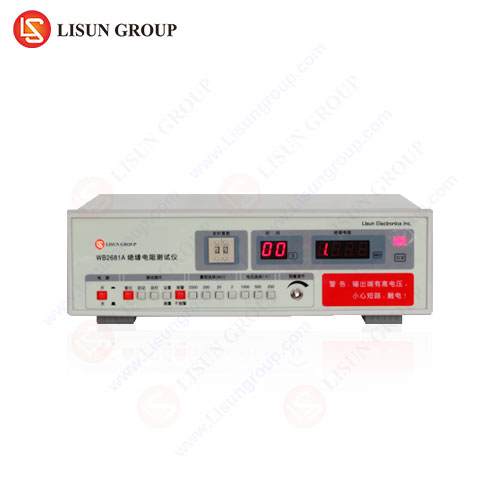
Executing reliable, repeatable, and safe high-current withstand voltage tests requires instrumentation engineered for precision, power, and compliance. The LISUN WB2671A Withstand Voltage Tester exemplifies a modern solution designed to meet these rigorous demands across diverse industrial applications.
Core Specifications and Capabilities:
The WB2671A is a microprocessor-controlled AC/DC dielectric strength tester. Its specifications are tailored for both standard and high-current applications:
- Output Voltage Range: AC 0-5kV / DC 0-6kV, with 0.5% accuracy.
- Critical High-Current Output: AC short-circuit current up to 100mA, with precise settable current limits and measurement.
- Timing Control: Programmable test duration from 1-99 seconds, accommodating both the longer durations of standard hipot tests and the short, 1-2 second bursts for high-current tests.
- Measurement Resolution: Voltage and current are measured with high resolution (0.01mA for current), ensuring accurate detection of leakage and fault currents.
- Arc Detection: Integrated arc detection circuitry can identify intermittent breakdowns that might not cause a full short circuit but indicate insulation weakness—a vital feature for predictive failure analysis.
Operational Principles in High-Current Mode:
When configured for a high-current withstand test, the operator sets the target voltage (e.g., 1500VAC), the upper current limit (e.g., 100mA), and a short test time (e.g., 2 seconds). Upon initiation, the WB2671A ramps the voltage to the setpoint. If the EUT’s insulation holds, the leakage current remains low, and the test passes after the timer elapses. However, if a low-impedance fault is present or simulated, the current will rapidly rise towards the 100mA limit. The instrument’s robust output stage is designed to maintain the full test voltage while supplying this high current. This sustains the fault condition, allowing the protective device in the EUT (like a fuse) to heat and open. The subsequent sudden drop in current is detected by the tester, which can be programmed to interpret this as a “pass” for the protective function. If the current rises but the voltage collapses or the protective device fails to operate within the time limit, the instrument will flag a failure.
Comparative Advantages in Industrial Deployment
The deployment of a dedicated instrument like the WB2671A offers distinct advantages over repurposed or less capable equipment.
Safety and Operator Protection: The instrument incorporates multiple hardware and software safety interlocks, including zero-start protection (voltage only rises from zero after start is pressed), over-current and over-voltage protection, and a secure ground connection. The high-current output is controlled and monitored, preventing uncontrolled arc-flash hazards.
Compliance and Audit Readiness: With its high accuracy and programmability, the WB2671A facilitates strict adherence to international safety standards (IEC, UL, CSA, GB). Test parameters and results can be logged, providing a verifiable audit trail for quality assurance and regulatory submissions.
Versatility Across Product Lines: A single instrument can be used on the production line for final safety testing of a household power strip, in the R&D lab for an automotive relay, and in the quality lab for a medical power supply. This reduces capital expenditure and training overhead.
Enhanced Diagnostic Capability: Beyond a simple pass/fail, the precise current measurement allows engineers to analyze trends. A gradually increasing leakage current over successive production units might indicate a process issue with insulation material or spacing, enabling proactive correction before failures occur.
Integration into Quality Assurance and Production Workflows
Implementing high-current testing effectively requires integration into broader quality frameworks. For cable and wiring systems, the test is often performed as a 100% production-line check. For industrial control systems and telecommunications equipment, it may be part of a type-test regimen during design validation or a sampling plan for incoming inspection of components. In consumer electronics and office equipment, it validates the safety of power adapters and internal insulation.
A typical automated test station might involve the WB2671A controlled via its RS232 or USB interface by a host computer running LabVIEW or a proprietary test executive. The program sets the test parameters, initiates the test, collects the results (peak current, final result, time-to-failure if applicable), and marks the unit accordingly. This closed-loop system ensures consistency and eliminates operator interpretation error.
Interpretation of Test Data and Failure Analysis
The data yielded from a high-current test is rich with diagnostic information. A pass result confirms the integrity of the insulation and the correct function of the protective system. A failure, however, requires nuanced analysis:
- Instantaneous Breakdown at High Current: This typically indicates a gross insulation failure—a direct short. This could be caused by a manufacturing defect like a pinched wire or contaminated PCB.
- Current Rise Without Protective Device Operation: This is a critical failure mode for the high-current test. It suggests the fuse is incorrectly rated, the earth connection has high resistance, or the fault path impedance is too high to generate sufficient current.
- Arcing or Intermittent Failure: Detected by the arc detection circuit, this points to a potential weakness like a void in molded insulation, insufficient creepage distance, or a contaminated surface. While it might pass a standard low-current hipot, it represents a latent reliability risk.
Conclusion
High-Current Withstand Voltage Testing represents a more severe and realistic assessment of a product’s safety architecture compared to standard dielectric tests. It moves beyond verifying that insulation merely exists, to validating that the entire system—insulation, protective devices, and conductive paths—will behave predictably and safely under catastrophic fault conditions. As electrical systems become more pervasive and power-dense across industries from automotive to medical, the role of this test grows in importance. The utilization of precise, capable, and safe instrumentation, such as the LISUN WB2671A, is not merely a matter of regulatory compliance, but a fundamental engineering practice that underpins product reliability, brand integrity, and ultimate end-user safety.
FAQ Section
Q1: What is the primary functional difference between the standard hipot mode and the high-current mode on an instrument like the WB2671A?
The standard hipot mode is designed to verify insulation integrity by applying high voltage and ensuring leakage current stays below a low threshold (e.g., 5mA). The high-current mode is designed to test protective systems by applying high voltage and allowing current to rise to a much higher set limit (e.g., 100mA), confirming that protective devices like fuses will operate under a simulated fault condition.
Q2: For a Class I appliance (with an earth ground), what does a “pass” in a high-current withstand test actually prove?
A pass proves that the protective earth connection is of sufficiently low impedance. In a fault where a live part contacts the earthed enclosure, the resulting current will be high enough (exceeding the tester’s set limit) to quickly blow the supply fuse or trip the circuit breaker, thereby removing the hazardous voltage from the accessible part, rather than leaving it energized.
Q3: Can the WB2671A be used for DC high-pot testing, and are high-current tests relevant for DC insulation?
Yes, the WB2671A provides both AC and DC output. High-current DC withstand testing is less common but is specified in certain standards, particularly for evaluating insulation in DC systems like photovoltaic arrays, EV battery packs, or telecom rectifiers. The principle is the same: to ensure a low-impedance fault would generate enough current to activate DC-rated protective devices.
Q4: How do I determine the correct test voltage and current limit for my specific product?
These parameters are almost always defined by the applicable safety standard for the product category (e.g., IEC 62368-1 for AV/IT equipment, UL 1598 for luminaires). The standard will specify the test voltage (often based on working voltage and insulation type) and the required current trip point or limit for the high-current test. The manufacturer’s test specifications should be derived directly from these normative references.
Q5: Is high-current withstand testing destructive to the product under test?
When testing the protective earth integrity of a final product, the test is generally non-destructive if the product passes. The high current flows briefly and is cleared by the instrument. However, if testing a component like a fuse or a sacrificial insulation path to verify its own breaking capacity, the test is intentionally destructive to that component. It is crucial to distinguish between testing a safety system (which should pass intact) and testing a protective component (which may be sacrificed).
