







Foundational Principles for Ensuring Measurement Precision in Electrical Safety Testing
Accurate electrical measurements constitute a non-negotiable prerequisite for ensuring the safety, reliability, and compliance of a vast array of electrical and electronic products. The process of verifying insulation integrity, in particular, serves as a critical barrier against potential hazards such as electric shock, fire, and equipment failure. Achieving a high degree of measurement confidence requires a systematic approach that encompasses environmental considerations, equipment selection, procedural rigor, and data interpretation. This treatise delineates essential methodologies for maximizing measurement accuracy, with a specific focus on insulation resistance testing, and examines the role of advanced instrumentation in this domain.
The Criticality of Environmental Parameter Stabilization
The electrical properties of insulating materials are profoundly influenced by ambient conditions, with temperature and humidity being the predominant factors. The inverse relationship between temperature and insulation resistance is well-documented; a 10°C increase in temperature can typically result in a halving of the measured resistance value. This phenomenon is attributed to increased ionic mobility within the dielectric material. Conversely, high relative humidity can create surface leakage paths that shunt the intended measurement, yielding erroneously low resistance readings that do not reflect the bulk material’s true condition.
To mitigate these effects, all testing must be conducted under stabilized environmental conditions. Specimens should be acclimatized within the test environment for a sufficient duration, often exceeding four hours, to achieve thermal equilibrium. Testing should ideally occur in a controlled atmosphere with a relative humidity maintained below 70% and at a standard temperature, such as 23°C ± 5°C, as referenced in standards like IEC 60243-1. Recording these parameters alongside the measured data is not merely good practice but is essential for subsequent trend analysis and correct interpretation. A reading of 500 MΩ at 35°C, for instance, may indicate a healthier insulation system than a reading of 750 MΩ at 20°C for the same component.
Selection and Verification of Appropriate Test Voltage and Duration
The application of an incorrect test voltage is a primary source of measurement inaccuracy. Test voltages are specified by international standards (e.g., IEC 60664-1, UL 60950-1) based on the equipment’s rated operational voltage. Applying a voltage that is too low may fail to stress the insulation sufficiently to reveal latent weaknesses, while an excessively high voltage can cause irreversible damage to otherwise healthy insulation or pose a safety risk.
Furthermore, the duration of voltage application is critical. Insulation resistance is not an instantaneous property but one that can exhibit time-dependent behavior, such as dielectric absorption and polarization. A short-duration test may only measure surface leakage, whereas a longer test allows the absorption current to decay, revealing the true conduction current and thus a more accurate representation of the bulk insulation resistance. Standardized tests often prescribe specific time intervals, such as the 1-minute reading used for the Polarization Index (PI) calculation, which is the ratio of the 10-minute resistance to the 1-minute resistance. Modern instruments automate these timed sequences to eliminate operator error.
Implementing Rigorous Pre-Test Discharge and Safety Protocols
A frequently overlooked yet vital step in the testing sequence is the safe discharge of capacitive components within the equipment under test (EUT). Cables, motor windings, and power supply filters can store a significant lethal charge following a high-voltage DC test. A robust testing protocol mandates a safe discharge period immediately after the test voltage is removed. This discharge should be actively monitored to ensure the terminal voltage has decayed to a safe level, typically below 60 V DC.
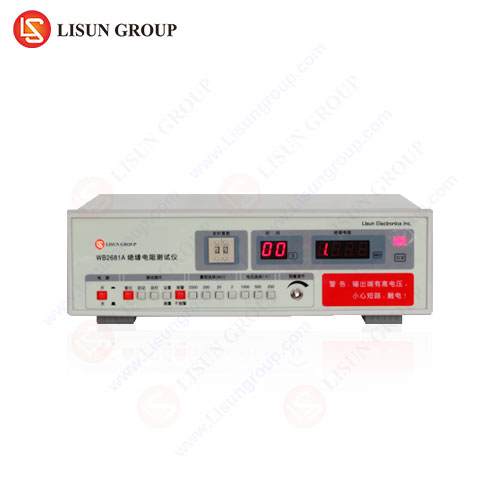
This procedure is not only a fundamental safety imperative for personnel but also protects the measuring instrument from potential damage caused by residual charge. Instruments like the LISUN WB2681A Insulation Resistance Tester integrate automatic discharge circuits that safely dissipate this stored energy post-test, thereby embedding this critical safety function directly into the operational workflow and removing reliance on manual, and potentially fallible, procedures.
Advanced Instrumentation for Demanding Applications: The LISUN WB2681A
For laboratories and quality assurance departments requiring uncompromising data integrity, the selection of the measurement instrument is paramount. The LISUN WB2681A Insulation Resistance Tester is engineered to address the stringent demands of modern electrical safety testing across diverse industries. Its design incorporates features specifically aimed at enhancing measurement accuracy, operator safety, and procedural efficiency.
The WB2681A generates a selectable, stabilized DC test voltage, with ranges extending from 50 V to 1000 V, suitable for testing everything from low-voltage consumer electronics to industrial control systems. The instrument boasts a high measurement range up to 200 GΩ, ensuring sufficient headroom for evaluating high-integrity insulation systems found in aerospace components or medical devices. Its accuracy is typically better than ±(3%+5 digits), providing the resolution necessary for discerning subtle changes in insulation condition over time.
The testing principle relies on applying the known, stable DC voltage to the EUT and precisely measuring the minute leakage current that flows through the insulation. Using Ohm’s Law (R = V/I), the instrument calculates and displays the resistance. The WB2681A enhances this basic principle with advanced functionalities such as automatic calculation of the Polarization Index (PI) and Dielectric Absorption Ratio (DAR), which are crucial for condition-based monitoring of motors and generators in industrial control systems. Its programmability allows for the creation of standardized test sequences, ensuring repeatability and compliance with internal and external quality standards.
Specification Table: LISUN WB2681A Insulation Resistance Tester
| Parameter | Specification |
|---|---|
| Test Voltage | 50 V, 100 V, 250 V, 500 V, 1000 V |
| Insulation Resistance Range | 0.01 MΩ to 200 GΩ |
| Accuracy | ±(3% reading + 5 digits) |
| Short-Circuit Current | Approx. 2 mA |
| Polarization Index (PI) | Automatic Calculation |
| Display | Digital LCD with backlight |
| Safety Standards | Complies with IEC 61010-1, CAT III 600V |
Mitigating Surface Leakage Through Proactive Terminal Guarding
In environments with elevated humidity or on components with contaminated surfaces, surface leakage current can become a significant source of error. This current flows across the surface of the insulator between the live conductor and the ground, bypassing the volume of the insulation material that is the actual subject of the test. To negate this effect, the guarding technique is employed.
High-end insulation testers, including the WB2681A, are equipped with a third terminal, the Guard terminal. By connecting this guard terminal to a conductive path that intercepts the surface leakage, this extraneous current is shunted away from the main measurement circuit. The instrument then measures only the current passing through the volume of the insulation, yielding a far more accurate representation of its true quality. This is particularly critical when testing multi-conductor cables and wiring systems, where leakage between adjacent conductors can invalidate a standard two-wire measurement.
Establishing a Regimen of Instrument Calibration and Verification
The accuracy of any measurement system is contingent upon its calibration status. Even the most sophisticated instrument will experience measurement drift over time due to component aging and environmental stress. A formal metrology program, traceable to national or international standards, is indispensable. The calibration interval should be determined based on the instrument’s usage frequency, environmental conditions, and the criticality of the measurements it provides.
Beyond periodic external calibration, daily or weekly verification using a calibrated high-value resistance standard is a recommended practice. This quick check provides immediate confidence in the instrument’s performance before commencing critical testing on production lines or field assets. The stability and low-temperature coefficient of the WB2681A’s internal reference components contribute to extended periods of stable performance between formal calibrations, a key advantage in maintaining consistent quality control in high-volume manufacturing environments for household appliances and automotive electronics.
Data Logging and Trend Analysis for Predictive Maintenance
A single insulation resistance measurement provides a snapshot of condition at a specific moment. However, the true power of this data is unlocked through longitudinal analysis. A gradual, sustained downward trend in insulation resistance is a far more telling indicator of impending failure than a single reading that is just above a pass/fail threshold.
Modern test instruments facilitate this approach through integrated data logging and communication interfaces. The ability to timestamp and store thousands of readings allows for the creation of historical records for critical assets such as turbine generators, MRI machines, or aircraft wiring harnesses. By applying trend analysis, maintenance can be transitioned from a reactive or time-based model to a predictive one, scheduling interventions precisely when needed, thereby maximizing asset uptime and preventing catastrophic failures in telecommunications infrastructure or medical devices.
Addressing Industry-Specific Measurement Challenges
The application of these principles varies according to the unique demands of each sector. In the automotive electronics industry, testing must account for vibrations and thermal cycling, requiring robust connections during test. For lighting fixtures, particularly LED drivers, the presence of surge protection devices (SPDs) requires a careful test strategy to avoid measuring the SPD’s characteristics instead of the insulation. In medical devices, patient safety standards (e.g., IEC 60601-1) impose stricter leakage current limits, necessitating instruments with higher measurement resolution and stability. The programmability and robust test lead accessories available with systems like the WB2681A make it adaptable to these varied, high-stakes environments, from the production of office equipment to the validation of aerospace components.
Frequently Asked Questions (FAQ)
Q1: What is the functional difference between a Polarization Index (PI) and a simple insulation resistance value?
A simple insulation resistance measurement provides a point-in-time assessment of the insulation’s condition. The Polarization Index (PI), which is the ratio of the 10-minute resistance to the 1-minute resistance, assesses the absorption characteristics of the insulation. A high PI (e.g., >2.0) indicates clean, dry insulation in good condition, while a low PI (e.g., <1.0) suggests moisture, contamination, or aging, providing a more nuanced diagnostic capability.
Q2: Why is the short-circuit current specification of an insulation tester important?
The short-circuit current, typically in the range of 1-5 mA for instruments like the WB2681A, determines the instrument’s ability to charge capacitive loads quickly and maintain a stable test voltage in the presence of surface leakage. A higher available current leads to a faster stabilization of the reading and provides a more robust measurement, especially on large motors or long cable runs with significant capacitance.
Q3: Can the WB2681A be used for routine production-line testing of household appliances?
Yes, its programmability and fast, stable measurement cycle make it highly suitable for high-volume production environments. The ability to set precise pass/fail thresholds for insulation resistance ensures consistent quality control for products like washing machines, refrigerators, and power tools, directly supporting compliance with standards such as IEC 60335-1.
Q4: How does the Guard terminal function on the WB2681A, and when is it mandatory?
The Guard terminal provides a low-impedance path to shunt surface leakage currents away from the main measurement circuit. Its use is mandatory when testing multi-conductor cables to prevent current leakage between cores from affecting the measurement, or when testing any component in a humid or contaminated environment where surface conduction is likely to occur.
Q5: What safety certifications should I look for in an insulation tester for industrial use?
The instrument must comply with relevant safety standards for electrical test equipment, most notably IEC 61010-1. Furthermore, it should carry a Measurement Category rating (e.g., CAT III 600V) appropriate for the intended test environment. This rating certifies that the instrument is designed to withstand voltage transients that can occur on electrical systems, protecting the operator from potential hazards.
