








Fundamental Principles of Dielectric Integrity Assessment
Insulation resistance (IR) testing constitutes a fundamental non-destructive evaluation method within electrical engineering, serving as a primary diagnostic for the integrity of dielectric materials. The core principle involves the application of a calibrated, high direct current (DC) voltage, typically ranging from 50V to 10kV or more, across the insulation barrier separating conductive components. The resultant current flow, which is minuscule in a healthy insulator, is measured with high precision. This measured current is a composite of three components: the capacitive charging current, which decays rapidly; the absorption current, related to dielectric polarization; and the conduction or leakage current, which is stable and indicative of the insulation’s actual resistive quality. The insulation resistance value, calculated using Ohm’s Law (R = V/I), provides a quantitative measure of the dielectric’s health. This value is inversely proportional to the level of contamination, moisture ingress, aging, or physical degradation present. Advanced testing methodologies, such as the Dielectric Absorption Ratio (DAR) and Polarization Index (PI), extend this basic principle by analyzing resistance trends over time, offering deeper insights into the material’s condition and its ability to withstand long-term electrical stress.
Critical Role in Preventive Maintenance for Industrial Control Systems
Within industrial environments, control systems form the operational backbone, governing processes from assembly lines to chemical plants. The failure of a motor, programmable logic controller (PLC), or associated circuitry due to insulation breakdown can precipitate catastrophic production halts and safety incidents. Insulation resistance testing is therefore a cornerstone of predictive maintenance protocols. For example, periodic testing of servo motor windings can detect the early stages of insulation degradation caused by thermal cycling, vibration, or contamination from conductive dusts. A declining Polarization Index, as measured by a sophisticated instrument, signals moisture absorption or winding contamination long before a catastrophic ground fault occurs. Similarly, testing the insulation integrity of busbars, switchgear, and control transformers within an industrial panel identifies potential failure points, allowing for scheduled remediation during planned downtime. This proactive approach contrasts sharply with reactive maintenance, mitigating unplanned outages, reducing repair costs, and enhancing overall operational safety. The data gleaned from these tests also facilitates trend analysis, enabling maintenance teams to forecast the remaining service life of critical assets and optimize their replacement schedules.
Ensuring Safety and Compliance in Household Appliance Manufacturing
The global household appliance industry operates under a stringent framework of safety standards, such as IEC 60335-1, which mandates rigorous dielectric strength and insulation resistance tests. For manufacturers of products like washing machines, refrigerators, and dishwashers, IR testing is a non-negotiable step in the production line. It verifies that the insulation between live parts (e.g., motor windings, heating elements) and accessible conductive surfaces (e.g., chassis, outer casing) possesses sufficient resistance to prevent hazardous leakage currents. This is particularly critical for appliances used in humid environments like bathrooms and kitchens, where moisture can significantly degrade insulating materials. A typical test involves applying 500V DC between the power plug’s live and neutral pins (connected together) and the appliance’s grounded metal frame. A pass result, often requiring a resistance value exceeding 100 MΩ, confirms that the product is safe for consumer use and compliant with international safety regulations. Failure to meet these criteria can lead to electric shock hazards, product recalls, and significant brand reputation damage.
Validation of Cable and Wiring System Integrity
Cables and wiring harnesses are the circulatory system of any electrical installation, yet their insulation is perpetually vulnerable to damage during installation, thermal stress, and environmental exposure. Insulation resistance testing is the definitive method for verifying the integrity of new installations and assessing the condition of aging systems. For new builds, such as the wiring within a commercial office complex or the cabling for a telecommunications backbone, a successful IR test confirms the absence of installation damage, poor terminations, or substandard materials. For existing systems, the test can pinpoint localized degradation, such as insulation cracking in a motor supply cable subject to excessive heat, or generalized moisture ingress in underground conduits. The test is typically performed phase-to-phase and phase-to-ground, with the entire circuit under test isolated. The ability to perform step-voltage tests is also valuable, as it can reveal insulation weaknesses that are only apparent at higher electrical stresses, simulating transient overvoltage conditions.
Reliability Assurance in Automotive Electronics and Aerospace Components
The automotive and aerospace sectors demand unparalleled levels of reliability from their electronic components. In modern vehicles, high-voltage systems in electric and hybrid cars, along with sophisticated infotainment and advanced driver-assistance systems (ADAS), rely on flawless insulation to function correctly and safely. Insulation resistance testing is employed at multiple stages: for individual components like sensors and control units, for wiring harnesses, and for the final assembled vehicle. It ensures that high-voltage battery packs and traction motors are isolated from the vehicle chassis, preventing short circuits and potential thermal events. Similarly, in aerospace, every wire, connector, and avionic component must withstand extreme environmental conditions, including wide temperature fluctuations, vibration, and low atmospheric pressure. IR testing per standards such as AS50881 is mandatory to verify that insulation will not break down under these stresses, thereby ensuring the continued airworthiness and safety of the aircraft. The consequences of insulation failure in these domains extend beyond mere malfunction to critical safety-of-life scenarios.
The WB2681A Insulation Resistance Tester: A Technical Overview
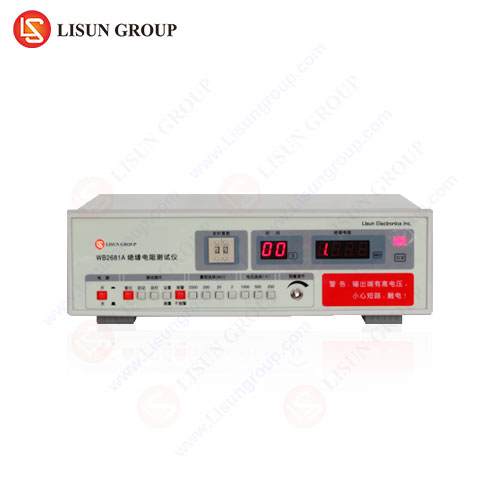
The LISUN WB2681A Insulation Resistance Tester represents a contemporary solution engineered to meet the rigorous demands of the applications detailed herein. This instrument is designed for precision, safety, and operational efficiency across laboratory, production line, and field service environments.
Key Specifications:
- Test Voltages: Selectable range from 50V to 1000V, accommodating a wide spectrum of standards and applications.
- Resistance Measurement Range: Extends from 0.01 MΩ to 9999 MΩ, providing high-resolution data for both low-resistance and high-integrity insulation systems.
- Accuracy: High measurement accuracy, typically within ±(3%+5 digits), ensuring reliable and repeatable results.
- Output Short-circuit Current: A robust short-circuit current capability enhances the instrument’s ability to charge capacitive loads quickly and maintain stable voltage during testing.
- User Interface: Features a clear digital display for resistance, voltage, and test time, often including a live count-up timer for PI and DAR tests.
- Safety Compliance: Designed and certified in accordance with relevant IEC safety standards for electronic measuring apparatus, ensuring operator protection.
Testing Principles and Competitive Advantages:
The WB2681A operates on the standardized DC voltage application principle. Its internal circuitry generates a highly stable and filtered test voltage, which is crucial for obtaining accurate and noise-free resistance measurements. A key competitive advantage lies in its robust construction and design features tailored for real-world use. The instrument typically incorporates guard terminal functionality, which allows the user to bypass surface leakage currents, thereby isolating and measuring only the volume resistance of the insulation material under test. This is indispensable for obtaining accurate readings in humid conditions or on contaminated surfaces. Furthermore, its automatic discharge circuit enhances operator safety by safely dissipating stored capacitive energy from the equipment under test upon completion of the measurement. Compared to more basic megohmmeters, the WB2681A’s combination of a wide voltage range, high accuracy, and safety features makes it a versatile tool for quality assurance teams testing medical device power supplies, R&D engineers validating new lighting fixture designs, and maintenance technicians troubleshooting office equipment.
Application in Quality Control for Medical Devices and Consumer Electronics
The manufacture of medical devices and consumer electronics imposes some of the most stringent quality control requirements. For a medical device such as a patient monitor or an MRI subsystem, electrical safety is paramount. Insulation failure could directly endanger patient lives. IR testing is therefore a mandatory step in the production process, verifying isolation between mains-powered internal circuits and any patient-connected parts. The WB2681A, with its precise low-voltage testing capabilities, is ideally suited for such sensitive applications, ensuring compliance with standards like IEC 60601-1 without risking damage to delicate internal electronics.
In the consumer electronics sector, for products ranging from smartphones to power adapters, IR testing safeguards against field failures and returned merchandise. A power adapter, for instance, must have robust isolation between its primary (high-voltage) and secondary (low-voltage) sides. During production, a 100% test using an instrument like the WB2681A at a specified voltage (e.g., 500V DC) ensures every unit meets the minimum IR specification, preventing potential shock hazards and ensuring brand reliability. The speed and reliability of such testers are critical to maintaining high throughput on automated production lines without compromising on safety.
Diagnostic Protocols for Electrical Components and Telecommunications Equipment
Discrete electrical components and telecommunications infrastructure represent another critical application area. Components such as switches, sockets, transformers, and relays must provide reliable insulation in their off-state or between isolated contacts. Batch acceptance testing using an IR tester can quickly identify manufacturing defects in moldings or internal clearances. In telecommunications, central office equipment and outdoor cabinets house sensitive electronics that are protected by surge protective devices (SPDs) and rely on proper insulation to maintain signal integrity and prevent ground loops. Periodic IR testing of power distribution units (PDUs), backup battery systems, and the insulation of main feeder cables within a facility is a standard part of network reliability programs. It helps identify aging infrastructure before it leads to service outages.
Interpretation of Test Results and Industry Standards
The raw data from an insulation resistance test is only as valuable as its interpretation. Acceptable resistance values are not universal; they are dictated by the equipment type, its operating voltage, and applicable standards. For example, a 1 kV motor might require a minimum IR value of 5 MΩ, while a low-voltage control circuit may only require 1 MΩ. Standards such as IEEE 43 provide detailed guidance on testing rotating machinery and interpreting Polarization Index values. A PI of less than 1.0 indicates severely compromised insulation, likely contaminated with moisture, while a PI of 4.0 or higher suggests dry, clean insulation in excellent condition. Understanding these benchmarks and the factors that influence IR readings—such as temperature (resistance halves approximately for every 10°C increase) and humidity—is essential for making correct pass/fail judgments and accurate diagnostic conclusions about the asset’s health.
FAQ Section
Q1: What is the primary difference between an insulation resistance test and a hipot (dielectric withstand) test?
An insulation resistance test is a non-destructive, quantitative test that measures the actual resistance value of the insulation at a DC voltage, providing a measure of its quality. A hipot test is a pass/fail, stress test that applies a much higher AC or DC voltage to verify that the insulation can withstand a specified overvoltage without breaking down. IR testing is often used for condition assessment and maintenance, while hipot testing is a final safety verification in production.
Q2: Why is a guard terminal used, and when is it necessary?
The guard terminal is used to shunt surface leakage currents away from the main measurement circuit. This is necessary when testing in humid or contaminated environments where current flowing across the surface of the insulator can distort the measurement of the current flowing through the insulation volume. Using the guard terminal ensures the measured value reflects the true bulk insulation resistance.
Q3: How does temperature affect an insulation resistance reading, and how should it be corrected?
Insulation resistance has a strong inverse relationship with temperature. As temperature increases, resistance decreases exponentially. For accurate trending over time, readings should be corrected to a standard base temperature (e.g., 20°C or 40°C) using standard correction factors or formulas provided in engineering standards like IEEE 43. This prevents a falsely low reading on a hot day from being misinterpreted as insulation failure.
Q4: For a new piece of equipment, what is a typical minimum acceptable insulation resistance value?
While specific standards must be consulted, a common rule of thumb for electrical equipment is a minimum of 1 MΩ per kilovolt of operating voltage, plus 1 MΩ. For example, for a 480V motor (0.48 kV), the minimum acceptable IR would be (0.48 + 1) = 1.48 MΩ. However, modern equipment, especially electronics, often far exceeds this minimum, with values in the hundreds or thousands of MΩs being typical for a healthy system.
Q5: What safety precautions are critical when performing insulation resistance testing?
Safety is paramount. Always de-energize, lock out, and tag out the equipment under test. Verify the absence of voltage with a known-working voltage tester before connecting the IR tester. Ensure all equipment grounds are properly connected. After testing, the equipment will hold a capacitive charge; the WB2681A automatically discharges this, but it is essential to verify discharge with a voltage tester before handling the test leads or the equipment.
