








Ensuring Product Safety with Dielectric Strength Testing
Introduction to Insulation Integrity as a Foundational Safety Parameter
The operational safety and long-term reliability of electrical and electronic equipment are fundamentally predicated on the integrity of their insulation systems. These systems, comprising materials such as polymers, ceramics, and composites, serve as the primary barrier against catastrophic failure modes, including short circuits, electrical fires, and user electrocution. Over time, insulation can degrade due to thermal stress, mechanical vibration, environmental contamination (e.g., moisture, dust), and electrical overstress. A latent insulation weakness represents a significant, often invisible, hazard. Consequently, rigorous evaluation of dielectric strength—the insulation’s ability to withstand high voltage without breakdown—is not merely a quality check but a critical, non-negotiable component of product validation and regulatory compliance. Dielectric strength testing, commonly termed hipot (high-potential) or withstand voltage testing, provides a quantitative and definitive assessment of this property, serving as a cornerstone of safety certification protocols worldwide.
The Electrophysical Principles of Dielectric Breakdown Testing
At its core, dielectric strength testing is a destructive evaluation of an insulation system’s maximum voltage endurance. The test applies a significantly higher-than-normal AC or DC voltage between conductive parts that are normally isolated—for instance, between live parts and accessible conductive surfaces (earth). This elevated stress intentionally exceeds the product’s rated operational voltage by a substantial margin, as defined by international safety standards. The objective is not to degrade functional products but to verify that the insulation possesses a sufficient safety margin, or dielectric withstand capability, to endure transient overvoltages, such as switching surges or lightning-induced impulses, that may occur during the product’s service life.
The test procedure monitors the resultant leakage current flowing through and across the insulation. Under ideal conditions, this current remains extremely low, typically in the microampere range, constrained by the insulation’s high resistivity. A well-designed insulation system will withstand the applied test voltage for the prescribed duration (commonly 60 seconds) without exhibiting breakdown. Breakdown is characterized by a sudden, exponential increase in leakage current, often culminating in a visible arc or puncture of the insulating material. This event unequivocally identifies a weakness. The test parameters—voltage level, ramp rate, duration, and trip current limit—are meticulously specified in standards such as IEC 60335, IEC 60601, IEC 60950, and their regional derivatives (UL, CSA, GB). The selection of AC versus DC testing involves nuanced considerations: AC testing more closely simulates operational stress and is sensitive to capacitive leakage, while DC testing imposes less stress on capacitive loads and is often used for field testing or evaluating components like cables and capacitors.
Industry-Specific Applications and Regulatory Imperatives
The universality of electrical safety translates into a broad mandate for dielectric strength testing across diverse industrial sectors. The specific test requirements, however, are meticulously tailored to the operational environment, risk profile, and intended use of the equipment.
In the Electrical and Electronic Equipment and Consumer Electronics sectors, encompassing everything from power adapters to desktop computers, testing ensures user protection against shock from accessible parts. Household Appliances, like washing machines and refrigerators, are tested to guarantee safety despite exposure to moisture and varying temperatures. For Automotive Electronics, the test regimen must account for extreme vibration, thermal cycling, and a harsh electrical environment with significant voltage transients, making insulation robustness paramount for critical systems like battery management and motor controllers.
Lighting Fixtures, particularly high-intensity discharge or LED drivers, require testing to manage the high voltages often present in ballasts or power supplies. Industrial Control Systems and Telecommunications Equipment demand high reliability in electrically noisy environments; insulation failure here can lead to catastrophic process shutdowns or network outages. The Medical Device field, governed by the stringent IEC 60601 standard, imposes the most rigorous isolation requirements, often necessitating reinforced or double insulation to protect both patient and operator from micro-shock hazards.
Aerospace and Aviation Components are subject to testing that considers reduced atmospheric pressure at altitude, which can lower dielectric strength. Electrical Components such as switches, relays, and sockets undergo testing to validate isolation between contacts and to ground. Cable and Wiring Systems are routinely subjected to dielectric tests to detect insulation flaws from manufacturing. Finally, Office Equipment like printers and copiers integrate high-voltage power supplies and heating elements, necessitating comprehensive safety validation.
Operational Implementation: The WB2671A Withstand Voltage Tester
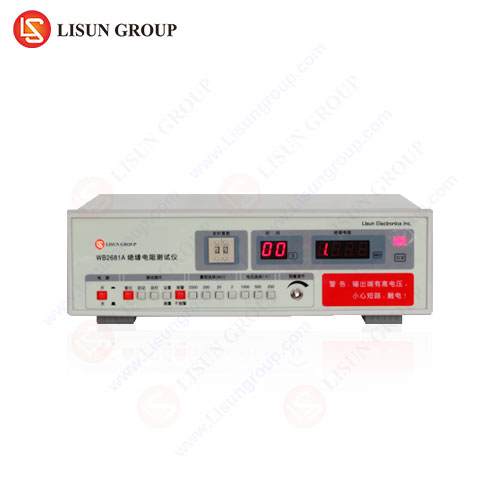
Effective dielectric strength testing requires instrumentation that combines high-voltage generation with precise measurement, robust safety features, and compliance with standard-mandated methodologies. The LISUN WB2671A Withstand Voltage Test System exemplifies a modern, integrated solution designed to meet these complex demands across the aforementioned industries.
The WB2671A is a microprocessor-controlled AC/DC dielectric strength tester engineered for laboratory and production-line applications. Its core function is to generate a stable, programmable high-voltage output and measure the resultant leakage current with high accuracy, determining pass/fail status against user-defined limits.
Key Specifications and Functional Capabilities:
- Test Voltage Output: AC: 0–5 kV / 0–10 kV / 0–20 kV; DC: 0–6 kV / 0–12 kV / 0–24 kV (model dependent).
- Voltage Accuracy: Typically ± (2% of reading + 0.5% of full scale).
- Leakage Current Measurement Range: 0.10 mA to 20.00 mA, with a resolution of 0.01 mA.
- Trip Current Setting: User-definable from 0.10 mA to 20.00 mA, serving as the critical failure threshold.
- Test Timer: Programmable from 1 to 999 seconds, with a manual mode for indefinite testing.
- Ramp Function: Allows programmable voltage rise time (e.g., 5 seconds) to the target withstand voltage, preventing inrush-related false failures.
- Output Waveform Distortion: ≤ 3% for AC output, ensuring a clean test signal per standard requirements.
The testing principle is automated and repeatable. The operator connects the device under test (DUT), sets the required withstand voltage, trip current, and test duration via the intuitive interface. Upon initiation, the unit ramps the voltage to the set level, holds it for the duration while continuously monitoring leakage current, and immediately terminates the test while registering a FAIL if the current exceeds the trip limit. A visual and audible alarm signals the outcome. Advanced models may include RS232 or GPIB interfaces for data logging and integration into automated test sequences, which is critical for high-volume production environments.
Competitive Advantages in Industrial Application
The WB2671A’s design addresses several practical challenges inherent to dielectric testing. Its high accuracy in both voltage output and current measurement ensures that compliance judgments are reliable and defensible during agency audits. The programmable ramp function is not merely a convenience; it is essential for testing capacitive loads (e.g., long cables, power supply filters) where a sudden application of full voltage can cause an inrush displacement current that exceeds the trip threshold, incorrectly failing a good unit. The ability to finely adjust the trip current from 0.10 mA upward allows alignment with the most stringent standards (e.g., medical devices often require sub-milliampere trip levels) and provides sensitivity to detect early-stage insulation degradation that a coarser setting might miss.
Safety is integral. The instrument incorporates hardware and software protections against output short circuits, over-current, and over-voltage. When integrated into a test station with safety interlocks (e.g., a guarded test fixture that cuts power when the enclosure is opened), it forms a complete safety system. Its robustness and programmability make it equally suitable for the R&D lab, where engineers perform design validation and margin testing, and the manufacturing floor, where operators require a simple, fast, and foolproof test routine.
Interpreting Test Data and Failure Analysis
A passing result confirms the insulation’s adequacy at the time of test. However, the quantitative data—the actual leakage current value—can be diagnostically valuable. A current reading that is stable but consistently near (yet below) the trip threshold may indicate aging insulation or marginal design, warranting further investigation. A reading that gradually “creeps” upward during the test duration can signal contamination on a surface (tracking) or thermal instability in the dielectric material.
A failure, indicated by a trip event, necessitates root cause analysis. The failure mode—whether a flashover across a surface, a puncture through bulk material, or a tracking path—provides clues. Surface flashovers may point to inadequate creepage/clearance distances or contamination. Bulk puncture suggests a material defect or insufficient insulation thickness. Correlation with other tests, such as insulation resistance (IR) measurement, can provide a more complete picture of insulation health, as IR testing is a non-destructive, lower-voltage test sensitive to moisture and gross contamination.
Standards Compliance and Testing Protocol Design
Adherence to published safety standards is not optional. These documents (IEC, UL, EN, GB, etc.) precisely define test voltages, which are typically based on the equipment’s rated voltage, insulation type (basic, supplementary, reinforced), and installation category. For example, a Class I appliance (with protective earth) might be tested at 1250 VAC between live parts and earthed accessible metal, while a Class II double-insulated product might require 3000 VAC. The standards also specify environmental pre-conditioning, such as humidity treatment, that must precede the dielectric test to simulate worst-case conditions.
Designing a test protocol involves:
- Identifying the applicable standard(s).
- Determining all necessary test points (e.g., primary-to-secondary, primary-to-earth, secondary-to-earth).
- Setting the correct test voltage, frequency (for AC), and duration.
- Defining an appropriate trip current limit, often specified in the standard or derived from product-specific risk assessment.
- Establishing safe fixturing and operator procedures.
The WB2671A’s programmability allows storage of multiple such protocols, enabling rapid switching between test setups for different product lines.
Conclusion
Dielectric strength testing remains an indispensable, globally recognized method for safeguarding life and property. It is a direct interrogation of the product’s last line of defense against electrical hazards. As products become more compact, operate at higher efficiencies, and are deployed in increasingly demanding environments, the role of precise, reliable, and standards-compliant withstand voltage testing only grows in importance. Implementing a rigorous testing regimen with capable instrumentation is a fundamental responsibility of manufacturers across all electrical and electronic disciplines, serving as a critical pillar of product safety, quality assurance, and corporate due diligence.
FAQ Section
Q1: What is the difference between AC and DC dielectric strength testing, and when should each be used?
AC testing applies a sinusoidal high voltage, typically at power frequency (50/60 Hz). It is the most common method for final product testing as it most closely replicates operational stress and tests both capacitive and resistive leakage. DC testing applies a unipolar high voltage. It is often used for testing components like capacitors and long-length cables, as it does not cause charging currents in capacitive loads that could lead to false failures. DC testing is also used for field testing of installed equipment due to the lighter, less hazardous test equipment required.
Q2: How is the appropriate “trip current” setting determined for a specific product?
The trip current is the leakage current threshold that, if exceeded, causes the tester to fail the unit. Its setting is primarily guided by the applicable safety standard. Some standards prescribe a specific value (e.g., 5 mA for many household appliances). Others, particularly for medical devices, may specify a much lower value (e.g., 0.5 mA). In the absence of a specific mandate, it is set based on a risk assessment, considering the product’s design, insulation system, and the sensitivity required to detect a hazardous breakdown while avoiding nuisance trips from harmless displacement currents.
Q3: Can dielectric strength testing damage a functional, safe product?
When performed correctly according to standard protocols, the test is designed to stress the insulation without causing degradation in a sound product. The voltage, while high, is applied for a short, controlled duration. However, repeated or non-standard testing can cumulatively stress insulation. Therefore, it is generally considered a type test for design validation or a 100% production line test for safety verification, not a routine maintenance procedure. Proper ramp-up functions, as found in testers like the WB2671A, further minimize stress.
Q4: Why is a “ramp” function important in a withstand voltage tester?
A ramp function gradually increases the voltage from zero to the target test voltage over a set time (e.g., 5 seconds). This is critical for testing devices with significant capacitance, such as switched-mode power supplies or long cables. A sudden application of full voltage causes a large inrush of capacitive charging current, which can momentarily exceed the trip current limit and cause a false failure. Ramping allows this transient to settle, ensuring the test measures only the conductive leakage current through the insulation.
Q5: Our production line tests a high volume of units. Can the WB2671A be automated?
Yes. The WB2671A is designed for integration into automated test systems. It features digital communication interfaces (such as RS232). This allows it to be controlled by a host computer or PLC (Programmable Logic Controller). Test parameters can be sent remotely, the test can be initiated and terminated automatically, and results (PASS/FAIL, actual leakage current) can be read back and logged into a database. This enables seamless integration with barcode scanners, conveyor systems, and statistical process control software for high-efficiency production testing.
