








Ensuring Product Safety: A Guide to Leakage Current Standard Compliance
Introduction: The Critical Role of Leakage Current in Product Safety
In the design, manufacture, and certification of electrical and electronic equipment, ensuring user safety is a non-negotiable imperative. Among the myriad of safety parameters, leakage current stands as a fundamental metric, representing the unintended flow of electrical current from a live part to an accessible conductive part or to earth under normal operating conditions. This phenomenon, while often minute in magnitude, poses significant risks of electric shock, fire hazard, and equipment malfunction. Consequently, rigorous compliance with international leakage current standards is not merely a regulatory hurdle but a cornerstone of responsible engineering and corporate due diligence. This article provides a comprehensive examination of leakage current, its governing standards, testing methodologies, and the instrumental role of precision measurement equipment in achieving compliance across diverse industrial sectors.
Defining Leakage Current: Types and Physiological Implications
Leakage current manifests in several distinct forms, each with specific measurement requirements and safety implications. Understanding these classifications is essential for accurate testing and standard interpretation.
- Touch Current (Enclosure Leakage Current): This is the current that could flow through a human body or a representation thereof (a measurement network) coming into contact with the accessible parts of equipment. It is the primary concern for shock hazard.
- Earth Leakage Current (Protective Conductor Current): This current flows from the mains supply through or across insulation into the protective earth conductor. Excessive earth leakage can cause protective devices like RCDs (Residual Current Devices) to nuisance trip, disrupting operations.
- Patient Leakage Current: A specialized subset critical in medical device applications, this refers to current that flows from applied parts or accessible surfaces through a patient to earth. Standards for this are exceptionally stringent due to the patient’s heightened vulnerability.
The physiological effect of electric current on the human body is frequency-dependent. At power frequencies (50/60 Hz), currents as low as 0.5 milliamperes (mA) can be perceptible, while currents exceeding 10 mA can lead to muscular tetany, preventing the victim from letting go. Higher currents can induce ventricular fibrillation and cardiac arrest. Measurement standards therefore incorporate weighting networks, such as those defined in IEC 60990, to simulate the body’s frequency-dependent impedance, ensuring that measured values accurately reflect the potential hazard.
The Regulatory Landscape: Key International Standards
Compliance is dictated by a complex framework of international and regional standards, which vary by product category and market. Key standards include:
- IEC 62368-1: The hazard-based safety standard for Audio/Video, Information and Communication Technology equipment. It supersedes older standards like IEC 60950-1 and IEC 60065, defining allowable touch current limits based on energy source classes.
- IEC 60335-1: The general safety standard for household and similar electrical appliances. It specifies detailed test conditions and limits for both touch and earth leakage currents.
- IEC 60601-1: The paramount standard for the safety and essential performance of medical electrical equipment. It defines exceptionally low limits for patient leakage currents (e.g., 100 µA under normal conditions) and mandates tests under single-fault conditions.
- IEC 61010-1: Safety requirements for electrical equipment for measurement, control, and laboratory use, relevant to industrial control systems and test equipment.
- UL 62368-1 / UL 60335-1: The North American adoptions of the respective IEC standards, with national deviations.
These standards prescribe not only the maximum allowable current limits but also the precise test configurations, power supply conditions (e.g., 110% of rated voltage), and application of fault conditions (such as reversed polarity or open neutral). A summary of common limits is presented in Table 1.
Table 1: Representative Leakage Current Limits (Normal Condition)
| Standard | Equipment Type | Touch Current Limit | Earth Leakage Current Limit | Notes |
| :— | :— | :— | :— | :— |
| IEC 62368-1 | Class I ICT Equipment | 0.25 mA (AC) | 3.5 mA | For hand-held equipment, limit is 0.75 mA. |
| IEC 60335-1 | Class I Household Appliance | 0.75 mA | – | Varies by appliance type and portability. |
| IEC 60601-1 | Medical Equipment (Type BF) | 0.1 mA (Patient) | 5 mA | Patient leakage is critically low. |
| IEC 61010-1 | Laboratory/Industrial | 0.5 mA (AC) | 5 mA | Dependent on installation category. |
Methodologies for Leakage Current Measurement
Accurate measurement requires specialized instrumentation that can apply the correct measurement network, isolate the device under test (DUT), and apply the required test voltages and fault conditions. The core principle involves placing a simulated human body impedance network—the Measuring Device (MD) as per IEC 60990—in the potential current path and measuring the voltage drop across it, or directly measuring the current. Tests are performed with the DUT energized at its rated voltage and frequency, and often at 110% of rated voltage to simulate worst-case grid conditions. Key test configurations include:
- Measurement from Accessible Parts to Earth: For touch current on earthed equipment.
- Measurement Between Any Two Accessible Parts: For equipment with multiple isolated enclosures.
- Measurement with Reversed Supply Polarity: To account for potential asymmetries in insulation.
- Measurement Under Single-Fault Conditions: Such as opening the protective earth conductor (for Class I equipment) or shorting specific functional insulation.
The WB2675D Leakage Current Tester: A Precision Instrument for Compliance Verification
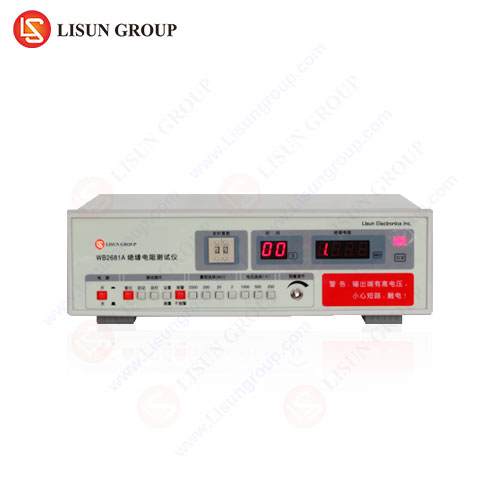
To execute these methodologies with the requisite accuracy and repeatability, engineers rely on dedicated leakage current testers. The LISUN WB2675D Leakage Current Tester exemplifies the capabilities required for modern compliance laboratories and production line testing.
Testing Principles and Core Specifications: The WB2675D operates by generating a stable, adjustable AC power source (typically 0-300V AC, 45-65Hz) to supply the DUT. It integrates the standardized measurement networks (MD1, MD2 for differential and composite modes as per relevant standards) within its circuitry. The instrument precisely measures the voltage developed across this network, converting it to a direct reading of leakage current in milliamperes (mA) or microamperes (µA). Its high-input impedance ensures minimal loading on the measurement circuit. Key specifications include:
- Measurement Range: 0.01 µA to 20 mA, covering the full spectrum from medical device micro-leakage to appliance-level currents.
- Test Voltage: 0-300V AC, adjustable with 1V resolution, allowing for precise application of 110% overvoltage tests.
- Measurement Accuracy: Typically ±(2% of reading + 5 digits), ensuring reliable data for certification.
- Integrated Networks: Compliant with IEC 60990, IEC 62368-1, IEC 60335-1, and other major standards.
- Test Modes: Automatic sequencing for normal, reverse, and open-earth fault tests, streamlining the compliance workflow.
Industry Use Cases and Application: The WB2675D’s versatility makes it indispensable across the product lifecycle.
- R&D and Design Validation: Engineers use it to vet prototypes of consumer electronics, lighting fixtures, and electrical components early in the design phase, identifying insulation weaknesses before production.
- Production Line End-of-Line Testing: In manufacturing of household appliances and office equipment, it provides a go/no-go test, ensuring every unit shipped meets safety limits.
- Quality Assurance and Audit: For automotive electronics sub-component suppliers and telecommunications equipment manufacturers, it offers auditable, precise data for quality records.
- High-Voltage Component Testing: Its adjustable voltage source is critical for testing cable and wiring systems and components intended for aerospace and aviation applications, where operating voltages can be higher.
Competitive Advantages in a Technical Context: The WB2675D distinguishes itself through several engineered features. Its wide current range negates the need for multiple instruments when testing diverse product categories, from a medical sensor to an industrial motor controller. The programmable test sequences reduce operator error and increase throughput in high-volume production environments. Furthermore, its robust internal protection circuits prevent damage from accidental short circuits or overloads during fault condition testing, a common occurrence when evaluating industrial control systems. The instrument’s calibration traceability to national standards provides the documentation rigor required for accredited laboratory testing.
Implementing a Robust Leakage Current Testing Protocol
Establishing a compliant testing protocol extends beyond procuring the correct instrument. It requires a systematic approach:
- Standard Identification: Precisely determine the applicable standard(s) for the target market and product category.
- Test Condition Definition: Document all required test configurations, voltages, frequencies, and fault conditions as mandated by the standard.
- Equipment Setup and Calibration: Ensure the tester, like the WB2675D, is within its calibration cycle and configured with the correct measurement network for the standard.
- DUT Preparation: The equipment must be in its ready-to-use state, with all covers installed. For appliances, tests may need to be run with motors operating or heaters cycling.
- Execution and Data Logging: Perform the test sequence, recording the steady-state leakage current value. Modern testers often feature data output for direct logging to a quality management system.
- Analysis and Reporting: Compare results against standard limits. Any non-conformance necessitates design review, focusing on insulation coordination, creepage and clearance distances, and grounding efficacy.
Conclusion: Safety as an Engineered Attribute
Leakage current compliance is a definitive metric of a product’s electrical safety integrity. It is a non-negotiable requirement enforced by global regulatory bodies and informed by decades of electrophysiological research. Navigating this complex requirement demands a confluence of precise standards interpretation, methodical testing protocols, and highly accurate instrumentation. Tools like the LISUN WB2675D Leakage Current Tester provide the technological foundation for this critical safety verification, enabling manufacturers across sectors—from medical devices to consumer electronics—to validate that their products are not only functional but fundamentally safe for end-users and integrated systems. In an era of increasing electrification and device connectivity, rigorous leakage current testing remains a paramount responsibility for the engineering community.
FAQ Section
Q1: Why is testing at 110% of rated voltage a common requirement in leakage current standards?
A1: Testing at 110% of the rated voltage simulates a worst-case scenario of an overvoltage condition on the mains supply network. Insulation properties can degrade slightly at higher voltages, and components may exhibit increased leakage. This test ensures a safety margin is maintained even during temporary grid anomalies, providing an additional layer of protection for the end-user.
Q2: For a Class II (double-insulated) appliance, which leakage current test is most critical?
A2: For Class II equipment, which lacks a protective earth connection, the earth leakage current test is not applicable. The primary focus is on touch current (enclosure leakage current). The test measures current flowing from the live parts through the reinforced or double insulation to any accessible conductive parts of the enclosure. The limits are typically stricter than for Class I equipment due to the absence of a protective earth as a primary safety barrier.
Q3: How does the WB2675D tester handle the different measurement networks (e.g., MD1 vs. MD2) required by various standards?
A3: The WB2675D has these standardized measurement networks integrated into its internal circuitry. The operator selects the desired test mode (e.g., per IEC 62368-1, IEC 60335-1) via its control interface. The instrument then automatically engages the correct internal network—including the appropriate resistors, capacitors, and diodes that simulate human body impedance for that specific standard—ensuring the measurement is physiologically relevant and compliant.
Q4: In production line testing, what is a typical “pass” threshold set for earth leakage current on a Class I IT power supply unit?
A4: While the absolute limit per IEC 62368-1 might be 3.5 mA, manufacturers typically set a more conservative internal pass/fail threshold in production. A common practice is to set the alarm limit at 50-70% of the standard’s maximum, for instance, at 2.0 mA. This builds in a significant safety margin to account for measurement uncertainty, component aging, and unit-to-unit variation, ensuring that even units at the high end of production variance remain well within the regulatory limit.
Q5: When testing a medical device, why is it necessary to perform measurements under “single-fault conditions”?
A5: Medical equipment is used in scenarios where patient vulnerability is extreme, and equipment failure could be life-threatening. Single-fault condition testing (e.g., opening the earth wire, shorting a component) verifies that the design incorporates redundant safety measures. The standard demands that even with one credible fault, the leakage currents, especially patient leakage currents, must not exceed the stricter “single-fault” limits, ensuring a fail-safe design philosophy.
