







Ensuring Compliance and Safety: Withstand Voltage Testing for Home Appliances
Introduction to Dielectric Withstand Verification
In the realm of electrical safety engineering, the dielectric withstand test, commonly termed the hipot (high potential) test, stands as a fundamental and non-negotiable verification procedure. Its primary objective is to assess the adequacy of an electrical product’s insulation system, ensuring it can safely contain operational voltages and withstand transient overvoltages without breakdown. For home appliances—devices intimately integrated into domestic environments—this test transcends mere compliance; it is a critical safeguard against electric shock, fire hazard, and premature product failure. The test simulates severe electrical stress by applying a significantly higher voltage than the normal operating voltage between live parts and accessible conductive surfaces. A failure, indicated by an excessive leakage current or a disruptive dielectric breakdown, reveals potentially lethal insulation flaws that could remain undetected during routine functional checks. Consequently, withstand voltage testing forms the cornerstone of product safety certification schemes globally, mandated by standards such as IEC 60335-1 for household appliances, UL 60335-1 in North America, and other region-specific homologation requirements.
Fundamental Principles of Dielectric Stress Testing
The underlying principle of the withstand voltage test is straightforward yet profound: to verify that the insulation barriers within an appliance possess sufficient dielectric strength. Insulation materials—whether polymeric housings, ceramic substrates, air gaps, or creepage distances on printed circuit boards—are not perfect. They may contain microscopic voids, contaminants, or thin regions due to manufacturing variances. Under normal operating conditions, these imperfections may be inconsequential. However, when subjected to elevated stress, such as from a lightning-induced surge or a switching transient, these weak points can become conductive pathways.
The test applies a high AC or DC voltage, typically ranging from 1,000 V to 4,000 V or higher depending on the working voltage and applicable standard, for a prescribed duration (commonly 60 seconds). This voltage is applied between all parts that should be electrically isolated: for instance, between the live (line) conductor and the earthed metal chassis of a washing machine, or between the primary and secondary circuits of a switched-mode power supply in a television. The test instrument, a withstand voltage tester, meticulously monitors the resultant current flow. A well-insulated product will exhibit only a small capacitive and resistive leakage current (usually limited to a few milliamperes). If the insulation is compromised, the current will increase precipitously, exceeding a preset failure threshold. This constitutes a test failure, indicating the insulation cannot be deemed safe for service.
Regulatory Frameworks and Standardized Test Protocols
Compliance is not a singular target but a multifaceted landscape defined by international, regional, and industry-specific standards. These documents prescribe not only the test voltage and duration but also the environmental preconditions (e.g., humidity conditioning), equipment setup, and pass/fail criteria. For household appliances, IEC 60335-1 is the preeminent international standard. It details specific test voltages based on the appliance’s rated voltage, insulation class (Basic, Supplementary, or Reinforced), and whether the test is performed on production lines (often with higher voltages for shorter durations, like 1 second) or in type-test laboratories.
Beyond appliances, analogous standards govern adjacent sectors:
- Electrical Components (Switches, Sockets): IEC 60669-1, IEC 60884-1
- Lighting Fixtures: IEC 60598-1
- Information Technology & Office Equipment: IEC 60950-1 / IEC 62368-1
- Medical Devices: IEC 60601-1 (which incorporates stringent patient leakage current limits alongside dielectric tests)
- Automotive Electronics: ISO 16750-2, LV 214
A robust testing regimen must therefore be adaptable, capable of being configured to the exacting parameters of these diverse protocols. The selection between AC and DC testing is also standards-driven. AC testing is generally preferred as it stresses insulation in a manner analogous to operational stress. DC testing is used for capacitive loads (like long cables) where AC testing would draw excessive capacitive current, or for field testing of installed equipment.
The WB2671A Withstand Voltage Tester: Architecture and Capabilities
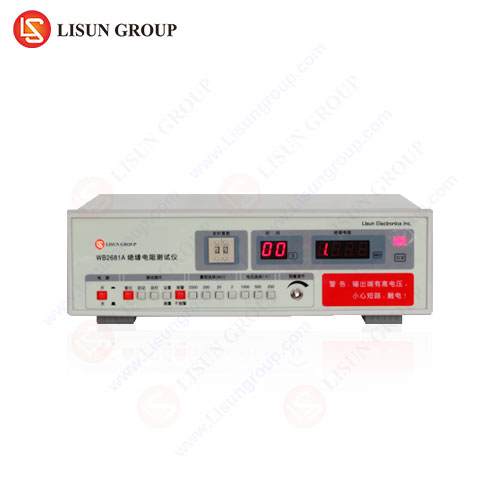
To meet the rigorous and varied demands of modern manufacturing and quality assurance, test equipment must offer precision, reliability, and operational safety. The LISUN WB2671A Withstand Voltage Tester exemplifies an engineered solution designed for this purpose. It is a microprocessor-controlled instrument integrating a high-voltage transformer, a precision measurement circuit, and comprehensive safety interlocks into a single benchtop unit.
The core operational specifications of the WB2671A are engineered to cover a vast array of applications:
- Output Voltage Range: 0–5 kV AC (50/60 Hz) and 0–6 kV DC. This range comprehensively addresses the test requirements for the majority of home appliances, electrical components, and low-voltage equipment as per major international standards.
- Voltage Accuracy: ± (2% of reading + 5 V). High accuracy is paramount to ensure the applied stress is neither insufficient (compromising safety) nor excessive (potentially damaging good insulation).
- Current Measurement Range: 0–2 mA / 0–20 mA. The instrument provides two ranges to allow for high-resolution measurement of low leakage currents (critical for medical or sensitive electronics) and the detection of higher breakdown currents.
- Arc Detection Sensitivity: Adjustable. This feature is crucial for identifying partial discharges or micro-arcs that precede a full breakdown, often a sign of contaminated or degraded insulation.
- Test Timers: Programmable from 1–999 seconds, supporting both standard duration type tests and rapid production-line tests.
The testing principle employed by the WB2671A involves a closed-loop control system. The user sets the desired voltage, current limit, and test time. Upon initiation, the instrument ramps the output voltage to the setpoint at a controlled rate, holds it steadily for the duration, and continuously samples the leakage current. The measured current is compared against the failure threshold. If the threshold is exceeded at any point, the test is terminated immediately, the output is shut down safely, and a visual and audible alarm is activated. This rapid response protects the unit under test from further damage and alerts the operator.
Application Across Industrial Sectors
The utility of a precise withstand voltage tester like the WB2671A extends far beyond the final assembly line of a refrigerator or microwave. Its application is integral throughout the supply chain and across diverse industries.
- Household Appliances & Consumer Electronics: Final product verification for items like blenders, air conditioners, and televisions. Incoming inspection of critical sub-assemblies such as motors, heaters, and power supply units.
- Electrical Components: Testing the isolation integrity of switches, sockets, connectors, and circuit breakers. Verifying the insulation between contacts and the mounting frame.
- Cable and Wiring Systems: Performing routine tests on power cords, harnesses, and wiring assemblies to detect pinholes in insulation or faulty crimping.
- Lighting Fixtures: Ensuring safety in luminaires, particularly between the high-voltage LED driver circuitry and the accessible metal housing or heat sink.
- Industrial Control & Automotive Electronics: Validating the isolation of control transformers, relays, and sensors. Testing automotive components like EV charging modules, DC-DC converters, and infotainment systems for isolation robustness against load dumps and transients.
- Telecommunications & Office Equipment: Verifying insulation in power adapters, network equipment, and printers, ensuring user safety from mains voltage.
- Aerospace and Medical Devices: While these sectors often require even higher-specification equipment, instruments like the WB2671A serve vital roles in prototype validation and component-level screening, adhering to the foundational safety principles mandated in their respective stringent standards (e.g., DO-160 for aerospace, IEC 60601-1 for medical).
Operational Advantages in a Manufacturing Environment
In a production or quality lab context, the WB2671A provides several distinct advantages that translate to improved efficiency, reliability, and operator safety.
Enhanced Safety Protocols: The instrument incorporates hardware-based safety features including a zero-start interlock (preventing voltage output unless the controller is at zero), a high-voltage warning lamp, and secure terminal covers. These features mitigate the risk of operator exposure to hazardous voltages.
Testing Efficiency and Repeatability: Programmable voltage ramps, dwell times, and test sequences allow for the automation of complex test routines. This eliminates manual adjustment errors, ensures strict adherence to standard protocols, and significantly increases throughput on production lines. The digital display provides clear, unambiguous readouts of set parameters and measured values (voltage and current), facilitating reliable pass/fail judgments and data recording.
Diagnostic Precision: The adjustable current trip limits and arc detection function enable more than just binary pass/fail testing. They allow quality engineers to identify marginal products that, while not fully breaking down, exhibit higher-than-expected leakage. This can signal process drift, material contamination, or workmanship issues early, enabling corrective action before a major quality event occurs.
Data Integrity and Traceability: While a base model ensures compliance testing, the integration capability (common in such instrument families) for data logging and communication interfaces (RS232, USB, GPIB) supports quality management systems. Test results can be recorded, stored, and traced back to individual production batches, a requirement increasingly emphasized in audit trails for safety-critical components.
Mitigating Common Testing Pitfalls and Ensuring Accuracy
Even with advanced equipment, accurate withstand voltage testing requires meticulous attention to procedure. Common pitfalls include:
- Environmental Factors: High ambient humidity can lower the surface resistivity of insulation, leading to elevated leakage currents and false failures. Testing should be conducted in a controlled environment as stipulated by the standard.
- Grounding and Setup: Improper grounding of the test fixture or the unit under test can create unintended current paths, skewing measurements. The return lead of the tester must be securely connected to the accessible conductive parts of the device.
- Test Point Selection: Applying voltage between incorrect points (e.g., between two live parts that are normally connected) is a procedural error that fails to stress the intended insulation barrier. Test plans must be derived directly from the safety standard’s diagrams and requirements.
- Instrument Calibration: Regular metrological calibration against accredited standards is essential to maintain the declared accuracy of the voltage output and current measurement. An out-of-tolerance tester can erroneously pass unsafe products or fail good ones.
The design of the WB2671A, with its stable output, precise metrology, and clear interface, aids in mitigating these issues by providing operators with a reliable and consistent tool, reducing variability inherent in the test process.
Conclusion: A Foundational Pillar of Product Integrity
Dielectric withstand voltage testing remains an indispensable, irreplaceable assessment in the safety validation of any electrically powered product. For the home appliance industry, where products are entrusted for daily use in homes worldwide, its role is particularly acute. Implementing this test with equipment that offers precision, safety, and adaptability—such as the LISUN WB2671A Withstand Voltage Tester—is not merely a compliance exercise. It is a direct investment in brand integrity, consumer trust, and the fundamental ethical obligation to prevent harm. As appliance technology evolves with greater connectivity and smarter functionalities, the insulation systems may become more complex, but the imperative for rigorous dielectric verification will only intensify, solidifying its status as a foundational pillar of electrical safety engineering.
FAQ Section
Q1: What is the primary difference between AC and DC withstand voltage testing, and when should each be used?
AC withstand testing stresses insulation in a manner similar to operational power frequency stress and is generally the preferred method per most safety standards for final product testing. DC testing is typically used for highly capacitive loads (e.g., long power cables, large motors) where AC testing would cause excessive capacitive charging current, which could trip the tester incorrectly. DC testing is also common for field testing or for testing components like semiconductors that cannot tolerate AC.
Q2: How is the appropriate test voltage determined for a specific appliance?
The test voltage is strictly defined by the applicable safety standard (e.g., IEC 60335-1). It is primarily based on the appliance’s rated voltage, the type of insulation being tested (Basic, Supplementary, Reinforced), and whether it is a type test or a routine production test. The standard provides formulas and tables. For example, for Basic insulation at a rated voltage of 230V, a common type-test voltage is 1,250 V AC. The WB2671A’s voltage range is designed to easily cover these calculated values.
Q3: Can a product pass a withstand voltage test but still be unsafe?
Yes, a withstand voltage test is a single and specific stress test. It does not assess other critical safety aspects such as grounding continuity, temperature rise under load, mechanical strength, or resistance to heat and fire. It is one essential part of a comprehensive suite of safety tests required for full certification. A product with a poor earth bond could pass a hipot test but still present a severe shock hazard.
Q4: What does “arc detection” or “flashover detection” mean on a tester like the WB2671A, and why is it important?
Arc detection circuitry identifies sudden, brief spikes in current that indicate a partial discharge or flashover across the surface of insulation, even if the overall leakage current remains below the failure threshold. This can reveal contamination (dust, moisture), creepage path issues, or impending insulation failure that a standard current limit test might miss. It is a more sensitive diagnostic tool for quality control.
Q5: How often should a withstand voltage tester be calibrated?
Calibration frequency depends on usage intensity, environmental conditions, and quality system requirements (e.g., ISO 9001). A general industry practice is annual calibration by an accredited laboratory to ensure traceability to national standards. For high-volume production or critical applications, more frequent interval checks (e.g., quarterly) using a calibrated reference divider may be advisable. The WB2671A’s stability supports reliable performance between calibration cycles.
