







Electrical Insulation Testers: A Guide to Principles and Applications
Introduction to Insulation Integrity Assessment
The reliable operation of all electrical and electronic systems is fundamentally contingent upon the integrity of their insulation. Insulation materials, while not perfect conductors, possess a finite, and ideally very high, electrical resistance. This resistance prevents leakage currents, mitigates short-circuit risks, ensures user safety, and guarantees equipment longevity. Over time, insulation degrades due to thermal cycling, mechanical stress, environmental contamination (moisture, dust, chemicals), and electrical overstress. The quantitative measurement of this insulation resistance (IR) is therefore a critical predictive and preventative maintenance activity. Electrical insulation testers, also known as megohmmeters or meggers, are the specialized instruments designed for this precise purpose. They apply a known, often high, DC voltage to the insulation under test and measure the resultant leakage current, calculating and displaying the resistance, typically in the megohm (MΩ) or gigohm (GΩ) range. This non-destructive test provides a vital snapshot of insulation health, informing decisions on equipment commissioning, routine maintenance, and failure analysis.
Fundamental Electrophysical Principles of Insulation Testing
At its core, insulation testing evaluates the resistive property of dielectric materials. When a DC voltage is applied across an insulation barrier, the resulting current is not instantaneous or purely resistive. It comprises three distinct components, each with its own time-dependent characteristic. The initial capacitive charging current surges as the distributed capacitance of the system charges; this current decays rapidly to zero. The absorption current or dielectric absorption current, is a slower-decaying component resulting from the polarization of dielectric molecules within the insulation material. Finally, the conductive leakage current or conduction current, is the steady-state current that flows through and over the insulation due to actual conductive paths. It is this conductive current that is inversely proportional to the true insulation resistance (R = V / I_leakage).
The Dielectric Absorption Ratio (DAR) and Polarization Index (PI) are diagnostic metrics derived from timed resistance measurements that help isolate the absorption current effects from the conductive leakage. The DAR is the ratio of a 60-second reading to a 30-second reading, while the PI is the ratio of a 10-minute reading to a 1-minute reading. A rising PI (typically >2.0) indicates healthy, dry insulation with good dielectric absorption, while a low PI (≈1.0) suggests moisture, contamination, or severe aging where conductive leakage dominates. Understanding these principles is essential for interpreting megger readings beyond a simple pass/fail threshold.
Instrumentation Architectures: From Analog to Advanced Digital Systems
Traditional analog insulation testers utilized hand-cranked or motor-driven DC generators to produce test voltages, with a moving-coil ohmmeter for display. Modern instruments are predominantly solid-state, employing switched-mode power supplies to generate precise, stable high-voltage DC from low-voltage sources. Key architectural components include a high-voltage DC generator, a precision current measurement circuit capable of resolving nanoampere-level leakage currents, a microprocessor for control and calculation, and robust safety circuits for operator and device protection.
Digital architectures enable advanced features such as programmable test voltage ramps, automatic calculation of DAR/PI, continuous data logging, and the implementation of guard terminals. The guard terminal is a critical innovation for eliminating surface leakage errors. It works by providing a parallel, low-resistance path for surface currents traveling across contaminated insulator housings, ensuring that the measured current at the main terminal is solely the volume leakage current through the insulation itself. This is indispensable for accurate testing of components like multi-conductor cables or bushings.
Standards and Compliance Frameworks Governing Insulation Testing
Insulation testing procedures and acceptable resistance values are not arbitrary; they are codified in numerous international and industry-specific standards. These standards define test voltages, minimum resistance thresholds, environmental conditions, and methodologies. Key standards include:
- IEC 60204-1: Safety of machinery – Electrical equipment of machines. Specifies insulation resistance tests for electrical equipment.
- IEC 60335-1: Household and similar electrical appliances – Safety.
- IEC 60601-1: Medical electrical equipment.
- IEEE 43: Recommended Practice for Testing Insulation Resistance of Rotating Machinery.
- NFPA 70B: Recommended Practice for Electrical Equipment Maintenance.
- MIL-STD-202: Test Methods for Electronic and Electrical Component Parts.
Compliance with these standards is mandatory for manufacturers in relevant sectors to achieve CE, UL, or other certifications. For maintenance personnel, they provide a benchmark for determining whether insulation resistance values indicate a hazardous or degraded condition. For instance, IEEE 43 recommends a minimum IR of (Rated Voltage in V / 1000) + 1 MΩ for armature windings, and a PI of 2.0 or greater for most machine insulation classes.
The WB2681A Insulation Resistance Tester: A Technical Examination
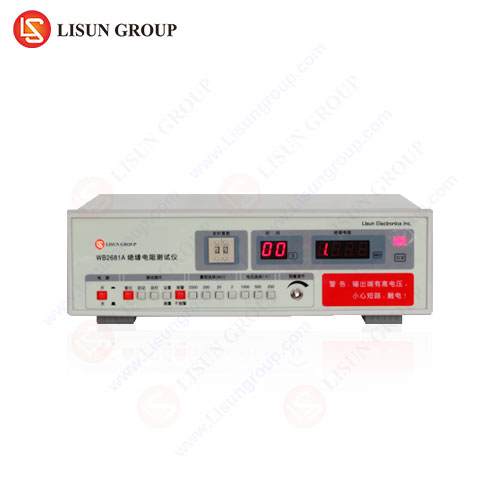
The LISUN WB2681A exemplifies the application of the aforementioned principles in a modern, fully-featured insulation resistance tester. Designed for laboratory, production line, and field service applications, it integrates precision measurement with robust safety features.
Core Specifications and Testing Principles:
The WB2681A generates six selectable DC test voltages: 250V, 500V, 1000V, 2500V, 5000V, and 10000V, allowing it to conform to a wide range of standards based on equipment voltage ratings. Its measurement range extends from 0.01 MΩ to 100 TΩ (10^14 Ω), capable of characterizing both marginally degraded and exceptionally high-quality insulation. The instrument employs a constant-voltage test methodology, maintaining the selected voltage within a tight tolerance regardless of load variations, ensuring consistent and comparable readings. It features automatic calculation of Polarization Index (PI) and Dielectric Absorption Ratio (DAR), with programmable test timers to facilitate these standardized diagnostic routines. A built-in discharge circuit safely dissipates stored capacitive energy from the device under test after measurement is complete.
Industry Use Cases and Application Scenarios:
The WB2681A’s versatility makes it suitable for diverse sectors:
- Electrical Components & Cable Systems: Verifying insulation integrity in switches, sockets, terminal blocks, and complete wiring harnesses. Its guard terminal is crucial for testing multi-core cables.
- Household Appliances & Consumer Electronics: Production-line safety testing of motors, heaters, and internal wiring in devices like refrigerators, washing machines, and power supplies.
- Automotive Electronics: Testing high-voltage insulation in electric vehicle battery packs, traction motors, and charging systems, where 5000V testing may be specified.
- Industrial Control Systems & Telecommunications: Assessing insulation in motor windings, transformers, PLCs, and backplane assemblies in control cabinets and telecom racks.
- Lighting Fixtures: Safety testing of insulation between live parts and the chassis in high-power LED drivers and commercial lighting systems.
- Medical Devices & Aerospace: High-reliability testing of sensitive instrumentation, where even minute leakage currents are unacceptable. The WB2681A’s high-resolution measurement is critical here.
Competitive Advantages in Operational Context:
The instrument’s advantages are realized in practical use. Its wide voltage and resistance range eliminate the need for multiple devices. The bright, graphical LCD displays not only numerical values but also real-time trending graphs of resistance over time, aiding in visual diagnosis of absorption characteristics. Enhanced safety is provided through features like live circuit detection, which prevents testing if a hazardous voltage is present, and a clear warning system for high voltage and stored charge. Its ruggedized design and calibration stability ensure reliability in both controlled laboratory environments and demanding field conditions, reducing measurement uncertainty and improving audit compliance.
Interpretive Analysis of Test Results and Diagnostic Thresholds
A raw megohm reading is of limited value without contextual interpretation. Acceptable insulation resistance is not a single value but a function of equipment type, size, temperature, humidity, and historical data. The “one-megohm rule” is an outdated and often dangerously simplistic guideline. Modern practice relies on trend analysis and standardized indices.
A time-resistance test yielding a high and steadily increasing resistance (good PI/DAR) indicates sound, dry insulation. A low and flat resistance profile suggests pervasive moisture or contamination. A initially high but then decreasing resistance can point to localized defects that break down under sustained voltage. For new equipment, results are compared against manufacturer specifications or industry standard minimums. For in-service equipment, the most powerful analysis comes from trending readings taken under similar conditions (e.g., corrected to 40°C) over time. A consistent, order-of-magnitude drop in IR is a definitive warning of impending failure, even if the absolute value remains above a generic minimum.
Advanced Testing Methodologies: Step Voltage and Ramp Testing
Beyond standard spot or timed tests, advanced methodologies provide deeper diagnostic insight, particularly for aging insulation. Step Voltage Testing involves applying increasing voltage steps (e.g., 0.5kV, 1kV, 2kV, 5kV) for a fixed duration at each step and plotting the measured insulation resistance. Healthy insulation will show a stable or slightly decreasing resistance curve. A sharp drop in resistance at a higher voltage step indicates a weakness or incipient crack that only breaks down under higher electrical stress.
Ramp Testing is a more sophisticated variant where the test voltage is increased linearly at a constant rate. The instrument monitors the leakage current. A linear increase in current with voltage is expected. Any non-linear, abrupt increase in current signifies insulation breakdown. These destructive tests (when pushed to failure) are invaluable for determining the dielectric strength margin of a material or for forensic analysis of a failure mode. Instruments like the WB2681A, with their programmable voltage outputs and high-speed logging, are capable of supporting such advanced test sequences.
Safety Protocols and Mitigation of Operational Hazards
Operating a high-voltage insulation tester entails significant risks, including electric shock from the tester output or from induced voltages in long cables, and arc-flash hazards from catastrophic insulation failure during test. Rigorous safety protocols are non-negotiable. These include: strict adherence to lock-out/tag-out (LOTO) procedures to ensure the equipment under test is isolated from all energy sources; verifying the absence of voltage with a properly rated voltage detector before connecting the tester; using personal protective equipment (PPE) suitable for the potential hazard level; ensuring all equipment grounds are properly connected; and being acutely aware of the capacitive energy storage in large systems, allowing the tester’s discharge cycle to complete fully before disconnecting leads. The tester itself must be independently certified to safety standards such as IEC 61010.
Integration into Predictive Maintenance and Quality Assurance Regimes
Insulation resistance testing is a cornerstone of both Condition-Based Maintenance (CBM) and Reliability-Centered Maintenance (RCM). Integrated into a scheduled maintenance program, it transforms electrical maintenance from reactive to predictive. In a manufacturing quality assurance context, 100% production line testing with instruments like the WB2681A provides a definitive pass/fail safety check before products leave the factory. Data logging capabilities allow for the storage of test results against serial numbers, creating an auditable quality record and enabling statistical process control (SPC) to identify subtle shifts in material quality or manufacturing processes. This data-driven approach minimizes warranty returns, prevents field failures, and substantiates compliance claims.
Frequently Asked Questions (FAQ)
Q1: What is the primary difference between using a multimeter’s resistance function and a dedicated insulation tester like the WB2681A?
A multimeter typically uses a very low test voltage (often <10V) to measure resistance. This is suitable for measuring conductive paths but is wholly inadequate for assessing insulation, as it cannot stress the dielectric material or overcome surface film resistances. An insulation tester applies a high DC voltage (250V to 10kV), which can reveal leakage paths that are invisible at low voltage, providing a true representation of the insulation's condition under operational stress.
Q2: How do I select the correct test voltage for a specific piece of equipment?
The test voltage is generally chosen based on the equipment’s rated operational voltage and the relevant standard. A common rule is to use a DC test voltage equal to or slightly higher than the peak AC operating voltage (e.g., 500V DC for 230/400V AC equipment, 1000V or 2500V DC for medium-voltage gear). Manufacturer instructions and applicable standards (IEC, IEEE, etc.) always take precedence. Using too high a voltage can overstress aged insulation, while too low a voltage may not reveal latent defects.
Q3: Why does the measured insulation resistance value often increase during a timed test, and what does this mean?
This increase is due to the dielectric absorption effect in healthy insulation. As the DC voltage is applied, the capacitive charging current quickly dissipates, and the slower polarization (absorption) current decays over minutes. The measured resistance, which is the voltage divided by the total current, therefore appears to rise as these transient currents diminish. A steady, significant rise (resulting in a high Polarization Index) is a strong indicator of dry, uncontaminated insulation.
Q4: The WB2681A features a “Guard” terminal. When and how should it be used?
The guard terminal should be used when you need to isolate the volume resistance of the primary insulation from surface leakage currents. A common application is testing a multi-conductor cable. By connecting the guard wire to the shielding or to the other conductors you are not currently testing, surface leakage currents along the cable jacket or between conductors are shunted away from the measurement circuit. This ensures the reading reflects only the insulation resistance between the conductor under test and ground, providing a more accurate assessment of the core insulation material.
Q5: What are the critical environmental factors that affect an insulation resistance measurement, and how should they be accounted for?
Temperature and humidity are the two most significant factors. Insulation resistance has a strong negative temperature coefficient; it decreases exponentially as temperature increases. Humidity, particularly condensation, creates surface leakage paths that can drastically lower readings. For accurate trend analysis, measurements should be taken under similar conditions (e.g., at normal operating temperature). Corrections can be applied using standard temperature coefficients (often a halving of IR per 10°C rise), and surface leakage can be mitigated by cleaning and drying surfaces or using the guard terminal. Always record ambient conditions alongside the resistance value.
