






Dielectric Withstand Voltage and Insulation Resistance: A Comparative Guide for Electrical Safety Compliance
Introduction to Fundamental Insulation Integrity Assessments
The assurance of electrical safety and long-term operational reliability in any electrotechnical system is fundamentally predicated on the integrity of its insulation. Among the suite of validation tests employed by manufacturers and certification bodies, Dielectric Withstand Voltage (DWV), also commonly termed Hipot (High Potential) testing, and Insulation Resistance (IR) testing constitute two cornerstone methodologies. While both are directed at evaluating insulation performance, their underlying principles, application objectives, and diagnostic outcomes are distinct and complementary. A comprehensive understanding of these differences is not merely academic; it is a practical necessity for engineers designing compliance strategies, quality assurance protocols, and predictive maintenance schedules across diverse industries. This guide provides a detailed comparative analysis of DWV and IR testing, elucidating their respective roles in a holistic electrical safety regimen.
Theoretical Underpinnings: Voltage Stress Versus Resistive Leakage
At its core, the distinction between DWV and IR testing resides in the electrical property being interrogated and the nature of the applied stimulus.
Dielectric Withstand Voltage testing is a stress test of a pass/fail nature. It involves applying a significantly elevated AC or DC voltage—substantially higher than the equipment’s normal operating voltage—between live parts and accessible conductive parts (e.g., chassis, ground) for a specified duration. The primary objective is not measurement but the application of a severe but controlled overpotential to verify that the insulation can withstand transient overvoltages, such as those from switching surges or lightning-induced transients, without catastrophic breakdown. The test monitors for insulation failure, which is typically defined as a sudden, sustained flow of current (a “breakdown” or “flashover”) exceeding a predetermined threshold. It is a go/no-go test for dielectric strength and spacing adequacy.
Conversely, Insulation Resistance testing is a diagnostic measurement performed at or moderately above the rated voltage, usually using a DC source. It quantifies the ohmic value of the insulation material itself by measuring the minute leakage current that flows through and over its surface. The result, expressed in megohms (MΩ) or gigohms (GΩ), is a direct indicator of the insulation’s quality, cleanliness, dryness, and degradation state. A low or declining IR value signals contamination (dust, moisture), aging, thermal degradation, or physical damage, serving as an early warning of potential future failure under normal operating conditions.
Operational Parameters and Standardized Test Regimes
The execution of these tests is governed by stringent international and regional standards, which define voltage levels, application times, and pass/fail criteria. Standards such as IEC 60335 (household appliances), IEC 60601 (medical devices), IEC 60950/62368 (IT/AV equipment), and UL standards provide the normative framework.
For Dielectric Withstand Voltage, the test voltage is typically calculated as a multiple of the working voltage plus a fixed offset. For example, a common requirement for basic insulation in mains-powered equipment is 1000 VAC + (2 × working voltage), applied for 60 seconds. The leakage current trip limit is equally critical, often set in the range of 3 mA to 10 mA for most equipment classes, though medical devices impose far stricter limits (e.g., 100-500 µA) due to patient safety considerations. The test can be performed with AC or DC voltage; AC testing is more severe for most applications as it stresses the insulation cyclically and can reveal weaknesses related to capacitive effects and peak voltages.
Insulation Resistance testing parameters are generally less aggressive. A standard DC test voltage of 500 V is common for equipment rated up to 500 VAC, while 1000 V or 2500 V may be used for higher-voltage systems. The test is usually applied for a shorter period, such as 60 seconds, with the resistance value recorded at the end of this period to allow for capacitive charging currents to dissipate (the “dielectric absorption” effect). Acceptance criteria are minimum resistance values, often specified as >1 MΩ, >2 MΩ, or higher, depending on the standard and application. Trends over time are frequently more valuable than a single absolute measurement.
Comparative Diagnostic Outcomes and Industry Applications
The complementary nature of DWV and IR testing becomes evident when examining their diagnostic outputs and preferred industry use cases.
DWV is the definitive test for safety certification and production line screening. Its ability to detect gross defects—such as insufficient creepage/clearance distances, pinched wires, compromised insulation barriers, or solder splashes—is unparalleled. It is a mandatory test for type approval and is commonly used as a 100% production line test for final assembled products. For instance, in Automotive Electronics (e.g., EV battery packs, motor controllers), a DWV test ensures high-voltage components are isolated from the vehicle chassis. In Medical Devices, it verifies that no hazardous leakage current can reach the patient. For Lighting Fixtures and Household Appliances, it confirms user safety against electric shock under fault conditions.
IR testing serves as a powerful tool for predictive maintenance, quality control of materials, and troubleshooting. It is indispensable for assessing the condition of insulation in field-deployed equipment or long-lead components. In Industrial Control Systems and Telecommunications Equipment, periodic IR testing of motor windings, transformers, and backplane wiring can forecast failures before they cause downtime. For Cable and Wiring Systems, it is a fundamental acceptance test to verify the integrity of the insulation extrusion process. In the manufacture of Electrical Components like switches and sockets, IR testing of the molded insulating body ensures material purity and proper curing.
Integrating Advanced Testing: The Role of the LISUN WB2671A Withstand Voltage Tester
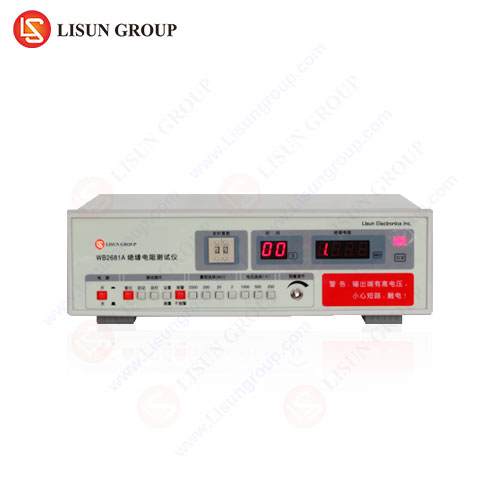
The practical implementation of rigorous DWV testing demands instrumentation that combines precision, safety, and operational efficiency. The LISUN WB2671A Withstand Voltage Tester exemplifies this class of equipment, engineered to meet the exacting requirements of modern compliance laboratories and high-throughput production environments.
The WB2671A operates on the core principle of applying a user-defined, stabilized high voltage while continuously monitoring the resultant leakage current with high resolution. Its microcontroller-based feedback system ensures voltage output accuracy, typically within ±3%, even under varying load conditions. The instrument is designed to comply with the essential safety and performance criteria outlined in standards like IEC 61010.
Specifications and Functional Capabilities:
- Test Voltage Range: 0–5 kV AC (50/60 Hz) and 0–6 kV DC, covering the vast majority of commercial and industrial equipment testing requirements.
- Voltage Regulation: ≤ 3%, ensuring consistent stress application.
- Leakage Current Measurement: Ranges from 0.1 mA to 20 mA, with a resolution of 0.1 mA. This granularity allows for precise trip point setting, crucial for sensitive applications like Medical Devices or Aerospace and Aviation Components where leakage must be minimized.
- Timing Function: Programmable test duration from 1–99 seconds, with automatic ramp-up and decay.
- Output Waveform Distortion: ≤ 5%, guaranteeing a clean sinusoidal AC output free from harmonics that could cause erroneous stress or measurement.
Industry Use Cases and Competitive Advantages:
In a Consumer Electronics or Office Equipment factory, the WB2671A’s rapid test cycle and reliable pass/fail judgment enable 100% production line testing without becoming a bottleneck. For an Electrical and Electronic Equipment certification lab, its accuracy and programmability facilitate repeatable testing per multiple international standards. A service center for Industrial Control Systems can utilize its DC withstand function to safely test aged equipment without the risk of capacitive inrush currents that an AC test might impose on large systems.
The competitive advantages of the WB2671A lie in its synthesis of robustness and precision. Its arc detection circuitry can differentiate between a true breakdown and a harmless transient discharge (e.g., from dust), reducing false failures. The inclusion of both AC and DC withstand functions in a single unit provides exceptional versatility, allowing engineers to select the most appropriate stress mode—DC for capacitive loads or to test without magnetizing transformers, AC for a more comprehensive stress test. The intuitive interface with clear fault indicators (visual and audible alarms) minimizes operator error, while its robust construction ensures longevity in demanding industrial environments.
Synthesizing a Comprehensive Insulation Evaluation Strategy
A robust electrical safety program does not choose between DWV and IR testing; it strategically employs both. A recommended integrated approach involves:
- Design & Type Approval Phase: Perform comprehensive DWV testing at the limits specified by relevant safety standards to validate the design’s dielectric strength. Concurrently, establish baseline IR measurements for critical subassemblies.
- Incoming Quality Control (IQC): Use IR testing to verify the quality of insulating materials, components (transformers, motors), and Cable and Wiring Systems before they enter production.
- Production Line Testing: Implement 100% DWV testing as a final safety check on every assembled unit to catch any manufacturing defects. A quick IR test may be added for critical products.
- Field Maintenance & Reliability Engineering: Conduct periodic IR testing on installed equipment in Telecommunications, Aerospace, and power distribution systems. Trend the data over time. A significant drop in IR value triggers further investigation and potentially a follow-up, cautious DWV test to assess remaining strength.
This stratified approach leverages the strength of DWV as a definitive safety verdict and the prognostic power of IR as a leading indicator of insulation health.
Conclusion
Dielectric Withstand Voltage and Insulation Resistance testing are symbiotic pillars of electrical safety evaluation. The former acts as the ultimate proof test, a simulated stress event confirming the margin of safety against catastrophic failure. The latter serves as a diagnostic health monitor, revealing the gradual degradation that precedes such failure. For engineers, quality professionals, and safety certifiers across sectors—from Medical Devices to Automotive Electronics—mastery of both methodologies, and the deployment of capable instrumentation like the LISUN WB2671A, is essential for delivering products that are not only compliant but inherently safe and reliable throughout their operational lifecycle.
FAQ Section
Q1: When should I use AC Dielectric Withstand Voltage testing versus DC?
AC testing is generally preferred for final product testing as it stresses insulation more comprehensively due to the cyclical voltage reversal, which tests both polarities and can reveal issues related to peak voltage and capacitive coupling. DC testing is advantageous for testing highly capacitive loads (like long cables or power supplies with large filter capacitors) as it avoids high charging currents, and it is often used for field testing of existing installations where the test equipment must be smaller and lighter.
Q2: Can a product pass a DWV test but still have poor insulation resistance?
Yes, this is a critical distinction. A DWV test applies a high voltage for a short time. Insulation that is degraded but not yet completely broken down may withstand this brief stress. However, its reduced material integrity will manifest as a low IR value under a lower, sustained voltage. The poor IR indicates the insulation is deteriorating and may fail in the future under normal operating conditions or a surge.
Q3: What are the key safety precautions when operating a withstand voltage tester like the WB2671A?
Primary precautions include: ensuring the Device Under Test (DUT) is properly isolated and all personnel are clear before initiating a test; using the instrument’s safety interlock features if equipped; securely grounding the test fixture and DUT chassis; and following a strict lock-out/tag-out procedure for production jigs. The high voltages involved can be lethal.
Q4: How do I set the appropriate leakage current trip limit on the WB2671A for my product?
The trip limit is not arbitrary; it is typically defined by the safety standard applicable to your product. For example, IEC 60601-1 for medical equipment specifies very low patient leakage currents. You must consult the relevant standard (e.g., IEC 60335, UL 60950-1) for the prescribed limit based on your product’s classification, rating, and application. The instrument’s fine resolution allows you to set this limit accurately.
Q5: Why is the output waveform purity (low distortion) of a Hipot tester important?
A distorted AC waveform contains harmonics (higher frequency components). These harmonics can cause disproportionately high leakage currents through capacitive elements in the DUT, leading to a false failure indication. A pure sinusoidal output, as specified for the WB2671A, ensures the voltage stress is applied as intended by the standard, yielding a true and repeatable test result.
