







Compliance Testing for Electrical Safety: Stand Voltage Verification per IEC 60335
Electrical safety is a non-negotiable cornerstone of product design and manufacturing across a vast spectrum of industries. The integrity of insulation systems, which prevent hazardous live parts from becoming accessible to users or from causing short circuits, is paramount. Among the suite of verification tests mandated by international safety standards, the dielectric strength test, commonly referred to as the withstand voltage test or high-potential (hipot) test, stands as a critical and definitive assessment. This article provides a detailed technical examination of withstand voltage testing as specified within the IEC 60335 series of standards for household and similar electrical appliances, elucidating its principles, methodologies, and implementation using advanced instrumentation such as the LISUN WB2671A Withstand Voltage Tester.
Fundamental Principles of Dielectric Strength Testing
The core objective of a withstand voltage test is to verify that the electrical insulation of a product or component can safely endure transient overvoltages that may occur during its operational lifetime without breakdown. These overvoltages can arise from switching events, lightning-induced surges, or faults in the supply network. The test does not assess the insulation’s long-term durability under normal operating voltage—a function of other tests like insulation resistance measurement—but rather its margin of safety against exceptional stress.
The test is performed by applying a significantly higher AC or DC voltage than the rated operating voltage between live parts and accessible conductive parts (e.g., metal enclosures, accessible screws). For a defined test duration, typically measured in seconds, the insulation must not break down. Breakdown is indicated by a sudden, uncontrolled increase in current flow (leakage current) through or across the insulation material. The applied test voltage and its nature (AC or DC) are meticulously prescribed within standards like IEC 60335-1, the general safety requirements for household appliances, with specific values detailed in subsequent part-2 standards for particular appliance types.
IEC 60335-1: Specific Requirements for Test Voltage and Methodology
IEC 60335-1, Clause 16, “Dielectric strength,” provides the authoritative framework. The standard stipulates that the test voltage is applied for 1 minute, or for 5 seconds if a production line test is conducted with increased voltage. The value of the test voltage depends on the working voltage of the appliance and the type of insulation being tested.
For basic insulation and supplementary insulation, the test voltage is generally calculated as (1000 V + 2 working voltage). For reinforced insulation and double insulation, which provide a higher degree of protection, the required test voltage is doubled: (2000 V + 4 working voltage). It is critical to note that the “working voltage” considered is the highest voltage that may occur across the insulation under normal operating conditions or single-fault conditions, which can be higher than the nominal supply voltage.
The standard further specifies that the test voltage source must have a capacity such that when the output is short-circuited, the output current is at least 200 mA. The over-current relay, which terminates the test upon detecting a breakdown, must be set to trip at a current value typically between 100 mA and 200 mA for most appliance testing. This ensures the test is severe enough to detect weak insulation but not so severe as to cause damage from capacitive inrush currents, which are particularly relevant for switch-mode power supplies and large motors.
Instrumentation for Precision Compliance: The LISUN WB2671A Withstand Voltage Tester
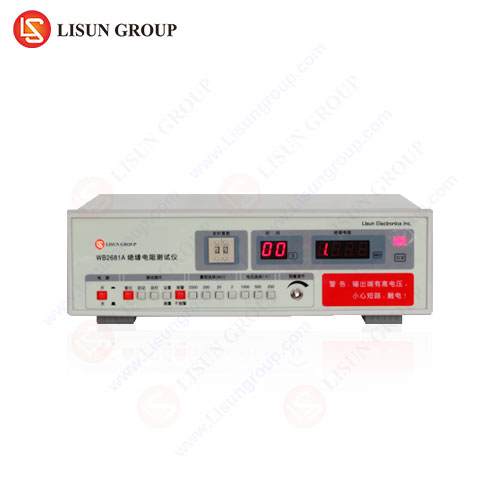
Accurate, reliable, and safe execution of the withstand voltage test necessitates specialized equipment. The LISUN WB2671A Withstand Voltage Tester is engineered to meet and exceed the stringent requirements of IEC 60335 and analogous standards (e.g., UL, CSA, GB). Its design incorporates the precise control, measurement, and safety features necessary for both laboratory type-testing and high-throughput production line verification.
Key Specifications and Operational Principles:
The WB2671A generates a programmable high-voltage AC output, typically ranging from 0 to 5 kV or 0 to 20 kV, with a frequency of 50/60 Hz, aligning with standard power network frequencies. Its output power rating ensures compliance with the minimum 200 mA short-circuit current requirement. The instrument’s core functionality revolves around three interrelated parameters: the preset test voltage (Vset), the actual output voltage (Vout), and the real-time leakage current (Ileak).
During a test cycle, the unit ramps the voltage from zero to the preset value at a user-defined rate, holds it for the set duration, and then ramps down. The integrated microcontroller continuously monitors the leakage current. If Ileak exceeds the user-defined cutoff limit (set between 0.1 mA and 200 mA, as appropriate for the Device Under Test – DUT), the tester immediately cuts off the high voltage, registers a FAIL, and records the breakdown voltage and current. A PASS result is logged only if the insulation sustains the full voltage for the entire duration without triggering the cutoff.
Advanced Features for Enhanced Testing Integrity:
Beyond basic functionality, the WB2671A incorporates features critical for modern compliance workflows. Arc detection algorithms can identify intermittent breakdowns (arcing) that may not sustain a current above the main cutoff but still indicate insulation weakness. Programmable test sequences allow for automated testing of multiple voltage points or insulation points in a single fixture. RS232, USB, and LAN interfaces facilitate integration into factory automation systems and direct data logging for quality traceability, a requirement in regulated industries like medical devices and automotive electronics.
Industry-Specific Application Contexts and Test Considerations
The universal principle of dielectric strength testing is applied with nuanced considerations across different sectors, all of which can utilize instrumentation like the WB2671A.
- Household Appliances & Consumer Electronics: Testing a food mixer involves applying high voltage between the mains input and its metal housing. For a Class II (double-insulated) hair dryer, the test voltage is applied between live parts and the accessible plastic surface, often using a metal foil electrode to simulate user contact.
- Automotive Electronics: While governed by ISO 16750 and LV standards, the principle remains. Components like engine control units (ECUs) must withstand surges. Testing often uses DC hipot to simulate battery system transients, a mode also supported by advanced testers.
- Lighting Fixtures (IEC 60598): For LED drivers, the test is applied between primary and secondary circuits (reinforced insulation) and between primary circuits and the metal chassis. The capacitive nature of LED drivers requires a tester with sufficient current capacity to charge the capacitance without false tripping.
- Medical Devices (IEC 60601-1): Requirements are exceptionally stringent. “Patient protection” necessitates very low leakage current limits. Withstand voltage tests for a dialysis machine’s internal power supply would use voltages derived from its working voltage, with meticulous attention to the application of test probes to all relevant insulation barriers.
- Industrial Control Systems & Telecommunications Equipment: Printed circuit board assemblies (PCBAs) for PLCs or servers undergo “flash testing” at the end of production lines. Here, a 5-second test at a higher voltage (e.g., 150% of the 1-minute test voltage) is common, demanding a fast-ramping, reliable tester like the WB2671A to maintain throughput.
- Aerospace and Aviation Components (e.g., DO-160): Environmental stresses like humidity and altitude are factored into test conditions. Insulation must withstand specified voltages under low-pressure conditions, simulating high-altitude operation.
- Electrical Components and Cable Systems: A simple mains socket is tested between its contacts and mounting ears. Cable assemblies are tested conductor-to-conductor and conductor-to-shield. The high volume of such tests demands robust, automated handling systems integrated with the voltage tester.
Mitigating Common Testing Pitfalls and Ensuring Result Validity
Erroneous test results carry significant risk—either passing a faulty product (a safety hazard) or failing a good one (costly scrap). Key pitfalls include:
- Incorrect Test Point Selection: Failing to test every relevant insulation barrier as per the standard’s constructional requirements. A comprehensive test plan based on the appliance’s schematic and construction is essential.
- Improper Cutoff Current Setting: Setting the trip current too low may cause failures due to harmless capacitive charging currents, especially in large motors or devices with EMI filters. Setting it too high may miss partial breakdowns. Analysis of the DUT’s typical leakage profile is necessary.
- Grounding Errors: The non-tested side of the insulation must be properly connected to ground or the tester’s return terminal. Floating potentials can lead to inaccurate readings and safety risks.
- Environmental Factors: Conducting tests in high-humidity environments can cause surface tracking along plastics, yielding a false failure. Tests should be performed under controlled conditions as specified in the standard (e.g., after humidity treatment in a climate chamber for some tests).
The WB2671A aids in mitigating these issues through features like real-time leakage current display (allowing observation of stable vs. rising current), programmable soft-start ramp times to safely charge capacitive loads, and robust, shielded test leads to minimize environmental interference.
Integration into a Holistic Safety Verification Regime
It is imperative to recognize that the withstand voltage test is one element of a comprehensive safety assessment. It is typically preceded by visual inspections and insulation resistance tests. A failure in the hipot test is a definitive indicator of a catastrophic insulation fault. However, a pass does not, in isolation, guarantee long-term safety. It must be correlated with results from earth bond continuity tests (for Class I appliances), temperature rise tests, and abnormal operation tests. Together, this suite of evaluations provides a multi-faceted validation of the product’s electrical safety, ensuring compliance not only with IEC 60335 but with the fundamental duty of care owed to the end-user.
FAQ: Withstand Voltage Testing and the LISUN WB2671A
Q1: Can the LISUN WB2671A perform both AC and DC withstand voltage tests?
While the standard WB2671A model is configured for AC withstand voltage testing per the primary requirements of IEC 60335-1, many of LISUN’s withstand voltage test systems offer combined AC/DC output or are available in dedicated DC versions. The choice depends on the specific standards applicable to the device under test (e.g., DC testing is prevalent in automotive and telecoms for DC-rated components).
Q2: How do we determine the correct cutoff current for testing a switch-mode power supply (SMPS) with significant Y-capacitance?
The Y-capacitors between primary and secondary sides create a predictable capacitive leakage current (I = 2πfCV). First, calculate this expected current based on the capacitance value and test frequency. The cutoff current should be set to a value higher than this calculated steady-state current but lower than the standard’s maximum permissible trip current (e.g., 100 mA). The WB2671A allows precise setting within this range and its real-time current display can be used to verify the stable capacitive current before setting the final limit.
Q3: Is it safe to perform a production-line hipot test on a completed appliance?
Yes, when performed correctly. The test is non-destructive for sound insulation. Key safety precautions include: ensuring the DUT is properly isolated on a non-conductive surface, using an interlocked safety test fixture, employing high-voltage warning lights, and ensuring the tester is equipped with a zero-start interlock (voltage only rises after the test lead is connected). The WB2671A incorporates multiple hardware and software safety interlocks to protect the operator.
Q4: What is the significance of the “ramp time” setting on the tester?
The ramp time (the time taken to rise from 0V to the full test voltage) is crucial for testing capacitive loads. An instantaneous application of high voltage can cause an inrush current that may trip the cutoff relay, causing a false failure. A slower ramp time (e.g., 2-5 seconds) allows the capacitive load to charge gradually. The WB2671A offers programmable ramp times to accommodate different DUT characteristics.
Q5: How does the WB2671A support quality traceability for audits?
The instrument can store test results (PASS/FAIL, actual test voltage, maximum leakage current, etc.) internally. Via its communication interfaces (USB, RS232, LAN), these results can be output in real-time to a host computer or Manufacturing Execution System (MES). This creates a digital record for each unit tested, which is essential for compliance with quality management standards (ISO 9001) and regulatory audits in sectors like medical devices and automotive.
