








Methodological Rigor in Evaluating Insulation Integrity and Leakage Current
The assurance of electrical safety constitutes a non-negotiable pillar in the design, manufacture, and certification of virtually all electrically powered and electronic devices. Within this domain, the accurate measurement of leakage current stands as a critical diagnostic procedure, serving as a primary indicator of insulation performance, grounding efficacy, and overall product safety. Compliance testing for leakage current is not merely a regulatory hurdle but a fundamental engineering practice that mitigates risks of electric shock, fire hazard, and equipment malfunction. This article delineates the technical principles, standardized methodologies, and instrumental requirements for rigorous leakage current testing, with a specific examination of advanced instrumentation such as the LISUN WB2675D Leakage Current Tester.
Fundamental Principles of Leakage Current and Insulation Failure
Leakage current, in its most essential definition, refers to any unintended flow of electrical current from a live conductive part to accessible conductive parts or to earth under normal operating conditions. This current manifests through multiple parallel paths, each with distinct characteristics and implications. Capacitive leakage arises from the inherent capacitance between live parts and earthed metal enclosures or between primary and secondary circuits in transformers; it is often frequency-dependent and may be present even in perfectly insulated systems. Resistive leakage is a more direct consequence of insulation degradation, representing current flowing through compromised dielectric materials due to moisture ingress, contamination, thermal aging, or physical damage.
The physiological impact of leakage current on the human body is a primary safety concern. Currents as low as 0.5 milliamperes (mA) AC can be perceptible, while currents exceeding 10 mA can induce muscular tetany, preventing voluntary release from a conductive source. Ventricular fibrillation, a potentially fatal cardiac arrhythmia, can be triggered by currents in the range of 30-100 mA traversing the thorax. Consequently, international safety standards establish stringent permissible leakage limits, typically categorized as Earth Leakage Current (flowing through the protective earth conductor), Touch Current (accessible part to earth, with the earth connection open), and Patient Leakage Current (in medical applications, from applied parts to earth). Accurate measurement requires instrumentation that can simulate the human body’s frequency-dependent impedance, as defined by networks such as the standardized 1.5 kΩ resistor paralleled with a 0.22 µF capacitor for touch current measurements.
Regulatory Frameworks and Standardized Testing Protocols
Compliance is governed by a complex matrix of international, regional, and product-specific standards. Key foundational documents include IEC 62353 for medical electrical equipment, IEC 60990 for touch current and protective conductor current measurement methods, and IEC 60335-1 for household and similar electrical appliances. Derivative standards such as UL 60950-1 (ICT equipment), ANSI/AAMI ES60601-1 (medical devices), and AS/NZS 62368.1 (audio/video, information, and communication technology equipment) provide product-family-specific implementations. These standards prescribe not only the maximum allowable leakage current values—which vary based on equipment class (I, II, or III), type of current (AC, DC, or composite), and application environment—but also the precise measurement circuits, power supply conditions (110% of rated voltage is commonly specified), and operational modes of the equipment under test (EUT).
A critical testing protocol involves the application of the “reverse line polarity” test. This procedure entails measuring leakage current with both normal and reversed connections of the live (L) and neutral (N) supply conductors. This reversal accounts for potential asymmetries in the insulation system or filtering components within the EUT, which could result in different leakage values depending on the instantaneous polarity of the supply voltage. Comprehensive testing also mandates evaluations under both normal conditions and after a single fault condition, such as the interruption of the neutral conductor or the failure of a single protective component, to verify that safety is maintained even in a degraded state.
Instrumentation Requirements for Accredited Compliance Testing
The fidelity of leakage current measurements is wholly dependent on the precision and compliance of the test instrumentation. A dedicated leakage current tester must integrate several core functionalities beyond a simple ammeter. It must incorporate the standardized measuring device (MD) network as per IEC 60990 to accurately weight the frequency components of the current according to their physiological risk. The instrument must provide a stable, adjustable, and metrologically sound source of test voltage, capable of delivering 110% of the rated voltage of the EUT without sag. Internal switching for line polarity reversal must be seamless and reliable.
High input impedance and guarded measurement circuits are essential to prevent the instrument itself from loading the measurement and introducing error. Furthermore, the tester must offer multiple measurement modes: differential measurement for protective conductor current, direct measurement for touch current with the MD network, and often, selectable measurement ranges from microamperes to milliamperes with appropriate resolution. For modern switched-mode power supplies and variable-speed drives, which generate high-frequency leakage currents, the instrument’s bandwidth must extend sufficiently to capture these spectral components without attenuation, as stipulated by standards which may require measurement up to 1 MHz or higher.
Operational Analysis of the LISUN WB2675D Leakage Current Tester
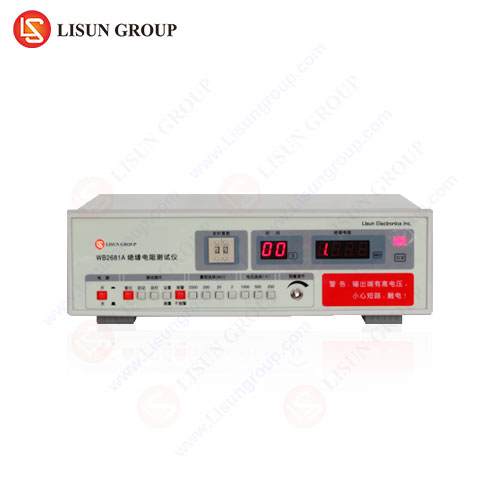
The LISUN WB2675D exemplifies a modern, fully integrated apparatus designed to meet and exceed the requirements for comprehensive leakage current and electrical safety testing. Its design philosophy centers on accuracy, operational efficiency, and adaptability across diverse industrial sectors.
Core Specifications and Testing Principles: The WB2675D features a wide measurement range from 0.001 mA to 20 mA AC/DC, with a basic accuracy of ±(1.5% + 5 digits). It integrates the complete array of measurement networks defined in IEC 60990, including the touch current network, and automatically applies the correct weighting for each selected test mode (Earth, Touch, Case, etc.). Its test voltage output is programmable from 0 to 300V AC/DC, with precise regulation to maintain the required 110% overvoltage condition. A key operational principle is its use of a high-precision, true RMS sensing circuit coupled with a digital signal processor (DSP), ensuring accurate measurement of non-sinusoidal leakage waveforms common in equipment employing rectifiers and high-frequency switching.
Industry-Specific Application Scenarios:
- Medical Devices & IEC 62353: The tester automates the sequence for Type B, BF, and CF applied parts, measuring patient leakage under normal and single-fault conditions, which is paramount for patient safety.
- Household Appliances & IEC 60335-1: It performs automated polarity reversal and measures touch current on the metallic housings of washing machines, refrigerators, and electric kettles after humidity treatment.
- Automotive Electronics & ISO 6469-3: For on-board chargers or high-voltage components in electric vehicles, it validates isolation resistance and functional current under DC bias.
- Lighting Fixtures & IEC 60598: It assesses leakage from LED drivers and the accessible metal parts of luminaires, particularly in Class I fixtures.
- Industrial Control Systems: The instrument evaluates PLCs, motor drives, and sensors for leakage that could cause nuisance tripping of ground-fault circuit interrupters (GFCIs) or pose a shock hazard in control cabinets.
- Telecommunications & ICT Equipment: It verifies compliance with SELV (Safety Extra-Low Voltage) limits and limits on telecommunication network voltage (TNV) circuits as per IEC 62368-1.
Competitive Advantages in Verification Workflows: The WB2675D distinguishes itself through integrated automation and data integrity features. Its programmable test sequences allow users to define multi-step tests (e.g., apply voltage, reverse polarity, measure, compare to limit) which are executed consistently, eliminating operator variance. The large LCD display presents not only the measured value but also the selected network, voltage, and a clear PASS/FAIL indication against a user-defined limit. Data logging and RS-232/GPIB/USB interfaces facilitate direct connection to factory quality management systems, enabling traceability and statistical process control. Its robust internal protection circuits guard against damage from accidental application of high voltage to the measurement terminals, a common risk in production test environments.
Integration of Testing within Product Development and Production Lifecycles
Effective safety compliance is not an endpoint inspection but a process integrated throughout the product lifecycle. During the design and prototyping phase, preliminary leakage current measurements using an instrument like the WB2675D identify insulation weaknesses, inform component selection (e.g., Y-capacitors in EMI filters), and validate grounding strategies. In the design verification and type approval stage, comprehensive testing against all applicable clauses of the relevant standard is conducted to support certification by a Nationally Recognized Testing Laboratory (NRTL).
Within mass production, 100% final testing or high-frequency sampling using automated test stations anchored by a precision leakage current tester is critical. This ensures that manufacturing variances—such as inconsistencies in potting compounds, cable crimping, or solder flux contamination—do not result in non-compliant units reaching the market. For products in the field, periodic safety testing as part of preventive maintenance, especially for medical and industrial equipment, relies on portable yet accurate testers to verify ongoing safety.
Interpretation of Results and Mitigation of Excessive Leakage
A measured leakage current exceeding the permissible limit necessitates a structured diagnostic approach. The first step is to verify the test setup and instrument calibration. Subsequently, engineering analysis focuses on identifying the dominant leakage path. High capacitive leakage may indicate an overly aggressive EMI filter design; mitigation may involve reviewing the values and placement of Y-capacitors or improving board layout to reduce parasitic coupling. High resistive leakage points directly to insulation breakdown. Investigation may involve thermal imaging to locate hotspots, hipot testing to pinpoint weak spots, or material analysis to identify dielectric contamination or moisture absorption. Corrective actions range from redesigning creepage and clearance distances, specifying insulation materials with higher Comparative Tracking Index (CTI), to improving manufacturing cleanliness and sealing processes.
Future Trajectories in Safety Compliance and Measurement Technology
The evolution of electrical safety testing continues to be driven by technological advancement and regulatory harmonization. The increasing proliferation of wide-bandgap semiconductors (SiC, GaN) in power electronics results in switching frequencies in the MHz range, pushing the required measurement bandwidth for leakage current higher. The growth of renewable energy systems and energy storage introduces new testing scenarios involving DC leakage and DC residual current devices (RCDs). Furthermore, the integration of IoT connectivity into safety testers enables predictive maintenance of the test equipment itself, remote monitoring of production line test results, and real-time updates to test protocols in response to standard revisions. Instruments are evolving towards greater intelligence, with capabilities for waveform analysis of leakage current to diagnose specific failure modes, thereby transitioning from simple compliance checking to advanced diagnostic tools.
FAQ: Leakage Current Testing and the WB2675D Tester
Q1: What is the significance of using the 110% of rated voltage during leakage current testing?
Applying 110% of the rated voltage represents a standardized stress condition intended to simulate a worst-case supply scenario, such as a sustained overvoltage on the mains network. This ensures that the insulation system provides an adequate safety margin under abnormal but plausible operating conditions, not just under ideal nominal voltage.
Q2: Can the LISUN WB2675D be used for testing both Class I and Class II (double-insulated) equipment?
Yes, the WB2675D is designed for comprehensive testing of all equipment classes. For Class I equipment, earth leakage current is the primary measurement. For Class II equipment, which lacks a protective earth connection, the critical measurement is touch current (enclosure leakage), performed by placing the measuring network between any accessible conductive part and earth. The tester’s modes directly support these distinct test configurations.
Q3: Why does measured leakage current sometimes vary between the normal and reversed line polarity test positions?
This variation is typically due to asymmetries in the equipment’s internal circuitry. Common causes include the physical placement and inherent capacitance of an EMI filter’s Y-capacitors relative to the live and neutral lines, or asymmetries in transformer winding capacitances. The test standard requires measurement in both polarities, and the highest reading is compared to the limit to ensure safety regardless of how the plug is inserted into the outlet.
Q4: How often should a leakage current tester like the WB2675D be calibrated to maintain accreditation?
Calibration intervals are determined by the user’s quality system, accreditation body requirements (e.g., ISO/IEC 17025), and the instrument’s usage frequency and criticality. A typical interval for such precision safety test equipment in an active production or certification lab is 12 months. However, more frequent interim checks using a calibrated reference source are recommended to ensure ongoing measurement confidence.
Q5: In a production environment, what is the typical test time for a leakage current check using an automated system?
With an integrated tester like the WB2675D configured in an automated sequence, a complete leakage current test—including ramp-up to test voltage, stabilization, measurement in both polarities, and comparison to limits—can typically be executed in 5 to 15 seconds per unit. This speed is essential for maintaining throughput in high-volume manufacturing while ensuring 100% safety testing.
