






Dielectric Strength Verification: Principles, Standards, and the Role of Advanced Withstand Voltage Testing
Introduction to Dielectric Withstand Testing as a Critical Safety Protocol
Within the global manufacturing ecosystem for electrical and electronic goods, product safety and long-term reliability are non-negotiable imperatives. Among the most critical validation procedures employed to ensure these attributes is the dielectric withstand test, commonly known as the hipot (high-potential) or withstand voltage test. This non-destructive test serves as a primary defense against electric shock hazards and premature component failure by verifying the integrity of a product’s insulation system. The test subjects the insulation between live parts and accessible conductive parts—or between circuits of different potentials—to a significantly elevated voltage for a prescribed duration. A successful test outcome confirms that the insulation possesses sufficient dielectric strength to withstand not only normal operating voltages but also transient overvoltages that may occur during the product’s service life. Failure, indicated by an unacceptable leakage current or a complete dielectric breakdown (arc), identifies potentially catastrophic flaws such as inadequate creepage/clearance distances, insulation voids, contaminants, or manufacturing defects. As international safety standards evolve to address increasingly complex and miniaturized products, the precision, safety, and programmability of the test equipment itself become paramount. This article examines the technical underpinnings of dielectric withstand testing, explores its applications across diverse industries, and analyzes the capabilities of modern test instrumentation, with specific reference to the LISUN WB2671A Withstand Voltage Tester as a representative advanced solution.
Fundamental Electrophysical Principles Governing Insulation Evaluation
The dielectric withstand test is rooted in fundamental principles of electrostatics and materials science. Insulation materials are not perfect dielectrics; they possess a finite, though very high, electrical resistance. When a high voltage is applied across an insulating barrier, a small, measurable current, known as leakage current, will flow. This current comprises three primary components: capacitive charging current (Ic), which is instantaneous and decays rapidly; absorption current (Ia), related to dielectric polarization; and conduction or leakage current (Ir), which is steady-state and most critical for safety evaluation. It is this steady-state conduction current that the test instrument monitors.
The applied test voltage, typically an AC sine wave at power frequency (e.g., 50/60 Hz) or a DC voltage, stresses the insulation. The test level is substantially higher than the normal operating voltage—often 1000V AC plus twice the working voltage for basic insulation, as per standards like IEC 60335-1 for household appliances. The objective is not to degrade the insulation but to prove it can endure exceptional stress without breakdown. A breakdown occurs when the electric field strength exceeds the dielectric strength of the material, causing ionization and creating a conductive path. The tester must accurately generate this high voltage, measure the resultant leakage current with milliampere or microampere precision, and immediately terminate the output upon detecting a current exceeding a preset failure threshold (the cut-off current). This rapid termination protects both the operator and the unit under test (UUT) from damage due to sustained arcing.
Architectural and Functional Analysis of the LISUN WB2671A Withstand Voltage Tester
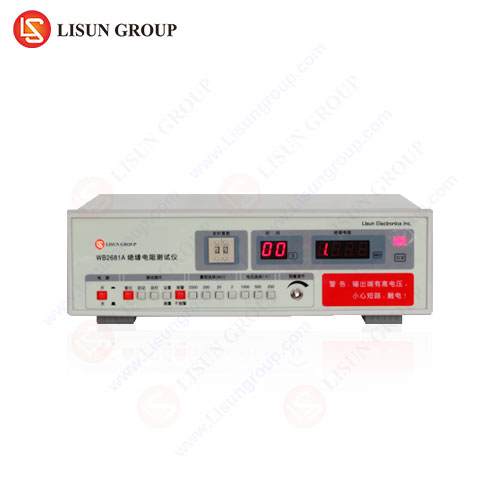
Modern withstand voltage testers, such as the LISUN WB2671A, integrate sophisticated electronics, safety interlocks, and user-programmable logic to perform these critical evaluations reliably and repeatably. The WB2671A is a microprocessor-controlled instrument designed to generate, measure, and control high AC/DC test voltages with a high degree of accuracy and operator safety.
Core Specifications and Operational Parameters:
The WB2671A typically features a wide output voltage range, for example, AC: 0–5 kV / 0–20 kV and DC: 0–6 kV / 0–24 kV (model dependent), with a voltage resolution as fine as 0.1 V. Its output frequency for AC testing can often be set between 40 Hz to 70 Hz, accommodating various regional standards. The leakage current measurement range is critical, with high-resolution detection down to 0.01 mA, and programmable failure thresholds (cut-off current) across multiple ranges (e.g., 0.10 mA to 20.00 mA). The voltage ramp-up time (rise time) is adjustable, allowing for a soft start to avoid inrush currents that could falsely trip the test, while the test duration (dwell time) is precisely controllable from 1 to 999 seconds.
Key Functional and Safety Features:
Beyond basic voltage application, advanced testers incorporate several essential features. The WB2671A includes a real-time display of applied voltage and measured leakage current, often with a graphical trend. It offers multiple operational modes: Withstand Mode (pass/fail based on cut-off current), Step-Up Mode (incremental voltage increases to find breakdown point), and Scanning Mode for multi-point testing. Integral to its design are hardware and software safety mechanisms: a zero-start interlock ensures the output voltage always begins at 0V, high-voltage warning indicators, an emergency stop button, and automatic discharge of stored energy in the UUT after a DC test. Remote control interfaces (RS232, USB, GPIB) enable seamless integration into automated production lines or quality assurance stations.
Cross-Industry Application Paradigms for Dielectric Strength Validation
The dielectric withstand test is a universal requirement, but its implementation parameters are meticulously defined by industry-specific safety standards. The following use cases illustrate its critical role.
Electrical and Electronic Equipment & Household Appliances: Compliance with IEC 60335-1 is mandatory. For a washing machine motor, the test verifies insulation between windings and the chassis. For a power supply in a television, it tests between primary (mains) and secondary (low-voltage) circuits, as well as between primary and grounded accessible parts. The WB2671A’s programmable sequences allow testing multiple points in a single fixture cycle.
Automotive Electronics: The automotive environment imposes extreme thermal, vibrational, and humidity stresses. Standards like ISO 16750-2 and LV 124 mandate rigorous testing. A withstand voltage test on an Engine Control Unit (ECU) ensures isolation between high-side driver circuits and the metal casing, preventing short circuits that could lead to vehicle system failure.
Lighting Fixtures (LED Drivers, HID Ballasts): IEC 60598-1 requires testing between the output of the LED driver (which may be a SELV – Safety Extra-Low Voltage circuit) and the input mains, and between live parts and the luminaire’s metallic body. The high accuracy of the leakage current measurement is vital, as false failures due to capacitive coupling must be distinguished from true insulation faults.
Medical Devices: Perhaps the most stringent application, governed by IEC 60601-1. Patient-connected devices (e.g., ECG monitors, ultrasound probes) require Applied Part testing. Here, the test not only checks mains insulation but also verifies isolation of the patient connection from mains with significantly higher test voltages and lower allowable leakage currents (often in the microampere range). The tester’s ability to set very low, precise cut-off currents is essential.
Aerospace and Aviation Components: DO-160G and related standards require testing under conditioned environments (e.g., at high altitude/low pressure). Insulation breakdown at reduced atmospheric pressure is a significant risk. Test equipment must provide stable, repeatable outputs, and results must be meticulously documented—a capability supported by the data logging functions of instruments like the WB2671A.
Cable and Wiring Systems: For finished cable assemblies (e.g., power cords per IEC 60227), the test is performed between all conductors twisted together and a water bath or metallic shield surrounding the insulation. This checks for pinholes or inconsistencies in the insulating jacket or conductor insulation.
Industrial Control Systems, Telecommunications, and Office Equipment: Programmable Logic Controllers (PLCs), servers, and routers are tested per IEC 61131-2, IEC 60950-1/62368-1. The test validates isolation in power supplies, between communication ports (RS-485, Ethernet) and mains, and within internal DC-DC converters.
Comparative Advantages of Modern Programmable Withstand Voltage Test Systems
Transitioning from manual, transformer-based hipot testers to microprocessor-controlled systems like the WB2671A yields substantial technical and operational benefits. Enhanced Measurement Fidelity is primary; digital signal processing allows for true RMS voltage and current measurement, filtering out transient spikes that could cause false failures. Improved Operator Safety is engineered through hardware interlocks, fail-safe relays, and clear fault annunciation. Test Process Integrity is bolstered by programmable test sequences that eliminate operator error in setting voltage, time, and pass/fail limits. Data Traceability, a requirement in medical and automotive industries, is enabled via stored test results, including timestamps, measured values, and pass/fail status, which can be exported for quality records. Production Line Integration is streamlined through remote I/O control and communication protocols, allowing the tester to be triggered by and report to a central Manufacturing Execution System (MES).
Standards Compliance and Calibration Metrology
The validity of any withstand voltage test is contingent upon the calibration and traceability of the equipment. The generated voltage and measured current must be traceable to national standards (e.g., NIST, NPL). Standards such as IEC 61010-1 (safety requirements for electrical equipment for measurement, control, and laboratory use) govern the tester itself. Regular calibration, typically annually, against a certified high-voltage divider and precision microammeter is mandatory to maintain compliance with quality management systems like ISO 9001 and industry-specific audits. Advanced testers often include self-diagnostic routines to verify internal circuit integrity before each use.
Interpretation of Test Results and Failure Mode Analysis
A “pass” result indicates the insulation withstood the prescribed stress without exceeding the allowable leakage current. A “fail” result necessitates root cause analysis. A sudden, dramatic current increase typically indicates a hard breakdown—a direct short or carbonized path. A gradual current rise that exceeds the limit may point to surface contamination (dust, moisture) or marginal insulation. In DC testing, observing the leakage current trend can be diagnostic: a current that decreases over time suggests capacitive charging, while a current that increases may indicate insulation degradation under stress. The high-resolution monitoring capabilities of modern testers provide this diagnostic data, moving quality control from simple pass/fail to insightful process analysis.
FAQ: Technical Inquiries on Withstand Voltage Testing
Q1: What is the critical difference between AC and DC withstand voltage testing, and when should each be used?
AC testing at power frequency (50/60 Hz) stresses insulation in a manner similar to operational stress, including capacitive and inductive effects. It is the most common test for mains-powered equipment. DC testing applies a constant voltage, which charges the insulation capacitance. The steady-state current is purely conductive, making it sensitive to volume resistivity. DC testing is often used for high-capacitive loads (like long cables), where AC testing would require a very high current capacity, and for equipment like semiconductors that cannot tolerate the displacement current of an AC test.
Q2: How is the appropriate test voltage and cut-off current determined for a specific product?
The primary source is the relevant product safety standard (e.g., IEC 60335-1, IEC 60601-1). These standards specify formulae based on working voltage, insulation type (basic, supplementary, reinforced), and product category. The cut-off current, or failure threshold, is also often stipulated by the standard (e.g., 5 mA for many household appliances). For proprietary components, the specification may be defined by the component manufacturer or the end-product designer’s safety engineering analysis.
Q3: Can a withstand voltage test damage a functional unit under test?
When performed correctly with properly configured equipment, it is a non-destructive test. However, incorrect parameters—excessively high voltage, too long a duration, or an inappropriate cut-off current—can overstress and degrade insulation. Applying a DC test to a component with an electrolytic capacitor without a proper discharge path can damage the capacitor. Adherence to standard-specified test conditions is crucial to avoid latent damage.
Q4: Why is voltage ramp-up (rise time) control important?
A controlled, gradual ramp-up (e.g., 100 V/s to 500 V/s) prevents inrush currents caused by the capacitive charging of the UUT from instantaneously exceeding the cut-off current and causing a false failure. It allows the insulation system to stabilize under increasing stress, yielding a more accurate and repeatable measurement of the true conductive leakage current at the target test voltage.
Q5: How does the WB2671A enhance safety in a production test environment?
It incorporates multiple layers: a zero-start circuit prevents high voltage from being present at the test probes upon initiation; hardware-based over-current protection acts independently of software; real-time ground continuity monitoring (optional) verifies the UUT is properly grounded before applying high voltage; and an automatic voltage discharge circuit safely drains stored energy from the UUT after a DC test, protecting the next operator in line.
