







Advanced Methodologies in Dielectric Withstand Verification for Modern Electrical Systems
The proliferation of complex electrical and electronic systems across diverse industries has precipitated a concomitant escalation in safety requirements. Regulatory frameworks and international standards mandate rigorous validation of electrical insulation integrity to mitigate risks of electric shock, fire hazard, and equipment failure. Dielectric withstand testing, commonly known as hipot (high-potential) testing, remains a cornerstone of this validation regime. However, the evolution of device technology—spanning miniaturized consumer electronics, high-voltage automotive drivetrains, and mission-critical aerospace components—demands a parallel advancement in testing methodologies. This article delineates the technical imperatives for sophisticated electrical safety testing solutions, examining the underlying principles, critical parameters, and the integration of precision instrumentation such as the LISUN WB2671A Withstand Voltage Tester to meet contemporary challenges.
The Electrophysical Basis of Insulation Breakdown and Its Quantification
At its core, dielectric withstand testing evaluates the efficacy of an insulating material or system by applying a stress voltage significantly higher than its normal operating rating for a prescribed duration. The objective is not to induce failure but to verify that the insulation can withstand transient overvoltages and operational stresses without breakdown. The fundamental electrophysical process involves the imposition of a strong electric field across the dielectric. When the field strength exceeds the material’s intrinsic dielectric strength, the insulating properties collapse, leading to a rapid increase in conduction current—a breakdown event.
This process is quantified by several key parameters: the test voltage (AC or DC), the ramp rate, the dwell time at the target voltage, and the trip current threshold. The selection of these parameters is not arbitrary; it is dictated by the relevant product safety standard (e.g., IEC 61010-1, IEC 60601-1, UL 60950-1) and the device’s application. AC testing, typically at power frequencies of 50/60 Hz, subjects the insulation to both voltage stress and capacitive charging currents, making it suitable for most line-powered equipment. DC testing applies a continuous polarizing voltage, advantageous for capacitive loads like long cable runs or switch-mode power supply inputs, as it eliminates capacitive current and allows for the measurement of true leakage current.
The critical metric monitored during the test is the leakage current. A well-designed tester must accurately distinguish between the harmless capacitive charging current, the acceptable resistive leakage current through the insulation, and the onset of breakdown current. Advanced instruments employ real-time vector analysis and digital signal processing to achieve this discrimination, setting precise and reliable trip thresholds to prevent unnecessary destruction of good units while ensuring faulty insulation is definitively identified.
Architectural Demands of a Modern Withstand Voltage Test System
A contemporary withstand voltage tester transcends the function of a simple high-voltage source. It is an integrated measurement system requiring precision, safety, programmability, and data integrity. The system architecture must encompass a stable, low-distortion high-voltage generator capable of delivering both AC and DC outputs with minimal ripple. Voltage measurement must be performed via a high-impedance, calibrated divider with traceability to national standards to ensure absolute accuracy, often required to be within ±3% of the set value.
Current measurement circuits represent a critical differentiator. They must feature multiple, selectable measurement ranges to capture currents from microamperes (µA) to milliamperes (mA) with high resolution. Sophisticated detection algorithms are necessary to ignore initial inrush currents and to implement true RMS measurement for AC waveforms, which may be non-sinusoidal due to the load characteristics. Furthermore, the system must incorporate comprehensive safety interlocks, including zero-start protection (ensuring output voltage is zero when a test is initiated), arc detection, and immediate short-circuit protection for both the device under test (DUT) and the operator.
Connectivity and programmability are paramount for integration into automated production lines or quality assurance laboratories. Support for standard communication protocols (RS-232, USB, LAN, GPIB) and programmable logic controller (PLC) interfaces allows for remote control, sequencing of complex test routines, and logging of all test parameters and results for traceability and statistical process control.
The LISUN WB2671A: A Paradigm of Precision in Safety Compliance Testing
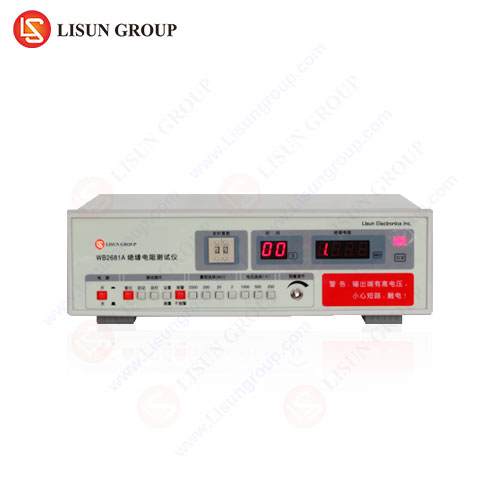
Embodying the advanced architectural principles outlined, the LISUN WB2671A Withstand Voltage Tester provides a robust platform for safety verification across the aforementioned industries. Its design prioritizes measurement fidelity, operational safety, and user configurability to address the stringent demands of modern compliance testing.
Core Specifications and Functional Capabilities:
The WB2671A features a broad voltage range, typically from 0 to 5 kV AC/DC, with higher-range models available, accommodating everything from low-voltage consumer gadgets to industrial control equipment. Its voltage and current measurement accuracy meet or exceed the requirements of major international standards. The instrument offers fully programmable test sequences, allowing users to define voltage levels, ramp times (e.g., a 500 V/s ramp to 3 kV), dwell times (commonly 60 seconds, as per many standards), and decay rates. The trip current threshold is adjustable in fine increments across multiple ranges, enabling precise calibration of the failure criterion based on the DUT’s characteristics and the applicable standard.
Advanced Testing Principles Implemented:
Beyond basic hipot testing, the WB2671A incorporates functionalities for insulation resistance (IR) testing, often performed as a complementary or preceding test. It can execute sequential test routines—for instance, performing an IR test at 500 V DC followed immediately by an AC withstand test at 1.5 kV—streamlining the safety validation workflow. Its real-time monitoring displays key parameters including applied voltage, measured leakage current, and test duration, while its internal memory can store numerous test profiles for different product lines.
Industry-Specific Use Cases and Applications:
- Medical Devices (IEC 60601-1): Testing patient-coupled equipment like monitors or diagnostic probes, where leakage current limits are exceptionally stringent. The WB2671A’s high-resolution current measurement is critical.
- Automotive Electronics (ISO 16750-2, LV214): Validating components for electric vehicles, such as battery management systems or onboard chargers, which must withstand high-voltage transients and environmental stress.
- Household Appliances & Lighting Fixtures (IEC 60335-1, IEC 60598-1): Ensuring the safety of motors, heaters, and LED drivers, where insulation between live parts and accessible metal casings is vital.
- Aerospace Components (DO-160, AS4373): Testing wiring harnesses and avionics for dielectric strength after exposure to humidity and altitude simulation, requiring reliable performance under extreme conditions.
- Telecommunications & Office Equipment: Verifying insulation in power supplies and network equipment, ensuring safety and reliability in continuous operation.
Competitive Advantages in Operational Context:
The WB2671A distinguishes itself through its measurement stability and noise immunity, which are essential for testing products with high inherent capacitance or in electrically noisy industrial environments. Its intuitive interface reduces operator error, while its robust construction and compliance with safety standards for test equipment (IEC 61010-1) ensure long-term reliability. The integration of both AC and DC hipot with insulation resistance in a single unit eliminates the need for multiple instruments, reducing capital expenditure and simplifying the test bench.
Integration with Complementary Safety and Performance Tests
Dielectric withstand testing is seldom performed in isolation. It is a key element within a holistic product safety and quality assessment protocol. A comprehensive testing station often sequences several electrical tests.
Typical Integrated Test Sequence:
- Ground Bond Test (Protective Earth Continuity): Verifies the integrity of the low-resistance path from any user-accessible conductive part to the protective earth terminal. This must be performed before the hipot test to ensure safety.
- Insulation Resistance Test: Applies a moderate DC voltage (e.g., 500V) to measure the resistive leakage through insulation in megaohms (MΩ). This identifies degraded but not yet failed insulation.
- Dielectric Withstand Test (AC/DC Hipot): Applies the high stress voltage as the definitive proof of insulation integrity.
- Functional Run Test: Often performed post-safety tests to ensure the DUT still operates correctly.
Advanced testers or integrated test executives can automate this entire sequence, improving throughput, ensuring the correct order is followed, and compiling a unified test report.
Navigating International Standards and Regulatory Landscapes
Compliance is the primary driver for electrical safety testing. The specific test voltage, duration, and leakage current limits are rigorously defined by a matrix of international, regional, and industry-specific standards. For example:
- IEC 62368-1 (Audio/Video, Information & Communication Technology Equipment): This hazard-based standard specifies test voltages based on the working voltage and insulation category (Basic, Supplementary, or Reinforced).
- UL 60950-1 / IEC 60950-1 (IT Equipment): While being superseded by IEC 62368-1, it remains widely referenced and defines clear hipot test requirements.
- IEC 61010-1 (Laboratory, Measurement, Control Equipment): Specifies test voltages derived from the rated supply voltage and overvoltage category.
A critical task for test engineers is to interpret these standards correctly for their specific product. The test voltage is often calculated as a function of the working voltage plus a standard-mandated increment. For instance, reinforced insulation might require a test voltage of (2 x Working Voltage + 1000V). The LISUN WB2671A’s programmability allows users to codify these complex formulas into reproducible test profiles, ensuring consistent standard-compliant application.
Data Integrity, Traceability, and Quality Assurance Systems
In regulated industries such as medical devices and aerospace, the mere act of performing a test is insufficient. Documentation proving that the test was performed correctly, on the correct unit, with calibrated equipment, is mandatory. Modern advanced testers are integral components of a quality management system.
They facilitate traceability through:
- Calibration Logs: Storing dates and results of periodic calibrations.
- DUT Serialization: Linking test results to specific product serial numbers via barcode or manual entry.
- Comprehensive Data Logging: Recording all test parameters, measured values, pass/fail status, and timestamps for every unit tested.
- Secure Data Export: Enabling results to be transferred to Manufacturing Execution Systems (MES) or Quality Management Software for long-term archiving and audit readiness.
This data-centric approach transforms the safety tester from a pass/fail gatekeeper into a source of valuable process intelligence, highlighting trends in insulation quality or early signs of supplier component issues.
Future Trajectories: Adaptive Testing and IoT Convergence
The future of electrical safety testing lies in increased intelligence and connectivity. Next-generation systems may incorporate adaptive testing algorithms, where the test parameters are dynamically adjusted based on real-time analysis of the DUT’s response during the ramp phase. The integration of the Industrial Internet of Things (IIoT) will enable predictive maintenance of the test equipment itself and fleet-wide analysis of test data across global manufacturing sites, identifying subtle correlations between test results and long-term field reliability. The foundational precision and connectivity of instruments like the WB2671A provide the necessary platform upon which these advanced analytical capabilities will be built.
Frequently Asked Questions (FAQ)
Q1: What is the fundamental difference between AC and DC dielectric withstand testing, and when should each be used?
AC testing stresses insulation in a manner similar to operational AC mains, imposing both voltage and capacitive stress. It is the preferred method for most final product testing. DC testing applies a steady polarizing voltage, eliminating capacitive current. It is used for testing components with high intrinsic capacitance (e.g., long cables, large capacitors), for testing after humidity exposure where AC testing could cause electrolysis, and for some specific standards. DC test voltages are typically set at 1.414 times the equivalent AC RMS value to achieve the same peak voltage stress.
Q2: How is the appropriate trip current threshold determined for a specific product?
The trip current is not arbitrary. It is primarily defined by the applicable product safety standard. For example, many standards for IT and household equipment specify a trip current of 100 mA for basic insulation tests. For medical devices, much lower limits (e.g., 10 mA or even lower for patient leakage currents) apply. The threshold must be set high enough to ignore normal capacitive charging currents but low enough to detect a genuine breakdown. The manufacturer’s risk assessment and historical test data also inform the final setting.
Q3: Can the LISUN WB2671A be integrated into a fully automated production test line?
Yes. The WB2671A is designed for automation with standard digital communication interfaces (RS-232, USB, LAN). It supports command-based remote control, allowing a host computer or PLC to start tests, set all parameters, retrieve results, and control the instrument’s internal pass/fail relays. This enables seamless integration into automated fixtures where a handler presents the DUT, initiates the test sequence, and sorts units based on the result.
Q4: Why is a “ramp rate” often specified in test protocols instead of instantly applying the full test voltage?
A controlled voltage ramp (e.g., 500 V/s) is crucial for two reasons. First, it prevents damaging a good DUT due to the transient surge associated with an instantaneous application of high voltage, which can induce a false breakdown. Second, it allows the operator or monitoring system to observe the leakage current trend during the ramp. A sudden, non-linear increase in current before reaching the target voltage can indicate a weak or deteriorating insulation system, providing diagnostic information beyond a simple pass/fail at the final voltage.
Q5: How frequently should a withstand voltage tester like the WB2671A be calibrated?
Calibration interval is determined by the user’s quality procedures, regulatory requirements, and instrument usage. A common interval in industrial settings is 12 months. However, more frequent intervals (e.g., 6 months) may be mandated in highly regulated industries like aerospace or medical devices. The calibration must be performed by an accredited laboratory traceable to national standards and should verify both voltage output accuracy and current measurement accuracy across all ranges.
