







Advanced Grounding Integrity Verification: Methodologies, Standards, and Instrumentation for Modern Electrical Systems
Introduction to Grounding System Imperatives in Safety-Critical Applications
A robust grounding system constitutes a non-negotiable cornerstone of electrical safety and operational reliability across virtually every sector of modern industry. Its primary functions—providing a path of least resistance for fault currents to facilitate protective device operation, stabilizing voltage references, and mitigating hazardous touch potentials—are universally acknowledged. However, the quantitative assessment of a grounding system’s efficacy, specifically the measurement of its resistance to earth, remains a domain where methodological precision and instrumental accuracy are paramount. Inadequate grounding resistance can lead to catastrophic failures, including equipment damage from transient overvoltages, electromagnetic interference (EMI) disrupting sensitive electronics, and, most critically, life-threatening electrocution hazards. This article delineates the technical principles underpinning grounding resistance measurement, examines relevant international standards, and explores the application of advanced testing instrumentation, with a specific focus on the LISUN WB2678A Grounding Resistance Tester, within diverse industrial contexts.
Fundamental Principles of Earth Electrode and Grounding System Resistance Measurement
The electrical resistance between an earth electrode and the surrounding soil is not a static, ohmic value but a complex function of soil composition, stratification, moisture content, and electrode geometry. The fundamental measurement principle involves injecting a known current (I) between the electrode under test (E) and a remote auxiliary current electrode (C), while simultaneously measuring the voltage potential (V) developed between the electrode under test and a separate auxiliary potential electrode (P). This is classically known as the Fall-of-Potential method, defined by the formula R = V/I. The critical nuance lies in the placement of the potential probe (P) within the electrical field gradient; incorrect placement leads to measurement errors from overlapping resistance areas or insufficient potential field capture. Modern testers employ variations, including the 62% rule for uniform soils, the Slope method for complex grounding grids, and the Attached Rod method for installed systems where remote probe placement is impractical. The selection of test frequency is also crucial: while DC measurements are susceptible to galvanic noise and soil polarization effects, a low-frequency AC test signal, typically between 94Hz to 128Hz, is used to mitigate these issues while avoiding harmonic interference from mains power (50/60Hz) and its multiples.
Analytical Framework: International Standards and Compliance Mandates
Grounding system verification is governed by a stringent framework of international and national standards, which prescribe not only performance thresholds but also approved testing methodologies. Key standards include:
- IEC 60364-6: Low-voltage electrical installations – Part 6: Verification.
- IEEE Std 81: Guide for Measuring Earth Resistivity, Ground Impedance, and Earth Surface Potentials of a Grounding System.
- NFPA 70 (NEC), Article 250: Grounding and Bonding.
- ISO 6469-3: Electrically propelled road vehicles – Safety specifications – Part 3: Protection against electrical hazards.
These documents mandate periodic testing and establish maximum permissible resistance values, which vary by application. For instance, telecommunications tower grounding may require resistance below 5Ω for lightning dissipation, while a residential service entrance might permit up to 25Ω. Compliance is not merely a legal formality but an essential component of risk management and quality assurance protocols.
Instrumentation Profile: The LISUN WB2678A Grounding Resistance Tester
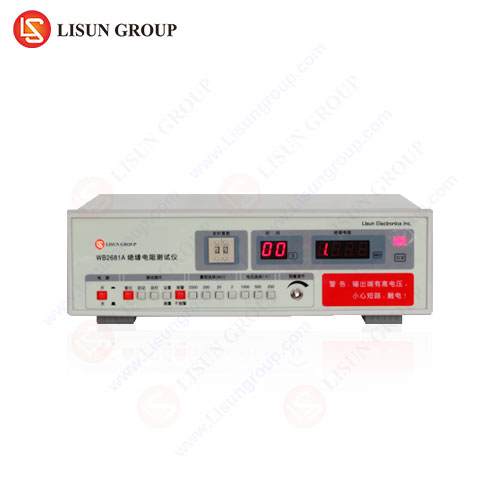
The LISUN WB2678A represents a contemporary implementation of grounding test technology, engineered to address the measurement challenges presented by modern, often electrically noisy, environments. Its design integrates the foundational Fall-of-Potential method with advanced signal processing and user-centric features to ensure reliable, standards-compliant results.
Core Specifications and Functional Capabilities:
- Measurement Ranges: 0.00Ω to 30.00kΩ, with a high-resolution of 0.01Ω in the lower ranges critical for precision validation.
- Test Current: Up to 200mA AC, ensuring sufficient signal strength for accurate measurements in higher-resistance soils without exceeding safety limits.
- Test Frequency: 128Hz ±2Hz, optimally selected to reject common power-line interference (50Hz/60Hz).
- Noise Rejection: Capable of suppressing common-mode AC noise up to 40V, a critical feature for testing in active substations or near industrial machinery.
- Additional Measurements: Incorporates functions for soil resistivity (using the Wenner four-pin method), ground voltage detection (to warn of hazardous existing potentials), and continuity resistance (for bonding verification).
- Safety & Build: Complies with IEC 61010-1 (CAT III 600V) for overvoltage category, featuring robust construction and clear, backlit LCD readout for field use.
Operational Principle: The WB2678A generates a constant-current, low-frequency sinusoidal signal. Its digital signal processing (DSP) engine employs selective filtering and phase-locked detection to isolate the test signal response from ambient electrical noise. This allows it to accurately resolve the voltage drop specifically attributable to the injected test current, even in electromagnetically hostile environments.
Industry-Specific Application Contexts and Use Cases
The necessity for precise grounding verification permeates numerous industries, each with unique system characteristics and failure mode implications.
1. Electrical & Electronic Equipment Manufacturing: During production line testing of industrial control systems, programmable logic controllers (PLCs), and server racks, verifying the protective earth terminal resistance is a final safety check. The WB2678A’s fast, stable reading ensures each unit complies with IEC 60950-1/62368-1 limits (typically <0.1Ω for continuity), preventing defective products from reaching the field.
2. Automotive Electronics and Electric Vehicle (EV) Infrastructure: The high-voltage systems in EVs (400V/800V DC) demand flawless grounding for safety isolation and EMI control. Component suppliers use testers like the WB2678A to validate the grounding integrity of onboard chargers, battery management systems, and motor drives. Furthermore, testing the grounding resistance of EV charging station installations is critical for user protection against insulation faults.
3. Telecommunications Equipment and Data Centers: Telecommunication shelters, base transceiver stations (BTS), and data centers rely on extensive grounding grids for lightning protection and signal reference. A resistance measurement that is too high can lead to lightning damage, data corruption, and equipment failure. The tester’s ability to measure up to 30kΩ is also utilized for evaluating the insulation resistance of coaxial cable shields to ground.
4. Medical Devices and Healthcare Facilities: Adherence to IEC 60601-1 for medical electrical equipment is stringent. The standard specifies detailed tests for earth leakage and protective earth resistance. Manufacturers of imaging systems, patient monitors, and surgical tools employ precision ground resistance testers during design validation and production to ensure no risk of hazardous leakage currents.
5. Aerospace and Aviation Components: Grounding in aircraft, both for airframe static dissipation and avionics system reference, is vital. Testing of grounding points on flight control systems, navigation electronics, and in-flight entertainment systems requires portable, highly accurate instruments capable of verifying very low resistance bonds in aluminum alloy structures.
6. Cable, Wiring, and Connector Systems: For manufacturers of power and data cables, the continuity and resistance of the grounding conductor within a cable assembly are key quality parameters. High-speed automated test fixtures can integrate the measurement principles of devices like the WB2678A to perform 100% production screening.
Comparative Analysis: Technical Advantages in Complex Field Environments
The WB2678A’s value proposition is accentuated when deployed in challenging real-world conditions beyond the controlled laboratory. Its competitive advantages are multi-faceted:
- Enhanced Noise Immunity: Traditional analog testers can provide erratic or unusable readings near transformers, variable-frequency drives, or high-voltage lines. The WB2678A’s digital filtering and high test current enable stable measurements where other instruments fail, reducing downtime and retesting.
- Operational Efficiency: Features such as data hold, MAX/MIN/AVG recording, and an adjustable alarm threshold for pass/fail judgment streamline the workflow for technicians performing hundreds of tests on a large grounding grid or during facility audits.
- Comprehensive Diagnostic Toolset: By combining grounding resistance, soil resistivity, and ground voltage measurement in one IP54-rated package, it eliminates the need for multiple devices. The soil resistivity function is particularly valuable for civil engineers designing new grounding systems or evaluating corrosion mitigation via chemical treatment of soil.
- Safety-Centric Design: The CAT III 600V rating provides an essential safety margin for technicians working on or near live electrical distribution panels. The pre-test ground voltage warning is a critical safeguard against connecting the tester to an energized point.
Data Interpretation, Troubleshooting, and Corrective Action Protocols
Obtaining a measurement is only the first step; correct interpretation is vital. A reading exceeding specification necessitates a systematic investigation. Potential causes include:
- High Soil Resistivity: Measured via the four-pin method. Corrective actions may involve installing longer/deeper electrodes, using multiple rods in a parallel array, or employing soil enhancement materials.
- Poor Physical Connections: Corrosion, loose lugs, or damaged conductors at the connection point between the grounding conductor and the electrode. This is identified by checking continuity from the test point to the electrode head.
- Electrode Degradation: Corrosion or physical damage to the buried electrode itself, requiring excavation and replacement.
A table of typical target resistances provides context:
| Application Example | Typical Maximum Target Resistance | Governing Standard/Reference |
|---|---|---|
| Telecommunications Tower | 5 Ω | IEEE Std 142, Telco Internal Specs |
| Residential Service | 25 Ω | NFPA 70 (NEC) |
| Industrial Substation | 1 Ω | IEEE Std 80 |
| Medical Isolated Power System | 0.5 Ω | IEC 60601-1 |
| Wind Turbine Foundation | 10 Ω | IEC 61400-24 |
Conclusion: The Integral Role of Precision Measurement in Systemic Safety
The integrity of a grounding system is a latent variable, invisible during normal operation but decisive during fault conditions. Its verification cannot be relegated to a presumptive or infrequent check. The evolution of testing instrumentation, as exemplified by devices like the LISUN WB2678A Grounding Resistance Tester, provides technical personnel with the means to perform accurate, reliable, and standards-compliant assessments even in complex electromagnetic environments. As electrical systems grow more pervasive and interconnected—from household IoT devices to national power grids—the disciplined application of advanced grounding resistance measurement remains an indispensable practice for ensuring operational continuity, protecting capital assets, and, most importantly, safeguarding human life.
FAQ Section
Q1: What is the significance of the test frequency (128Hz) used by the WB2678A, and why not use 50/60Hz?
Using a test frequency close to but distinct from mains power frequencies (50Hz/60Hz) allows the instrument’s filtering circuitry to effectively reject interference from the ubiquitous power line fields. A 128Hz signal sits between the 2nd and 3rd harmonic of 50/60Hz, in a spectral region typically lower in ambient noise, enabling cleaner signal detection and more accurate resistance calculation.
Q2: Can the WB2678A be used to test the grounding of an entire building’s electrical system, or is it only for single electrodes?
It is designed for both applications. For a single driven rod, the standard 3-pole Fall-of-Potential method is used. For a complex building ground grid, the 4-pole method (using two current and two potential probes) or the Selective Measurement method (using a current clamp) can be employed with appropriate accessories to measure the system resistance without disconnecting the ground conductor.
Q3: How often should grounding resistance be tested, and do conditions affect this schedule?
Initial verification after installation is mandatory. Periodic testing intervals are risk-based and should be defined by facility safety protocols, but common practices include annual testing for critical infrastructure (substations, data centers, hospitals). Testing frequency should increase following significant geological events (lightning strikes, floods), after any ground system modification, or in areas with highly corrosive soil conditions.
Q4: The instrument shows a “Noise” or “Overrange” warning. What are the likely causes and corrective steps?
A “Noise” warning indicates excessive interfering voltage (>40V AC) between the E and P terminals, which could compromise accuracy. An “Overrange” means the measured resistance exceeds the selected range. For noise, ensure test leads are not run parallel to live power cables, try repositioning the auxiliary probes, and verify the ground under test is not accidentally carrying stray current. For overrange, select a higher measurement range or check for open circuits in the test setup.
